
How National Challenges Can Impact International Decisions The
- Slides: 20
How National Challenges Can Impact International Decisions The ICT in Education Survey and the Relevance of Statistics for Evidence-Based Policymaking ONLINE EDUCA BERLIN 20 TH INTERNATIONAL CONFERENCE ON TECHNOLOGY SUPPORTED LEARNING & TRAINING Berlin | 4 th of December 2014
Who we are and what we do…
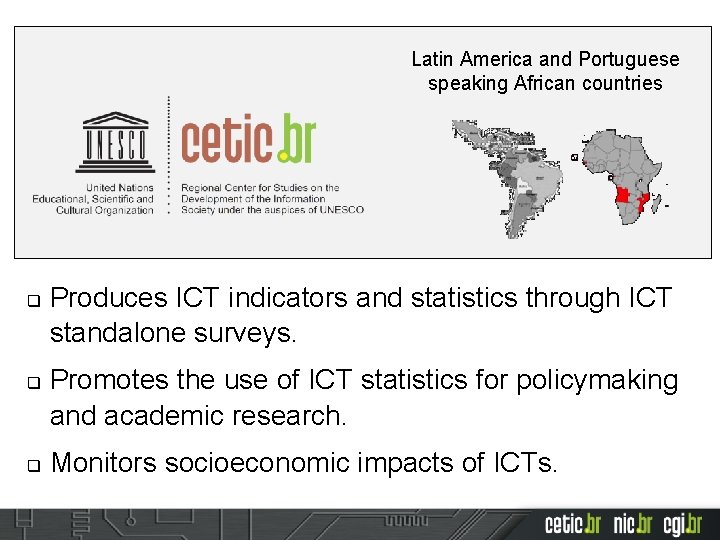
Latin America and Portuguese speaking African countries q q q Produces ICT indicators and statistics through ICT standalone surveys. Promotes the use of ICT statistics for policymaking and academic research. Monitors socioeconomic impacts of ICTs.
Facts and figures: basic education and ICT access and use in Brazil…
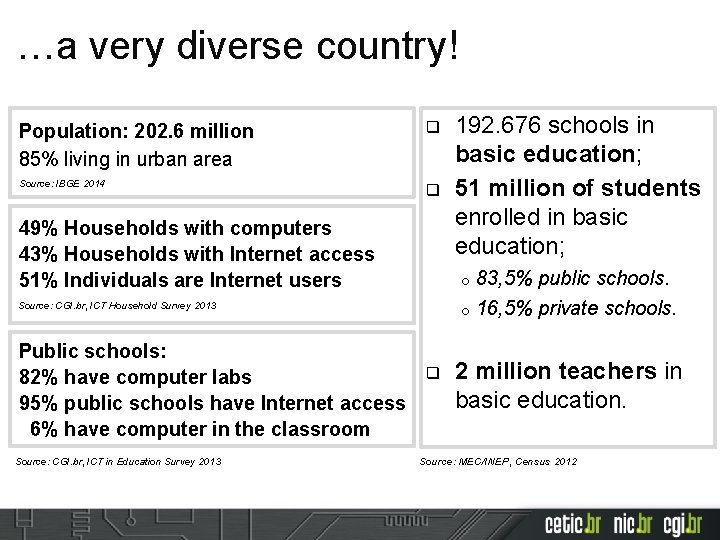
…a very diverse country! Population: 202. 6 million 85% living in urban area q Source: IBGE 2014 q 49% Households with computers 43% Households with Internet access 51% Individuals are Internet users 83, 5% public schools. o 16, 5% private schools. o Source: CGI. br, ICT Household Survey 2013 Public schools: q 82% have computer labs 95% public schools have Internet access 6% have computer in the classroom Source: CGI. br, ICT in Education Survey 2013 192. 676 schools in basic education; 51 million of students enrolled in basic education; 2 million teachers in basic education. Source: MEC/INEP, Census 2012
Why are statistics relevant for evidence-based policymaking?
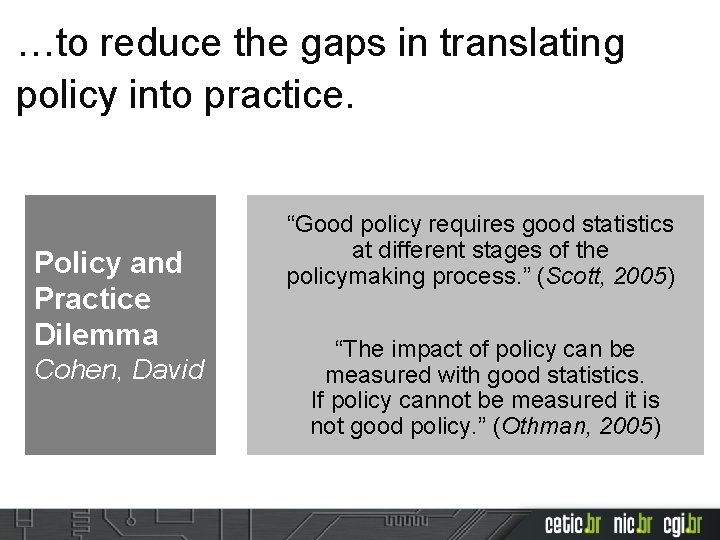
…to reduce the gaps in translating policy into practice. Policy and Practice Dilemma Cohen, David “Good policy requires good statistics at different stages of the policymaking process. ” (Scott, 2005) “The impact of policy can be measured with good statistics. If policy cannot be measured it is not good policy. ” (Othman, 2005)
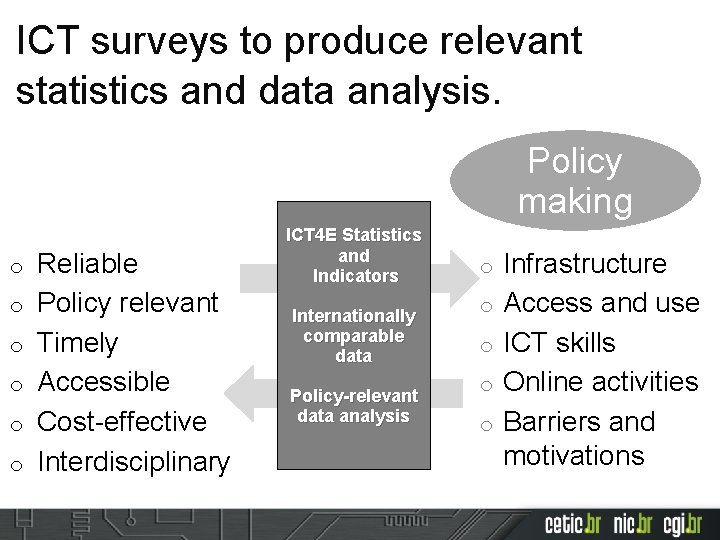
ICT surveys to produce relevant statistics and data analysis. Policy making o o o Reliable Policy relevant Timely Accessible Cost-effective Interdisciplinary ICT 4 E Statistics and Indicators Internationally comparable data Policy-relevant data analysis o o o Infrastructure Access and use ICT skills Online activities Barriers and motivations
Important policies for ICT in Education in Brazil…
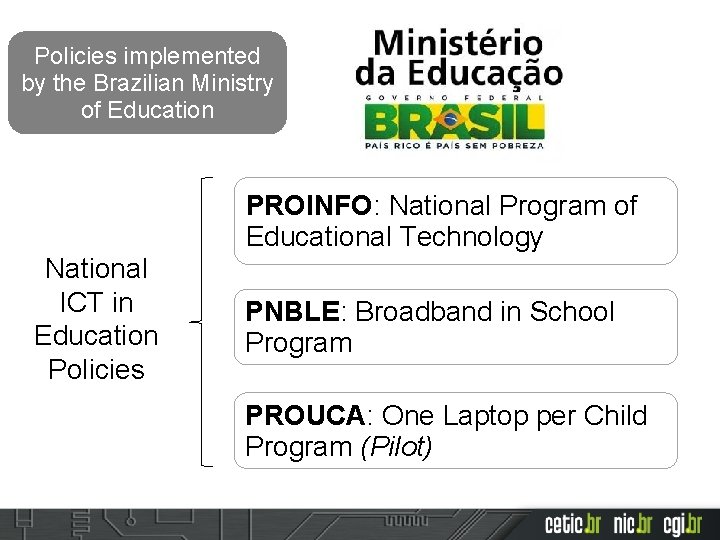
Policies implemented by the Brazilian Ministry of Education PROINFO: National Program of Educational Technology National ICT in Education Policies PNBLE: Broadband in School Program PROUCA: One Laptop per Child Program (Pilot)
What is the ICT in Education survey?
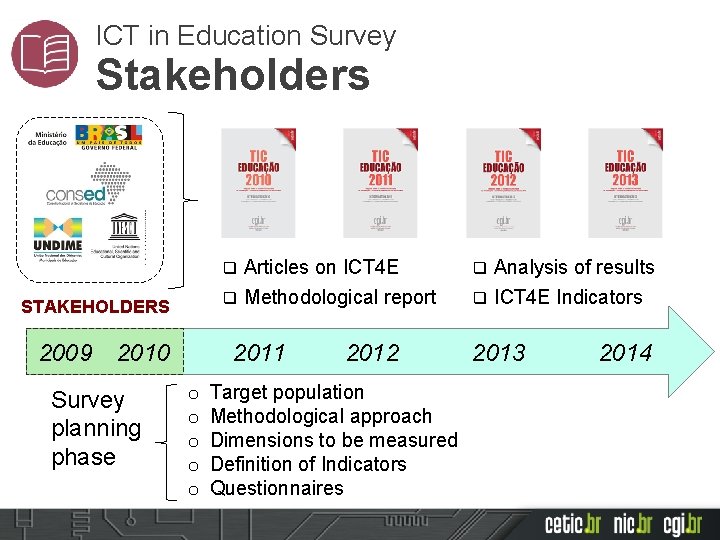
ICT in Education Survey Stakeholders Articles on ICT 4 E q Methodological report q STAKEHOLDERS 2009 2010 Survey planning phase 2011 o o o 2012 Target population Methodological approach Dimensions to be measured Definition of Indicators Questionnaires Analysis of results q ICT 4 E Indicators q 2013 2014
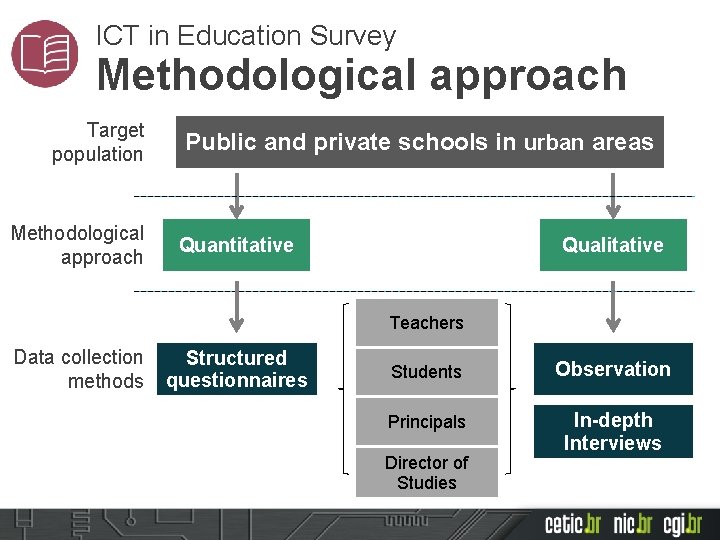
ICT in Education Survey Methodological approach Target population Methodological approach Public and private schools in urban areas Quantitative Qualitative Teachers Data collection methods Structured questionnaires Students Observation Principals In-depth Interviews Director of Studies
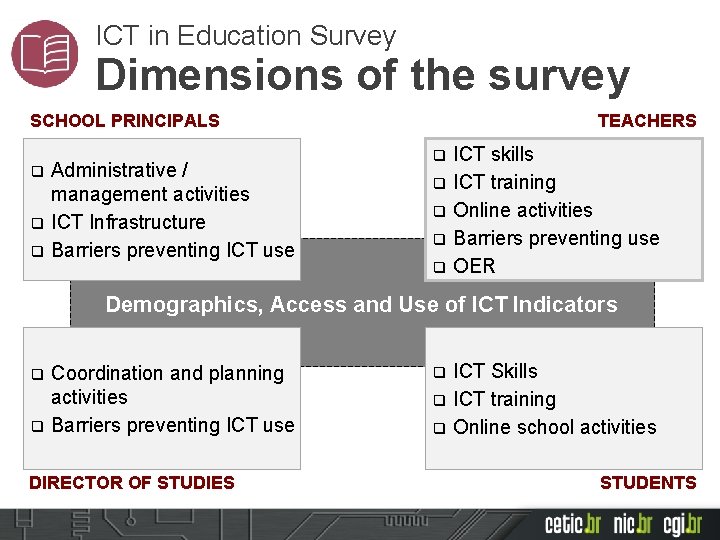
ICT in Education Survey Dimensions of the survey SCHOOL PRINCIPALS q q q Administrative / management activities ICT Infrastructure Barriers preventing ICT use TEACHERS q q q ICT skills ICT training Online activities Barriers preventing use OER Demographics, Access and Use of ICT Indicators q q Coordination and planning activities Barriers preventing ICT use DIRECTOR OF STUDIES q q q ICT Skills ICT training Online school activities STUDENTS
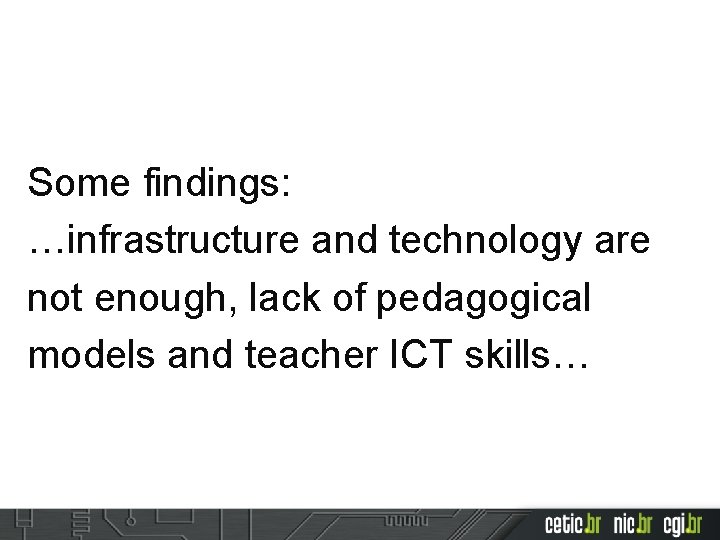
Some findings: …infrastructure and technology are not enough, lack of pedagogical models and teacher ICT skills…
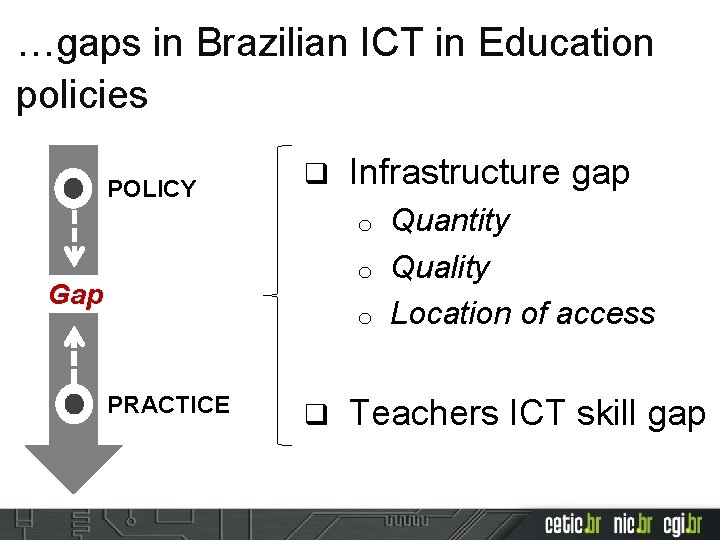
…gaps in Brazilian ICT in Education policies POLICY q Infrastructure gap Quantity o Quality o Location of access o Gap PRACTICE q Teachers ICT skill gap
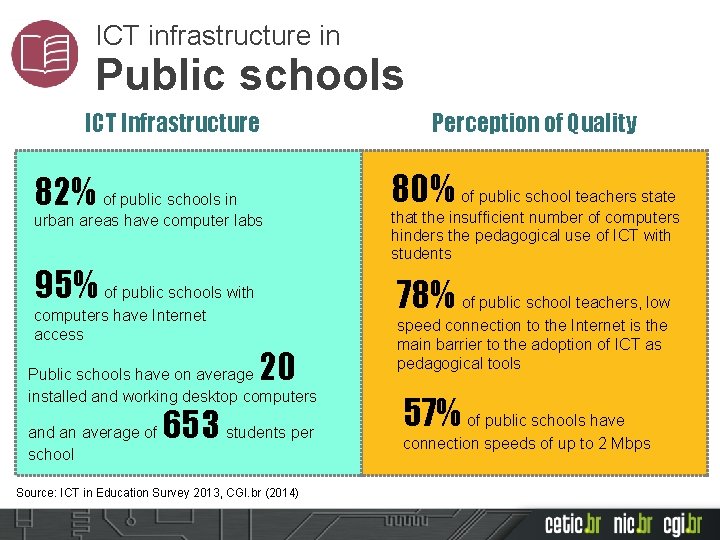
ICT infrastructure in Public schools ICT Infrastructure Perception of Quality 82% of public schools in 80% of public school teachers state 95% of public schools with 78% of public school teachers, low urban areas have computer labs computers have Internet access 20 Public schools have on average installed and working desktop computers and an average of school 653 students per Source: ICT in Education Survey 2013, CGI. br (2014) that the insufficient number of computers hinders the pedagogical use of ICT with students speed connection to the Internet is the main barrier to the adoption of ICT as pedagogical tools 57% of public schools have connection speeds of up to 2 Mbps
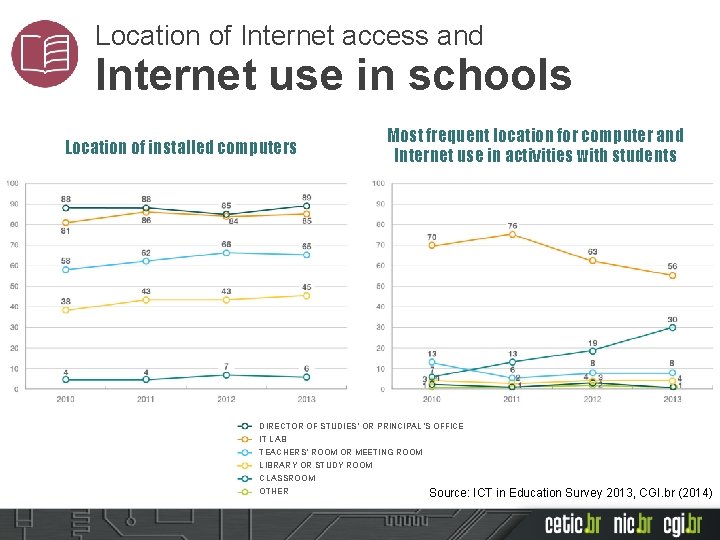
Location of Internet access and Internet use in schools Location of installed computers Most frequent location for computer and Internet use in activities with students DIRECTOR OF STUDIES’ OR PRINCIPAL’S OFFICE IT LAB TEACHERS’ ROOM OR MEETING ROOM LIBRARY OR STUDY ROOM CLASSROOM OTHER Source: ICT in Education Survey 2013, CGI. br (2014)
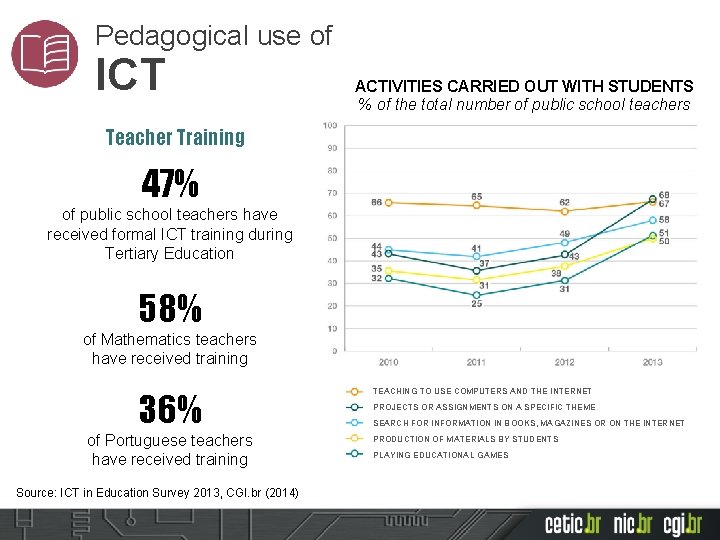
Pedagogical use of ICT ACTIVITIES CARRIED OUT WITH STUDENTS % of the total number of public school teachers Teacher Training 47% of public school teachers have received formal ICT training during Tertiary Education 58% of Mathematics teachers have received training 36% of Portuguese teachers have received training Source: ICT in Education Survey 2013, CGI. br (2014) TEACHING TO USE COMPUTERS AND THE INTERNET PROJECTS OR ASSIGNMENTS ON A SPECIFIC THEME SEARCH FOR INFORMATION IN BOOKS, MAGAZINES OR ON THE INTERNET PRODUCTION OF MATERIALS BY STUDENTS PLAYING EDUCATIONAL GAMES
Thank you www. cetic. br alexandre@nic. br @Comu. NICbr Facebook. com/nic. br