
How Music Works Part I Rhythm Chapter 3
- Slides: 10
How Music Works, Part I: Rhythm Chapter 3
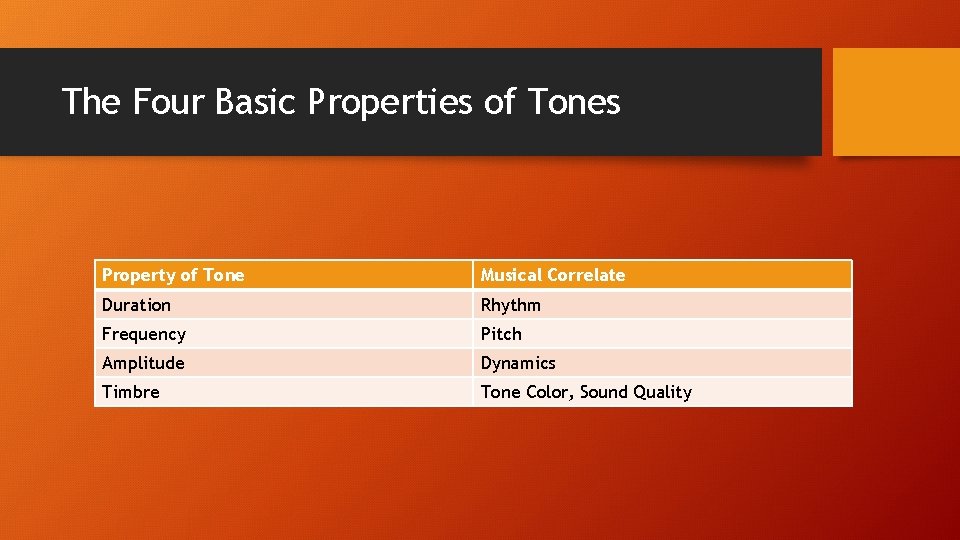
The Four Basic Properties of Tones Property of Tone Musical Correlate Duration Rhythm Frequency Pitch Amplitude Dynamics Timbre Tone Color, Sound Quality
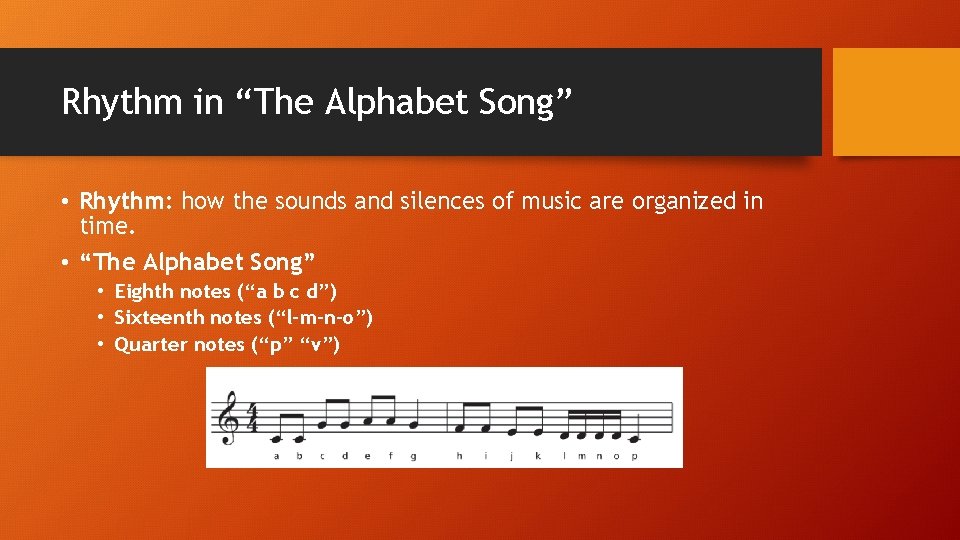
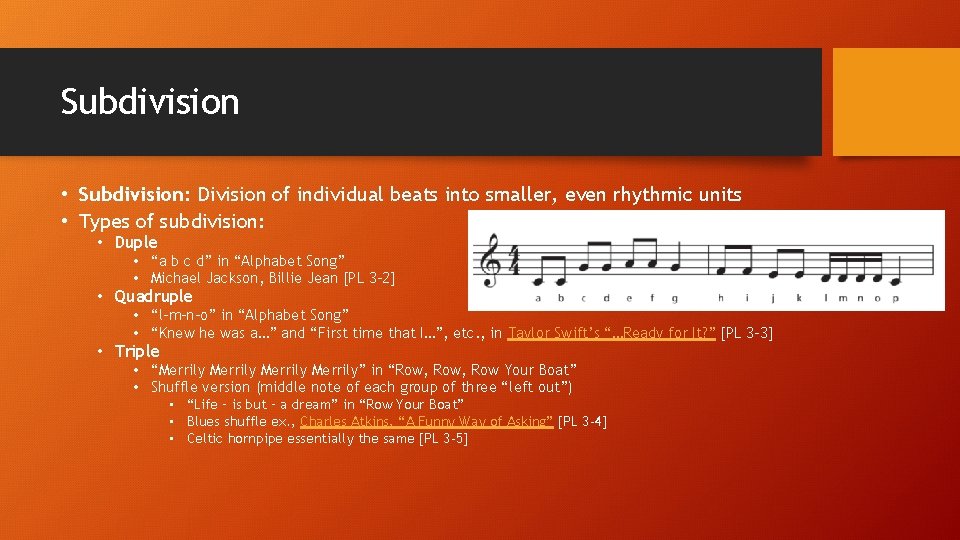
Rhythm in “The Alphabet Song” • Rhythm: how the sounds and silences of music are organized in time. • “The Alphabet Song” • Eighth notes (“a b c d”) • Sixteenth notes (“l-m-n-o”) • Quarter notes (“p” “v”)
Beat • Beat: the underlying pulse in a piece of music; what you tap your foot to when you listen, move your feet to when you dance • Often marked by a steady stream of quarter-note pulses (e. g. , “Alphabet Song”) • Each pulse is a beat; the continuous stream of pulses is called the beat • Sing “The Alphabet Song” while clapping the beat • Clap along with the beat of “Uptight, ” by Stevie Wonder [PL 3 -1] (follow the drum part)
Subdivision • Subdivision: Division of individual beats into smaller, even rhythmic units • Types of subdivision: • Duple • “a b c d” in “Alphabet Song” • Michael Jackson, Billie Jean [PL 3 -2] • Quadruple • “l-m-n-o” in “Alphabet Song” • “Knew he was a…” and “First time that I…”, etc. , in Taylor Swift’s “…Ready for It? ” [PL 3 -3] • Triple • “Merrily Merrily” in “Row, Row Your Boat” • Shuffle version (middle note of each group of three “left out”) • “Life – is but – a dream” in “Row Your Boat” • Blues shuffle ex. , Charles Atkins, “A Funny Way of Asking” [PL 3 -4] • Celtic hornpipe essentially the same [PL 3 -5]
Meter • Meter: Grouping of beats together to form larger units • One such group of beats is called a measure or a bar • The number of beats in a measure defines the music’s meter • Meters of two beats (duple), three beats (triple), and four beats (quadruple) the most common, at least in Western music • Other, more complex meters may occur as well (5, 7, 11, or 13 beats per measure), and the meter may change from one bar or section to the next • Often, there will be a pattern of different beat strengths, e. g. , Strong-weak -Medium-weak (S w M w) in quadruple meter, S w w in triple meter
Meter Examples • “Alphabet Song” • meter of four (S w M w) (Fig. 3. 7, p. 40) • “Star-Spangled Banner” • meter of three (S w w) (Fig. 3. 8, p. 40) • Egyptian music example “Alla Hai” (Hossam Ramzy) [PL 3 -6] • Meter of two (Fig. 3. 9, p. 40) • Mexican mariachi example “Cielito Lindo” (Mariachi Sol) [PL 3 -7] • Meter of three (S w w) (Fig 3. 10, p. 41) • Roma brass band, Romania, “Cantecul Miresei (Bride’s Song)” [PL 3 -8] • Meter of 7 (2+2+3) (Insights and Perspectives [I&P] box, p. 42) • Bulgarian music by Ivo Papazov, “Kurdzhaliyska Rachenitza” [PL 3 -9] • Meter of 7 (2+2+3, but with “tricks”!) (I&P box, p. 42)
Accent and Syncopation • Accent: note given special emphasis (usually played louder than notes surrounding it • Syncopation: an accented note that falls between main beats • Example with little to no syncopation: • PL 3 -10 (from Mozart, Eine Kleine Nachtmusik) • Examples with much syncopation: • PL 3 -11 (James Brown, “I Got You [I Feel Good]” – song starts at 1: 09) • PL 3 -12 (Jasbir Jassi, “Kudi”– bhangra music – song starts at 1: 35, syncopated “Hoi!” shouts at 2: 30) • West African drum-and-dance ensemble music [PL 3 -13] • Westerners describe such music as highly syncopated, but West African musicians may resist such a description (p. 43)
Tempo • Tempo: the rate at which the beats pass in music • Tempos range from very slow, to slow, medium-slow, medium (moderate), medium-fast, and very fast • Sing the “Alphabet Song” at several different tempos; does the feeling and mood of the song change? • Can be constant or variable, can accelerate or decelerate, suddenly or gradually • The Athenians, “Zorba the Greek” [PL 3 -14] – tempo accelerates gradually • The Beatles, “I Want You (She’s So Heavy)” [PL 3 -15] – sudden changes in both tempo and meter (e. g. , at 1: 56, 2: 23)
Free Rhythm • The term free rhythm may be applied to music in which there is no discernible beat, and in turn no discernible meter • Examples: • Opening section of a piece featuring the South Indian vina [PL 3 -16] (which is in free rhythm up to the point where the mrdangam drum enters) • Whitney Houston, opening section of “I Will Always Love You” [PL 3 -17]