
How Museums Shape Meaning The Rise of the
- Slides: 15
How Museums Shape Meaning • The Rise of the Museum • Function of Museums • • • Exhibition Education Collaboration (Diffusion) Restoration & Repair Identification Preservation & Protection • Primary Source: The Artist and the Museum • Museums and the Creation of Identity • The Role of the Curator: “Weaving narratives in museum galleries” Thomas P. Campbell • The Future of the Museum? “Building a museum of museums on the web” - Amit Sood
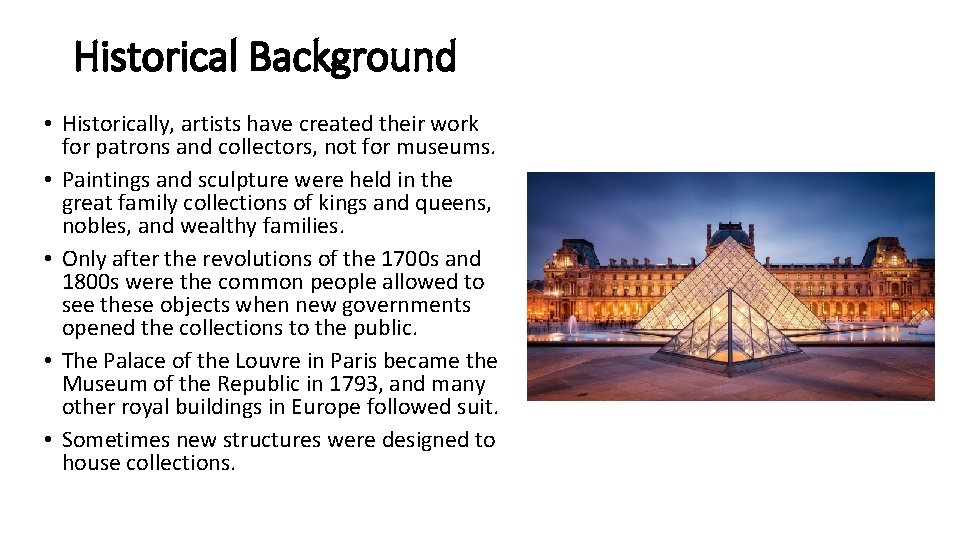
Historical Background • Historically, artists have created their work for patrons and collectors, not for museums. • Paintings and sculpture were held in the great family collections of kings and queens, nobles, and wealthy families. • Only after the revolutions of the 1700 s and 1800 s were the common people allowed to see these objects when new governments opened the collections to the public. • The Palace of the Louvre in Paris became the Museum of the Republic in 1793, and many other royal buildings in Europe followed suit. • Sometimes new structures were designed to house collections.
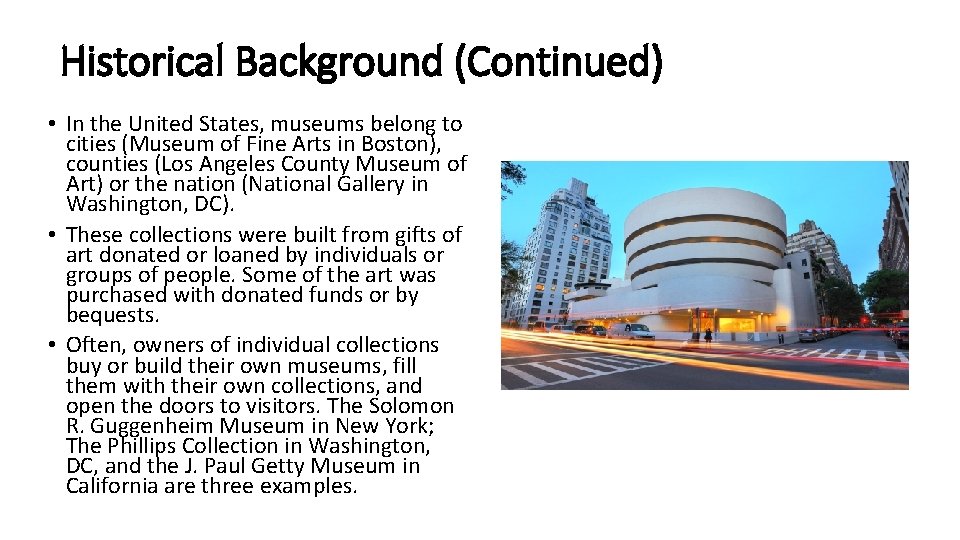
Historical Background (Continued) • In the United States, museums belong to cities (Museum of Fine Arts in Boston), counties (Los Angeles County Museum of Art) or the nation (National Gallery in Washington, DC). • These collections were built from gifts of art donated or loaned by individuals or groups of people. Some of the art was purchased with donated funds or by bequests. • Often, owners of individual collections buy or build their own museums, fill them with their own collections, and open the doors to visitors. The Solomon R. Guggenheim Museum in New York; The Phillips Collection in Washington, DC, and the J. Paul Getty Museum in California are three examples.
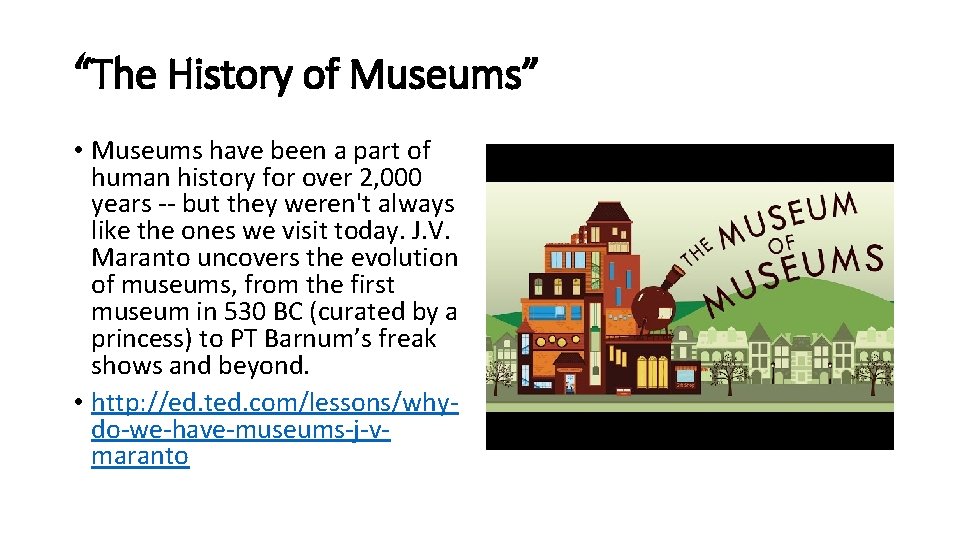
“The History of Museums” • Museums have been a part of human history for over 2, 000 years -- but they weren't always like the ones we visit today. J. V. Maranto uncovers the evolution of museums, from the first museum in 530 BC (curated by a princess) to PT Barnum’s freak shows and beyond. • http: //ed. ted. com/lessons/whydo-we-have-museums-j-vmaranto
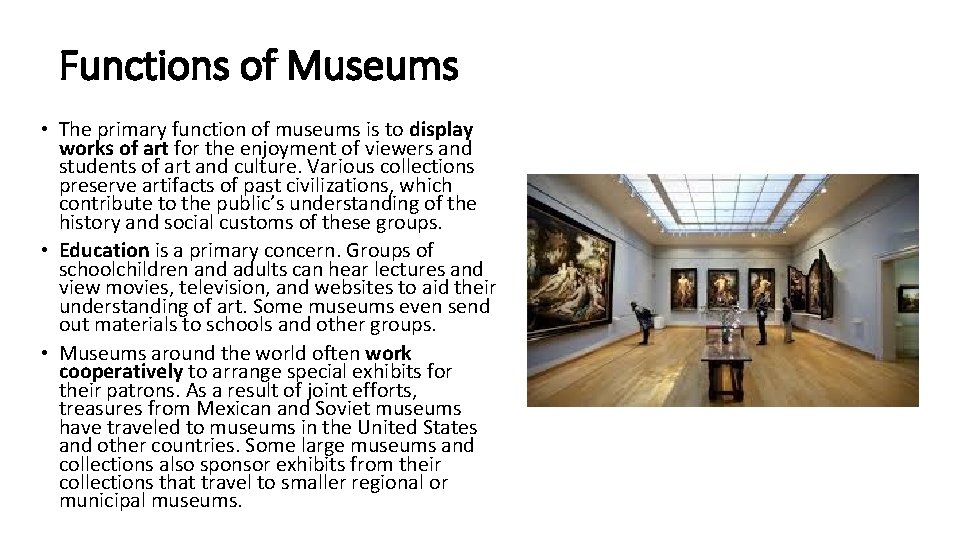
Functions of Museums • The primary function of museums is to display works of art for the enjoyment of viewers and students of art and culture. Various collections preserve artifacts of past civilizations, which contribute to the public’s understanding of the history and social customs of these groups. • Education is a primary concern. Groups of schoolchildren and adults can hear lectures and view movies, television, and websites to aid their understanding of art. Some museums even send out materials to schools and other groups. • Museums around the world often work cooperatively to arrange special exhibits for their patrons. As a result of joint efforts, treasures from Mexican and Soviet museums have traveled to museums in the United States and other countries. Some large museums and collections also sponsor exhibits from their collections that travel to smaller regional or municipal museums.
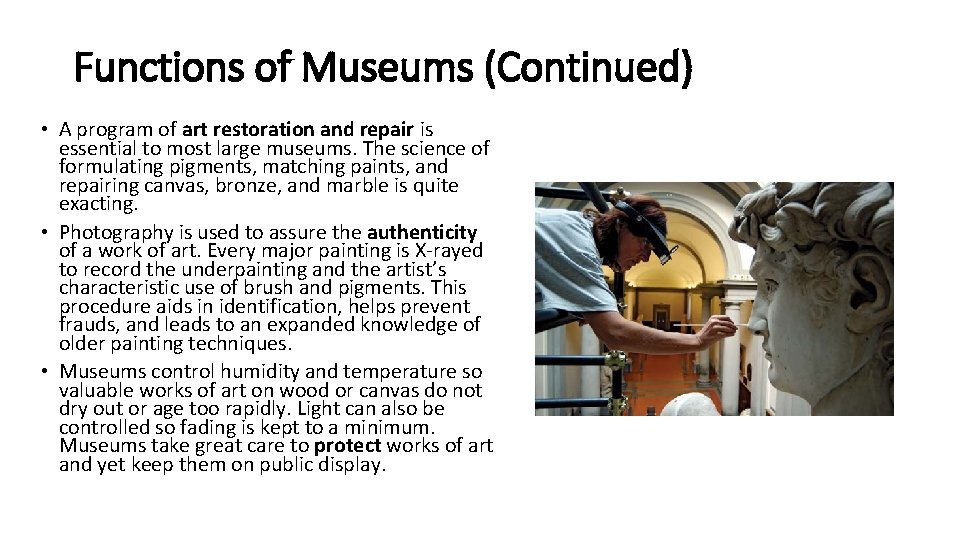
Functions of Museums (Continued) • A program of art restoration and repair is essential to most large museums. The science of formulating pigments, matching paints, and repairing canvas, bronze, and marble is quite exacting. • Photography is used to assure the authenticity of a work of art. Every major painting is X-rayed to record the underpainting and the artist’s characteristic use of brush and pigments. This procedure aids in identification, helps prevent frauds, and leads to an expanded knowledge of older painting techniques. • Museums control humidity and temperature so valuable works of art on wood or canvas do not dry out or age too rapidly. Light can also be controlled so fading is kept to a minimum. Museums take great care to protect works of art and yet keep them on public display.
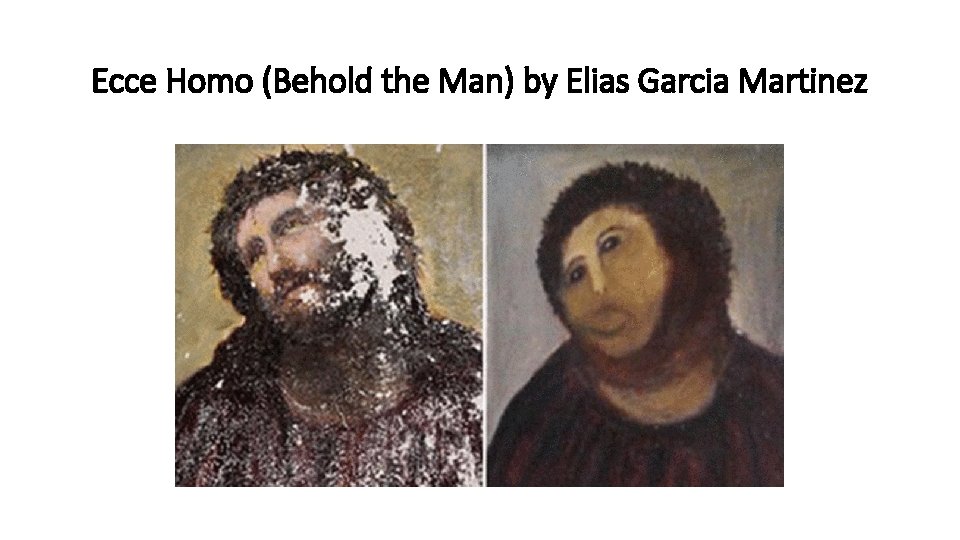
Ecce Homo (Behold the Man) by Elias Garcia Martinez
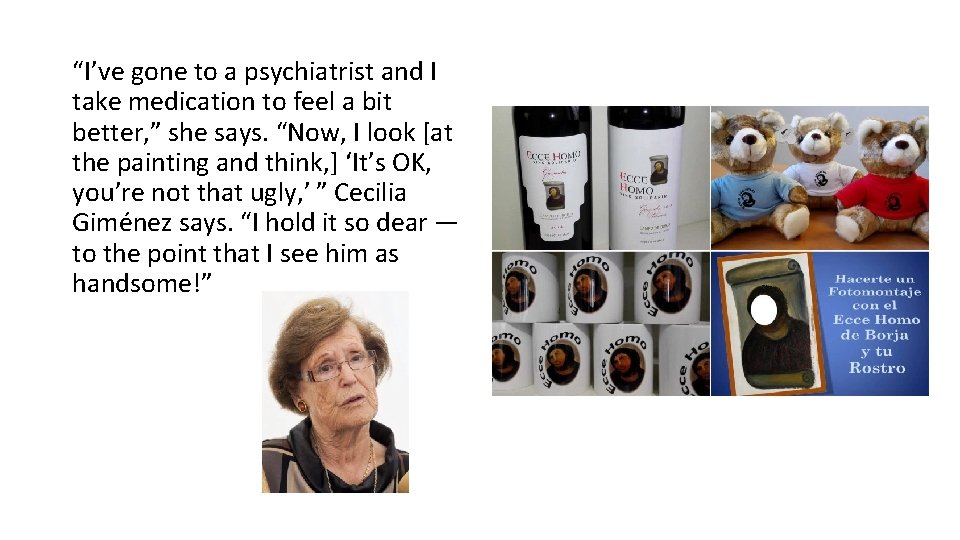
“I’ve gone to a psychiatrist and I take medication to feel a bit better, ” she says. “Now, I look [at the painting and think, ] ‘It’s OK, you’re not that ugly, ’ ” Cecilia Giménez says. “I hold it so dear — to the point that I see him as handsome!”
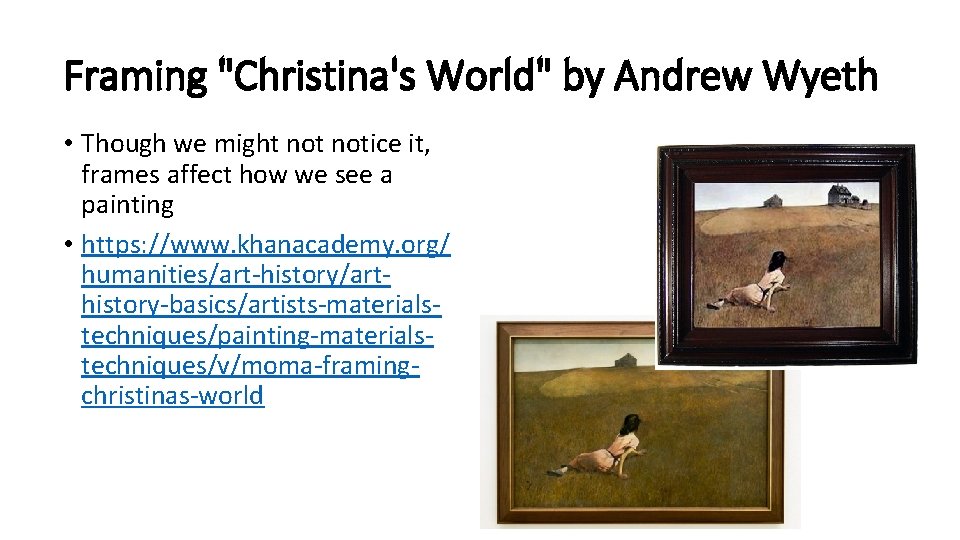
Framing "Christina's World" by Andrew Wyeth • Though we might notice it, frames affect how we see a painting • https: //www. khanacademy. org/ humanities/art-history/arthistory-basics/artists-materialstechniques/painting-materialstechniques/v/moma-framingchristinas-world
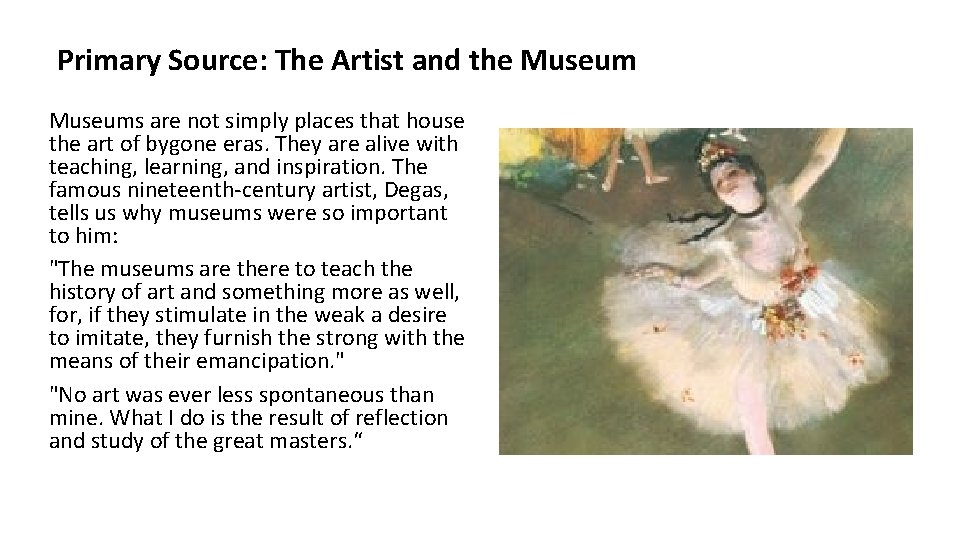
Primary Source: The Artist and the Museums are not simply places that house the art of bygone eras. They are alive with teaching, learning, and inspiration. The famous nineteenth-century artist, Degas, tells us why museums were so important to him: "The museums are there to teach the history of art and something more as well, for, if they stimulate in the weak a desire to imitate, they furnish the strong with the means of their emancipation. " "No art was ever less spontaneous than mine. What I do is the result of reflection and study of the great masters. “
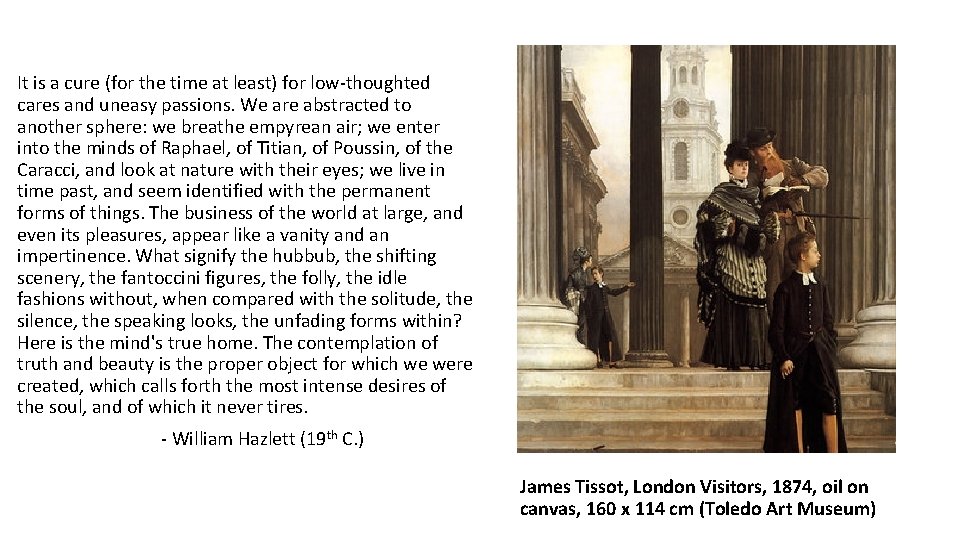
It is a cure (for the time at least) for low-thoughted cares and uneasy passions. We are abstracted to another sphere: we breathe empyrean air; we enter into the minds of Raphael, of Titian, of Poussin, of the Caracci, and look at nature with their eyes; we live in time past, and seem identified with the permanent forms of things. The business of the world at large, and even its pleasures, appear like a vanity and an impertinence. What signify the hubbub, the shifting scenery, the fantoccini figures, the folly, the idle fashions without, when compared with the solitude, the silence, the speaking looks, the unfading forms within? Here is the mind's true home. The contemplation of truth and beauty is the proper object for which we were created, which calls forth the most intense desires of the soul, and of which it never tires. - William Hazlett (19 th C. ) James Tissot, London Visitors, 1874, oil on canvas, 160 x 114 cm (Toledo Art Museum)
Museums and the Creation of Identity “A central premise of Postmodern criticism is that we are constructed in the codes, discourses, and languages of our cultural contexts. These codes do not seem to be artificial to us—instead, they seem natural. But this is an effect of the power of culture in defining us and the way we look at the world. Culture ‘naturalizes’ codes of identity, and we forget that how we define ourselves—and others—depends on choices we make. We imagine instead that things ‘have always been this way. ’ Postmodern art criticism offers a way to challenge that idea, by showing how visual (i. e. , cultural) representations of race, class, gender, and sex are created, how they change, and how they shape identity. ”
Museums and the Creation of Identity Carol Duncan in the following quotation from her book Civilizing Rituals strongly argues for the critical role museums play: “To control a museum means precisely to control the representation of a community and its highest values and truths. It is also the power to define the relative standing of individuals within that community. Those who are best prepared to perform its ritual—those who are most able to respond to its various cues—are also those whose identities (social, sexual, racial, etc. ) the museum ritual most fully confirms. It is precisely for this reason that museums and museum practices can become objects of fierce struggle and impassioned debate. What we see and do not see in art museums—and on what terms and by whose authority we do or do not see it—is closely linked to larger questions about who constitutes the community and who defines its identity” [pp. 8 -9].
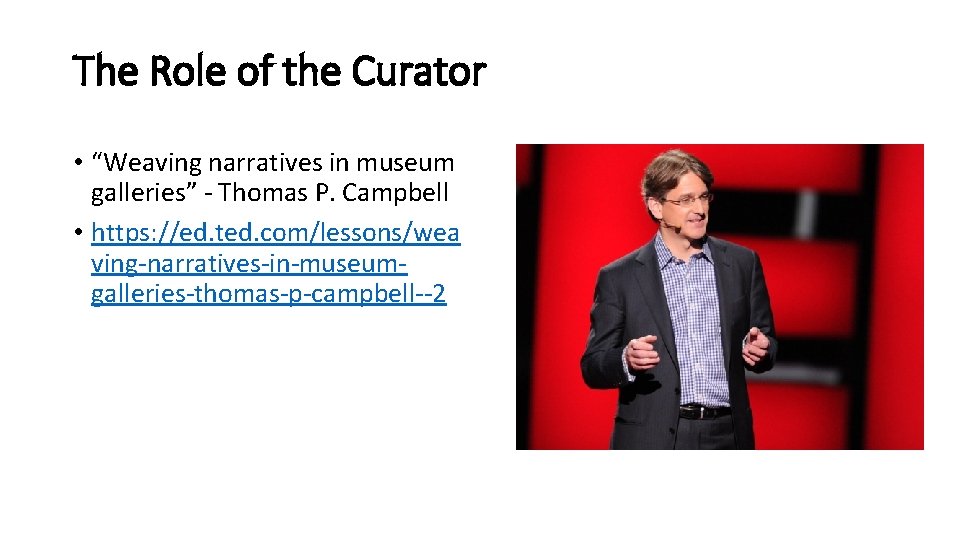
The Role of the Curator • “Weaving narratives in museum galleries” - Thomas P. Campbell • https: //ed. ted. com/lessons/wea ving-narratives-in-museumgalleries-thomas-p-campbell--2
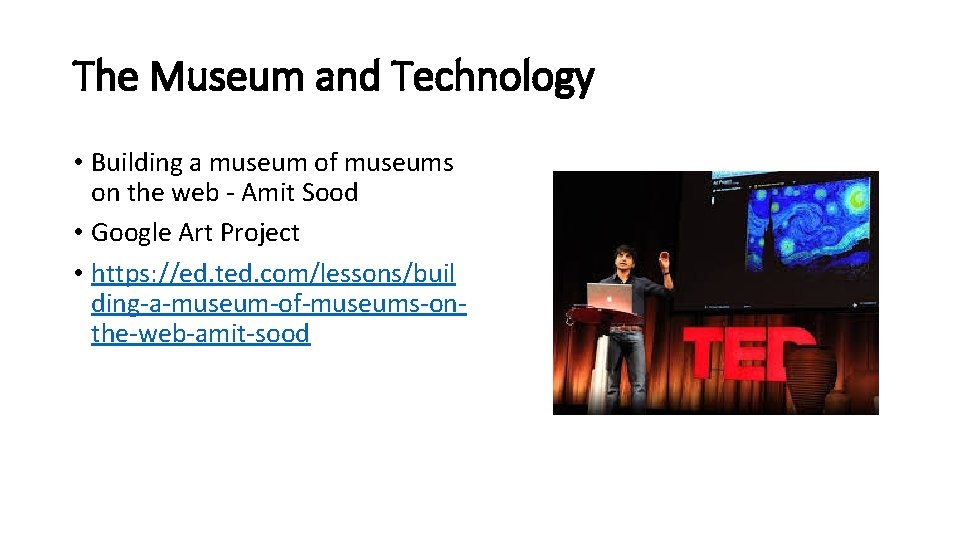
The Museum and Technology • Building a museum of museums on the web - Amit Sood • Google Art Project • https: //ed. ted. com/lessons/buil ding-a-museum-of-museums-onthe-web-amit-sood