
How Much Money Does It Cost To Complete


- Slides: 11
How Much Money Does It Cost To Complete A Panini sticker album? A Look At The Maths And Money Behind Panini Stickers Euan. D
Introduction Every 2 years many people look forward the spectacle of international football, whether it is the World Cup or European Championships (along with the Copa America and other continents competitions). As well as the excitement and pride of watching your national team perform on the largest footballing platform, many people find much excitement out of the tradition of sticker collecting for that year’s tournament. For every international tournament since 1970 the Italian company “Panini” have released a sticker album for football fans to buy and trade stickers and complete the year’s album of players. The packs consist of 5 stickers and generally cost around 50 p in the UK. So, this brings about an interesting question: how much money does it actually take to complete one of these albums? This is the question we will attempt to answer using the wonderful world of mathematics.
Lets Begin The Maths For the 2018 Russia World Cup album there were 682 total stickers to collect. That year the cost of a sticker packet was 80 p, which was an increase of 30 p which for me was outrageous! This would mean the value of each sticker was 16 p. From this we can see that the minimum price of filling the sticker book would be £ 109. 12 if you were to get extremely lucky when buying packs and have no repeats or “swapsies” as they may be referred to as. As we know this is incredibly unlikely; therefore how many sticker packs would it take until you collected all the stickers? Every year you will see headlines of the cost of filling one of these albums in newspapers or online. However, these predictions assume that the collector would be repeatedly buying packs until they filled their album. This would cost generally around £ 700 -£ 1000. In reality this is usually not the case as people often trade with their friends to gain stickers which they don’t currently own to reduce the cost of buying packs.
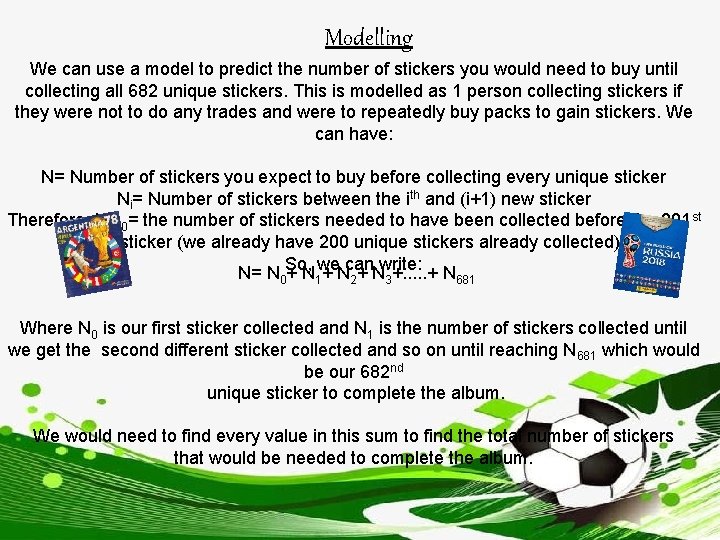
Modelling We can use a model to predict the number of stickers you would need to buy until collecting all 682 unique stickers. This is modelled as 1 person collecting stickers if they were not to do any trades and were to repeatedly buy packs to gain stickers. We can have: N= Number of stickers you expect to buy before collecting every unique sticker Ni= Number of stickers between the ith and (i+1) new sticker Therefore, N 200= the number of stickers needed to have been collected before the 201 st new sticker (we already have 200 unique stickers already collected). So, we can write: N= N 0+ N 1+ N 2+ N 3+. . . + N 681 Where N 0 is our first sticker collected and N 1 is the number of stickers collected until we get the second different sticker collected and so on until reaching N 681 which would be our 682 nd unique sticker to complete the album. We would need to find every value in this sum to find the total number of stickers that would be needed to complete the album.
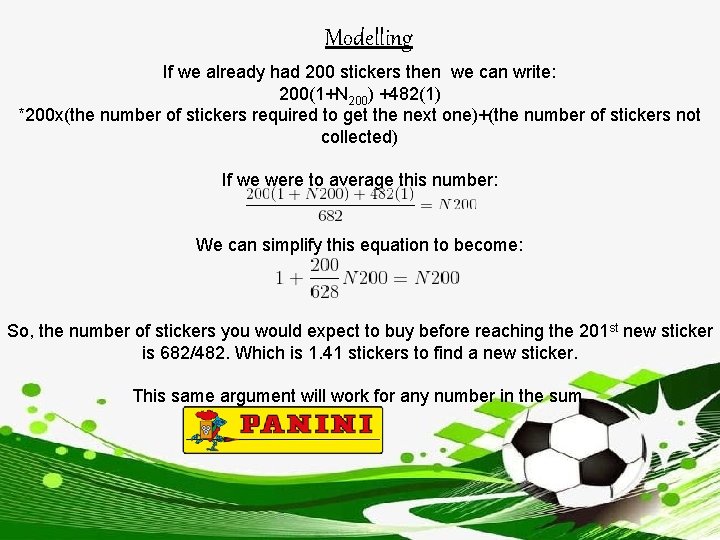
Modelling If we already had 200 stickers then we can write: 200(1+N 200) +482(1) *200 x(the number of stickers required to get the next one)+(the number of stickers not collected) If we were to average this number: We can simplify this equation to become: So, the number of stickers you would expect to buy before reaching the 201 st new sticker is 682/482. Which is 1. 41 stickers to find a new sticker. This same argument will work for any number in the sum.
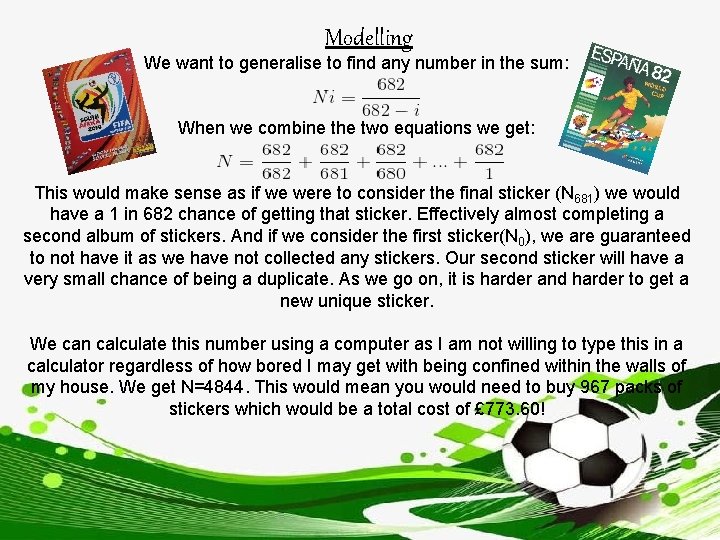
Modelling We want to generalise to find any number in the sum: When we combine the two equations we get: This would make sense as if we were to consider the final sticker (N 681) we would have a 1 in 682 chance of getting that sticker. Effectively almost completing a second album of stickers. And if we consider the first sticker(N 0), we are guaranteed to not have it as we have not collected any stickers. Our second sticker will have a very small chance of being a duplicate. As we go on, it is harder and harder to get a new unique sticker. We can calculate this number using a computer as I am not willing to type this in a calculator regardless of how bored I may get with being confined within the walls of my house. We get N=4844. This would mean you would need to buy 967 packs of stickers which would be a total cost of £ 773. 60!
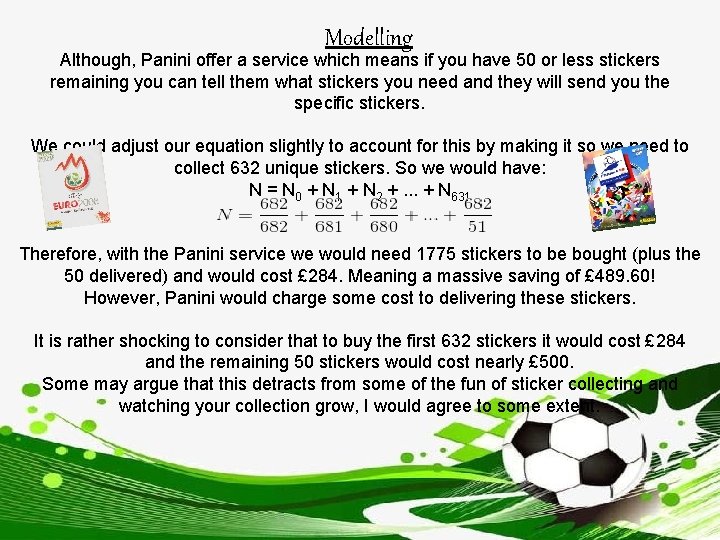
Modelling Although, Panini offer a service which means if you have 50 or less stickers remaining you can tell them what stickers you need and they will send you the specific stickers. We could adjust our equation slightly to account for this by making it so we need to collect 632 unique stickers. So we would have: N = N 0 + N 1 + N 2 +. . . + N 631 Therefore, with the Panini service we would need 1775 stickers to be bought (plus the 50 delivered) and would cost £ 284. Meaning a massive saving of £ 489. 60! However, Panini would charge some cost to delivering these stickers. It is rather shocking to consider that to buy the first 632 stickers it would cost £ 284 and the remaining 50 stickers would cost nearly £ 500. Some may argue that this detracts from some of the fun of sticker collecting and watching your collection grow, I would agree to some extent.
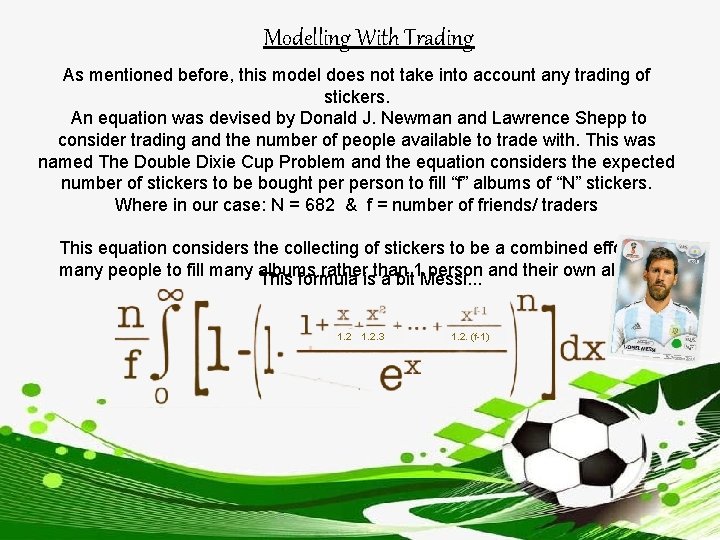
Modelling With Trading As mentioned before, this model does not take into account any trading of stickers. An equation was devised by Donald J. Newman and Lawrence Shepp to consider trading and the number of people available to trade with. This was named The Double Dixie Cup Problem and the equation considers the expected number of stickers to be bought person to fill “f” albums of “N” stickers. Where in our case: N = 682 & f = number of friends/ traders This equation considers the collecting of stickers to be a combined effort of many people to fill many albums rather than 1 person and their own album. This formula is a bit Messi. . . 1. 2. 3 1. 2. (f-1)
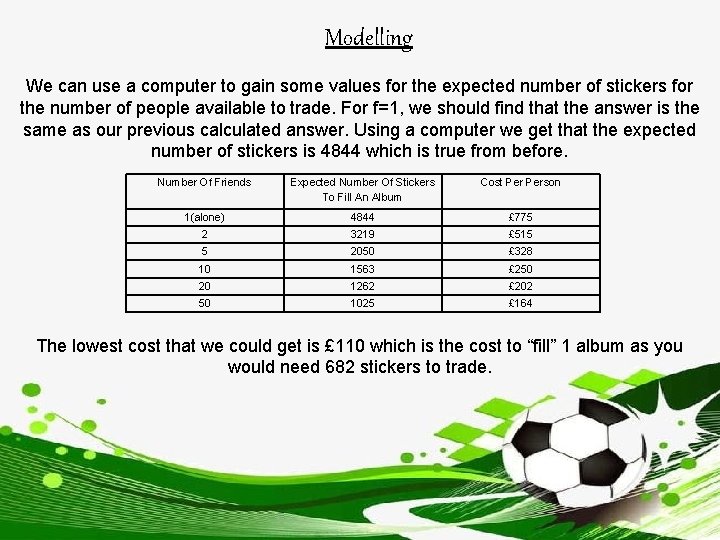
Modelling We can use a computer to gain some values for the expected number of stickers for the number of people available to trade. For f=1, we should find that the answer is the same as our previous calculated answer. Using a computer we get that the expected number of stickers is 4844 which is true from before. Number Of Friends Expected Number Of Stickers To Fill An Album Cost Person 1(alone) 4844 £ 775 2 3219 £ 515 5 2050 £ 328 10 1563 £ 250 20 1262 £ 202 50 1025 £ 164 The lowest cost that we could get is £ 110 which is the cost to “fill” 1 album as you would need 682 stickers to trade.
Modelling There are some assumptions that are made in these calculations. For example, are all stickers equally likely in packs? Or in other words, do Panini made some stickers more valuable and harder to get than others to boost their sales? Panini says that all stickers are distributed evenly and that you would not find 2 of the same sticker in a pack. But, even still, some cards may still be worth more to collectors, for example, if it were someone’s favourite player or from certain desired nationality. This is also something to consider on the trading side. Additionally, you often find some starter stickers in the book which is the same for everyone and this has also not been taken into account.
I hope you enjoyed this presentation and that it all made sense Thank you for taking the time to read it