
How much complexity is too much you should
- Slides: 9
How much complexity is too much? “you should try to make things as simple as possible, but not too simple” A. Einstein “All modeling is a gross simplification of the real system. ” G. Whelan “Don’t work any harder than you have to. ” K. Castleton
Talking Points • Who is Karl Castleton and “What does he do? ” • The ADVECTIVE, DISPERSIVE, and DECAY equation. • Intuition about the system • Intuition about the equation • Semi-Analytical techniques • Numerical techniques • Conclusions
Who is Karl Castleton • Mesa State Graduate: A. A. S. 1987, B. S. 1992 Computer Science and Mathematics • Washington State University: M. S. Computer Science 1997 • Works at Pacific Northwest National Laboratory • Master Project solved the advective, dispersive, decay equation by three different methods
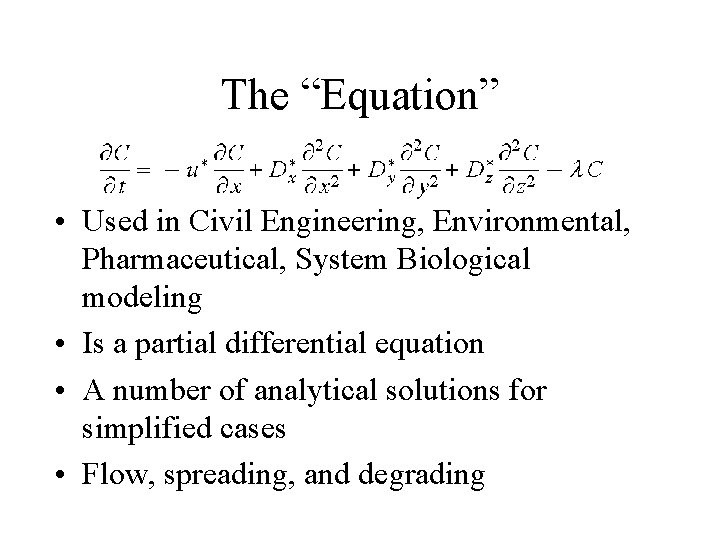
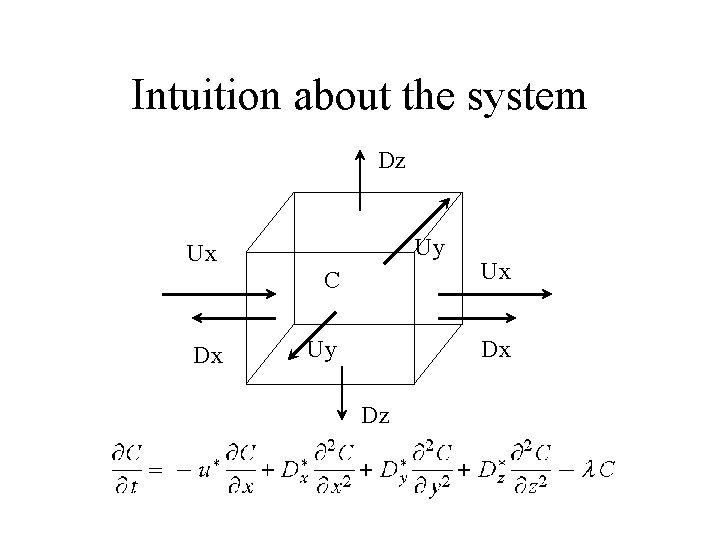
The “Equation” • Used in Civil Engineering, Environmental, Pharmaceutical, System Biological modeling • Is a partial differential equation • A number of analytical solutions for simplified cases • Flow, spreading, and degrading
Intuition about the system Dz Uy Ux Dx C Ux Uy Dx Dz
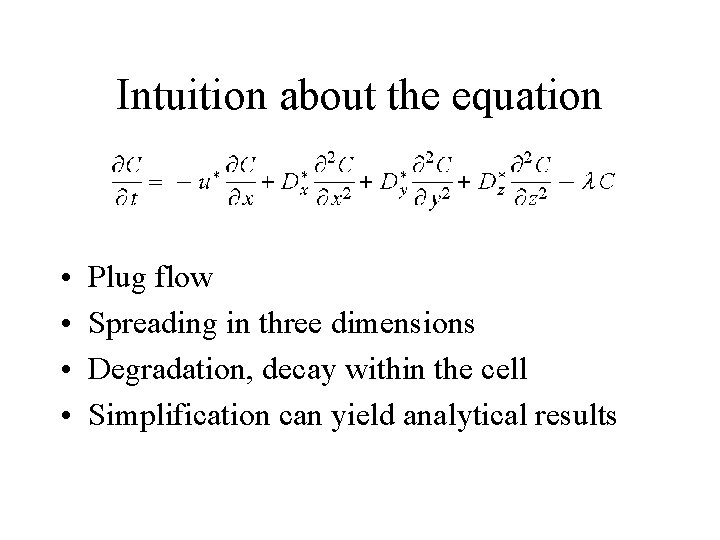
Intuition about the equation • • Plug flow Spreading in three dimensions Degradation, decay within the cell Simplification can yield analytical results
Semi-Analytical Techniques • Take the mathematics as far as it can go and then use a computer to put you over the top. • Reduce the model to a system that has an analytical result for instantaneous release. • Convolute the instantaneous release with input forcing function.
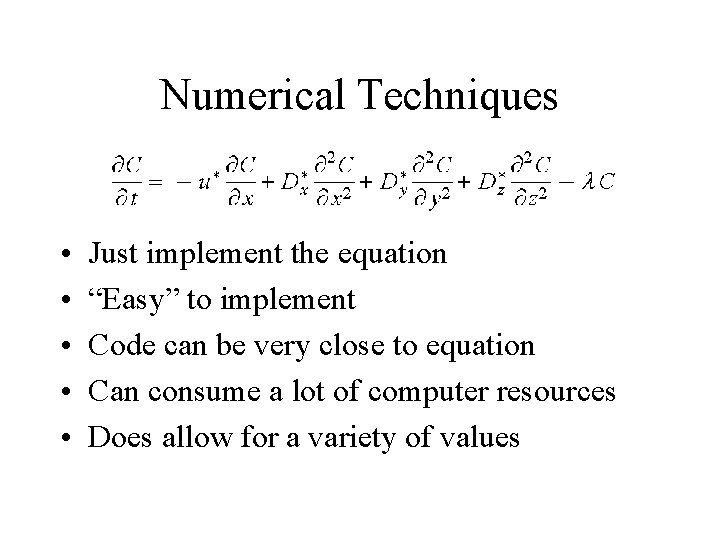
Numerical Techniques • • • Just implement the equation “Easy” to implement Code can be very close to equation Can consume a lot of computer resources Does allow for a variety of values
Conclusion • There are many ways to solve a modeling question • Use no more or less than you need • Do not always use the same tool/technique • Do not work any harder than you have to.