
How many times can you say this TONGUE
- Slides: 16
How many times can you say this TONGUE TWISTER without getting your tongue tangled?
BETTY BOTTER Betty Botter bought some butter. “But, ” she said, “the butter’s bitter. If I put it in my batter, it will make my batter bitter. But a bit of better butter— that would make my batter better. ”
BETTY BOTTER So she bought a bit of butter, better than her bitter butter. And she put it in her batter, and the batter was not bitter. So ‘twas better Betty Botter bought A bit of better butter!
What makes a tongue twister difficult to recite?
OBJECTIVES
Sound Devices • used by writers to convey and reinforce meaning or the experience of literature through the Commonly used sound skillful use of sound • increases the enjoyment of the reader and her appreciation for the work devices include: 1. Rhyme 2. Alliteration 3. Assonance 4. Onomatopoeia
RHYME -- it is when the end or final sound of two or more words are identical Example: It seems like my heart skips a mile Whenever you look at me and smile.
ALLITERATION -- it is the repetition of the first/initial consonant sounds of words that are fairly close together -- depends on sound, NOT spelling Example: from Robert Frost’s Nothing Gold Can Stay her hardest hue to hold
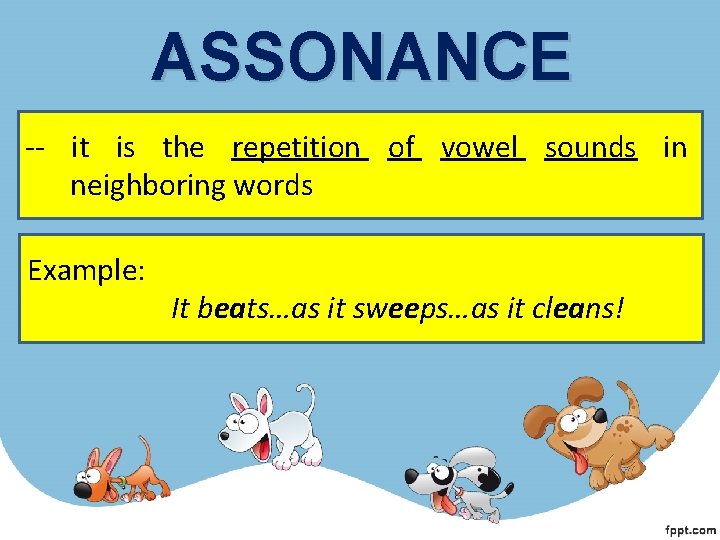
ASSONANCE -- it is the repetition of vowel sounds in neighboring words Example: It beats…as it sweeps…as it cleans!
ONOMATOPOEIA -- It is the use of words that imitates the sounds associated with the objects or actions they refer to. Being able to use it will help your writing come alive!
ONOMATOPOEIA Which of the following sentences creates a better picture? 1. There was a large tuba in the parade. 2. “Umpa-pa, umpa-pa, ” went the large tuba in the parade.
ONOMATOPOEIA -- it is simply a written word to represent noise or sound from the reality water plops into pond splish-splash downhill warbling magpies in tree trilling, melodic thrill -- Lee Emmett
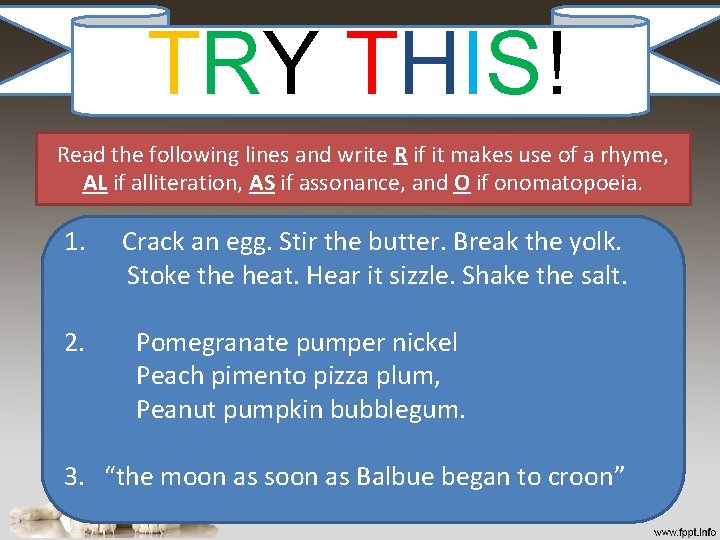
TRY THIS! Read the following lines and write R if it makes use of a rhyme, AL if alliteration, AS if assonance, and O if onomatopoeia. 1. 2. Crack an egg. Stir the butter. Break the yolk. Stoke the heat. Hear it sizzle. Shake the salt. Pomegranate pumper nickel Peach pimento pizza plum, Peanut pumpkin bubblegum. 3. “the moon as soon as Balbue began to croon”
TRY THIS! Read the following poem in the next slide. Examine how sound devices put special flavor in the poem. Look for rhymes, alliteration, assonance, and onomatopoeia and write them down in your notebook.
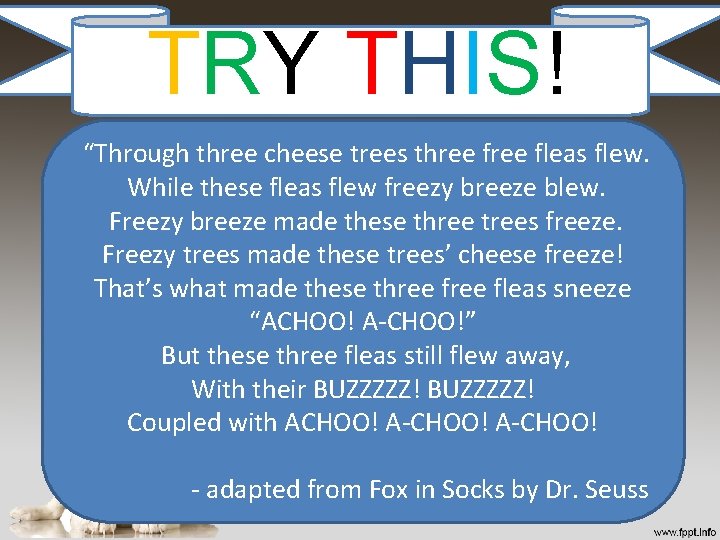
TRY THIS! “Through three cheese trees three fleas flew. While these fleas flew freezy breeze blew. Freezy breeze made these three trees freeze. Freezy trees made these trees’ cheese freeze! That’s what made these three fleas sneeze “ACHOO! A-CHOO!” But these three fleas still flew away, With their BUZZZZZ! Coupled with ACHOO! A-CHOO! - adapted from Fox in Socks by Dr. Seuss
References: • CALLIOPE by Barday Lipson, Ed. D. • http: //examples. yourdictionary. com/ • http: //www. ereadingsheets. com/figurativelanguage/poetic_devises