
HOW LANGUAGE COMMUNICATES 1 1 The Origin of

- Slides: 24
HOW LANGUAGE COMMUNICATES 1. 1 The Origin of Language • Language evolved because man needed to communicate, interact, establish relationship and companionship. • Language is the major verbal means of communicating among human beings • Historically, the varieties of language can be traced to the incidence that happened during the attempt to build the tower of Babel in the Bible
The Concept of Language • Ogunsiji (2013) defines language as a universal possession of human beings that distinguishes man from lower animal. • Language is a structured system of symbols that communicates meaning when a message is passed across from one human to another.
Language and Culture • Language and culture are intertwined and it may be impossible to view a person outside his or her culture. • Culture is the general way of life of a group of people. • The totality of human beings is summed up by their culture • Ogunsiji (2013) explains that culture influences the way humans use their language to express reality because culture controls the actions and reactions of human beings. Language itself influences the way culture is used. • In essence, language rides on the back of culture to establish itself as a formidable instrument of communication in human societies.
Functions of Language • Interaction • Information • Education • Sharing • Governance • Worship • Relationship
Features of Language • Language is dynamic • Language is arbitrary • Language is spoken • Language is structured • Language is systematic • Language has varieties • Language is symbolic • Language is acquired and influenced by learning environments • Language is reciprocal
The Process of Communication • Language is the major instrument for communication • Oyewole (2010) describes communication as the attempt to share meaning and information, establish relationship between two or more persons. • Communication is also the act of sending messages, ideas and information from one person to another through verbal or nonverbal channels • The process of communication is cyclical. • It involves the action taken by the sender of the message, then the reaction of the receiver follows through the feedback he receives. • The feedback triggers further messages from the initial sender making him or her a receiver and thus an interaction continues until it is terminated.
Important Terms in Communication • Sender • Message • Receiver • Channel • Medium • Feedback • Noise
Types of Communication • Intrapersonal: This is the type of communication that takes place within the speaker. It occurs in the mind of the speaker. It can take the from of soliloquizing. • Interpersonal: This is the communication between two people. It is also called dyadic communication. • Group communication: This is the communication within a group of triads to a small group of up to 12 and a large group of more than 50. • Mass communication: It entails communicating formally or informally with a a large heterogeneous group of people across communities and the entire world at large.
Verbal Communication • This refers to the use of sounds and words to express oneself. It uses the vocal cords to produce meaningful sounds with the aid of language to share information or pass across a message from a sender to a receiver
Advantages of Verbal Communication • It is usually instant, heard and informal • It requires no special preparation • Most times, it requires no formal preparations • It is mostly interpersonal • It gives room for immediate feedback
Disadvantages of Verbal Communication • It is spoken and does not require elaborate preparation thus, gives room for mistakes • It is usually face to face, therefore the nonverbal messages outweighs the verbal message • When it is not face to face, the tone and pitch of voice may be misunderstood or misconstrued • If the message is not recorded, it may be denied in a law court
Nonverbal Communication • It is the communication without the use of language sounds, instead it uses signs, gestures, sounds and symbols. • It is a powerful means of communication. It can be intentional and unintentional • It can support or contradict a verbal message • It maybe face to face or across a distance • A substantial part of human communication is nonverbal or a combination of verbal and nonverbal channel.
Terms for Describing Nonverbal Communication • Kinesics: The use of body movements that include gestures, arm and leg movements, facial expressions, eye gaze and so on. • Body language: nonverbal messages produced by the body consciously or unconsciously. • Paralanguage: the use of sounds such as grunting, hissings, whistling etc. • Colours • Emblems
Advantages of Nonverbal Communication • It can be used to repeat/reinforce the verbal message • It may be a substitute for the verbal message especially when there is noise • It may have several interpretations to complete the verbal message. • It endorses verbal message depending on the situation. • Sometimes, it may speak volume and convey messages deeper than the spoken messages.
Disadvantages of Nonverbal Communication • It is subject to misinterpretations and may be construed • It is culture specific and may not fully represent what it is supposed to represent • It is not a document and cannot be tendered in a law court as an evidence • It may negate the verbal communication and hamper effective communication.
Exercises • Define communication • In 10 sentences, why do you think verbal communication is superior to nonverbal communication.
THANK YOU FOR ATTENDING TODAY’S CLASS. GOD BLESS YOU ALL. AMEN.
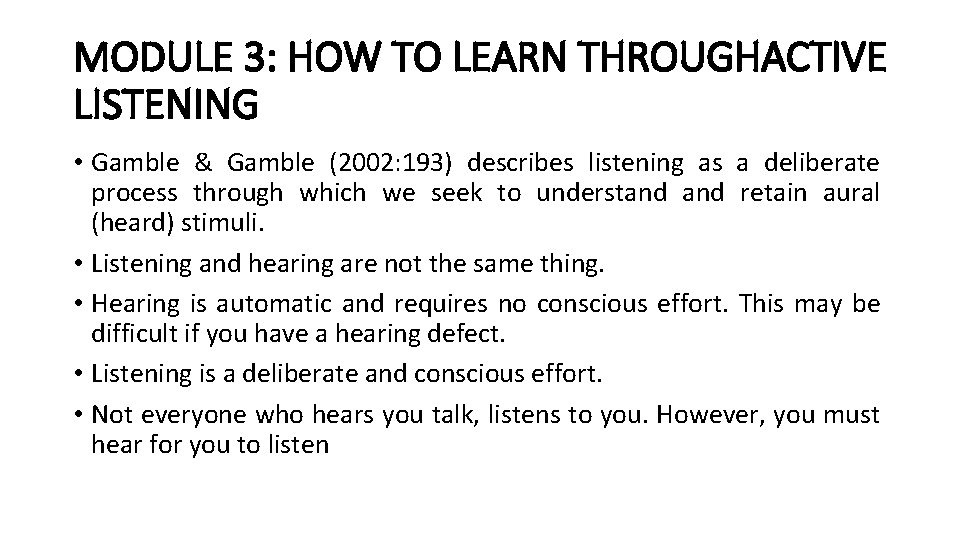
MODULE 3: HOW TO LEARN THROUGHACTIVE LISTENING • Gamble & Gamble (2002: 193) describes listening as a deliberate process through which we seek to understand retain aural (heard) stimuli. • Listening and hearing are not the same thing. • Hearing is automatic and requires no conscious effort. This may be difficult if you have a hearing defect. • Listening is a deliberate and conscious effort. • Not everyone who hears you talk, listens to you. However, you must hear for you to listen
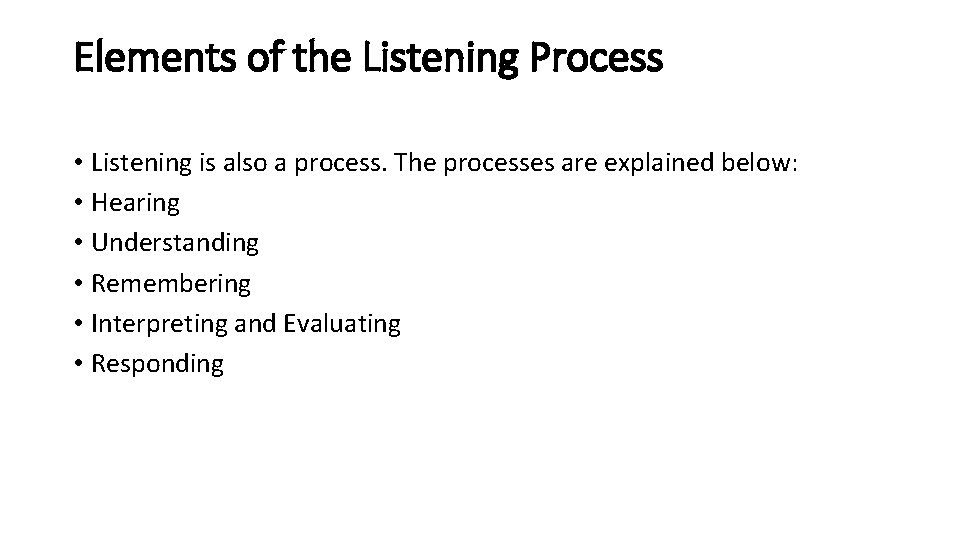
Elements of the Listening Process • Listening is also a process. The processes are explained below: • Hearing • Understanding • Remembering • Interpreting and Evaluating • Responding
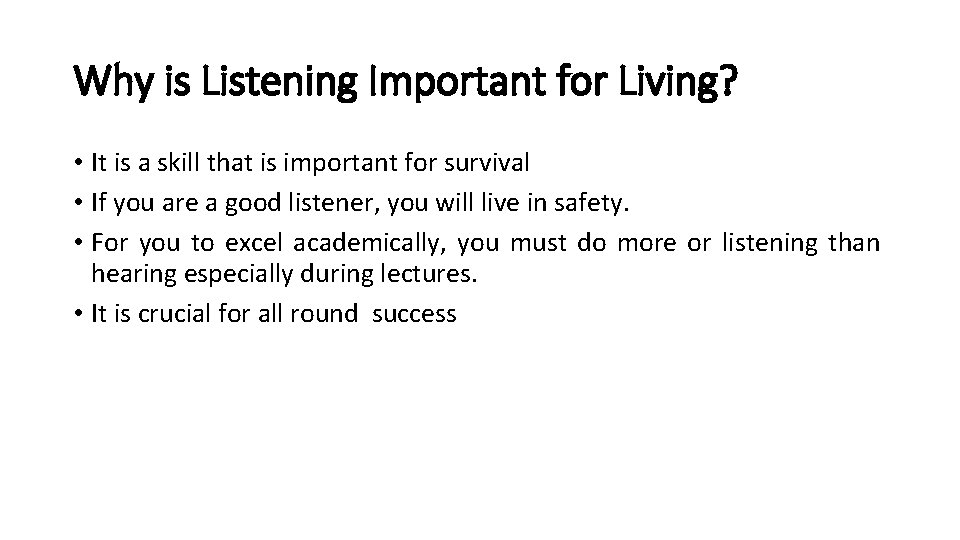
Why is Listening Important for Living? • It is a skill that is important for survival • If you are a good listener, you will live in safety. • For you to excel academically, you must do more or listening than hearing especially during lectures. • It is crucial for all round success
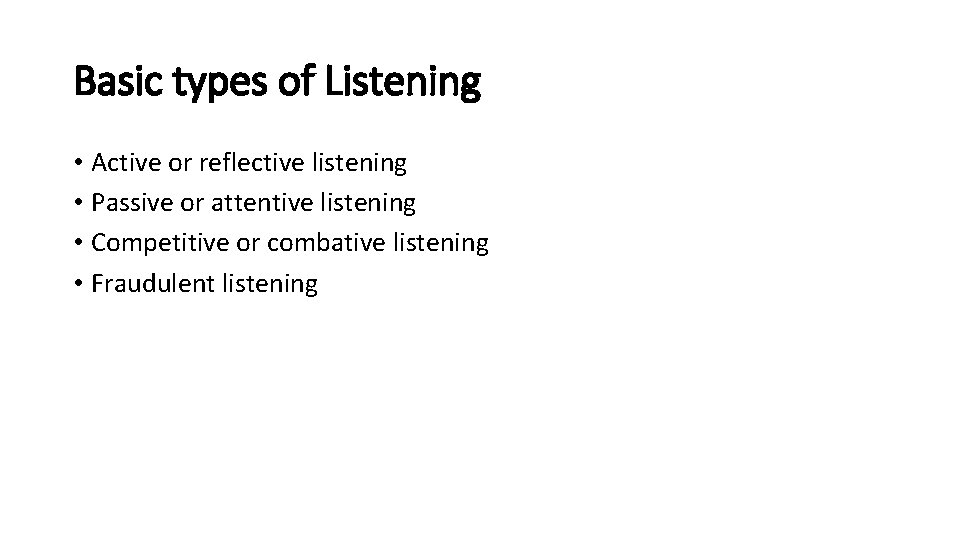
Basic types of Listening • Active or reflective listening • Passive or attentive listening • Competitive or combative listening • Fraudulent listening
Barriers to Effective Listening • Physical barrier • Physiological barrier • Language related barrier • Speakers’ presentation • Information overload
Strategies for Improving Listening Skills • Control source of noise • Be prepared to listen • Be conscious • Avoid all forms of prejudice • Listen actively • Listen with empathy • Avoid unnecessary interruptions; hear out the lecturer
Exercise • Discuss some common hindrances to effective listening