
How is WalMart Organized List as many sections


- Slides: 16
How is Wal-Mart Organized? List as many sections of Wal-Mart as you can (think of the large signs hanging from the ceiling) 2. Where would shampoo be found? 3. What other items would be with it and why? 1. 1
Classification Chapter 18
Question 1 Approximately how many named species are there on Earth? a) b) c) d) e) 750, 000 1 million 100, 000 2 million 50, 000 3
� Biologists have named and identified over 2 million species and estimate that 2 -100 million species still remain to be discovered. � A tropical rainforest may support thousands of species per acre! � To study the large amount of BIODIVERSITY, biologists use classification to group organisms based on similarities.
Ways to classify organisms 5 1. Physical Characteristics (traditional) 2. Evolutionary Trends › Scientists can look at ancestral relationships to see if organisms are related 3. Similarities in DNA and RNA › DNA shows that American vultures are more closely related to storks than to African vultures 4. Behavioral patterns › Different species of fireflies have different blinking patterns 5. Developmental patterns (fetal development)
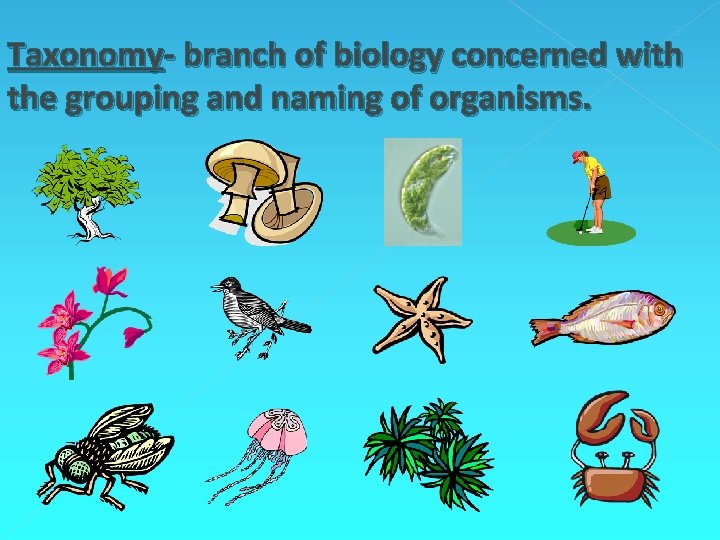
Taxonomy- branch of biology concerned with the grouping and naming of organisms.
Taxonomy (cont. ) � Aristotle - first taxonomist, classified all living things into one of 2 groups, plants and animals. � Carolus Linneaus - Swedish botanist, developed the classification system used by scientists today 7
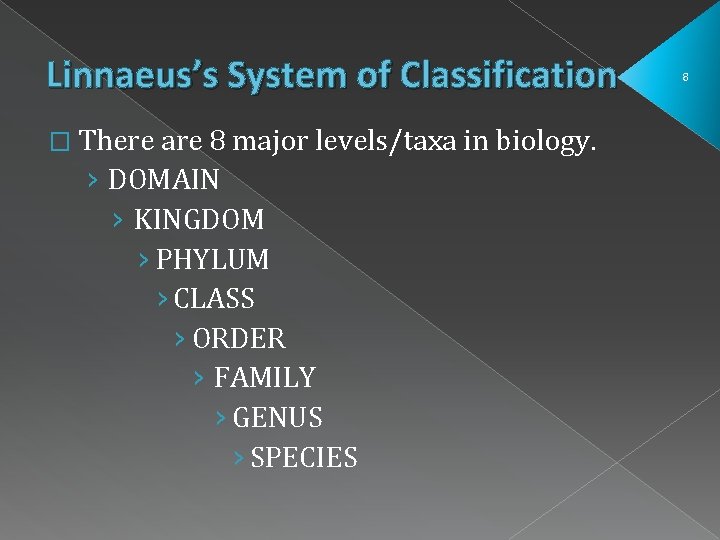
Linnaeus’s System of Classification � There are 8 major levels/taxa in biology. › DOMAIN › KINGDOM › PHYLUM › CLASS › ORDER › FAMILY › GENUS › SPECIES 8
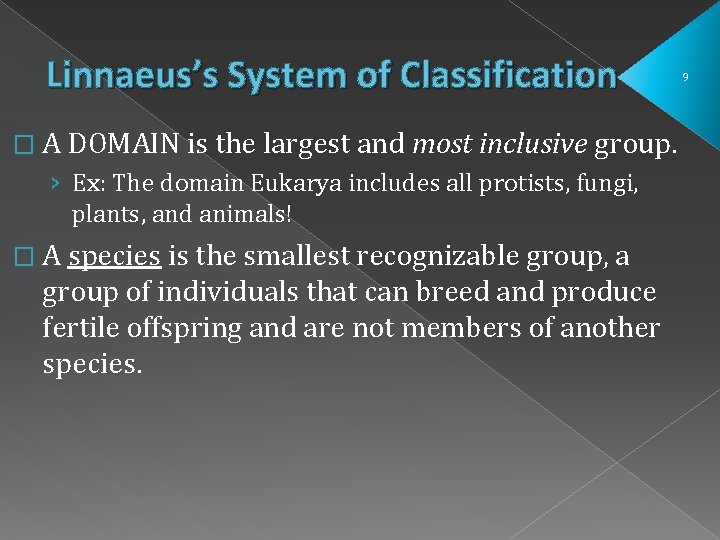
Linnaeus’s System of Classification � A DOMAIN is the largest and most inclusive group. › Ex: The domain Eukarya includes all protists, fungi, plants, and animals! � A species is the smallest recognizable group, a group of individuals that can breed and produce fertile offspring and are not members of another species. 9
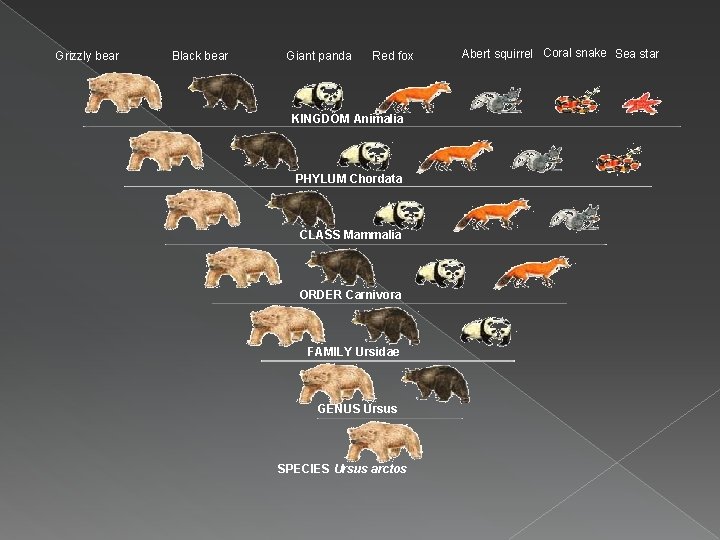
Grizzly bear Black bear Giant panda Red fox KINGDOM Animalia PHYLUM Chordata CLASS Mammalia ORDER Carnivora FAMILY Ursidae GENUS Ursus SPECIES Ursus arctos Abert squirrel Coral snake Sea star
Several different CLASSES make up a Kingdom B. Phylum C. Family D. Genus A. 11
Organisms in the same Order must also be in the same Genus B. Phylum C. Family D. Species A. 12
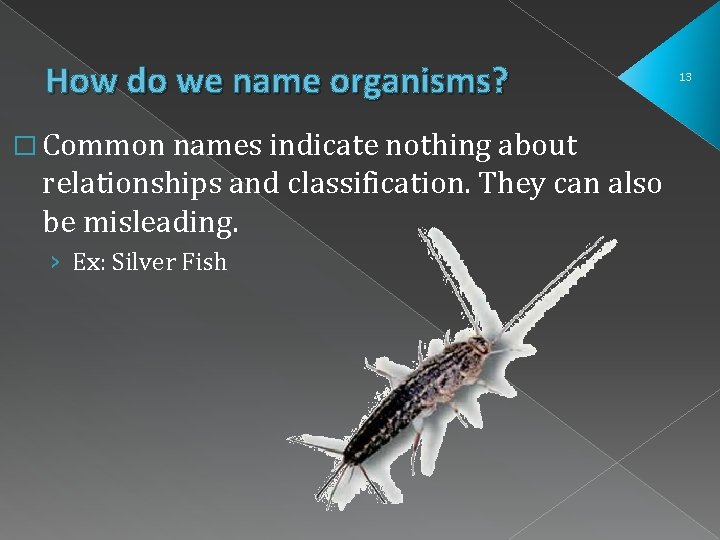
How do we name organisms? � Common names indicate nothing about relationships and classification. They can also be misleading. › Ex: Silver Fish 13
How do we name organisms? 14 � Some organisms have different common names in different parts of the world. › Ex: Buzzards in England Vultures in America � Scientific names help to clear up the confusion. Only one species has a given scientific name.
binomial nomenclature � Each organism can be named the Genus and Species taxa � these names are ALWAYS in italics or underlined if they are handwritten. › Genus – always capitalized, can be written alone › Specific Epithet (species) – never capitalized, usually descriptive of the organism, cannot be written without the genus name 15
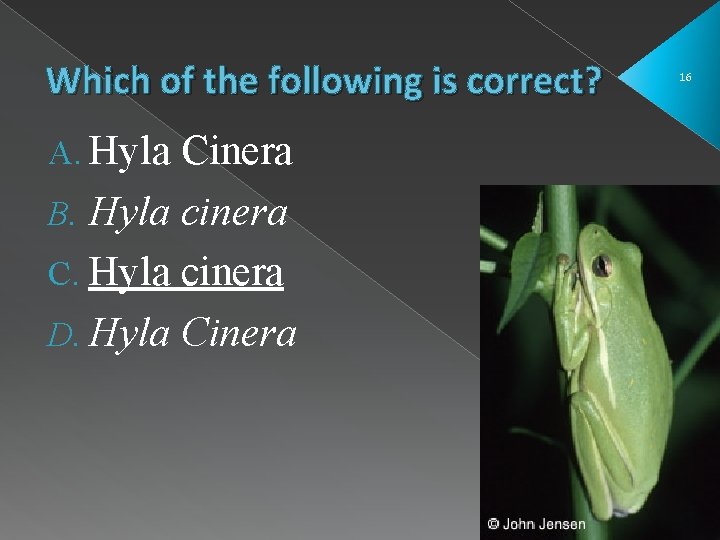
Which of the following is correct? A. Hyla Cinera B. Hyla cinera C. Hyla cinera D. Hyla Cinera 16