
How is total ozone distributed over the globe
How is total ozone distributed over the globe? By Ginny Bister, Robert Metcalfe, Ivan Mariscal
Total ozone • Is defined as the sum of all ozone in the atmosphere directly above a certain location • Most ozone resides in he stratospheric ozone layer and only about 10% is distributive throughout the troposphere – Measured in Dobson Units (DU) – Typical values are between 200 and 500 DU could form a layer of pure ozone gas at the earths surface with a thickness of 5 millimeters
Global distribution • Total ozone varies strongly with latitude – Largest values occurring at middle and high latitudes • This is result of ozone production rates from solar ultra-violet radiation • Total ozone values are lowest in the tropics
Seasonal distribution • Total ozone varies with season – March and September plots represent the early spring and fall seasons in the northern and southern hemispheres – June and December plots represent the winter and early summer seasons • Total ozone shows a maximum high latitude during spring because of increased ozone transport • Ozone transport is weaker during summer and early fall
Seasonal distribution cont. • In the Antarctic, a pronounced minimum in total ozone is observed during the spring. – The minimum is a consequence of an “ozone hole”, which describes the widespread chemical destruction of ozone by ozone depleting substances in spring • Now, the lowest values of total ozone in all seasons are found every spring in the Antarctic
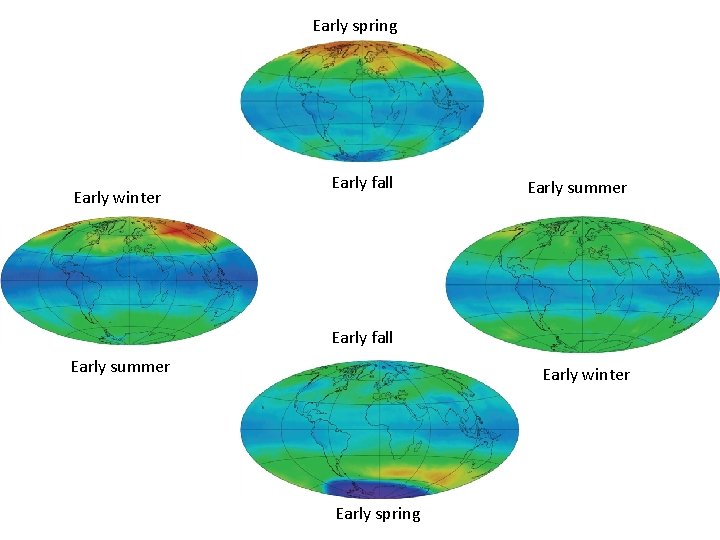
Early spring Early winter Early fall Early summer Early winter Early spring
Natural variations • Patterns change on daily to weekly timescales – Natural air motions blend air between regions of the stratosphere that have high ozone values and those that have low ozone values – Changes in balance of chemical production and loss processes as air moves to and from different locations • This balance is very sensitive to the amount of sunlight in a region
- Slides: 7