
How is Deloitte Audit responding to the risks
- Slides: 6
How is Deloitte Audit responding to the risks of COVID– 19 April 2020
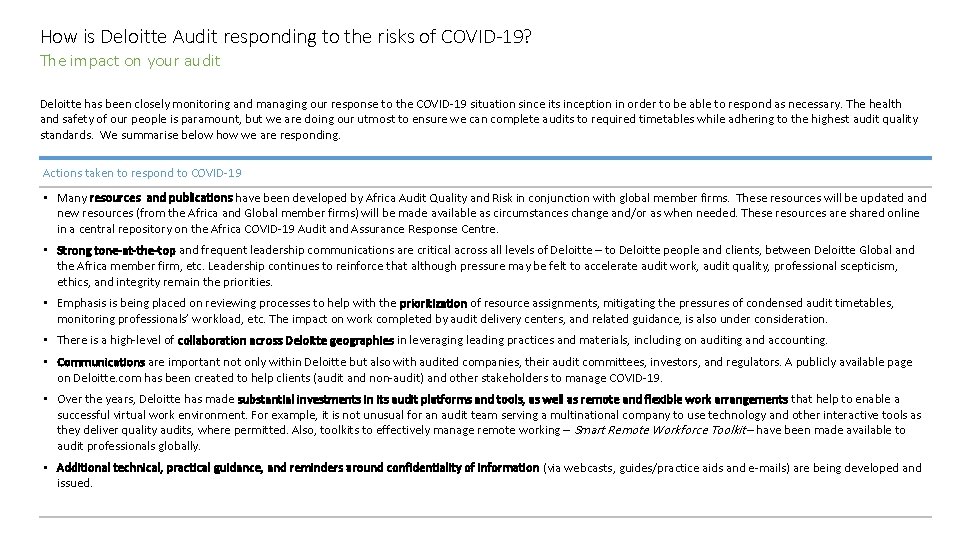
How is Deloitte Audit responding to the risks of COVID-19? The impact on your audit Deloitte has been closely monitoring and managing our response to the COVID-19 situation since its inception in order to be able to respond as necessary. The health and safety of our people is paramount, but we are doing our utmost to ensure we can complete audits to required timetables while adhering to the highest audit quality standards. We summarise below how we are responding. Actions taken to respond to COVID-19 • Many resources and publications have been developed by Africa Audit Quality and Risk in conjunction with global member firms. These resources will be updated and new resources (from the Africa and Global member firms) will be made available as circumstances change and/or as when needed. These resources are shared online in a central repository on the Africa COVID-19 Audit and Assurance Response Centre. • Strong tone-at-the-top and frequent leadership communications are critical across all levels of Deloitte – to Deloitte people and clients, between Deloitte Global and the Africa member firm, etc. Leadership continues to reinforce that although pressure may be felt to accelerate audit work, audit quality, professional scepticism, ethics, and integrity remain the priorities. • Emphasis is being placed on reviewing processes to help with the prioritization of resource assignments, mitigating the pressures of condensed audit timetables, monitoring professionals’ workload, etc. The impact on work completed by audit delivery centers, and related guidance, is also under consideration. • There is a high-level of collaboration across Deloitte geographies in leveraging leading practices and materials, including on auditing and accounting. • Communications are important not only within Deloitte but also with audited companies, their audit committees, investors, and regulators. A publicly available page on Deloitte. com has been created to help clients (audit and non-audit) and other stakeholders to manage COVID-19. • Over the years, Deloitte has made substantial investments in its audit platforms and tools, as well as remote and flexible work arrangements that help to enable a successful virtual work environment. For example, it is not unusual for an audit team serving a multinational company to use technology and other interactive tools as they deliver quality audits, where permitted. Also, toolkits to effectively manage remote working – Smart Remote Workforce Toolkit – have been made available to audit professionals globally. • Additional technical, practical guidance, and reminders around confidentiality of information (via webcasts, guides/practice aids and e-mails) are being developed and issued. 2
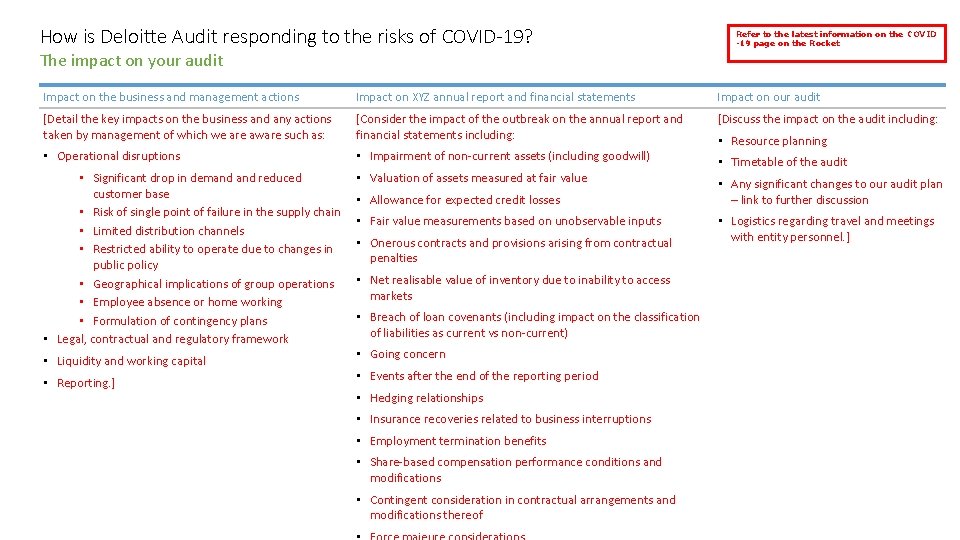
How is Deloitte Audit responding to the risks of COVID-19? Refer to the latest information on the COVID -19 page on the Rocket The impact on your audit Impact on the business and management actions Impact on XYZ annual report and financial statements Impact on our audit [Detail the key impacts on the business and any actions taken by management of which we are aware such as: [Consider the impact of the outbreak on the annual report and financial statements including: [Discuss the impact on the audit including: • Operational disruptions • Impairment of non-current assets (including goodwill) • Significant drop in demand reduced customer base • Risk of single point of failure in the supply chain • Limited distribution channels • Restricted ability to operate due to changes in public policy • Geographical implications of group operations • Employee absence or home working • Formulation of contingency plans • Legal, contractual and regulatory framework • Valuation of assets measured at fair value • Timetable of the audit • Liquidity and working capital • Reporting. ] • Allowance for expected credit losses • Fair value measurements based on unobservable inputs • Onerous contracts and provisions arising from contractual penalties • Resource planning • Any significant changes to our audit plan – link to further discussion • Logistics regarding travel and meetings with entity personnel. ] • Net realisable value of inventory due to inability to access markets • Breach of loan covenants (including impact on the classification of liabilities as current vs non-current) • Going concern • Events after the end of the reporting period • Hedging relationships • Insurance recoveries related to business interruptions • Employment termination benefits • Share-based compensation performance conditions and modifications • Contingent consideration in contractual arrangements and modifications thereof 3
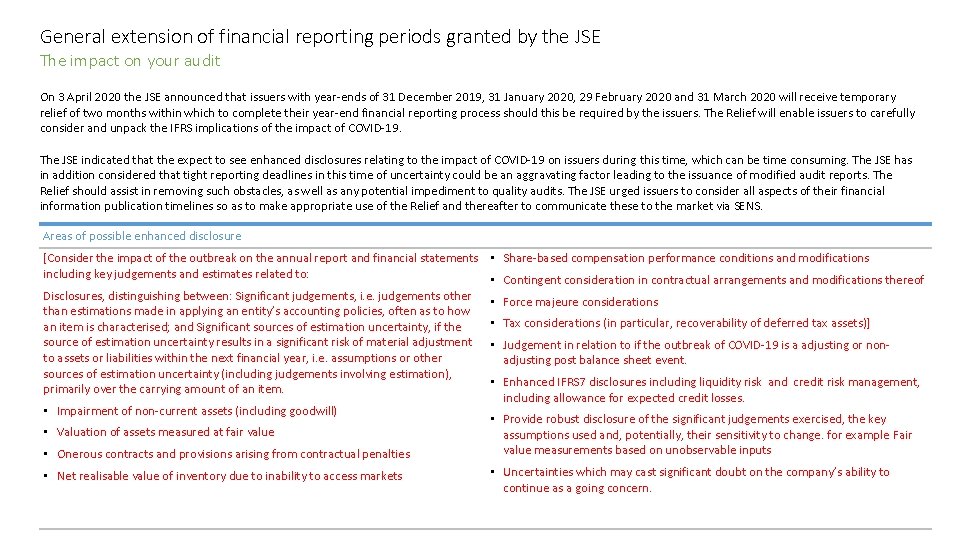
General extension of financial reporting periods granted by the JSE The impact on your audit On 3 April 2020 the JSE announced that issuers with year-ends of 31 December 2019, 31 January 2020, 29 February 2020 and 31 March 2020 will receive temporary relief of two months within which to complete their year-end financial reporting process should this be required by the issuers. The Relief will enable issuers to carefully consider and unpack the IFRS implications of the impact of COVID-19. The JSE indicated that the expect to see enhanced disclosures relating to the impact of COVID-19 on issuers during this time, which can be time consuming. The JSE has in addition considered that tight reporting deadlines in this time of uncertainty could be an aggravating factor leading to the issuance of modified audit reports. The Relief should assist in removing such obstacles, as well as any potential impediment to quality audits. The JSE urged issuers to consider all aspects of their financial information publication timelines so as to make appropriate use of the Relief and thereafter to communicate these to the market via SENS. Areas of possible enhanced disclosure [Consider the impact of the outbreak on the annual report and financial statements • Share-based compensation performance conditions and modifications including key judgements and estimates related to: • Contingent consideration in contractual arrangements and modifications thereof Disclosures, distinguishing between: Significant judgements, i. e. judgements other • Force majeure considerations than estimations made in applying an entity’s accounting policies, often as to how • Tax considerations (in particular, recoverability of deferred tax assets)] an item is characterised; and Significant sources of estimation uncertainty, if the source of estimation uncertainty results in a significant risk of material adjustment • Judgement in relation to if the outbreak of COVID-19 is a adjusting or nonto assets or liabilities within the next financial year, i. e. assumptions or other adjusting post balance sheet event. sources of estimation uncertainty (including judgements involving estimation), • Enhanced IFRS 7 disclosures including liquidity risk and credit risk management, primarily over the carrying amount of an item. including allowance for expected credit losses. • Impairment of non-current assets (including goodwill) • Provide robust disclosure of the significant judgements exercised, the key • Valuation of assets measured at fair value assumptions used and, potentially, their sensitivity to change. for example Fair value measurements based on unobservable inputs • Onerous contracts and provisions arising from contractual penalties • Uncertainties which may cast significant doubt on the company’s ability to • Net realisable value of inventory due to inability to access markets continue as a going concern. 4
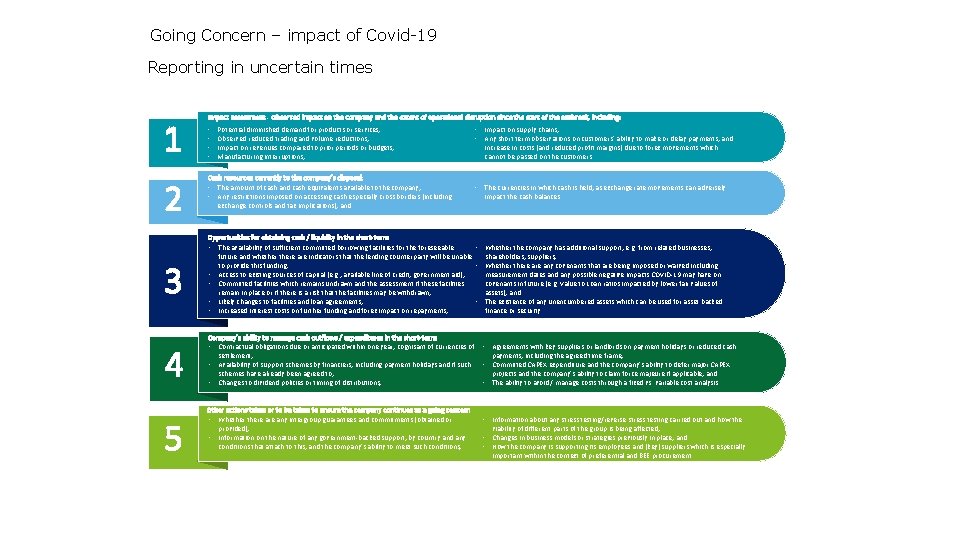
Going Concern – impact of Covid-19 Reporting in uncertain times 1 2 3 4 5 Impact assessment - Observed impact on the company and the extent of operational disruption since the start of the outbreak, including: • • Potential diminished demand for products or services; Observed reduced trading and volume reductions; Impact on revenues compared to prior periods or budgets; Manufacturing interruptions; Cash resources currently to the company’s disposal: • The amount of cash and cash equivalents available to the company; • Any restrictions imposed on accessing cash especially cross borders (including exchange controls and tax implications); and • Impact on supply chains; • Any short term observations on customers’ ability to make or delay payments; and Increase in costs (and reduced profit margins) due to forex movements which cannot be passed on the customers. • The currencies in which cash is held, as exchange rate movements can adversely impact the cash balances. Opportunities for obtaining cash / liquidity in the short-term • Whether the company has additional support, e. g. from related businesses, • The availability of sufficient committed borrowing facilities for the foreseeable shareholders, suppliers; future and whethere are indicators that the lending counterparty will be unable • Whethere any covenants that are being imposed or waived including to provide this funding; measurement dates and any possible negative impacts COVID-19 may have on • Access to existing sources of capital (e. g. , available line of credit, government aid); covenants in future (e. g. Value to Loan ratios impacted by lower fair values of • Committed facilities which remains undrawn and the assessment if these facilities remain in place or if there is a risk that the facilities may be withdrawn; assets); and • Likely changes to facilities and loan agreements; • The existence of any unencumbered assets which can be used for asset backed • Increased interest costs on further funding and forex impact on repayments; finance or security. Company’s ability to manage cash outflows / expenditures in the short-term • Contractual obligations due or anticipated within one year, cognisant of currencies of • Agreements with key suppliers or landlords on payment holidays or reduced cash settlement; payments, including the agreed time frame; • Availability of support schemes by financiers, including payment holidays and if such • Committed CAPEX expenditure and the company’s ability to defer major CAPEX schemes have already been agreed to; projects and the company’s ability to claim force majeure if applicable; and • Changes to dividend policies or timing of distributions; • The ability to avoid / manage costs through a fixed vs. variable cost analysis. Other actions taken or to be taken to ensure the company continues as a going concern • Whethere any intergroup guarantees and commitments (obtained or provided); • Information on the nature of any government-backed support, by country and any conditions that attach to this, and the company’s ability to meet such conditions; • Information about any stress testing/reverse stress testing carried out and how the viability of different parts of the group is being affected; • Changes in business models or strategies previously in place; and • How the company is supporting its employees and (key) suppliers which is especially important within the context of preferential and BEE procurement.
Deloitte refers to one or more of Deloitte Touche Tohmatsu Limited (“DTTL”), its global network of member firms, and their related entities (collectively, the “Deloitte organization”). DTTL (also referred to as “Deloitte Global”) and each of its member firms and related entities are legally separate and independent entities, which cannot obligate or bind each other in respect of third parties. DTTL and each DTTL member firm and related entity is liable only for its own acts and omissions, and not those of each other. DTTL does not provide services to clients. Please see www. deloitte. com/about to learn more. Deloitte is a leading global provider of audit and assurance, consulting, financial advisory, risk advisory, tax and related services. Our global network of member firms and related entities in more than 150 countries and territories (collectively, the “Deloitte organization”) serves four out of five Fortune Global 500® companies. Learn how Deloitte’s approximately 312, 000 people make an impact that matters at www. deloitte. com. This communication contains general information only, and none of Deloitte Touche Tohmatsu Limited (“DTTL”), its global network of member firms or their related entities (collectively, the “Deloitte organization”) is, by means of this communication, rendering professional advice or services. Before making any decision or taking any action that may affect your finances or your business, you should consult a qualified professional adviser. No representations, warranties or undertakings (express or implied) are given as to the accuracy or completeness of the information in this communication, and none of DTTL, its member firms, related entities, employees or agents shall be liable or responsible for any loss or damage whatsoever arising directly or indirectly in connection with any person relying on this communication. DTTL and each of its member firms, and their related entities, are legally separate and independent entities. © 2020. For information, contact Deloitte Touche Tohmatsu Limited.