
How is defined the persistence of learning over
![How are language and ideas related? Linguist ________contended that “language itself shapes a [person’s]](https://slidetodoc.com/presentation_image_h2/400f84057e83835b6bf9c7325c4f8173/image-71.jpg "How are language and ideas related? Linguist ________contended that “language itself shapes a [person’s]")
- Slides: 71
How is _______ defined? the persistence of learning over time through the encoding, storage, and retrieval of information
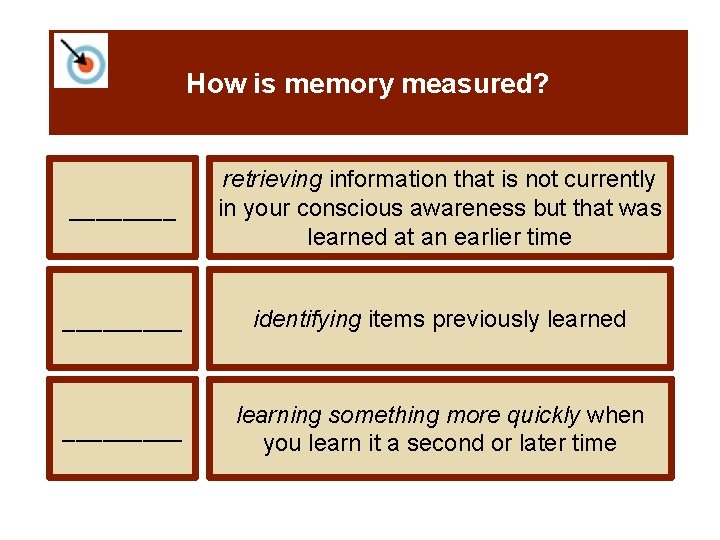
How is memory measured? ____ retrieving information that is not currently in your conscious awareness but that was learned at an earlier time _____ identifying items previously learned _____ learning something more quickly when you learn it a second or later time
How did Hermann ________ test speed of relearning? Pioneering memory researcher Hermann Ebbinghaus randomly selected a sample of syllables, like those you just saw, practiced them, and tested himself on his ability to accurately recall the items. The day after learning such a list, Ebbinghaus could recall few of the nonsense syllables. But they weren’t entirely forgotten.
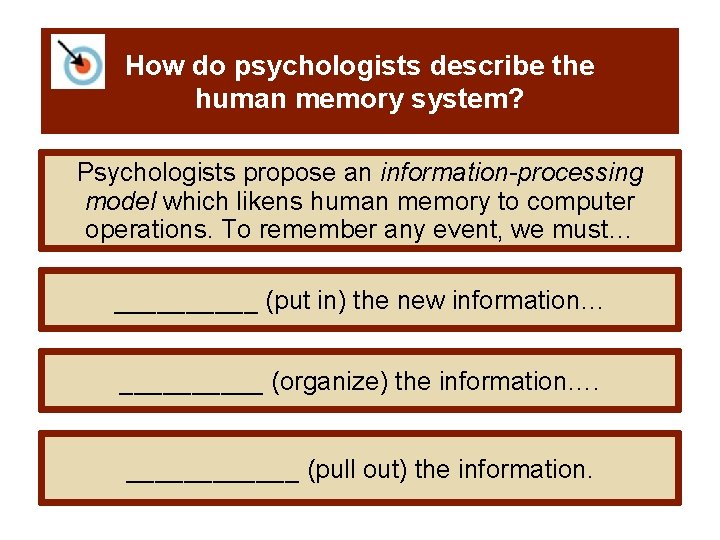
How do psychologists describe the human memory system? Psychologists propose an information-processing model which likens human memory to computer operations. To remember any event, we must… _____ (put in) the new information… _____ (organize) the information…. ______ (pull out) the information.
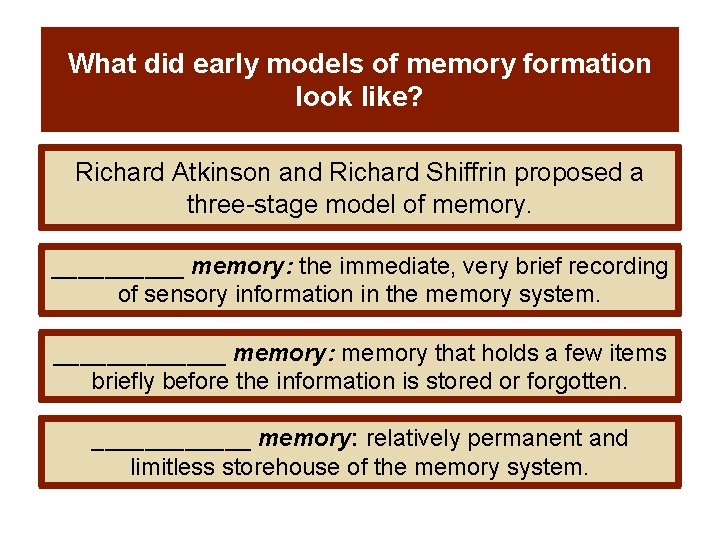
What did early models of memory formation look like? Richard Atkinson and Richard Shiffrin proposed a three-stage model of memory. _____ memory: the immediate, very brief recording of sensory information in the memory system. _______ memory: memory that holds a few items briefly before the information is stored or forgotten. ______ memory: relatively permanent and limitless storehouse of the memory system.
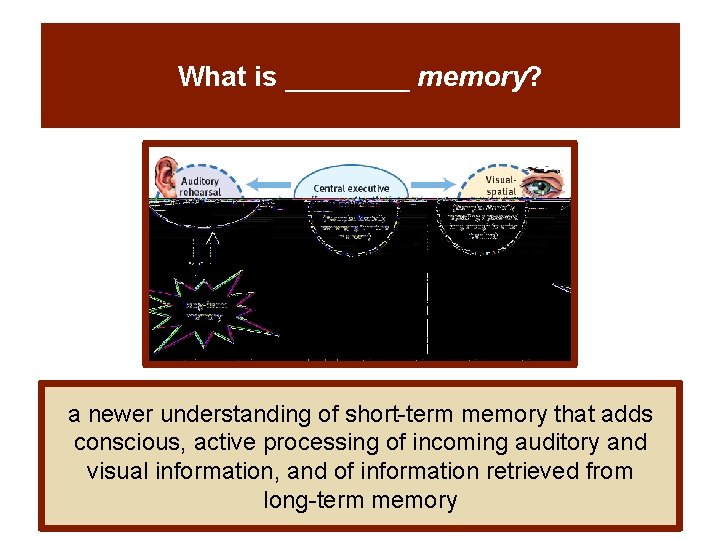
What is ____ memory? a newer understanding of short-term memory that adds conscious, active processing of incoming auditory and visual information, and of information retrieved from long-term memory
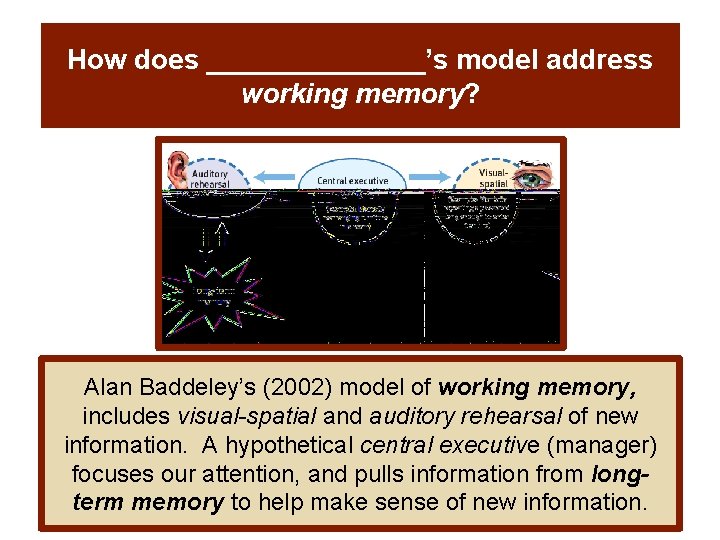
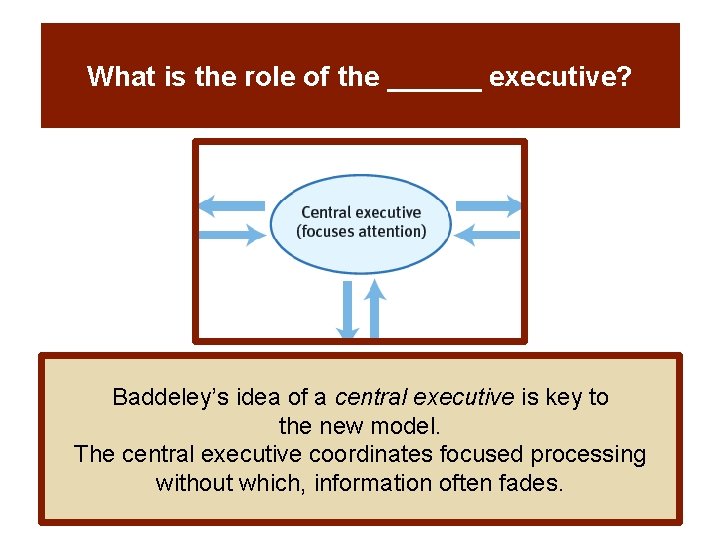
How does _______’s model address working memory? Alan Baddeley’s (2002) model of working memory, includes visual-spatial and auditory rehearsal of new information. A hypothetical central executive (manager) focuses our attention, and pulls information from longterm memory to help make sense of new information.
What is the role of the ______ executive? Baddeley’s idea of a central executive is key to the new model. The central executive coordinates focused processing without which, information often fades.
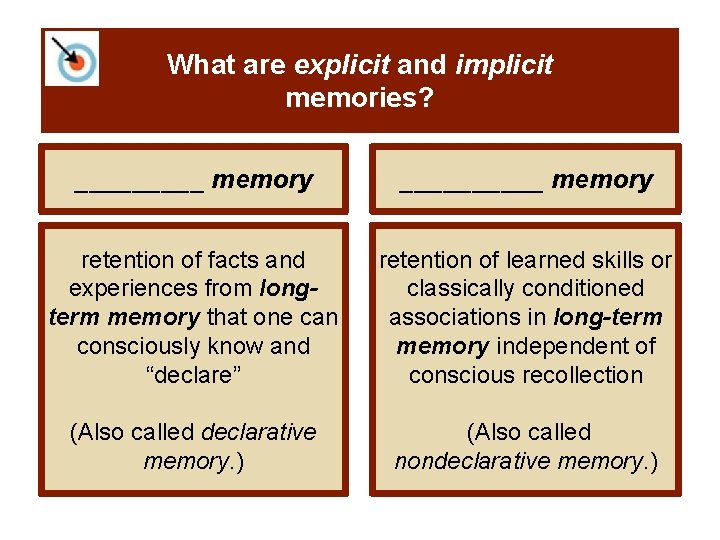
What are explicit and implicit memories? _____ memory retention of facts and experiences from longterm memory that one can consciously know and “declare” retention of learned skills or classically conditioned associations in long-term memory independent of conscious recollection (Also called declarative memory. ) (Also called nondeclarative memory. )
What information do we process automatically? _______ Can you remember the page or side of the book certain charts, graphs or material is located? _______ Have you ever retraced your steps through the sequence of your day to find a lost item? ____ Can you recall how many times today you have run into a good friend?
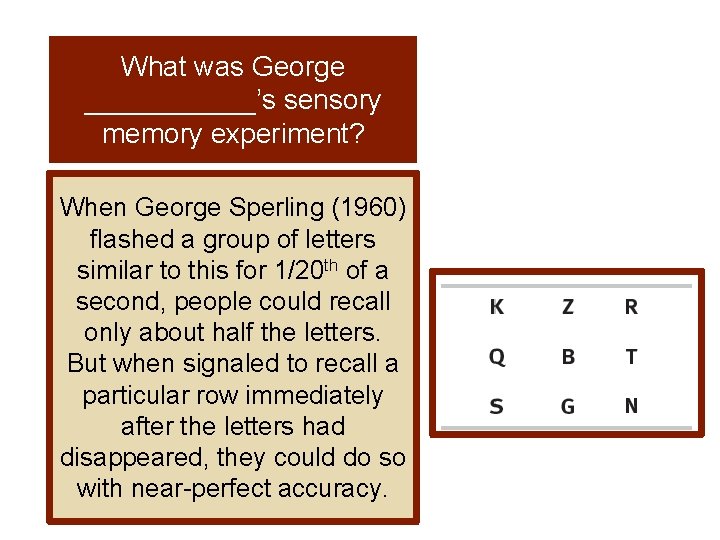
What was George ______’s sensory memory experiment? When George Sperling (1960) flashed a group of letters similar to this for 1/20 th of a second, people could recall only about half the letters. But when signaled to recall a particular row immediately after the letters had disappeared, they could do so with near-perfect accuracy.
What is_____memory? Sperling’s sensory memory experiment demonstrated iconic memory, a fleeting sensory memory of visual stimuli. For a few tenths of a second, our eyes register a picture-image memory of a scene, and we can recall any part of it in amazing detail.
What is ____ memory? We also have an impeccable, though fleeting, sensory memory for auditory stimuli, called echoic memory (Cowan, 1988; Lu et al. , 1992). Picture yourself in class, as your attention drifts to thoughts of the weekend. If your mildly irked teacher tests you by asking, “What did I just say? ” you can recover the last few words from your mind’s echo chamber. Auditory echoes tend to linger for 3 or 4 seconds.
What is our _______ memory capacity? George Miller (1956) proposed that we can store somewhere between 5 and 9 pieces of information (often referred to as _____) in short-term memory. Other researchers have confirmed that we can, if nothing distracts us, recall about seven digits. But the number varies by task; we tend to remember about six letters and only about five words. (Baddeley et al. , 1975; Cowan, 2015)
What are some effortful processing strategies that can help us encode and retrieve? ______________ Several effortful processing strategies can boost our ability to form new memories. Later, when we try to retrieve a memory, these strategies can make the difference between success and failure.
What is _______? Chunking is organizing items into familiar, manageable units. 16 items would be too much for the STM to hold, but chunked into 5 meaningful items, fits the 7 +/- 2 capacity of short-term memory. Were you able to recall the letters easier when chunked or grouped in the second way?
What is a _______ device? memory aids, especially those techniques that use vivid imagery and organizational devices, like acronyms or acrostics We more easily remember concrete, visualizable words (like bicycle or book) than we do abstract words (like peace or love).
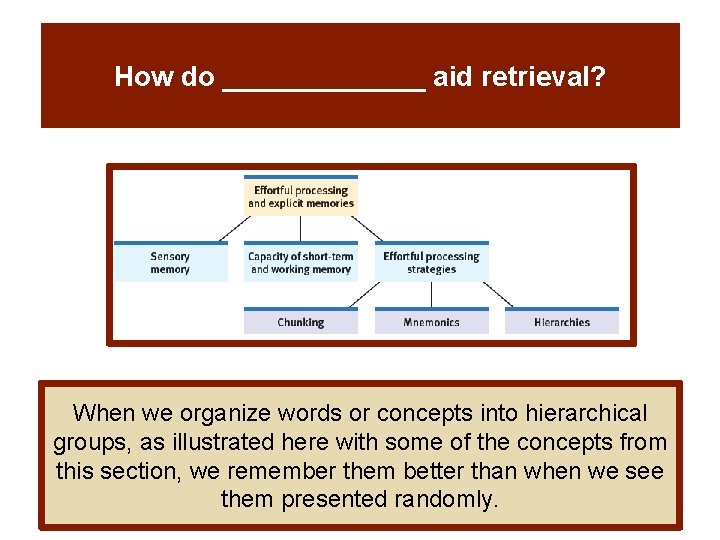
How do _______ aid retrieval? When we organize words or concepts into hierarchical groups, as illustrated here with some of the concepts from this section, we remember them better than when we see them presented randomly.
How can the spacing effect impact memory retrieval? The _______effect is the tendency for distributed study or practice to yield better long-term retention than is achieved through massed study or practice. Massed practice (cramming) can produce speedy short-term learning and a feeling of confidence. But to paraphrase Ebbinghaus (1885), those who learn quickly also forget quickly. Distributed practice produces better long-term recall.
How can the __________impact memory retrieval? One effective way to distribute practice is repeated self-testing, a phenomenon that researchers Roediger and Jeffrey Karpicke (2006) have called the _______ effect. Testing does more than assess learning and memory: it improves them. (Brown et al. , 2014; Pan et al. , 2015; Trumbo et al. , 2016)
What are two levels of processing? ______ processing _____processing encoding on a basic level, based on the structure or appearance of words encoding semantically, based on the meaning of the words; tends to yield the best retention
What is the _________ effect? Most people excel at remembering personally relevant information. Asked how well certain adjectives describe someone else, we often forget them; asked how well the adjectives describe us, we often remember them. This tendency, called the self-reference effect, is especially strong in members of individualist Western cultures. (Symons & Johnson, 1997; Wagar & Cohen, 2003)
What is the capacity of ________ memory? Our capacity for storing long-term memories is essentially limitless. One research team, after studying the brain’s neural connections, estimated its storage capacity as “in the same ballpark as the World Wide Web. ” (Sejnowski, 2016)
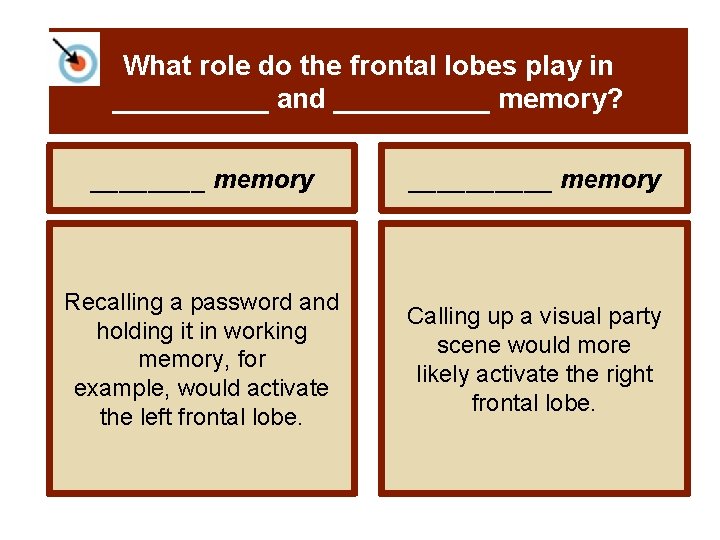
What role do the frontal lobes play in _____ and _____ memory? ____ memory _____ memory Recalling a password and holding it in working memory, for example, would activate the left frontal lobe. Calling up a visual party scene would more likely activate the right frontal lobe.
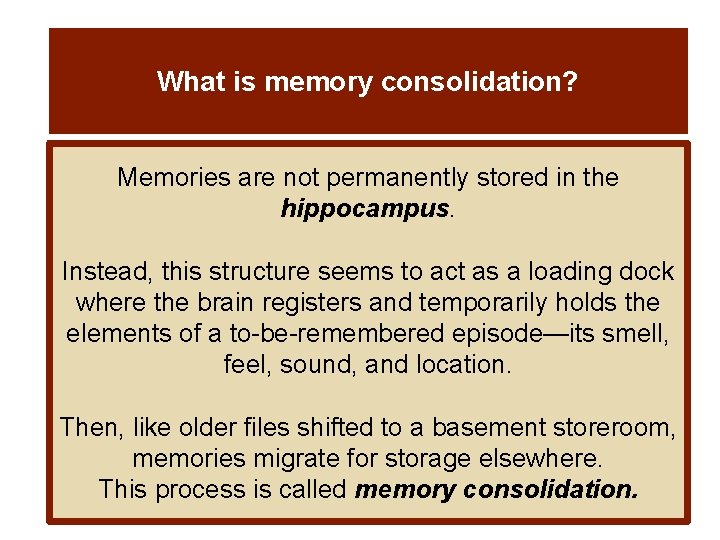
What is memory consolidation? Memories are not permanently stored in the hippocampus. Instead, this structure seems to act as a loading dock where the brain registers and temporarily holds the elements of a to-be-remembered episode—its smell, feel, sound, and location. Then, like older files shifted to a basement storeroom, memories migrate for storage elsewhere. This process is called memory consolidation.
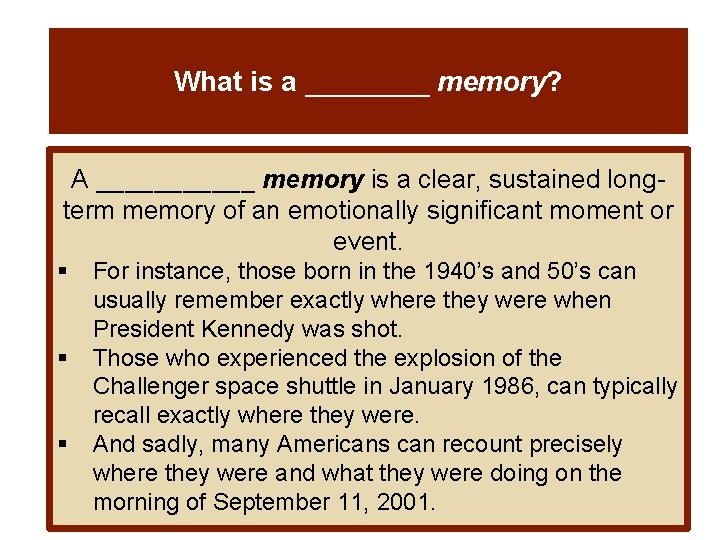
What is a ____ memory? A ______ memory is a clear, sustained longterm memory of an emotionally significant moment or event. § § § For instance, those born in the 1940’s and 50’s can usually remember exactly where they were when President Kennedy was shot. Those who experienced the explosion of the Challenger space shuttle in January 1986, can typically recall exactly where they were. And sadly, many Americans can recount precisely where they were and what they were doing on the morning of September 11, 2001.
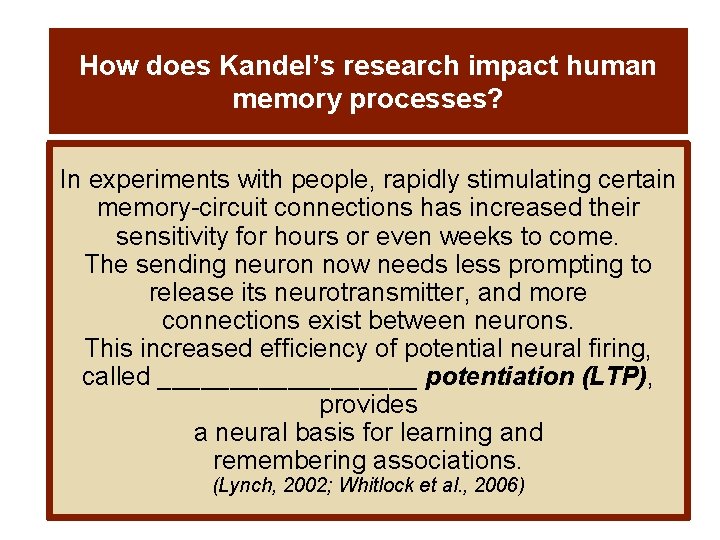
How does Kandel’s research impact human memory processes? In experiments with people, rapidly stimulating certain memory-circuit connections has increased their sensitivity for hours or even weeks to come. The sending neuron now needs less prompting to release its neurotransmitter, and more connections exist between neurons. This increased efficiency of potential neural firing, called _________ potentiation (LTP), provides a neural basis for learning and remembering associations. (Lynch, 2002; Whitlock et al. , 2006)
What is ______ potentiation (LTP)? an increase in a cell’s firing potential after brief, rapid stimulation; a neural basis for learning and memory
How do cues help with memory retrieval? When you encode into memory a target piece of information, such as the name of the person sitting next to you in class, you associate with it other bits of information about your surroundings, mood, seating position, and so on. These bits can serve as______ that you can later use to access the information. The more retrieval cues you have, the better your chances of finding a route to the suspended memory.
What is ____? the activation, often unconsciously, of particular associations in long-term implicit memory
What is _____-____ memory? Putting yourself back in the context where you earlier experienced something can prime your memory retrieval. Remembering, in many ways, depends on our environment. (Palmer, 1989) When you visit your childhood home or neighborhood, old memories surface.
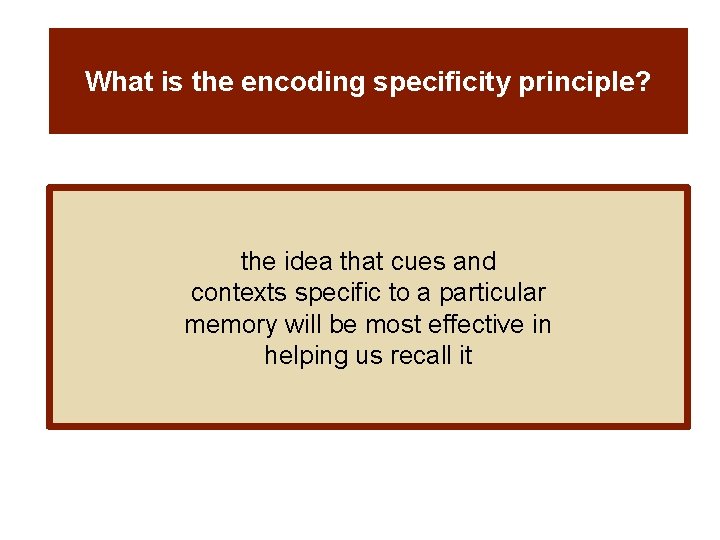
What is the encoding specificity principle? the idea that cues and contexts specific to a particular memory will be most effective in helping us recall it
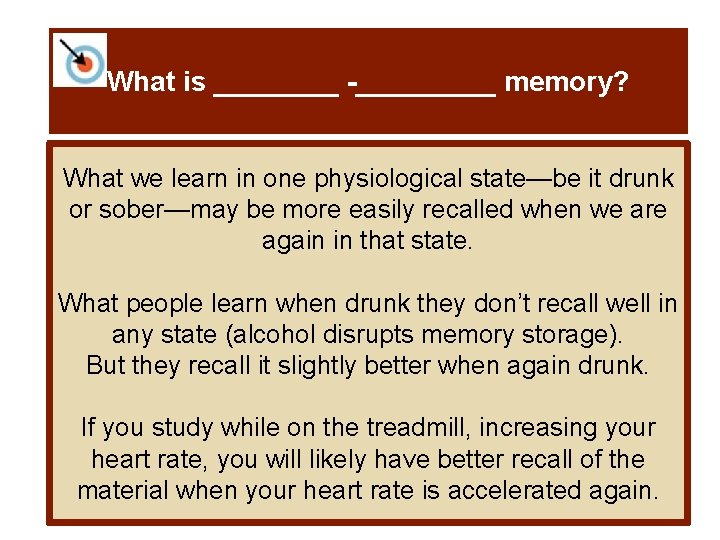
What is ____ -_____ memory? What we learn in one physiological state—be it drunk or sober—may be more easily recalled when we are again in that state. What people learn when drunk they don’t recall well in any state (alcohol disrupts memory storage). But they recall it slightly better when again drunk. If you study while on the treadmill, increasing your heart rate, you will likely have better recall of the material when your heart rate is accelerated again.
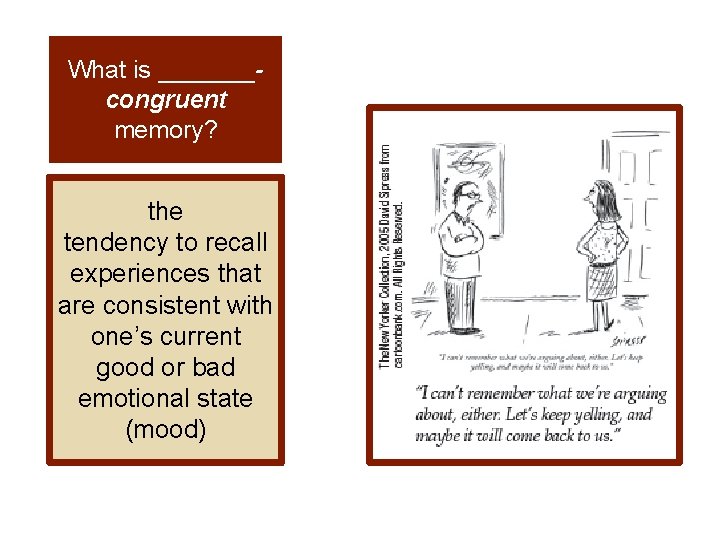
What is _______congruent memory? the tendency to recall experiences that are consistent with one’s current good or bad emotional state (mood)
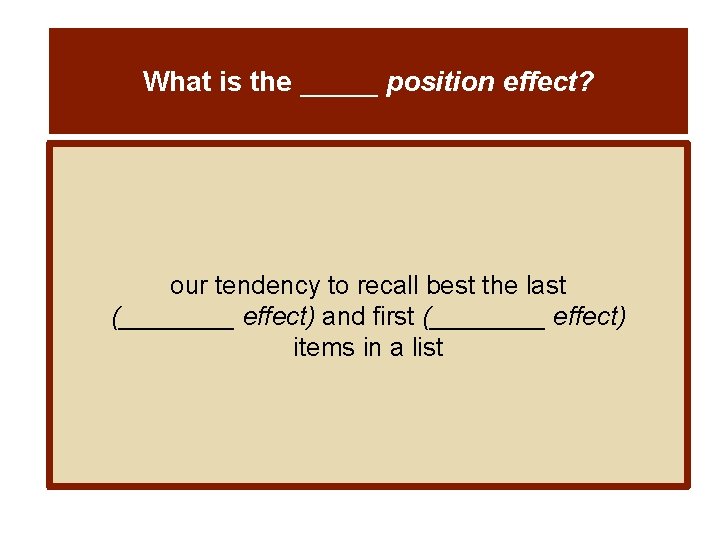
What is the _____ position effect? our tendency to recall best the last (____ effect) and first (____ effect) items in a list
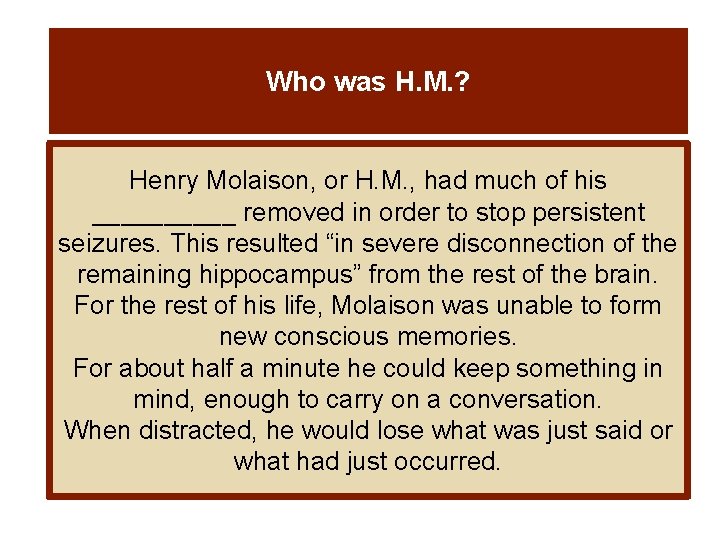
Who was H. M. ? Henry Molaison, or H. M. , had much of his _____ removed in order to stop persistent seizures. This resulted “in severe disconnection of the remaining hippocampus” from the rest of the brain. For the rest of his life, Molaison was unable to form new conscious memories. For about half a minute he could keep something in mind, enough to carry on a conversation. When distracted, he would lose what was just said or what had just occurred.
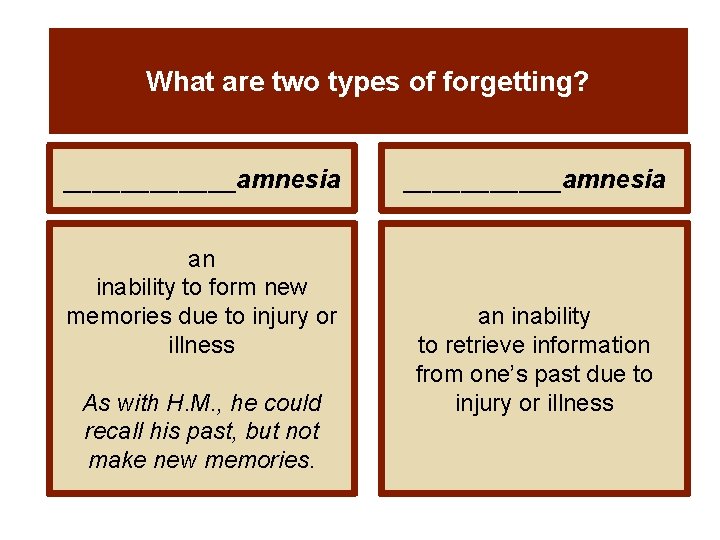
What are two types of forgetting? ______amnesia an inability to form new memories due to injury or illness As with H. M. , he could recall his past, but not make new memories. ______amnesia an inability to retrieve information from one’s past due to injury or illness
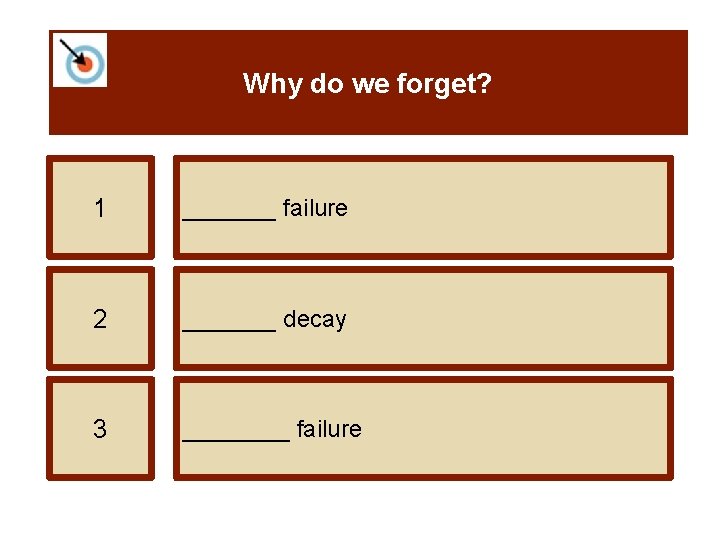
Why do we forget? 1 _______ failure 2 _______ decay 3 ____ failure
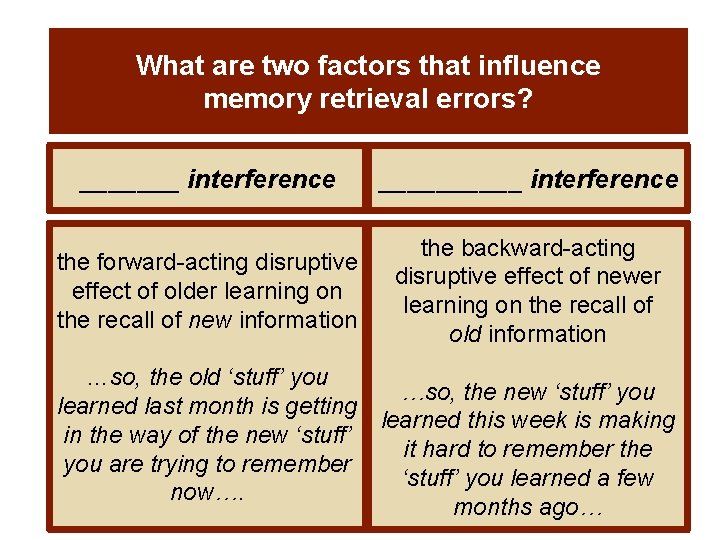
What are two factors that influence memory retrieval errors? _______ interference the forward-acting disruptive effect of older learning on the recall of new information the backward-acting disruptive effect of newer learning on the recall of old information …so, the old ‘stuff’ you …so, the new ‘stuff’ you learned last month is getting learned this week is making in the way of the new ‘stuff’ it hard to remember the you are trying to remember ‘stuff’ you learned a few now…. months ago…
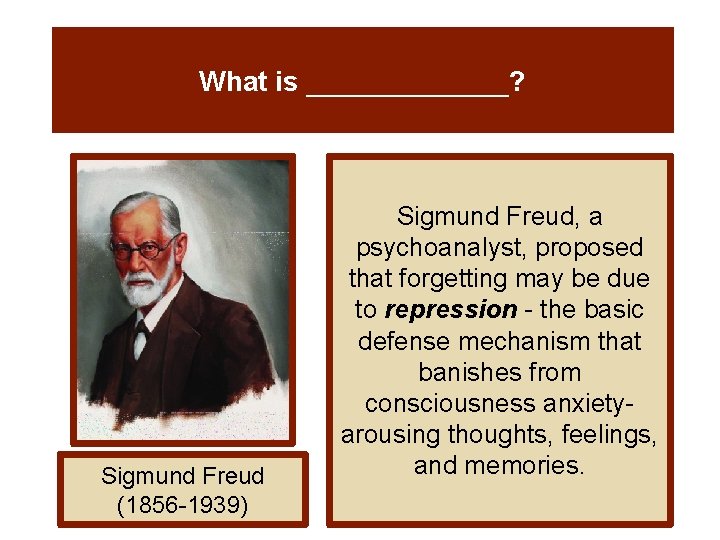
What is _______? Sigmund Freud (1856 -1939) Sigmund Freud, a psychoanalyst, proposed that forgetting may be due to repression - the basic defense mechanism that banishes from consciousness anxietyarousing thoughts, feelings, and memories.
What is the _______ effect? occurs when misleading information has distorted one’s memory of an event Elizabeth Loftus demonstrated that when exposed to subtle misleading information, people may misremember. (Loftus et al. , 1992)
What is ______ amnesia? faulty memory for how, when, or where information was learned or imagined (Also called ______ misattribution. ) Source amnesia tends to affect a person’s explicit memory and along with the misinformation effect, is at the heart of many false memories.
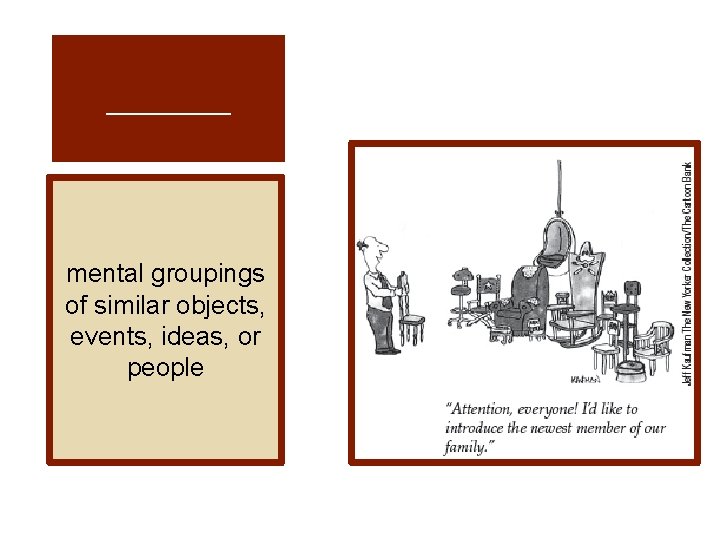
____ mental groupings of similar objects, events, ideas, or people
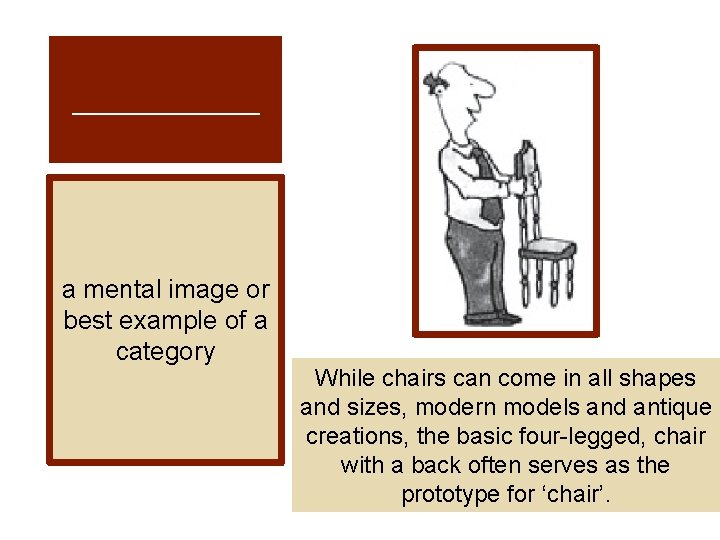
______ a mental image or best example of a category While chairs can come in all shapes and sizes, modern models and antique creations, the basic four-legged, chair with a back often serves as the prototype for ‘chair’.
How do prototypes help form concepts? Matching new items to a prototype provides a quick and easy method for sorting items into categories (or concepts). Concepts help us understand our world.
What is creativity and what are two kinds of thinking? _____ is the ability to produce new (novel) and valuable (useful) ideas. ______thinking _____ thinking narrowing the available problem solutions to determine the single best solution expanding the number of possible problem solutions; creative thinking that expands in different directions
What are two problem solving strategies? ______________ a methodical, logical rule or step-by-step procedure that guarantees solving a particular problem a simple thinking strategy that often allows us to make judgments and solve problems efficiently; usually speedier but also more error-prone than an algorithm
What is _____? a sudden realization of a problem’s solution; contrasts with strategy-based solutions Sometimes, no problem-solving strategy (such as algorithms or heuristics) seems to be at work at all, and we arrive at a solution to a problem in a quick instance…an “aha!” moment. Insight strikes suddenly, with no prior sense of “getting warmer” or feeling close to a solution.
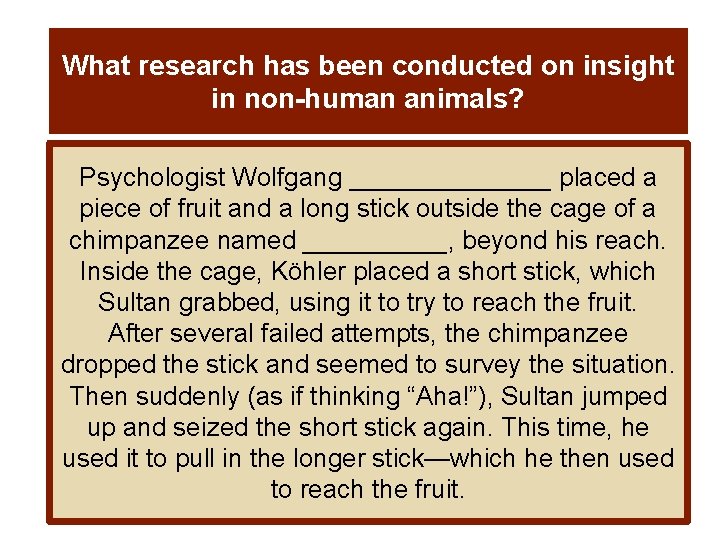
What research has been conducted on insight in non-human animals? Psychologist Wolfgang _______ placed a piece of fruit and a long stick outside the cage of a chimpanzee named _____, beyond his reach. Inside the cage, Köhler placed a short stick, which Sultan grabbed, using it to try to reach the fruit. After several failed attempts, the chimpanzee dropped the stick and seemed to survey the situation. Then suddenly (as if thinking “Aha!”), Sultan jumped up and seized the short stick again. This time, he used it to pull in the longer stick—which he then used to reach the fruit.
What are three obstacles to problem solving? __________ _______
What are two intuitive mental shortcuts? _______ heuristic estimating the likelihood of events in terms of how well they seem to represent, or match, particular prototypes; may lead us to ignore other relevant information estimating the likelihood of events based on their availability in memory; if instances come readily to mind (perhaps because of their vividness), we presume such events are common
How are our decisions and judgments affected by _______? O______ is the tendency to be more confident than correct— to overestimate the accuracy of our beliefs and judgments. Sometimes our decisions and judgments go awry simply because we are more confident than correct.
What is belief perseverance? clinging to one’s initial conceptions after the basis on which they were formed has been discredited ____ The more we come to appreciate why our beliefs might be true, the more tightly we cling to them. For instance, in politics, once we have explained to ourselves why candidate X or Y will be a better commander-in-chief, we tend to ignore evidence undermining our belief.
What is ______? the way an issue is posed; how an issue is worded can significantly affect decisions and judgments
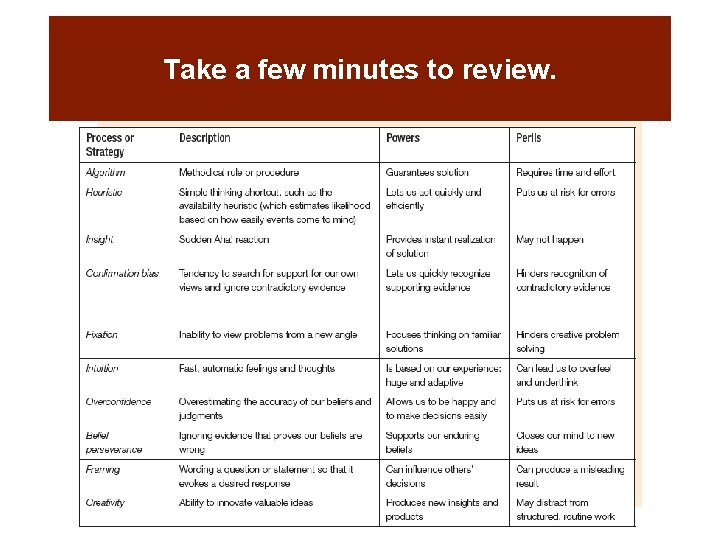
Take a few minutes to review.
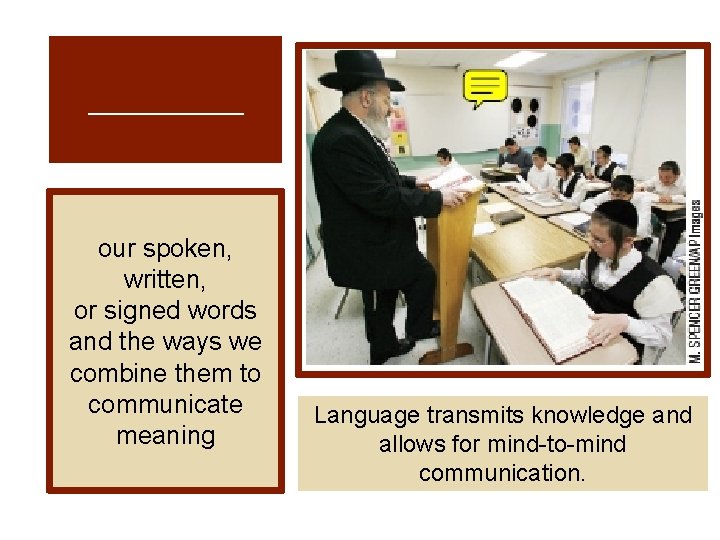
_____ our spoken, written, or signed words and the ways we combine them to communicate meaning Language transmits knowledge and allows for mind-to-mind communication.
What are the structural components of language? _______~ in a language, the smallest distinctive sound unit _______~ in a language, the smallest unit that carries meaning; may be a word or a part of a word (such as a prefix) _________~ in a language, a system of rules that enables us to communicate with and understand others
_______ Linguists surveying nearly 500 languages have identified 869 different phonemes in human speech, but no language uses all of them (Holt, 2002; Maddieson, 1984). To say bat, English speakers utter the phonemes b, a, and t. 3 phonemes! To say that: th, a and t Also 3 phonemes! Phonemes are sounds, not letters and not the same as syllables.
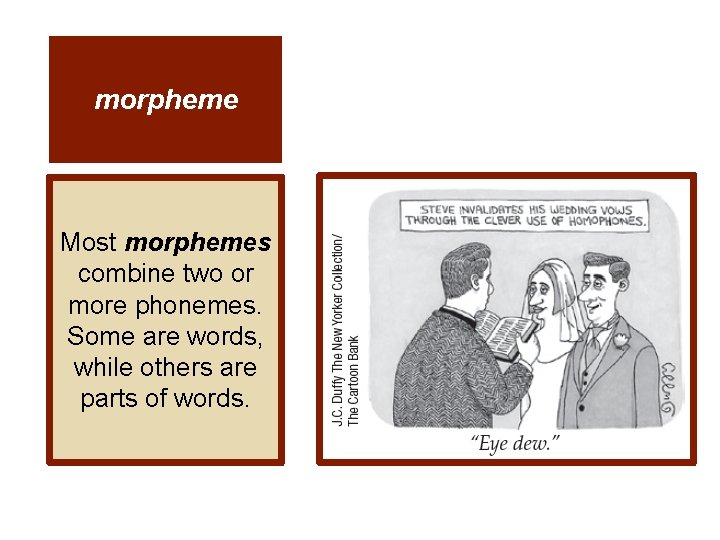
morpheme Most morphemes combine two or more phonemes. Some are words, while others are parts of words.
_______ Rules for word order and word meaning help us to understand language. Two components of grammar are semantics and syntax. Semantics is about selecting the correct word to convey the meaning you intend. Syntax is about putting the words into the correct order according to grammatical standards of your language.
______on grammar "Colorless green ideas sleep furiously. ” Noam Chomsky, a linguist, used this sentence to illustrate correct syntax (the nouns, adjectives and verbs are all in their proper place grammatically) but poor semantics (the choice of words do not convey the appropriate meaning…what is a ‘green idea’ and how can it be ‘colorless’? )
How do we acquire language and what is _______ grammar? Linguist Noam Chomsky has argued that language is nature’s gift—an unlearned human trait, separate from other parts of human cognition. He theorized that a built-in predisposition to learn grammar rules, which he called _____grammar, helps explain why preschoolers pick up language so readily and use grammar so well.
______ stage Beginning around 4 months, the stage of speech development in which an infant spontaneously utters various sounds (phonemes) is at first unrelated to the household language. Long after the beginnings of receptive language, babies’ productive language— their ability to produce words—matures.
____-word stage the stage in speech development, from about age 1 to 2, during which a child speaks mostly in single words Around their first birthday, most children enter the oneword stage. They have already learned that sounds carry meanings and now begin to use sounds—usually one barely recognizable syllable, such as ma or da— to communicate meaning.
_____-word stage At about 18 months, children’s learning of language explodes from about a word per week to a word per day. By their second birthday, most have entered the two-word stage. A 2 -year-old’s speech contains mostly nouns and verbs (“Want juice”). Their speech follows rules of syntax, arranging words in a sensible order. English-speaking children typically place adjectives before nouns—white house rather than house white. Spanish reverses this order, as in casa blanca.
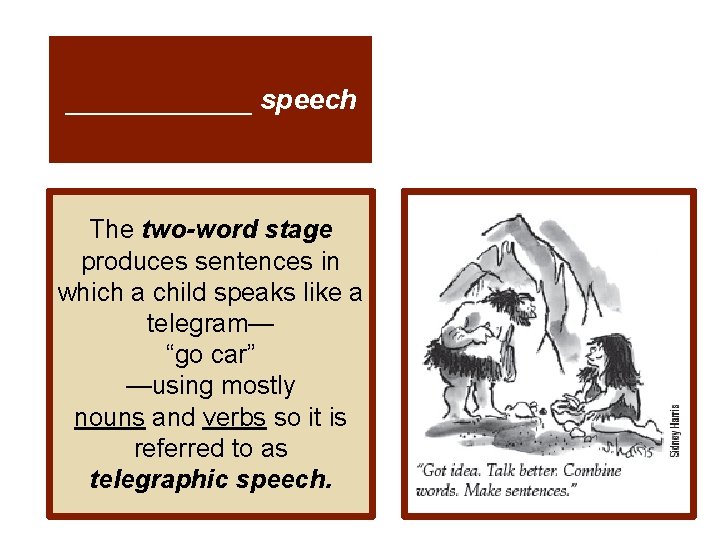
______ speech The two-word stage produces sentences in which a child speaks like a telegram— “go car” —using mostly nouns and verbs so it is referred to as telegraphic speech.
What is the ______ period of language development? Childhood seems to represent a critical (or “sensitive”) period for mastering certain aspects of language before the language-learning window slowly closes. (Hernandez & Li, 2007; Lenneberg, 1967) Later-than-usual exposure—at age 2 or 3—unleashes the idle language capacity of a child’s brain, producing a rush of language. But by about age 7, those who have not been exposed to either a spoken or a signed language lose their ability to master any language.
What is ____? impairment of language, usually caused by left hemisphere damage either to Broca’s area (impairing speaking) or to Wernicke’s area (impairing understanding)
What brain areas are involved in language processing and speech? in 1865, French physician Paul ____confirmed a fellow physician’s observation that after damage to an area of the left frontal lobe (____’s area) a person would struggle to speak words, yet could sing familiar songs and comprehend speech. A decade later, German investigator Carl ____ discovered that after damage to a specific area of the left temporal lobe (_____’s area), people were unable to understand others’ words and could speak only meaningless sentences.
How are language and ideas related? Linguist ________contended that “language itself shapes a [person’s] basic ideas. ” His hypothesis of ______ determinism proposed that language controls the way we think and interpret the world around us. For instance, the Hopi, a Native American tribe, have no past tense for their verbs, and so could not readily think about the past.