
How is Climate Change impacting British Columbias Managed
How is Climate Change impacting British Columbia’s Managed Forests? Considerations for stakeholders in the Okanagan that are adapting forest management to climate change Kristine Weese Resource Practices Branch Ministry of Forests, Lands and Natural Resource Operations
Overview • Context: climate change adaptation in BC • FLNR science and policy efforts to date • Projected impacts to forest ecosystems • Management issues & best practices • Barriers to adaptation • Key messages for Okanagan stakeholders 2

Climate Change in BC 3
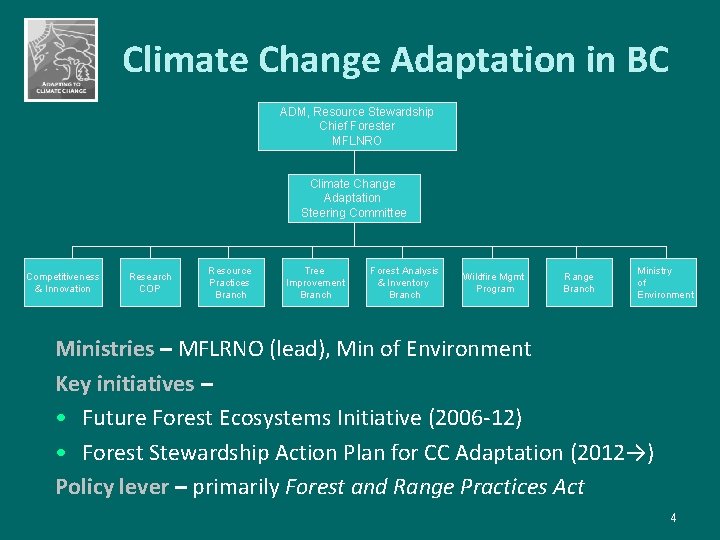
Climate Change Adaptation in BC ADM, Resource Stewardship Chief Forester MFLNRO Climate Change Adaptation Steering Committee Competitiveness & Innovation Research COP Resource Practices Branch Tree Improvement Branch Forest Analysis & Inventory Branch Wildfire Mgmt Program Range Branch Ministry of Environment Ministries – MFLRNO (lead), Min of Environment Key initiatives – • Future Forest Ecosystems Initiative (2006 -12) • Forest Stewardship Action Plan for CC Adaptation (2012→) Policy lever – primarily Forest and Range Practices Act 4
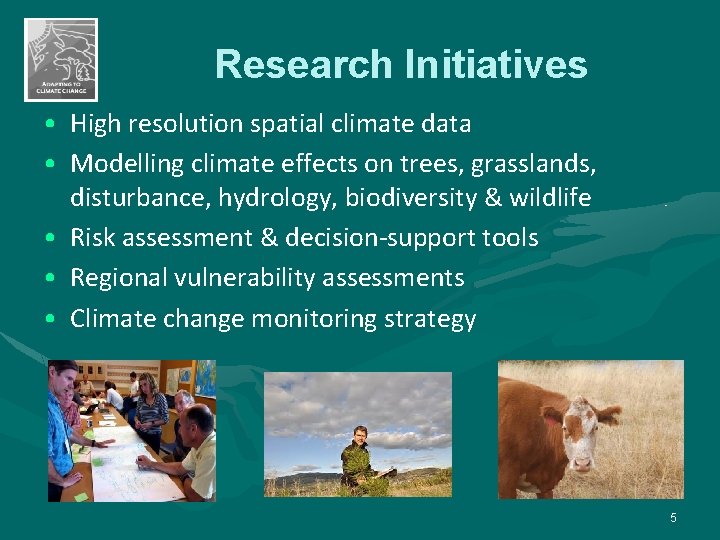
Research Initiatives • High resolution spatial climate data • Modelling climate effects on trees, grasslands, disturbance, hydrology, biodiversity & wildlife • Risk assessment & decision-support tools • Regional vulnerability assessments • Climate change monitoring strategy 5
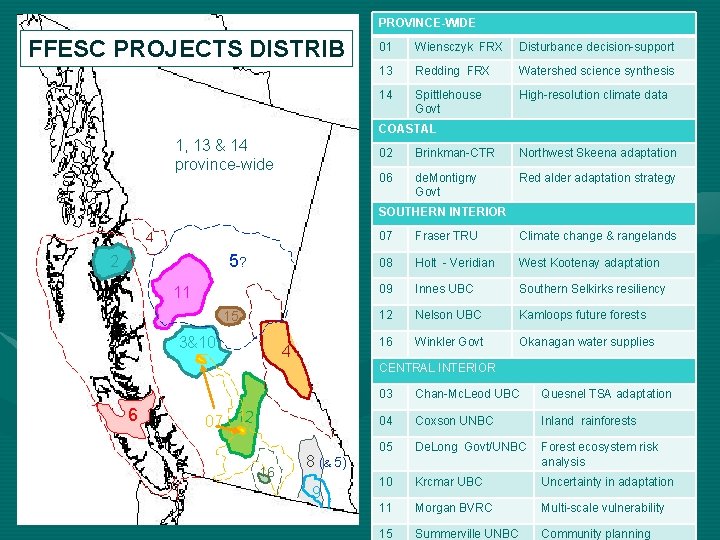
PROVINCE-WIDE FFESC PROJECTS DISTRIB 01 Wiensczyk FRX Disturbance decision-support 13 Redding FRX Watershed science synthesis 14 Spittlehouse Govt High-resolution climate data COASTAL 1, 13 & 14 province-wide 02 Brinkman-CTR Northwest Skeena adaptation 06 de. Montigny Govt Red alder adaptation strategy SOUTHERN INTERIOR 4 5? 2 11 15 3&10 4 07 Fraser TRU Climate change & rangelands 08 Holt - Veridian West Kootenay adaptation 09 Innes UBC Southern Selkirks resiliency 12 Nelson UBC Kamloops future forests 16 Winkler Govt Okanagan water supplies CENTRAL INTERIOR 6 07 07 12 16 8 (& 5) 9 03 Chan-Mc. Leod UBC Quesnel TSA adaptation 04 Coxson UNBC Inland rainforests 05 De. Long Govt/UNBC Forest ecosystem risk analysis 10 Krcmar UBC Uncertainty in adaptation 11 Morgan BVRC Multi-scale vulnerability 15 Summerville UNBC Community planning
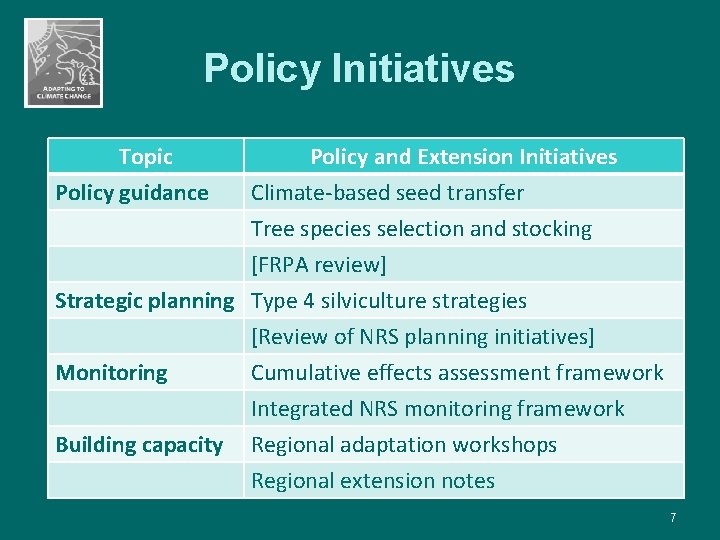
Policy Initiatives Topic Policy guidance Policy and Extension Initiatives Climate-based seed transfer Tree species selection and stocking [FRPA review] Strategic planning Type 4 silviculture strategies [Review of NRS planning initiatives] Monitoring Cumulative effects assessment framework Integrated NRS monitoring framework Building capacity Regional adaptation workshops Regional extension notes 7
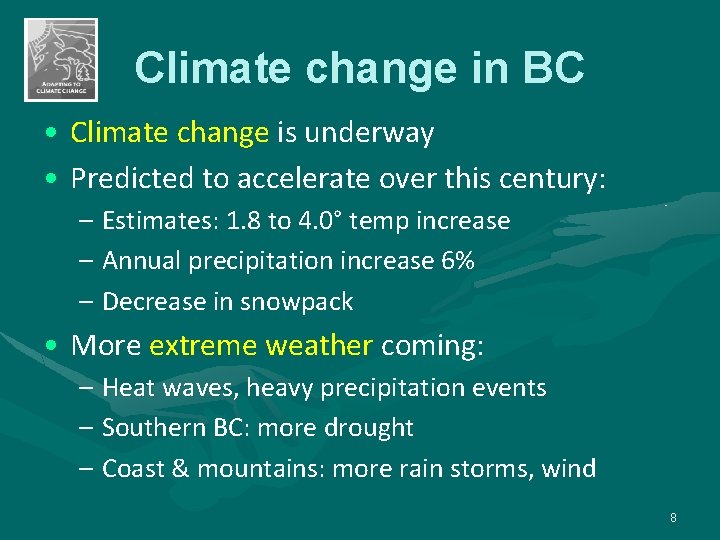
Climate change in BC • Climate change is underway • Predicted to accelerate over this century: – Estimates: 1. 8 to 4. 0° temp increase – Annual precipitation increase 6% – Decrease in snowpack • More extreme weather coming: – Heat waves, heavy precipitation events – Southern BC: more drought – Coast & mountains: more rain storms, wind 8
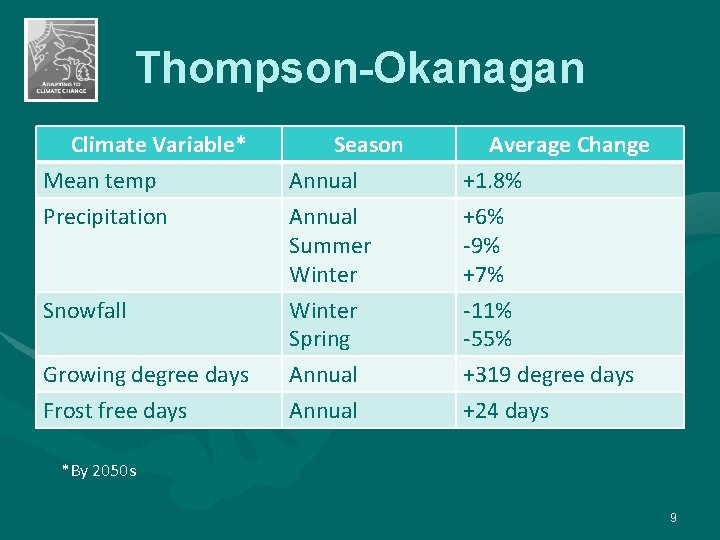
Thompson-Okanagan Climate Variable* Mean temp Precipitation Season Annual Summer Winter Average Change +1. 8% +6% -9% +7% Snowfall Winter Spring Annual -11% -55% +319 degree days +24 days Growing degree days Frost free days *By 2050 s 9
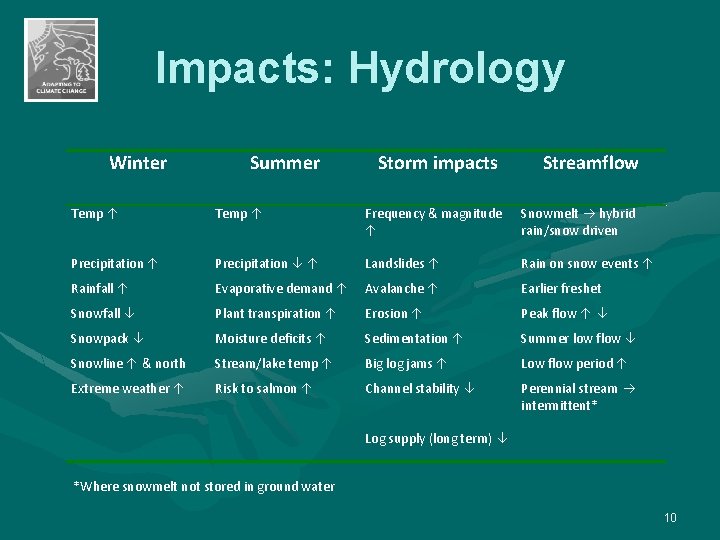
Impacts: Hydrology Winter Summer Storm impacts Streamflow Temp Frequency & magnitude Snowmelt hybrid rain/snow driven Precipitation Landslides Rain on snow events Rainfall Evaporative demand Avalanche Earlier freshet Snowfall Plant transpiration Erosion Peak flow Snowpack Moisture deficits Sedimentation Summer low flow Snowline & north Stream/lake temp Big log jams Low flow period Extreme weather Risk to salmon Channel stability Perennial stream intermittent* Log supply (long term) *Where snowmelt not stored in ground water 10
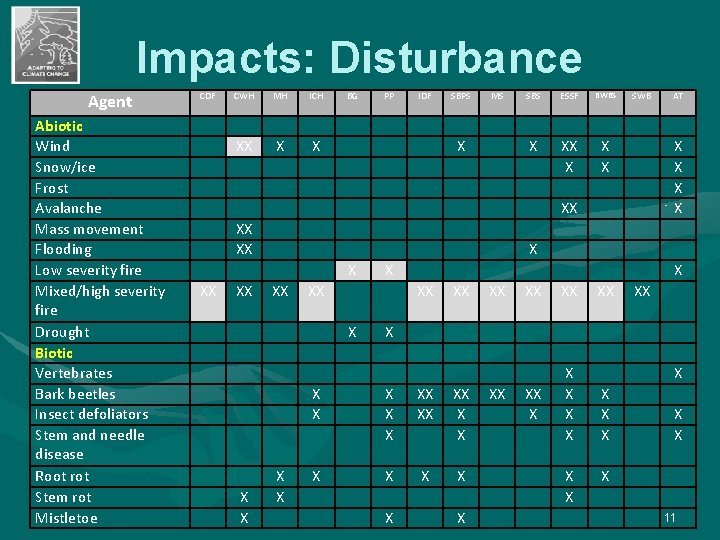
Impacts: Disturbance Agent Abiotic Wind Snow/ice Frost Avalanche Mass movement Flooding Low severity fire Mixed/high severity fire Drought Biotic Vertebrates Bark beetles Insect defoliators Stem and needle disease Root rot Stem rot Mistletoe CDF CWH MH ICH XX X X BG PP IDF SBPS MS X SBS ESSF BWBS X XX X SWB X X XX XX XX X X X AT XX XX XX X X X X X X X X X 11
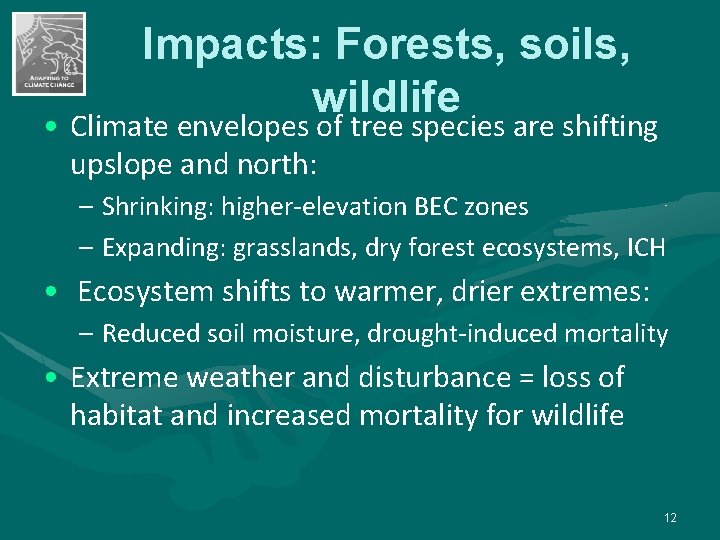
Impacts: Forests, soils, wildlife • Climate envelopes of tree species are shifting upslope and north: – Shrinking: higher-elevation BEC zones – Expanding: grasslands, dry forest ecosystems, ICH • Ecosystem shifts to warmer, drier extremes: – Reduced soil moisture, drought-induced mortality • Extreme weather and disturbance = loss of habitat and increased mortality for wildlife 12
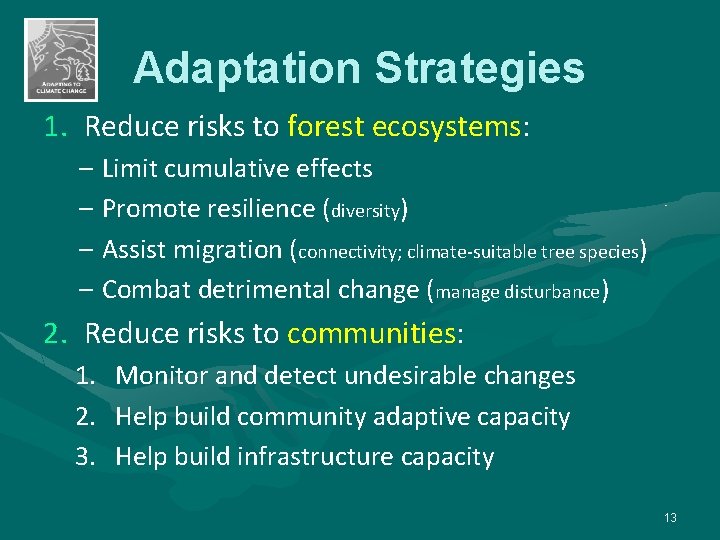
Adaptation Strategies 1. Reduce risks to forest ecosystems: – Limit cumulative effects – Promote resilience (diversity) – Assist migration (connectivity; climate-suitable tree species) – Combat detrimental change (manage disturbance) 2. Reduce risks to communities: 1. Monitor and detect undesirable changes 2. Help build community adaptive capacity 3. Help build infrastructure capacity 13
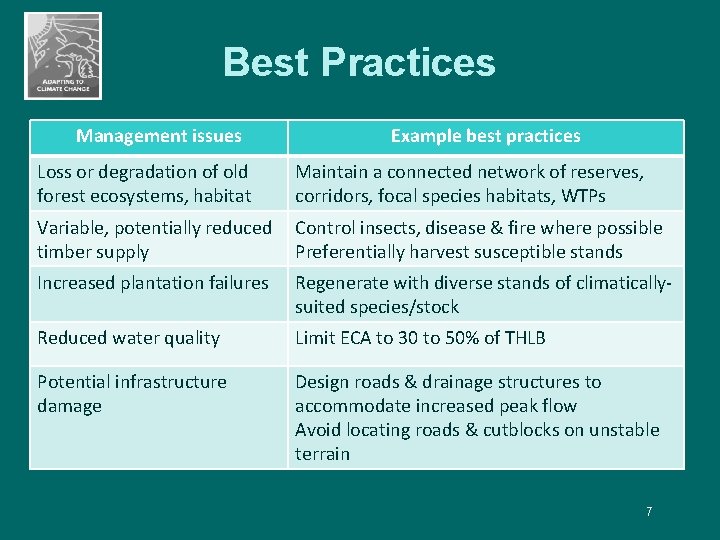
Best Practices Management issues Example best practices Loss or degradation of old forest ecosystems, habitat Maintain a connected network of reserves, corridors, focal species habitats, WTPs Variable, potentially reduced timber supply Control insects, disease & fire where possible Preferentially harvest susceptible stands Increased plantation failures Regenerate with diverse stands of climaticallysuited species/stock Reduced water quality Limit ECA to 30 to 50% of THLB Potential infrastructure damage Design roads & drainage structures to accommodate increased peak flow Avoid locating roads & cutblocks on unstable terrain 7
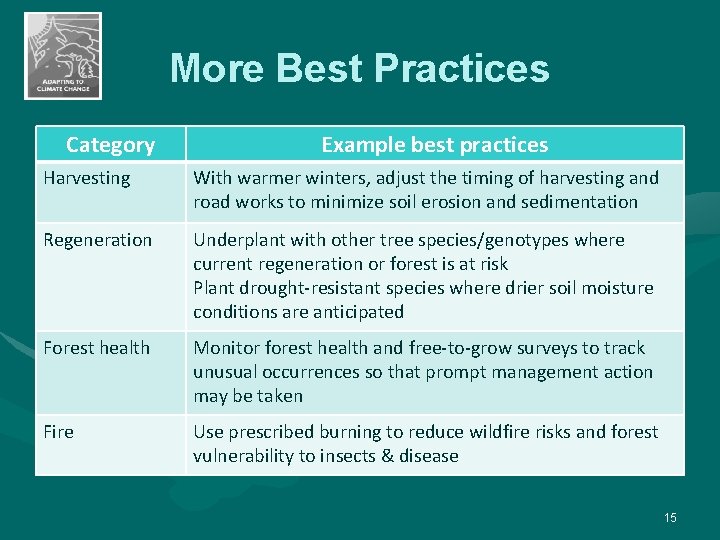
More Best Practices Category Example best practices Harvesting With warmer winters, adjust the timing of harvesting and road works to minimize soil erosion and sedimentation Regeneration Underplant with other tree species/genotypes where current regeneration or forest is at risk Plant drought-resistant species where drier soil moisture conditions are anticipated Forest health Monitor forest health and free-to-grow surveys to track unusual occurrences so that prompt management action may be taken Fire Use prescribed burning to reduce wildfire risks and forest vulnerability to insects & disease 15
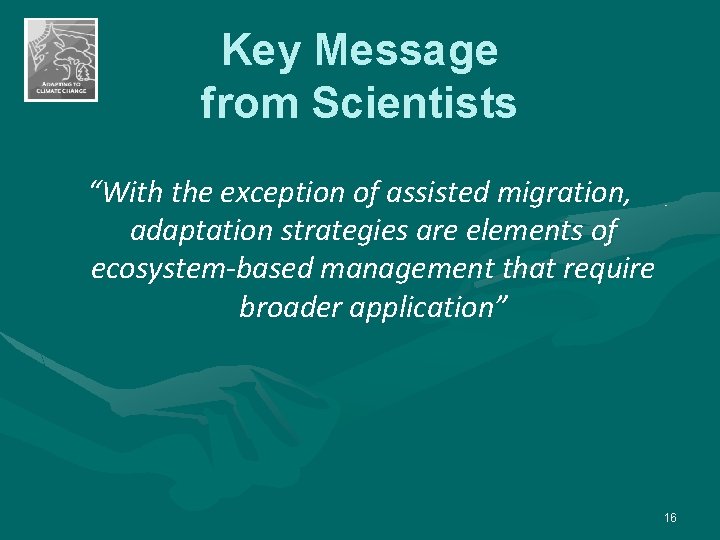
Key Message from Scientists “With the exception of assisted migration, adaptation strategies are elements of ecosystem-based management that require broader application” 16
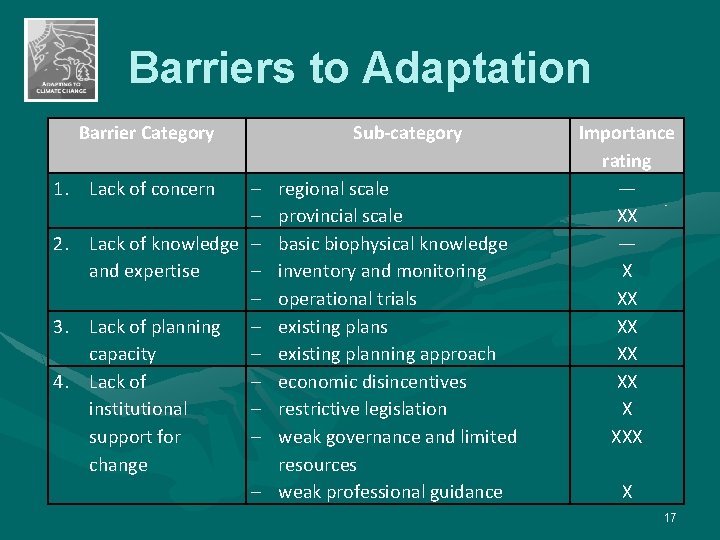
Barriers to Adaptation Barrier Category 2. Lack of knowledge and expertise 3. Lack of planning capacity 4. Lack of institutional support for change 1. Lack of concern Sub-category regional scale provincial scale basic biophysical knowledge inventory and monitoring operational trials existing planning approach economic disincentives restrictive legislation weak governance and limited resources weak professional guidance Importance rating — XX — X XX XXX X 17
Key Messages • Consider new and emerging science & policy • Utilize best (ecosystem-based) practices • Experiment, monitor, adapt: operational trials • Share ideas/learning thru ‘COPs’ • Advocate government action: – Risk-sharing / enabling innovation / incentives – Land use planning / monitoring – Supporting community adaptation 18
Contacts • Kristine Weese, Resource Practices Branch, FLNR – kristine. weese@gov. bc. ca • FFESC web site: http: //www. for. gov. bc. ca/hfp/future_forests/council/ • FLNR Climate Change Adaptation web site: http: //www. for. gov. bc. ca/het/climate/actionplan/index. htm 19
- Slides: 19