
How Irish Policymaking System Works and How to
- Slides: 27
How Irish Policymaking System Works and How to Influence It! Pat Montague, Change Advocate, Strategist and Capacity Builder, Fórsa Trade Union BCO Training, March 2021.
Connecting l Twitter handle ¡@patmontague l Email address ¡pat@montaguecomms. ie l Website ¡www. montaguecomms. ie
Power to the People l Irish Constitution – Bunreacht na hÉireann – adopted in 1937 l Constitution gives sovereignty to people who elect Oireachtas – Dáil, Seanad and President l Oireachtas legislates – makes laws l Since Independence, Government has largely initiated laws – has been changing somewhat l Ministers largely responsible for legislating in own areas
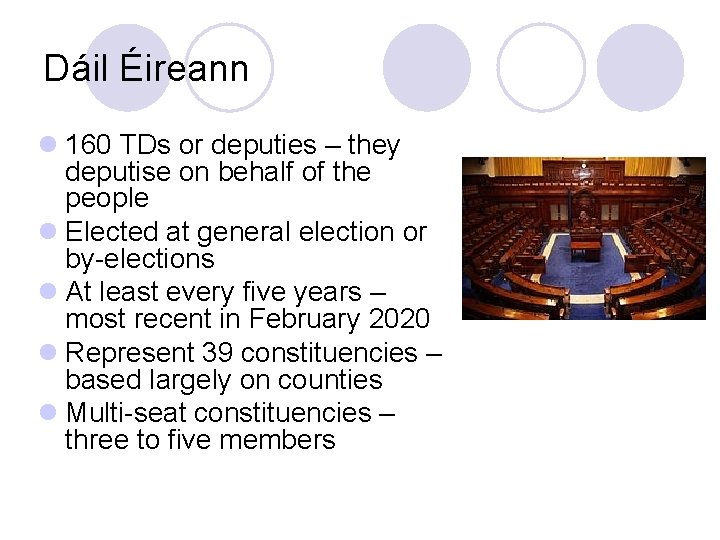
Dáil Éireann l 160 TDs or deputies – they deputise on behalf of the people l Elected at general election or by-elections l At least every five years – most recent in February 2020 l Represent 39 constituencies – based largely on counties l Multi-seat constituencies – three to five members
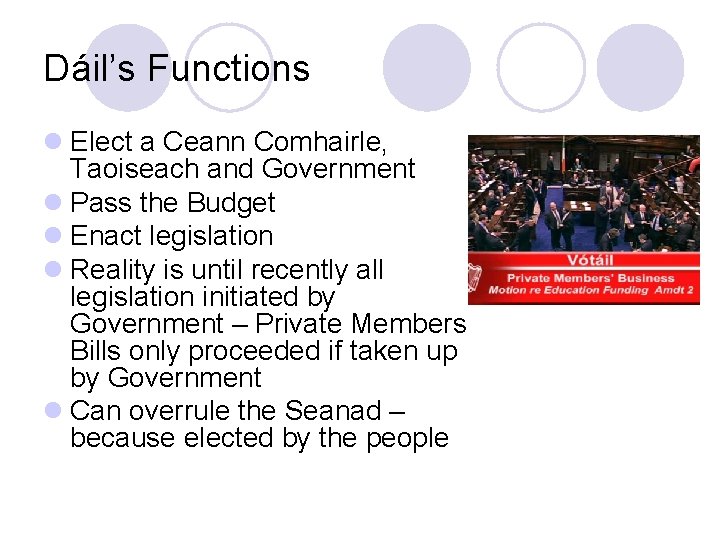
Dáil’s Functions l Elect a Ceann Comhairle, Taoiseach and Government l Pass the Budget l Enact legislation l Reality is until recently all legislation initiated by Government – Private Members Bills only proceeded if taken up by Government l Can overrule the Seanad – because elected by the people
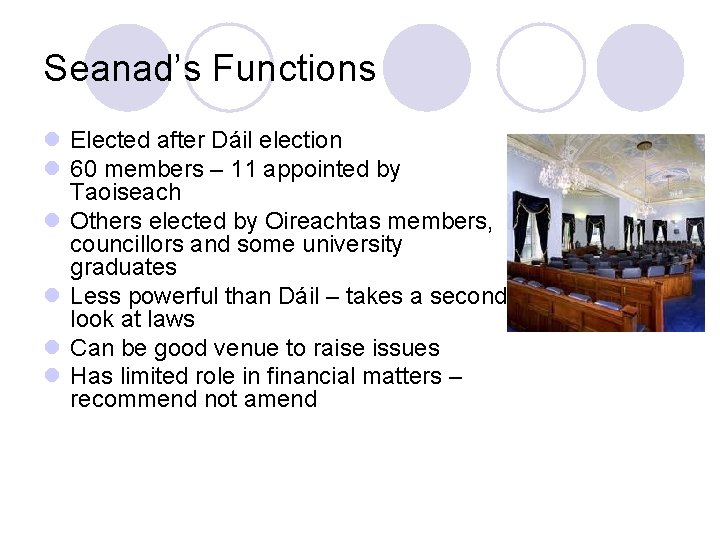
Seanad’s Functions l Elected after Dáil election l 60 members – 11 appointed by Taoiseach l Others elected by Oireachtas members, councillors and some university graduates l Less powerful than Dáil – takes a second look at laws l Can be good venue to raise issues l Has limited role in financial matters – recommend not amend
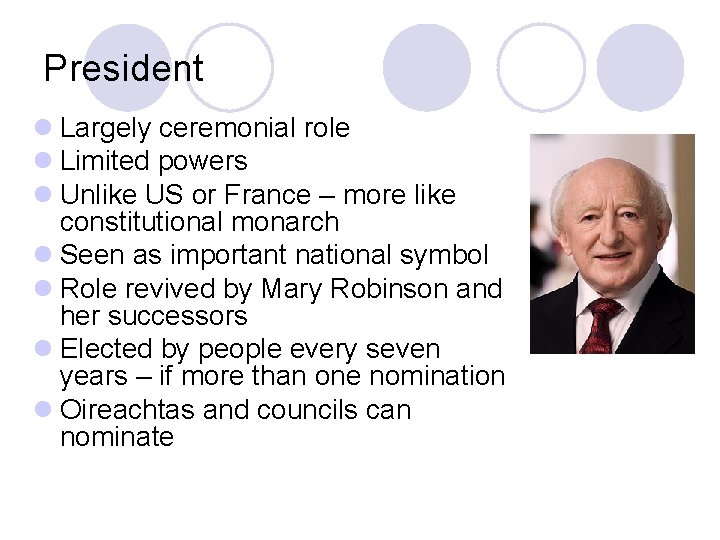
President l Largely ceremonial role l Limited powers l Unlike US or France – more like constitutional monarch l Seen as important national symbol l Role revived by Mary Robinson and her successors l Elected by people every seven years – if more than one nomination l Oireachtas and councils can nominate
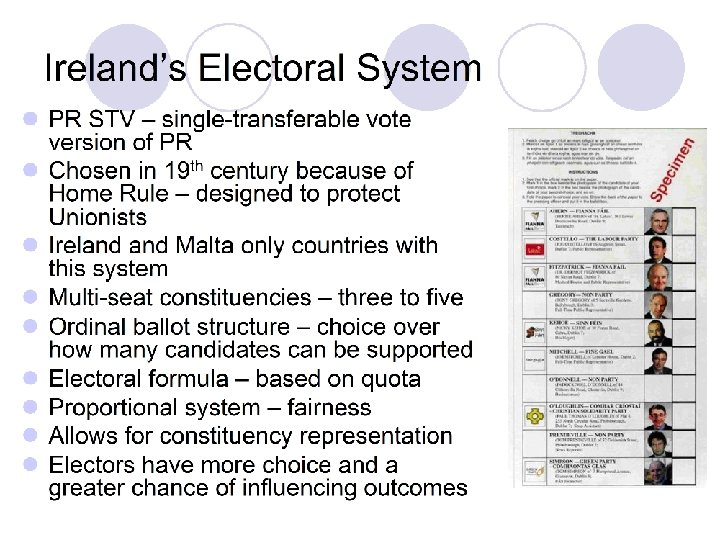
Ireland’s Electoral System l PR STV – single-transferable vote version of PR l Chosen in 19 th century because of Home Rule – designed to protect Unionists l Ireland Malta only countries with this system l Multi-seat constituencies – three to five l Ordinal ballot structure – choice over how many candidates can be supported l Electoral formula – based on quota l Proportional system – fairness l Allows for constituency representation l Electors have more choice and a greater chance of influencing outcomes
Political Consequences l Multi-seat constituencies – TDs and Councillors under pressure from own party and others l Good local service vital l Those who ignore constituencies can lose seats – including Ministers l Irish politics very localised – TDs and Councillors focus on own area and their brief l Less time for legislation and bigger picture issues
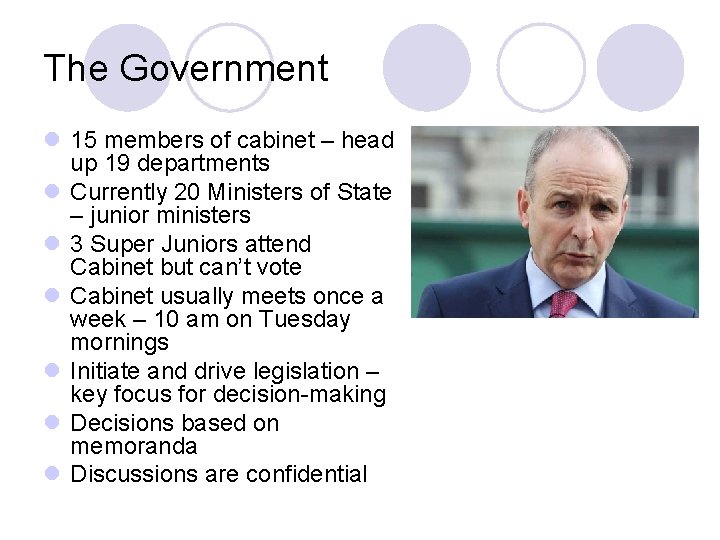
The Government l 15 members of cabinet – head up 19 departments l Currently 20 Ministers of State – junior ministers l 3 Super Juniors attend Cabinet but can’t vote l Cabinet usually meets once a week – 10 am on Tuesday mornings l Initiate and drive legislation – key focus for decision-making l Decisions based on memoranda l Discussions are confidential
Civil Servants or Ministers l Formal political responsibility lies with Ministers l Day-to-day matters dealt with by civil/public servants – very like British system l Tasked with advising, preparing policy/legislation and implementing decisions l Act as filters on policy matters l Can also be key decision makers – more with some Ministers than others l Important role can be played by Ministers of State too
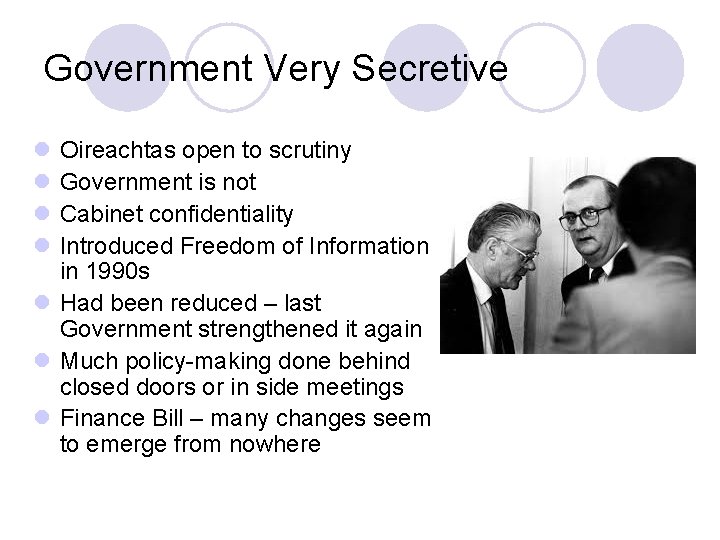
Government Very Secretive l l Oireachtas open to scrutiny Government is not Cabinet confidentiality Introduced Freedom of Information in 1990 s l Had been reduced – last Government strengthened it again l Much policy-making done behind closed doors or in side meetings l Finance Bill – many changes seem to emerge from nowhere
Evolving System l Significant changes in operation of Government since 1990 s l Ongoing coalition governments eager to keep cohesion l Avoid rows encountered by Albert Reynolds l Memoranda circulated at draft stage l Key policy issues signed off by Leaders and relevant Ministers l Key role for Programme Managers and Advisors l Office of Tánaiste has been reinstated l Green Leader has office in Dept of Taoiseach l Act as political buffers and drivers of change
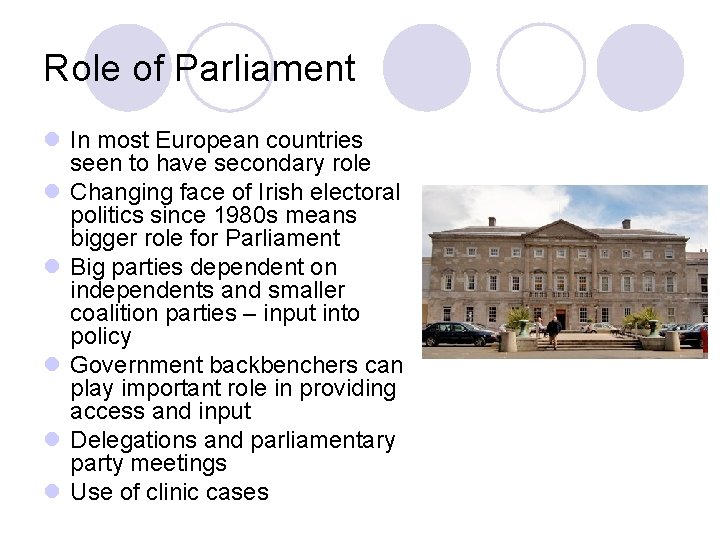
Role of Parliament l In most European countries seen to have secondary role l Changing face of Irish electoral politics since 1980 s means bigger role for Parliament l Big parties dependent on independents and smaller coalition parties – input into policy l Government backbenchers can play important role in providing access and input l Delegations and parliamentary party meetings l Use of clinic cases
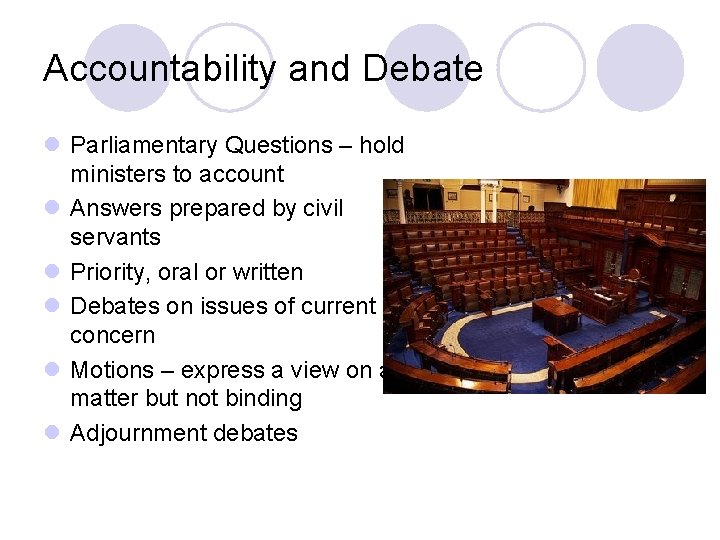
Accountability and Debate l Parliamentary Questions – hold ministers to account l Answers prepared by civil servants l Priority, oral or written l Debates on issues of current concern l Motions – express a view on a matter but not binding l Adjournment debates
Stronger Role l Part of agreement for last Government was stronger Dáil l More consultation and discussion l Stronger powers: ¡ Management of own Business; ¡ Stronger Office of Parliamentary Legal Advisor; ¡ Pre and post legislative scrutiny by Committees; ¡ Scrutiny of Budgets – Parliamentary Budget Office; ¡ Resources for Committees and members; ¡ Changes to rules on groups.
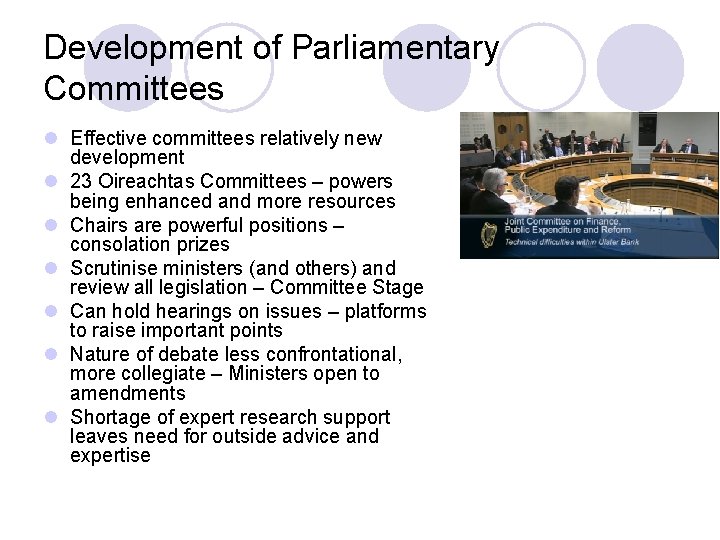
Development of Parliamentary Committees l Effective committees relatively new development l 23 Oireachtas Committees – powers being enhanced and more resources l Chairs are powerful positions – consolation prizes l Scrutinise ministers (and others) and review all legislation – Committee Stage l Can hold hearings on issues – platforms to raise important points l Nature of debate less confrontational, more collegiate – Ministers open to amendments l Shortage of expert research support leaves need for outside advice and expertise
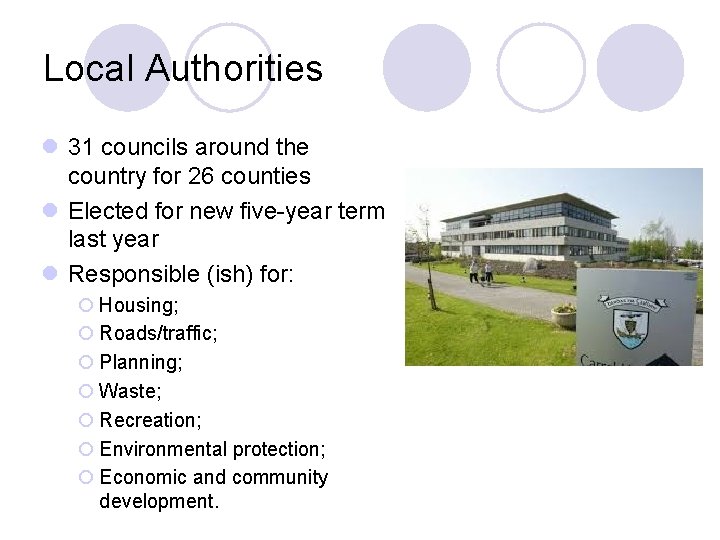
Local Authorities l 31 councils around the country for 26 counties l Elected for new five-year term last year l Responsible (ish) for: ¡ Housing; ¡ Roads/traffic; ¡ Planning; ¡ Waste; ¡ Recreation; ¡ Environmental protection; ¡ Economic and community development.
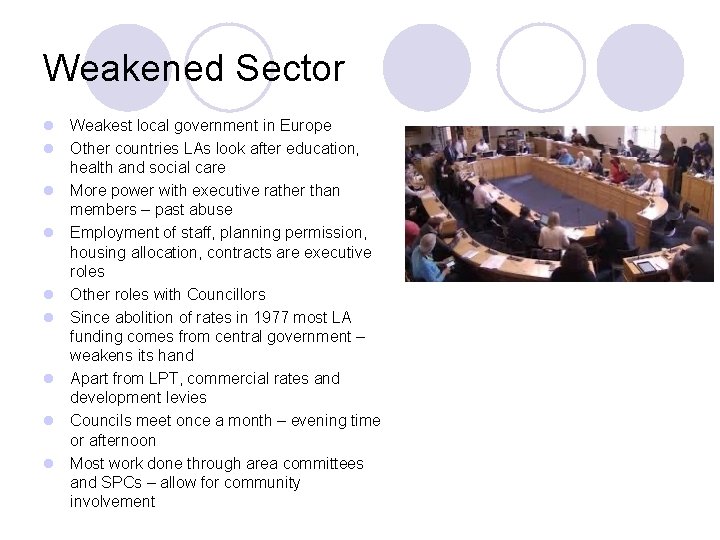
Weakened Sector l Weakest local government in Europe l Other countries LAs look after education, health and social care l More power with executive rather than members – past abuse l Employment of staff, planning permission, housing allocation, contracts are executive roles l Other roles with Councillors l Since abolition of rates in 1977 most LA funding comes from central government – weakens its hand l Apart from LPT, commercial rates and development levies l Councils meet once a month – evening time or afternoon l Most work done through area committees and SPCs – allow for community involvement
What is Lobbying? l Engaging with politicians and unelected officials l In the lobby of parliament or chamber l There are limits on what is up for grabs l Vast bulk of Budget based on last year’s Budget l Financial constraints – EU Budget Rules l More and more competing interests – becoming increasingly professionalised l Varying degrees of power – members, ideology, personal relations
Regulation of Lobbying l Regulation of Lobbying Act came into force in 2015 l Three Step Test -www. lobbying. ie ¡ Are people being paid to lobby for organisation – employees or consultants ¡ Relevant matter – policy, law, funding ¡ Communicating with DPOs l If so, have to register – board decision l Make returns three times a year
Accessible Playing Pitch • Ireland’s political system very localised – multi-seat constituencies • Most TDs and Councillors live in constituencies – hold clinics or attend meetings of local groups • What's happening in local areas is extremely important • Irish political system relatively accessible – many points of access • For example TDs often put down PQs in response to local representations • Your case needs to be communicated ‘on the ground’ • Will make more impact than national representations on their own
Not a Level Playing Pitch l Very competitive environment – ltd resources l Some groups have more access and influence l Many policymakers (civil servants) challenge advocacy role of NGOs – funding constraints l Key impact criterion – political power ¡ Social partners ¡ Significant commercial interests ¡ Supporters of political process l However, policymakers well-disposed to service providing organisations with national/local reach l Very conscious of an organisation’s ‘mandate’ and extent to which they are ‘connected’ l Many examples of groups with limited power punching above their weight – CF sufferers l Effective representation is the key
Persuade not Threaten l Ireland is a small country where everyone knows everyone else l Politics tends to work on consensual basis not ‘us and them’ – persuade across political spectrum l Fórsa not only one lobbying and campaigning l Multiple demands on elected reps – housing and health l Need to persuade them on your issues l Don't use threats, may work once – destroys relationships l Can lead to adverse reaction – policy makers ‘dig in’ l High risk approach l If politicians deliver – even if only in part – they expect acknowledgement not a slap l You have strong case to make – do it!
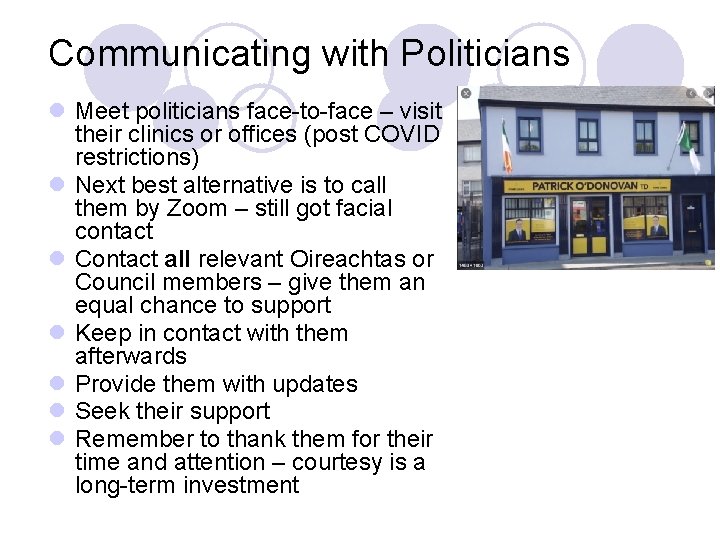
Communicating with Politicians l Meet politicians face-to-face – visit their clinics or offices (post COVID restrictions) l Next best alternative is to call them by Zoom – still got facial contact l Contact all relevant Oireachtas or Council members – give them an equal chance to support l Keep in contact with them afterwards l Provide them with updates l Seek their support l Remember to thank them for their time and attention – courtesy is a long-term investment
Advance Preparation l Nobody’s expecting you to be an expert on the economy l They are interested in how you are doing – you are one of their constituents l Give practical examples of the impact issues facing you is having particularly on their constituents! l Tell stories – forget about stats! l Think in advance about how providing better public services benefits everybody
Involve Wider Community l Brief family, friends and concerned community on issues l Get them to raise it on the doorsteps l Distribute information, leaflets – stalls in local towns l Ask them to lobby their politicians l Write letters to local papers l Participate in radio phone-in shows