
How individual difference measures inform event processing in
- Slides: 1
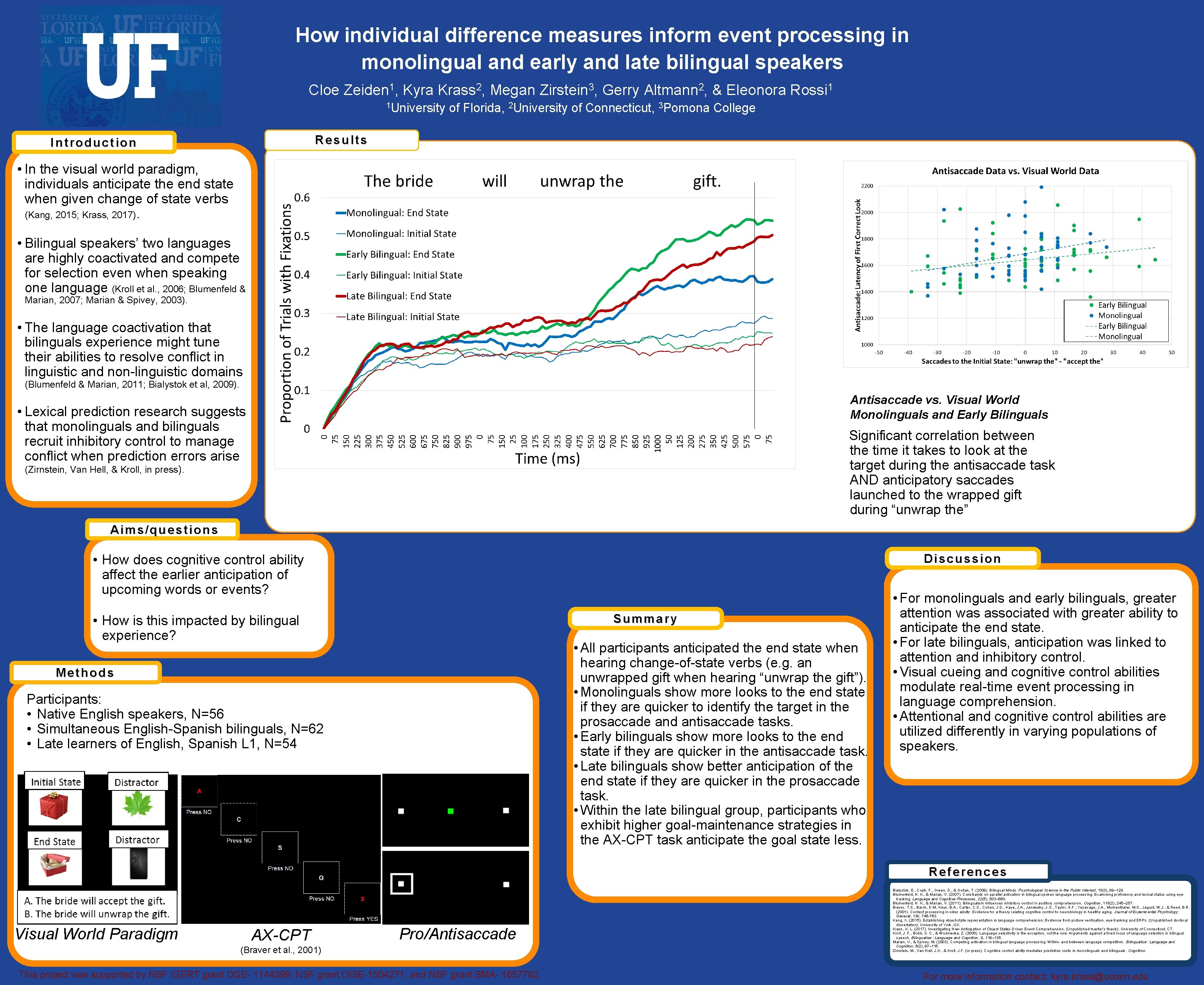
How individual difference measures inform event processing in monolingual and early and late bilingual speakers Cloe Zeiden 1, Kyra Krass 2, Megan Zirstein 3, Gerry Altmann 2, & Eleonora Rossi 1 1 University of Florida, 2 University of Connecticut, 3 Pomona College Results Introduction • In the visual world paradigm, individuals anticipate the end state when given change of state verbs (Kang, 2015; Krass, 2017). • Bilingual speakers’ two languages are highly coactivated and compete for selection even when speaking one language (Kroll et al. , 2006; Blumenfeld & Marian, 2007; Marian & Spivey, 2003). • The language coactivation that bilinguals experience might tune their abilities to resolve conflict in linguistic and non-linguistic domains (Blumenfeld & Marian, 2011; Bialystok et al, 2009). Antisaccade vs. Visual World Monolinguals and Early Bilinguals • Lexical prediction research suggests that monolinguals and bilinguals recruit inhibitory control to manage conflict when prediction errors arise Significant correlation between the time it takes to look at the target during the antisaccade task AND anticipatory saccades launched to the wrapped gift during “unwrap the” (Zirnstein, Van Hell, & Kroll, in press). Aims/questions Discussion • How does cognitive control ability affect the earlier anticipation of upcoming words or events? Summary • How is this impacted by bilingual experience? • All participants anticipated the end state when hearing change-of-state verbs (e. g. an unwrapped gift when hearing “unwrap the gift”). • Monolinguals show more looks to the end state if they are quicker to identify the target in the prosaccade and antisaccade tasks. • Early bilinguals show more looks to the end state if they are quicker in the antisaccade task. • Late bilinguals show better anticipation of the end state if they are quicker in the prosaccade task. • Within the late bilingual group, participants who exhibit higher goal-maintenance strategies in the AX-CPT task anticipate the goal state less. Methods Participants: • Native English speakers, N=56 • Simultaneous English-Spanish bilinguals, N=62 • Late learners of English, Spanish L 1, N=54 • For monolinguals and early bilinguals, greater attention was associated with greater ability to anticipate the end state. • For late bilinguals, anticipation was linked to attention and inhibitory control. • Visual cueing and cognitive control abilities modulate real-time event processing in language comprehension. • Attentional and cognitive control abilities are utilized differently in varying populations of speakers. References Visual World Paradigm AX-CPT Pro/Antisaccade (Braver et al. , 2001) This project was supported by NSF IGERT grant DGE- 1144399, NSF grant OISE-1504271, and NSF grant SMA- 1657782. Bialystok, E. , Craik, F. , Green, D. , & Gollan, T. (2009). Bilingual Minds. Psychological Science in the Public Interest, 10(3), 89– 129. Blumenfeld, H. K. , & Marian, V. (2007). Constraints on parallel activation in bilingual spoken language processing: Examining proficiency and lexical status using eyetracking. Language and Cognitive Processes, 22(5), 633– 660. Blumenfeld, H. K. , & Marian, V. (2011). Bilingualism influences inhibitory control in auditory comprehension. Cognition, 118(2), 245– 257. Braver, T. S. , Barch, D. M, Keys, B. A. , Carter, C. S. , Cohen, J. D. , Kaye, J. A. , Janowsky, J. S. , Taylor, S. F. , Yesavage, J. A. , Mumenthaler, M. S. , Jagust, W. J. , & Reed, B. R. (2001). Context processing in older adults: Evidence for a theory relating cognitive control to neurobiology in healthy aging. Journal of Experimental Psychology: General, 130, 746 -763. Kang, X. (2015). Establishing object-state representation in language comprehension: Evidence from picture verification, eye-tracking and ERPs. (Unpublished doctoral dissertation). University of York, UK. Krass, K. L. (2017). Investigating How Anticipation of Object States Drives Event Comprehension. (Unpublished master’s thesis). University of Connecticut, CT. Kroll, J. F. , Bobb, S. C. , & Wodniecka, Z. (2006). Language selectivity is the exception, not the rule: Arguments against a fixed locus of language selection in bilingual speech. Bilingualism: Language and Cognition, 9, 119– 135. Marian, V. , & Spivey, M. (2003). Competing activation in bilingual language processing: Within- and between-language competition. Bilingualism: Language and Cognition, 6(2), 97– 115. Zirnstein, M. , Van Hell, J. G. , & Kroll, J. F. (in press). Cognitive control ability mediates prediction costs in monolinguals and bilinguals. Cognition. For more information contact: kyra. krass@uconn. edu