
How High Dynamic Range Audio Makes Battlefield Bad

How High Dynamic Range Audio Makes Battlefield: Bad Company Go ”BOOM” Anders Clerwall EA/DICE
Overview » » » » Retrospective High Dynamic Range Audio Implications and Benefits Culling and Prioritizing Mixing & Mastering Conclusions Future » Q&A
Retrospective » Dynamic range traditionally faked > Duck and snapshot-mixing > Suits games with predictable sound scape > Still, a lot of manual labor » . . Even for multiplayer > Highly unpredictabale sound scape » Everything was turned to 11 > ”Every > sound is important!” But not at the same time! > Amplitude 1. 0 has no meaning
Retrospective » Battlefield: Bad Company > DICE’s first ”Next-Gen” (360/PS 3) game > More of everything > The sky’s the limit! » Frostbite >A new beginning > We decided to use HDR audio from the start! > > It’s Even the name sounded ”Next-Gen” all about the dynamic range!
What is HDR Audio? » It is. . > An automatic mixer > An automatic prioritization method > An effective culling method > A way of mapping one part of a large dynamic range to a smaller one (amplitude) > Basically like HDR lighting (Tone Mapping) » It is not. . > Compression > Although sometimes similar
What is HDR audio?
Great, but why? » Sadly we can’t play at 128 d. B in peoples’ homes > Neighbors, hearing loss, broken windows > Technical issues with audio equipment » Need a way to make sounds feel really loud > But still hear quiet sounds > Without all that traditional manual labor » Spend our time more wisely
Great, but why? » Lots of loud sounds make for a crowded upper part of the amplitude range > Difficult loud to make quiet sounds temporarily » ”Every sound is important!” > But not at the same time! > So we need a way to tell which ones are
How did we do it? » Specify loudness (d. BSPL) instead of amplitude > The key to HDR audio > Use real-life measurements as guideline > One value-range for all sounds » Measure each sound at the listener position > Perceived loudness > 3 D calculations > > Angle and distance attenuation/filter coefficients, etc. There’s no static ”Max. Distance” (gasp!)
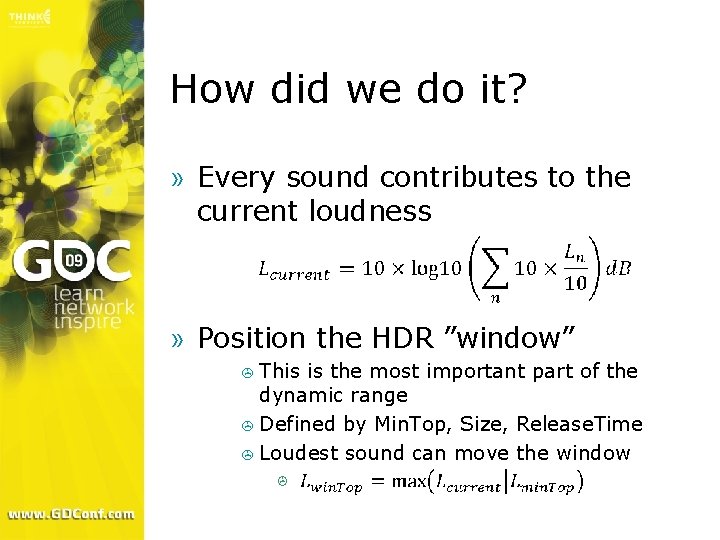
How did we do it? » Every sound contributes to the current loudness » Position the HDR ”window” > This is the most important part of the dynamic range > Defined by Min. Top, Size, Release. Time > Loudest sound can move the window >
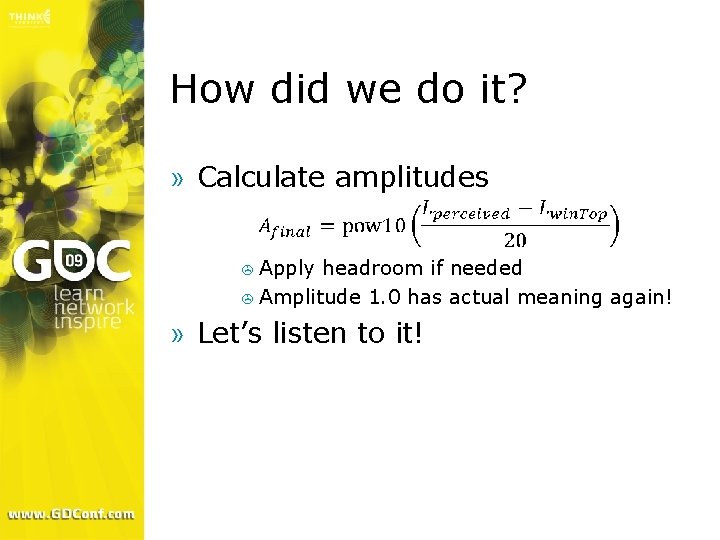
How did we do it? » Calculate amplitudes > Apply headroom if needed > Amplitude 1. 0 has actual meaning again! » Let’s listen to it!
Simple scenario video
Implications » Less control > No guarantee that a particular sound can always be heard > No way of predicting how loud a sound will be, in absolute volume » Somewhat of a paradigm-shift for sound designers > No longer controlling absolute volume, but rather the relative volume between sounds > Do they actually need control over that? > > I’m not a sound designer They haven’t complained (at least not about that)
Benefits » More control > Loudness > actually means something! Preserves the relationship between sounds in a clear way > It’s always obvious which sounds should play » Based on reality > But actually not reality > We’re making a game! > Creative control very important
Benefits » Easier to make exceptions to the rule than adding lots of rules > For example; give first-person sounds and VO some headroom » Less/cleaner code > Means less bugs. Promise! » Mixing the game » Enables some pretty nice culling schemes > Harsh, but fair
Pre-culling » Before a sound gets activated and starts rendering > Start > > with the sound’s specified loudness Apply distance/angle attenuation Remember, this is as loud as the sound could theoretically get! > Previous cutoff update’s HDR window bottom is » Helps clean up the sound scape » Low overhead > These calculations would be done anyway
Pre-culling » One-shots can be completely ignored » Loops are considered infinite and become pending > Until they’re explicitly stopped » Shifts load-balancing to where most knowledge is > More reliable > Distance is inferred by loudness > It’s about what you hear, not how far away you are
Culling of active sounds » Every sound is either ”Audible” or ”Inaudible” > Basically above or below some threshold of hearing > Assume HDR window bottom > May end up being the nth sound’s perceived loudness due to load-balancing » Once a sound becomes inaudible, suspend it > One-shots may never return > Looping sounds most likely will > Resume once audible again
Culling of active sounds » Worst-case: Lots of similarly loud sounds > They’re all inside the current HDR window > Limit on number of active sounds affects threshold of hearing » Best-case: Your weapon vs. bullet impacts nearby > Weapon will raise HDR window and bullet impacts can be completely ignored > Very common scenario in Bad Company
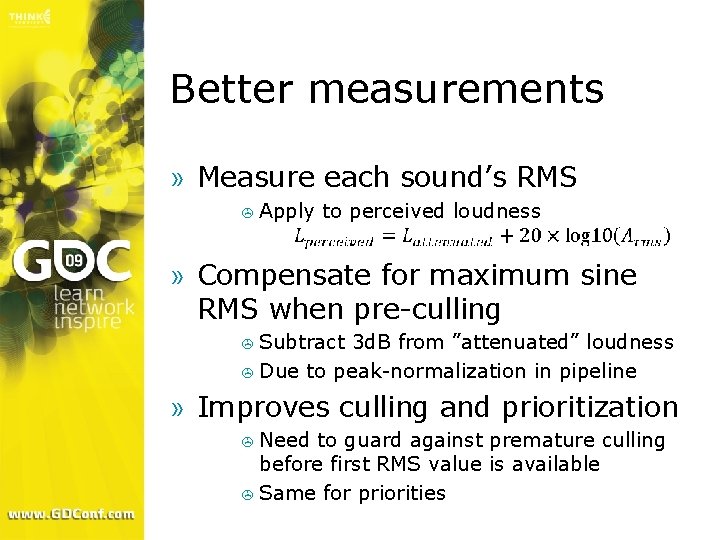
Better measurements » Measure each sound’s RMS > Apply to perceived loudness » Compensate for maximum sine RMS when pre-culling > Subtract 3 d. B from ”attenuated” loudness > Due to peak-normalization in pipeline » Improves culling and prioritization > Need to guard against premature culling before first RMS value is available > Same for priorities
Prioritizing » Sound designer specifies base priority > None, Low, Medium, High, Permanent > Combines with loudness into final priority at run-time » Priority determines rendering order > When max. rendering time is reached, expel quiet sounds > Ensures we should always hear the loudest sounds > Use Permanent priority carefully!
Mixing » Traditional scenario > Mixed at the end of the project > Spent at least a few weeks > Did nothing else » Fundamentally different approach with HDR audio >A lot of the complexity ends up being handled by the sound system automatically > Sound designer ”only” tweaks loudness and attenuation values
Mixing » Battlefield: Bad Company > Mixed throughout the project > Spent at least an equivalent of 6 months > In fact, the game was always mixed > Ship it! > Only a couple of days spent finalizing the mix at the end > Including tweaking the listening settings
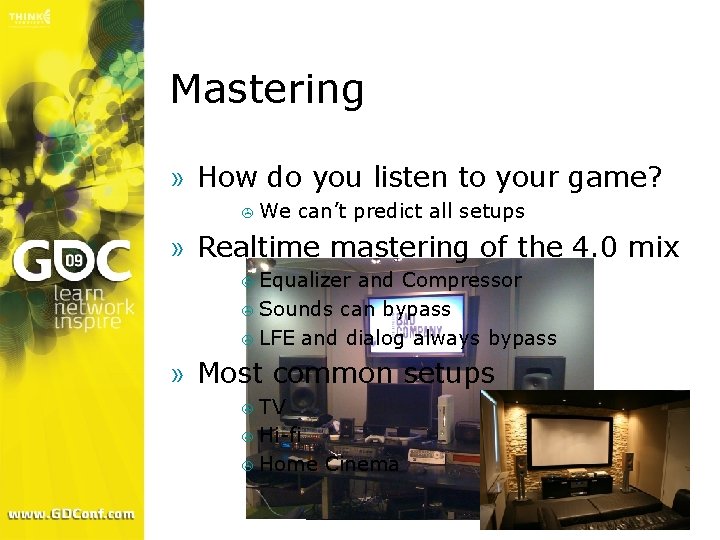
Mastering » How do you listen to your game? > We can’t predict all setups » Realtime mastering of the 4. 0 mix > Equalizer and Compressor > Sounds can bypass > LFE and dialog always bypass » Most common setups > TV > Hi-fi > Home Cinema
Let’s listen to the result!
Conclusions » Suits first/third-person games > Most likely other types of games as well » Battlefield: Bad Company audio on average 92 rated > Awesome sound design may have contributed > A case of great tech enabling awesome design » High Dynamic Range audio works! > Our gamble definitely paid off > The future for HDR audio looks ”loud”!
In the year 2000 » More accurate perceived loudness > Tweak distance model > Take frequencies into consideration > More fitting normalization of source data > Improves culling, prioritization and thus the whole sound scape » Better workflows and debug info > Live-tweaking was crucial, but could be improved > Fix things that didn’t get a lot of attention due to focus on shipping Bad Company » Optimize, Optimize!
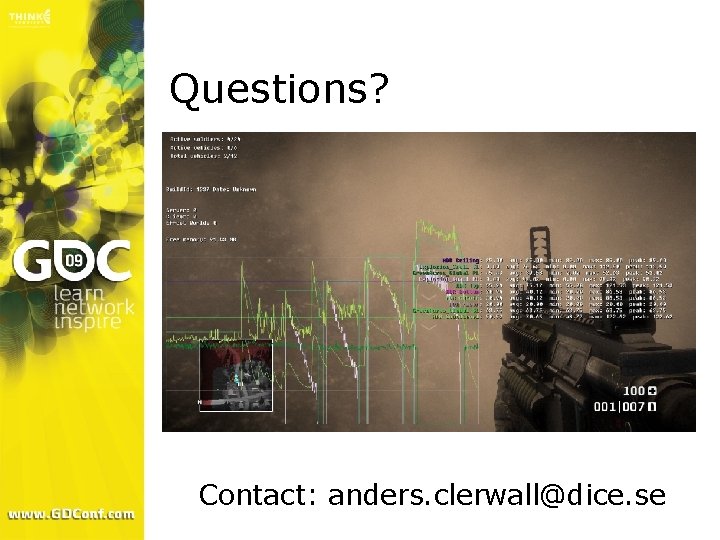
Questions? Contact: anders. clerwall@dice. se
- Slides: 29