
How Herbicides Work Lesson 2 The copyright in
How Herbicides Work Lesson 2 The copyright in these Weed Science Society of America (WSSA) training lessons is owned by the WSSA grants you a limited license to use these materials solely for training and educational purposes. Slides may be used individually, and their order of use may be changed; however, the content of each slide and the associated narrative may not be altered. If you have questions, please e-mail ‘info@wssa. net’. Herbicide Resistance Management ▪ Lesson How. WSSA do herbicides work? WSSA Herbicide Resistance Management Lesson 2 © 2: 2011 All Rights Reserved 1

Objectives By the end of this lesson, you will: Know the terminology associated with herbicide use, including tolerance, chemistry, efficacy, timing, and placement of applications. Understand how herbicides are categorized according to their mechanism of action. Above: Inflorescence of wild oat, a weed that is known to be resistant to several herbicides. Image number 5404825 at www. invasive. org. Herbicide Resistance Management ▪ Lesson How. WSSA do herbicides work? WSSA Herbicide Resistance Management Lesson 2 © 2: 2011 All Rights Reserved 2

What is a Herbicide? Herbicide: A chemical used to control or kill plants. Herbicide Resistance Management ▪ Lesson How. WSSA do herbicides work? WSSA Herbicide Resistance Management Lesson 2 © 2: 2011 All Rights Reserved 3
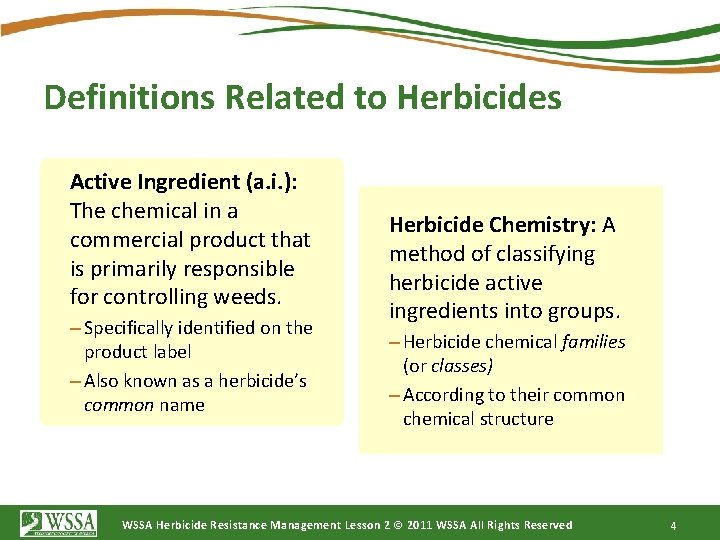
Definitions Related to Herbicides Active Ingredient (a. i. ): The chemical in a commercial product that is primarily responsible for controlling weeds. – Specifically identified on the product label – Also known as a herbicide’s common name Herbicide Chemistry: A method of classifying herbicide active ingredients into groups. – Herbicide chemical families (or classes) – According to their common chemical structure Herbicide Resistance Management ▪ Lesson How. WSSA do herbicides work? WSSA Herbicide Resistance Management Lesson 2 © 2: 2011 All Rights Reserved 4

Herbicide Names on a Label The Trade name or Product name, describes the formulated product and may contain more than one a. i. Common name of a. i. Chemical name of a. i. Herbicide Resistance Management ▪ Lesson How. WSSA do herbicides work? WSSA Herbicide Resistance Management Lesson 2 © 2: 2011 All Rights Reserved 5

Herbicide Efficacy Example: Herbicide Efficacy: A measure of herbicide activity. The ability of a herbicide to produce the desired effect. • For many weed species, a herbicide controlling 85% or more of the target weed population has good efficacy. • The weeds are susceptible to the herbicide. Controlled Herbicide Resistance Management ▪ Lesson How. WSSA do herbicides work? WSSA Herbicide Resistance Management Lesson 2 © 2: 2011 All Rights Reserved 6
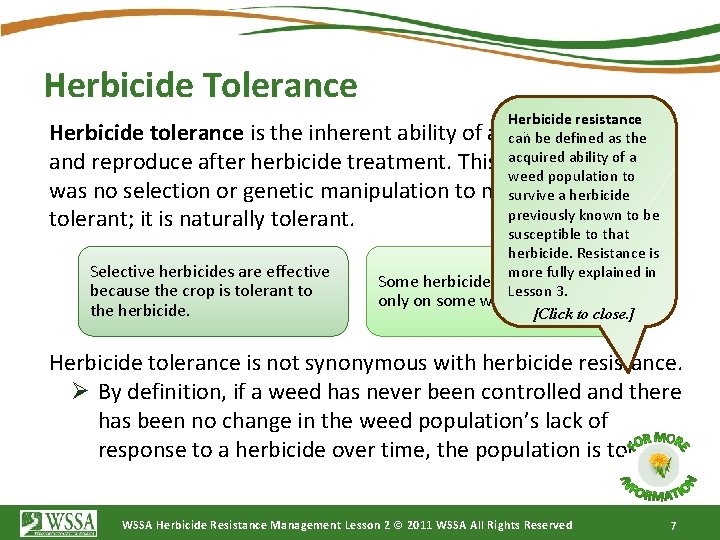
Herbicide Tolerance Herbicide resistance Herbicide tolerance is the inherent ability of a species to survive can be defined as the acquired ability a and reproduce after herbicide treatment. This implies thatofthere weed population to was no selection or genetic manipulation to make the plant survive a herbicide previously known to be tolerant; it is naturally tolerant. susceptible to that herbicide. Resistance is Selective herbicides are effective more fully explained in Some herbicides are effective Lesson 3. because the crop is tolerant to only on some weeds. the herbicide. [Click to close. ] Herbicide tolerance is not synonymous with herbicide resistance. Ø By definition, if a weed has never been controlled and there has been no change in the weed population’s lack of response to a herbicide over time, the population is tolerant. Herbicide Resistance Management ▪ Lesson How. WSSA do herbicides work? WSSA Herbicide Resistance Management Lesson 2 © 2: 2011 All Rights Reserved 7

Herbicide Spectrum of Control Narrow Spectrum: A herbicide that is more effective in controlling some plant species than others. No activity Activity Broad Spectrum: A herbicide that controls many plant species. Herbicide Resistance Management ▪ Lesson How. WSSA do herbicides work? WSSA Herbicide Resistance Management Lesson 2 © 2: 2011 All Rights Reserved 8
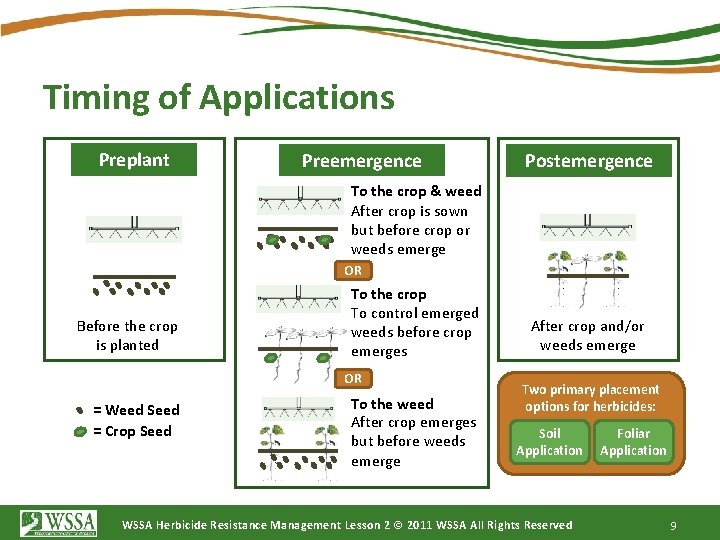
Timing of Applications Preplant Preemergence Postemergence To the crop & weed After crop is sown but before crop or weeds emerge OR Before the crop is planted To the crop To control emerged weeds before crop emerges OR = Weed Seed = Crop Seed To the weed After crop emerges but before weeds emerge After crop and/or weeds emerge Two primary placement options for herbicides: Soil Application Herbicide Resistance Management ▪ Lesson How. WSSA do herbicides work? WSSA Herbicide Resistance Management Lesson 2 © 2: 2011 All Rights Reserved Foliar Application 9
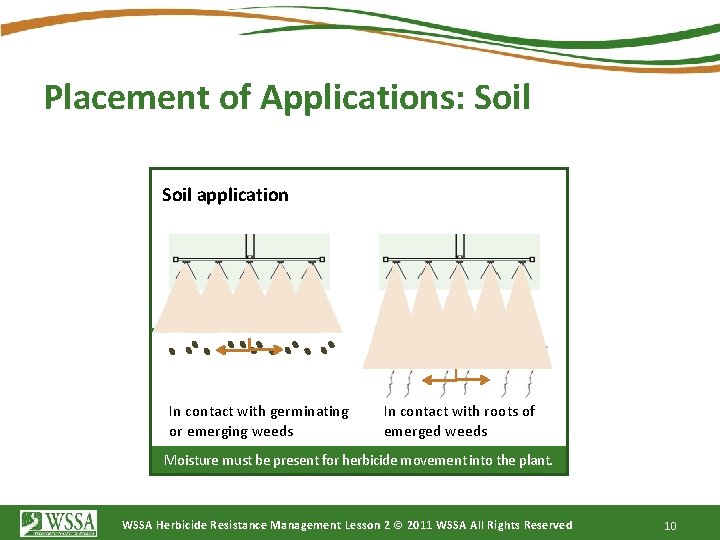
Placement of Applications: Soil application In contact with germinating or emerging weeds In contact with roots of emerged weeds Moisture must be present for herbicide movement into the plant. Herbicide Resistance Management ▪ Lesson How. WSSA do herbicides work? WSSA Herbicide Resistance Management Lesson 2 © 2: 2011 All Rights Reserved 10

Placement of Applications: Foliar application Applied directly to the leaves of plants Herbicide Resistance Management ▪ Lesson How. WSSA do herbicides work? WSSA Herbicide Resistance Management Lesson 2 © 2: 2011 All Rights Reserved 11
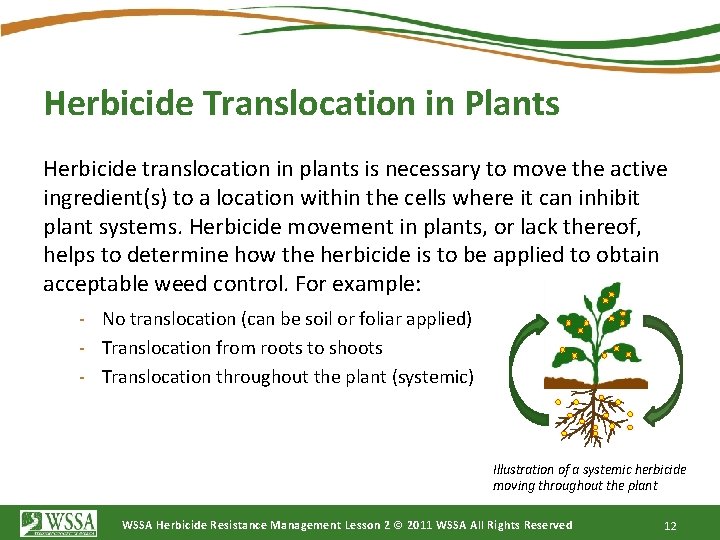
Herbicide Translocation in Plants Herbicide translocation in plants is necessary to move the active ingredient(s) to a location within the cells where it can inhibit plant systems. Herbicide movement in plants, or lack thereof, helps to determine how the herbicide is to be applied to obtain acceptable weed control. For example: - No translocation (can be soil or foliar applied) - Translocation from roots to shoots - Translocation throughout the plant (systemic) Illustration of a systemic herbicide moving throughout the plant Herbicide Resistance Management ▪ Lesson How. WSSA do herbicides work? WSSA Herbicide Resistance Management Lesson 2 © 2: 2011 All Rights Reserved 12
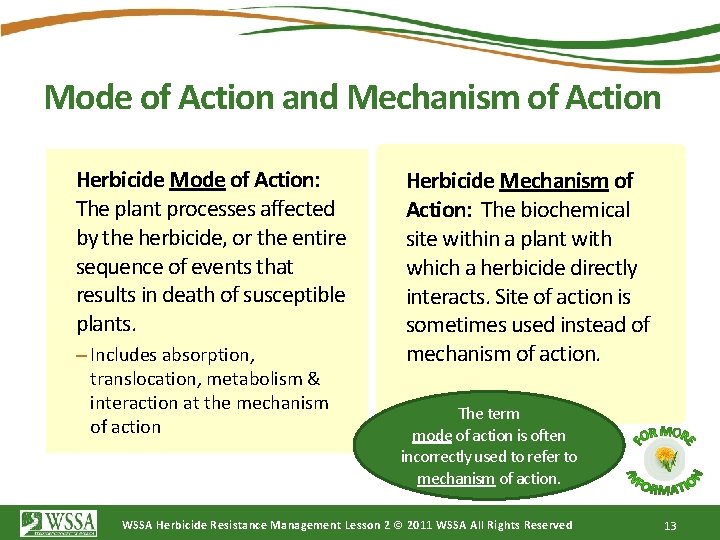
Mode of Action and Mechanism of Action Herbicide Mode of Action: The plant processes affected by the herbicide, or the entire sequence of events that results in death of susceptible plants. – Includes absorption, translocation, metabolism & interaction at the mechanism of action Herbicide Mechanism of Action: The biochemical site within a plant with which a herbicide directly interacts. Site of action is sometimes used instead of mechanism of action. The term mode of action is often incorrectly used to refer to mechanism of action. Herbicide Resistance Management ▪ Lesson How. WSSA do herbicides work? WSSA Herbicide Resistance Management Lesson 2 © 2: 2011 All Rights Reserved 13
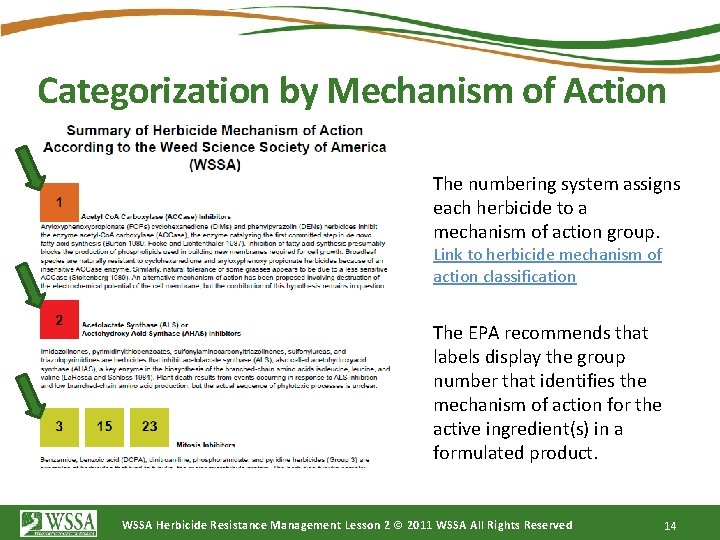
Categorization by Mechanism of Action The numbering system assigns each herbicide to a mechanism of action group. Link to herbicide mechanism of action classification The EPA recommends that labels display the group number that identifies the mechanism of action for the active ingredient(s) in a formulated product. Herbicide Resistance Management ▪ Lesson How. WSSA do herbicides work? WSSA Herbicide Resistance Management Lesson 2 © 2: 2011 All Rights Reserved 14

Goal of the Mechanism of Action Numbering System The goal of herbicide group number classification system is to provide a tool that aids in herbicide selection. Herbicide A Herbicide labels also include herbicide resistance management guidelines to direct growers and dealers to local extension experts for assistance with weed management decisions. Herbicide Resistance Management ▪ Lesson How. WSSA do herbicides work? WSSA Herbicide Resistance Management Lesson 2 © 2: 2011 All Rights Reserved Herbicide B 15
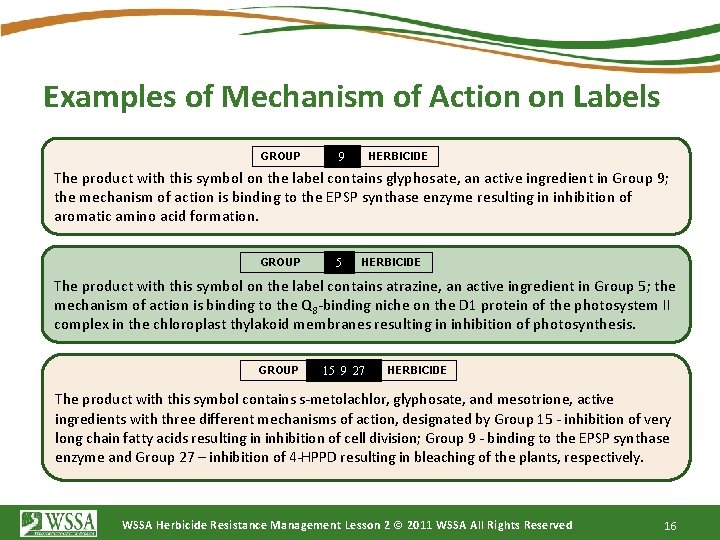
Examples of Mechanism of Action on Labels GROUP 9 HERBICIDE The product with this symbol on the label contains glyphosate, an active ingredient in Group 9; the mechanism of action is binding to the EPSP synthase enzyme resulting in inhibition of aromatic amino acid formation. GROUP 5 HERBICIDE The product with this symbol on the label contains atrazine, an active ingredient in Group 5; the mechanism of action is binding to the Q 8 -binding niche on the D 1 protein of the photosystem II complex in the chloroplast thylakoid membranes resulting in inhibition of photosynthesis. GROUP 15 9 27 HERBICIDE The product with this symbol contains s-metolachlor, glyphosate, and mesotrione, active ingredients with three different mechanisms of action, designated by Group 15 - inhibition of very long chain fatty acids resulting in inhibition of cell division; Group 9 - binding to the EPSP synthase enzyme and Group 27 – inhibition of 4 -HPPD resulting in bleaching of the plants, respectively. Herbicide Resistance Management ▪ Lesson How. WSSA do herbicides work? WSSA Herbicide Resistance Management Lesson 2 © 2: 2011 All Rights Reserved 16
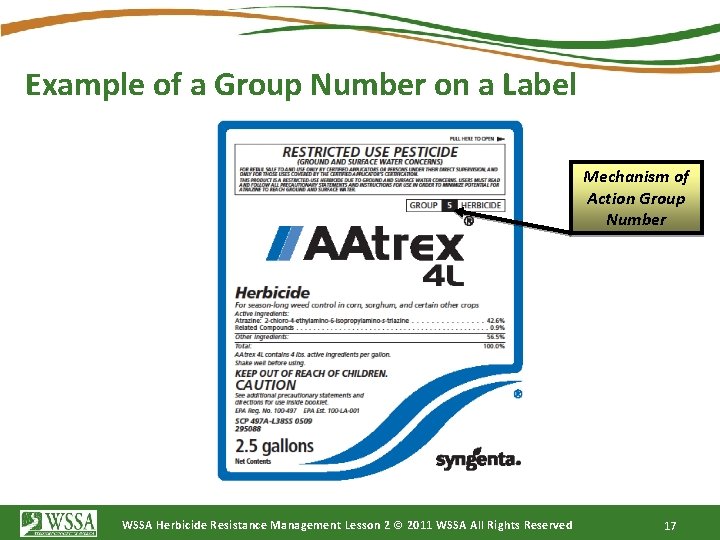
Example of a Group Number on a Label Mechanism of Action Group Number Herbicide Resistance Management ▪ Lesson How. WSSA do herbicides work? WSSA Herbicide Resistance Management Lesson 2 © 2: 2011 All Rights Reserved 17
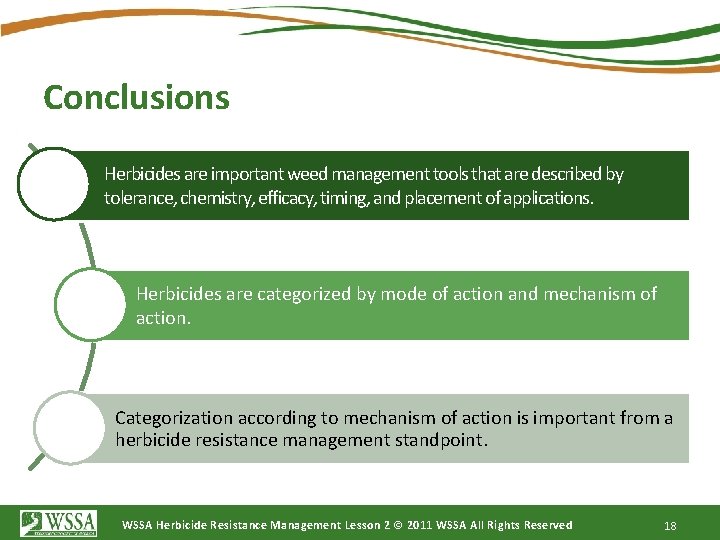
Conclusions Herbicides are important weed management tools that are described by tolerance, chemistry, efficacy, timing, and placement of applications. Herbicides are categorized by mode of action and mechanism of action. Categorization according to mechanism of action is important from a herbicide resistance management standpoint. Herbicide Resistance Management ▪ Lesson How. WSSA do herbicides work? WSSA Herbicide Resistance Management Lesson 2 © 2: 2011 All Rights Reserved 18
Credits: This lesson was developed by a WSSA sub-committee and reviewed by the WSSA Board of Directors and other WSSA members before being released. The sub-committee was composed of the following individuals. • • Wes Everman, Ph. D Les Glasgow, Ph. D Lynn Ingegneri, Ph. D Jill Schroeder, Ph. D David Shaw, Ph. D John Soteres, Ph. D Jeff Stachler, Ph. D François Tardif, Ph. D (North Carolina State University) (Syngenta) (Consultant) (New Mexico State University) (Mississippi State University) (Monsanto Company) (sub-committee chairman) (North Dakota State University and University of Minnesota) (University of Guelph) Financial support for this was provided by Global HRAC, North America HRAC, and WSSA. Our thanks are extended to the National Corn Growers Association for allowing us to use training materials posted on their website as the starting point for these training lessons. Herbicide Resistance Management ▪ Lesson How. WSSA do herbicides work? WSSA Herbicide Resistance Management Lesson 2 © 2: 2011 All Rights Reserved 19
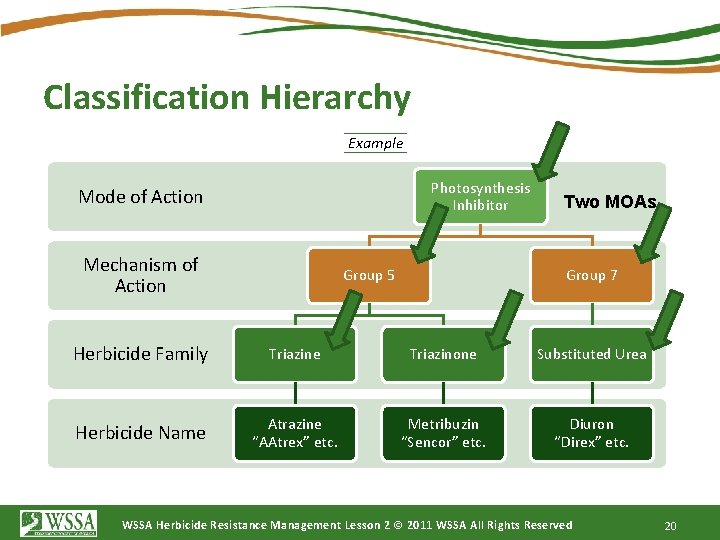
Classification Hierarchy Example Photosynthesis Inhibitor Mode of Action Mechanism of Action Group 5 Two MOAs Group 7 Herbicide Family Triazine Triazinone Substituted Urea Herbicide Name Atrazine “AAtrex” etc. Metribuzin “Sencor” etc. Diuron “Direx” etc. Herbicide Resistance Management ▪ Lesson How. WSSA do herbicides work? WSSA Herbicide Resistance Management Lesson 2 © 2: 2011 All Rights Reserved 20
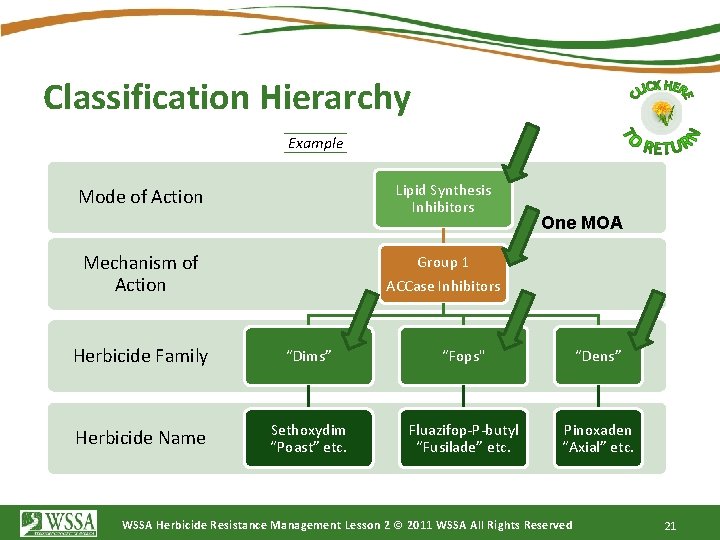
Classification Hierarchy Example Lipid Synthesis Inhibitors Mode of Action Mechanism of Action One MOA Group 1 ACCase Inhibitors Herbicide Family “Dims” “Fops" “Dens” Herbicide Name Sethoxydim “Poast” etc. Fluazifop-P-butyl “Fusilade” etc. Pinoxaden “Axial” etc. Herbicide Resistance Management ▪ Lesson How. WSSA do herbicides work? WSSA Herbicide Resistance Management Lesson 2 © 2: 2011 All Rights Reserved 21
- Slides: 21