
How has Ethiopia developed as an LIDC over

- Slides: 32
How has Ethiopia developed as an LIDC over the past 50 years? Dynamic Development Ethiopia part 2. MDGs review, trade structure and TNCs Resources Student’s progress trackers Students devices Main skills • Visual literacy Links to the spec • 6. 2 Are LIDCs likely to stay poor? • A case study of Ethiopia part 2). Are the Millennium development Goals being met? How it trade influencing development? A Act SPG social development, economic development, population, society, politics, technology, location, history 19/01/2022
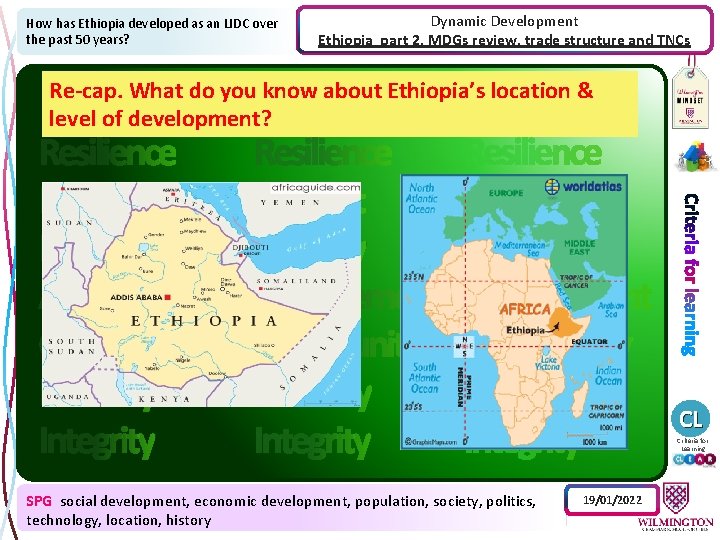
How has Ethiopia developed as an LIDC over the past 50 years? Dynamic Development Ethiopia part 2. MDGs review, trade structure and TNCs Re-cap. What do you know about Ethiopia’s location & level of development? CL Criteria for Learning SPG social development, economic development, population, society, politics, technology, location, history 19/01/2022
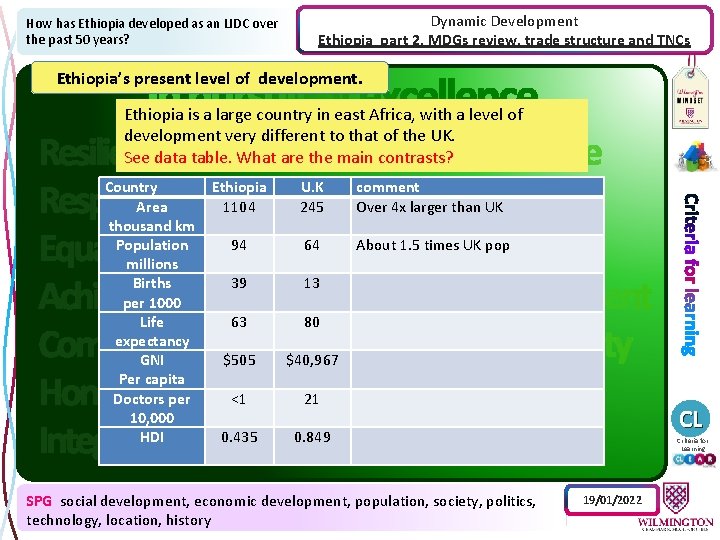
How has Ethiopia developed as an LIDC over the past 50 years? Dynamic Development Ethiopia part 2. MDGs review, trade structure and TNCs Ethiopia’s present level of development. Ethiopia is a large country in east Africa, with a level of development very different to that of the UK. See data table. What are the main contrasts? Country Area thousand km Population millions Births per 1000 Life expectancy GNI Per capita Doctors per 10, 000 HDI Ethiopia 1104 U. K 245 comment Over 4 x larger than UK 94 64 About 1. 5 times UK pop 39 13 63 80 $505 $40, 967 <1 21 0. 435 0. 849 SPG social development, economic development, population, society, politics, technology, location, history CL Criteria for Learning 19/01/2022
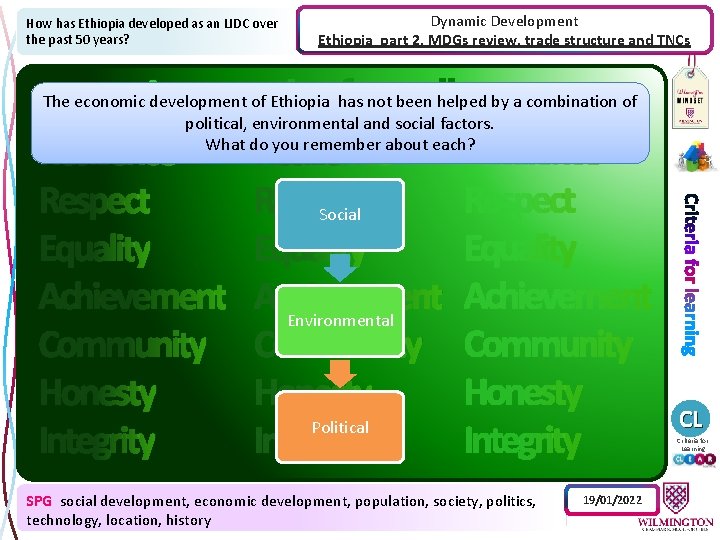
How has Ethiopia developed as an LIDC over the past 50 years? Dynamic Development Ethiopia part 2. MDGs review, trade structure and TNCs The economic development of Ethiopia has not been helped by a combination of political, environmental and social factors. What do you remember about each? Social Environmental CL Political SPG social development, economic development, population, society, politics, technology, location, history Criteria for Learning 19/01/2022
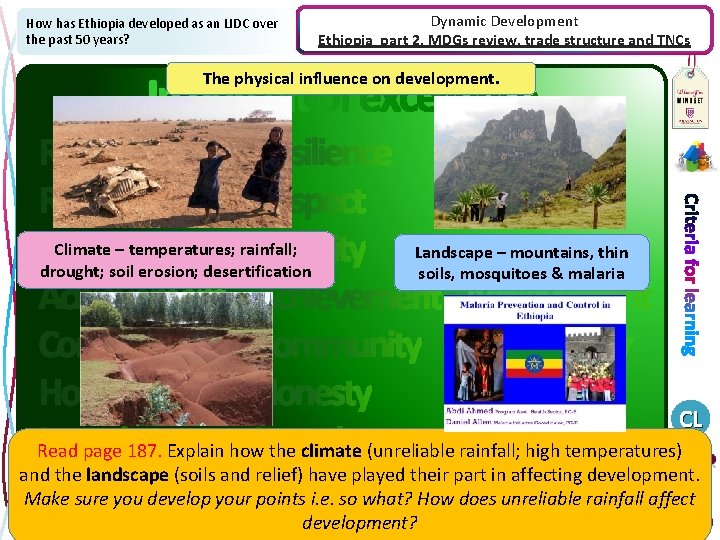
How has Ethiopia developed as an LIDC over the past 50 years? Dynamic Development Ethiopia part 2. MDGs review, trade structure and TNCs The physical influence on development. Climate – temperatures; rainfall; drought; soil erosion; desertification Landscape – mountains, thin soils, mosquitoes & malaria CL Criteria for Learning Read page 187. Explain how the climate (unreliable rainfall; high temperatures) and the landscape (soils and relief) have played their part in affecting development. Make suredevelopment, you develop your points i. e. sopopulation, what? How does unreliable 19/01/2022 rainfall affect SPG social economic development, society, politics, technology, location, history development?
How has Ethiopia developed as an LIDC over the past 50 years? Dynamic Development Ethiopia part 2. MDGs review, trade structure and TNCs Feedback from your Independent study: Research each of the following – Civil war (political unrest) in Ethiopia Famine and drought in Ethiopia Health care (doctors, disease) in Ethiopia Explain the impact of different political, social and environmental events from the last 50 years on the development of Ethiopia. Which description below best fits your explanation? A simple answer would: just list factual evidence A good answer would: would explain the impact of the different events on development A top achiever’s answer would: would explain the impact of the different events on development and make an assessment on which is the most significant. SPG social development, economic development, population, society, politics, technology, location, history 19/01/2022 A Act
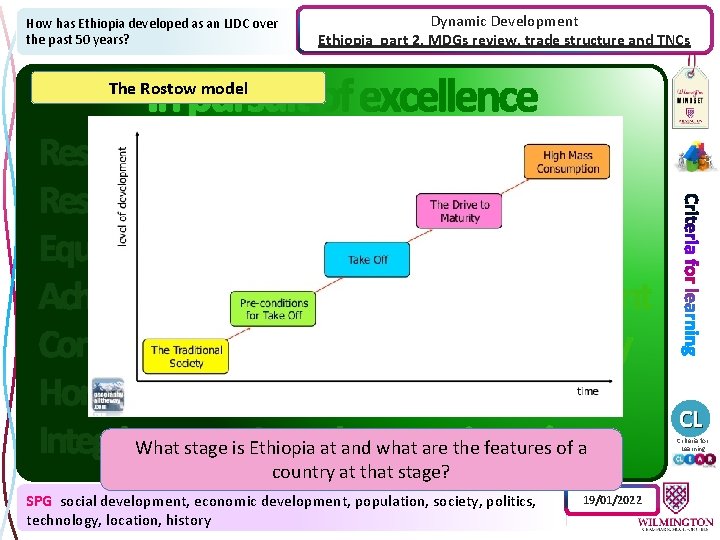
How has Ethiopia developed as an LIDC over the past 50 years? Dynamic Development Ethiopia part 2. MDGs review, trade structure and TNCs The Rostow model CL What stage is Ethiopia at and what are the features of a country at that stage? SPG social development, economic development, population, society, politics, technology, location, history 19/01/2022 Criteria for Learning
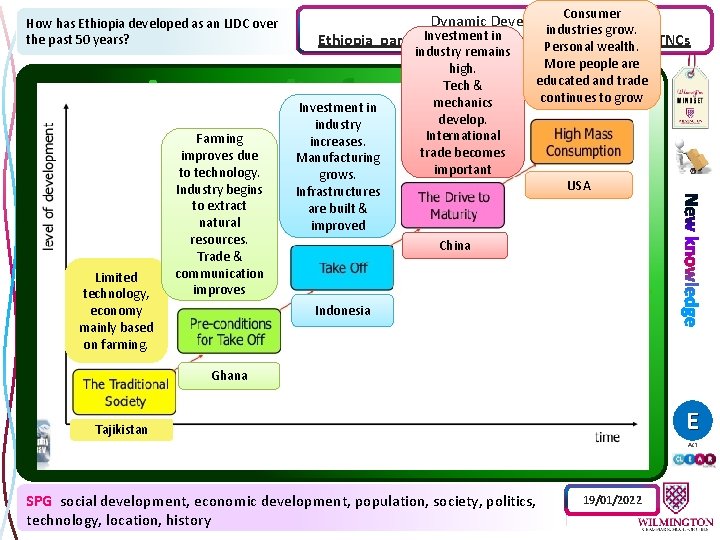
How has Ethiopia developed as an LIDC over the past 50 years? Limited technology, economy mainly based on farming. Farming improves due to technology. Industry begins to extract natural resources. Trade & communication improves Consumer Dynamic Development industries grow. Investment in Ethiopia part 2. MDGs review, trade structure and TNCs Personal wealth. Investment in industry increases. Manufacturing grows. Infrastructures are built & improved industry remains high. Tech & mechanics develop. International trade becomes important More people are educated and trade continues to grow USA China Indonesia Ghana E Tajikistan Act SPG social development, economic development, population, society, politics, technology, location, history 19/01/2022
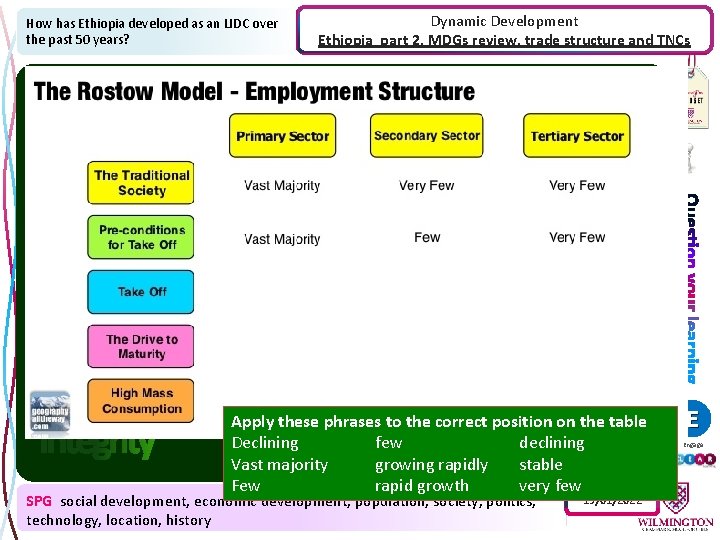
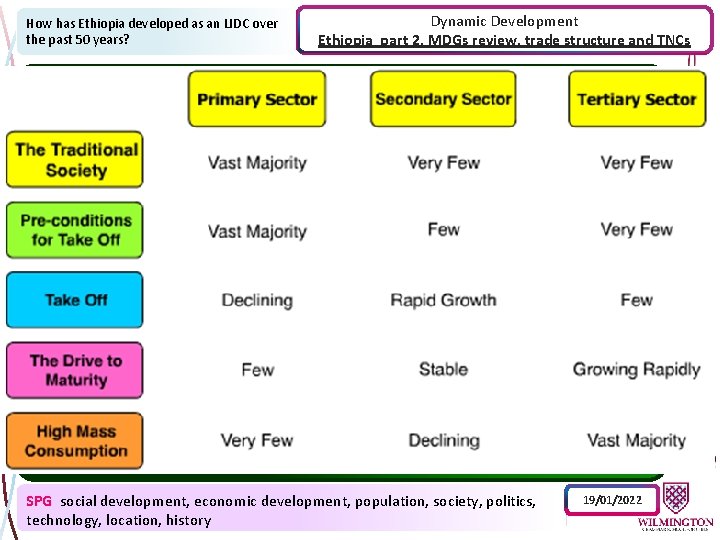
How has Ethiopia developed as an LIDC over the past 50 years? Dynamic Development Ethiopia part 2. MDGs review, trade structure and TNCs Apply these phrases to the correct position on the table Declining few declining Vast majority growing rapidly stable Few rapid growth very few SPG social development, economic development, population, society, politics, technology, location, history 19/01/2022 E Engage
How has Ethiopia developed as an LIDC over the past 50 years? Dynamic Development Ethiopia part 2. MDGs review, trade structure and TNCs SPG social development, economic development, population, society, politics, technology, location, history 19/01/2022
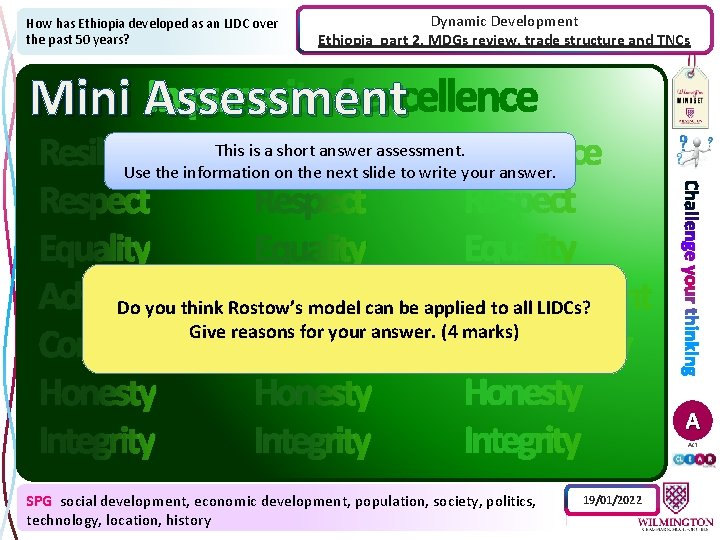
How has Ethiopia developed as an LIDC over the past 50 years? Dynamic Development Ethiopia part 2. MDGs review, trade structure and TNCs Mini Assessment This is a short answer assessment. Use the information on the next slide to write your answer. Do you think Rostow’s model can be applied to all LIDCs? Give reasons for your answer. (4 marks) A Act SPG social development, economic development, population, society, politics, technology, location, history 19/01/2022
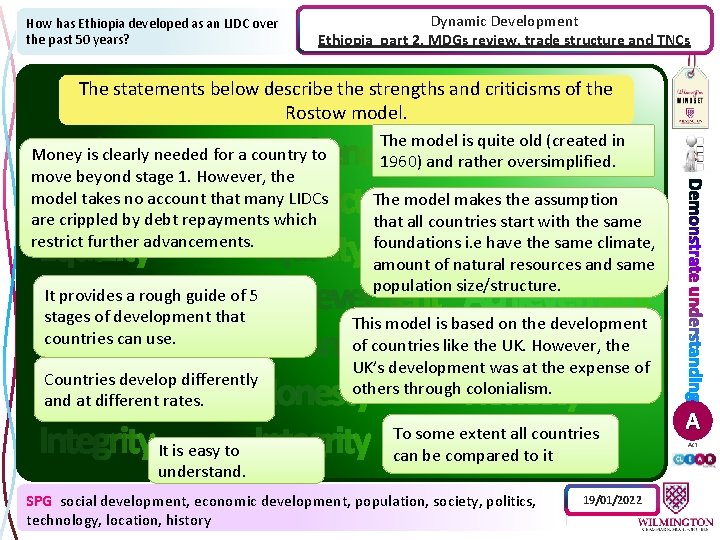
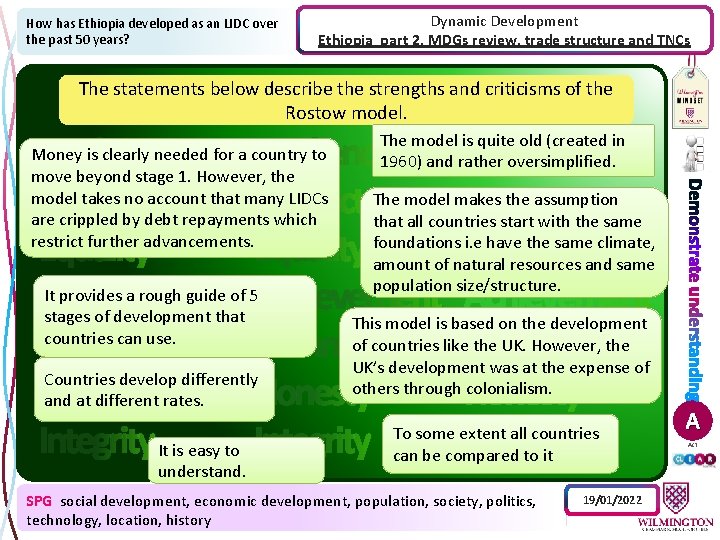
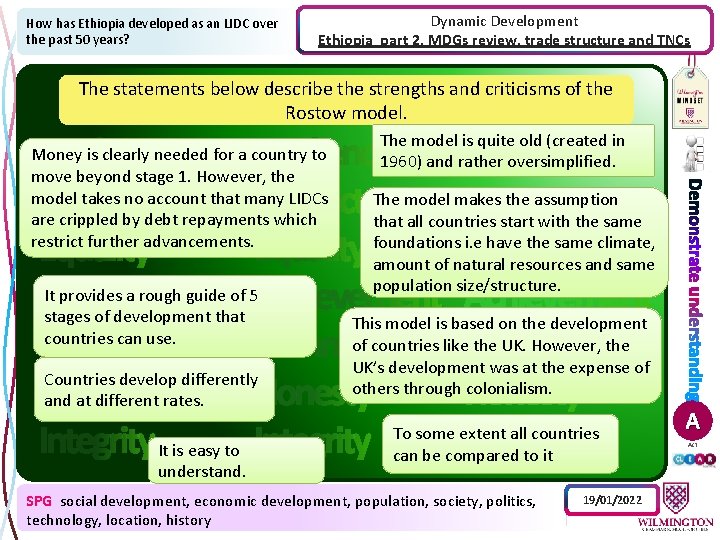
How has Ethiopia developed as an LIDC over the past 50 years? Dynamic Development Ethiopia part 2. MDGs review, trade structure and TNCs The statements below describe the strengths and criticisms of the Rostow model. Money is clearly needed for a country to move beyond stage 1. However, the model takes no account that many LIDCs are crippled by debt repayments which restrict further advancements. It provides a rough guide of 5 stages of development that countries can use. Countries develop differently and at different rates. It is easy to understand. The model is quite old (created in 1960) and rather oversimplified. The model makes the assumption that all countries start with the same foundations i. e have the same climate, amount of natural resources and same population size/structure. This model is based on the development of countries like the UK. However, the UK’s development was at the expense of others through colonialism. To some extent all countries can be compared to it SPG social development, economic development, population, society, politics, technology, location, history 19/01/2022 A Act
How has Ethiopia developed as an LIDC over the past 50 years? Dynamic Development Ethiopia part 2. MDGs review, trade structure and TNCs The statements below describe the strengths and criticisms of the Rostow model. Money is clearly needed for a country to move beyond stage 1. However, the model takes no account that many LIDCs are crippled by debt repayments which restrict further advancements. It provides a rough guide of 5 stages of development that countries can use. Countries develop differently and at different rates. It is easy to understand. The model is quite old (created in 1960) and rather oversimplified. The model makes the assumption that all countries start with the same foundations i. e have the same climate, amount of natural resources and same population size/structure. This model is based on the development of countries like the UK. However, the UK’s development was at the expense of others through colonialism. To some extent all countries can be compared to it SPG social development, economic development, population, society, politics, technology, location, history 19/01/2022 A Act
How has Ethiopia developed as an LIDC over the past 50 years? Dynamic Development Ethiopia part 2. MDGs review, trade structure and TNCs The statements below describe the strengths and criticisms of the Rostow model. Money is clearly needed for a country to move beyond stage 1. However, the model takes no account that many LIDCs are crippled by debt repayments which restrict further advancements. It provides a rough guide of 5 stages of development that countries can use. Countries develop differently and at different rates. It is easy to understand. The model is quite old (created in 1960) and rather oversimplified. The model makes the assumption that all countries start with the same foundations i. e have the same climate, amount of natural resources and same population size/structure. This model is based on the development of countries like the UK. However, the UK’s development was at the expense of others through colonialism. To some extent all countries can be compared to it SPG social development, economic development, population, society, politics, technology, location, history 19/01/2022 A Act
How has Ethiopia developed as an LIDC over the past 50 years? Dynamic Development Ethiopia part 2. MDGs review, trade structure and TNCs The statements below describe the strengths and criticisms of the Rostow model. Money is clearly needed for a country to move beyond stage 1. However, the model takes no account that many LIDCs are crippled by debt repayments which restrict further advancements. It provides a rough guide of 5 stages of development that countries can use. Countries develop differently and at different rates. It is easy to understand. The model is quite old (created in 1960) and rather oversimplified. The model makes the assumption that all countries start with the same foundations i. e have the same climate, amount of natural resources and same population size/structure. This model is based on the development of countries like the UK. However, the UK’s development was at the expense of others through colonialism. To some extent all countries can be compared to it SPG social development, economic development, population, society, politics, technology, location, history 19/01/2022 A Act
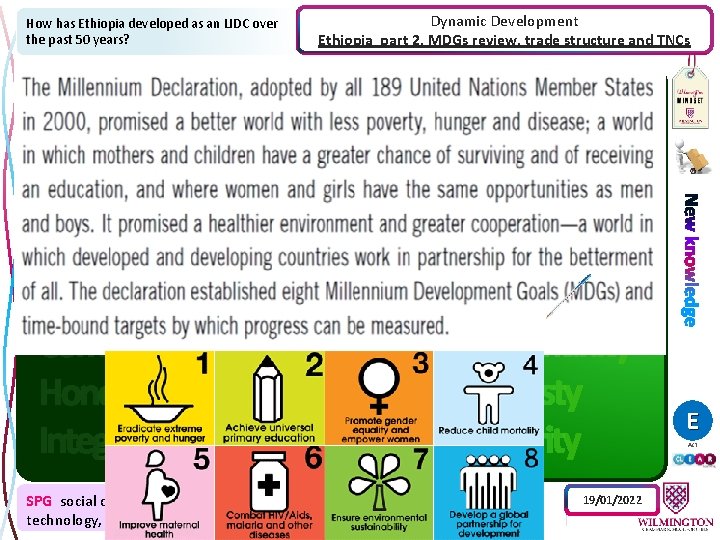
How has Ethiopia developed as an LIDC over the past 50 years? Dynamic Development Ethiopia part 2. MDGs review, trade structure and TNCs E Act SPG social development, economic development, population, society, politics, technology, location, history 19/01/2022
How has Ethiopia developed as an LIDC over the past 50 years? Dynamic Development Ethiopia part 2. MDGs review, trade structure and TNCs A Act SPG social development, economic development, population, society, politics, technology, location, history 19/01/2022
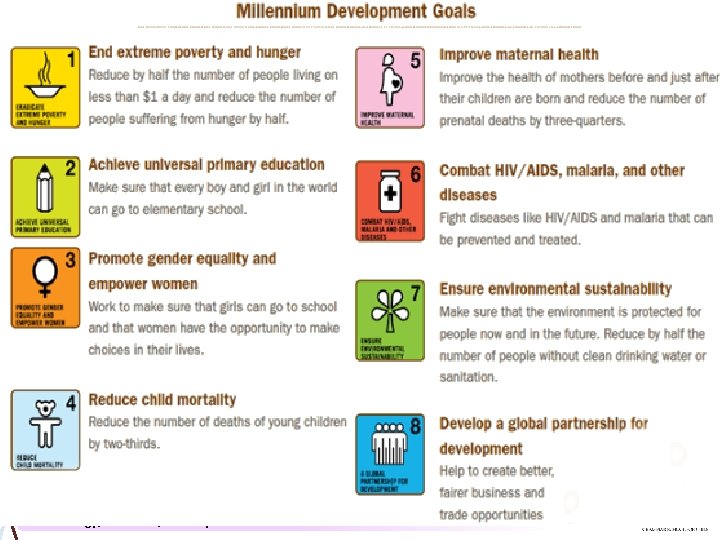
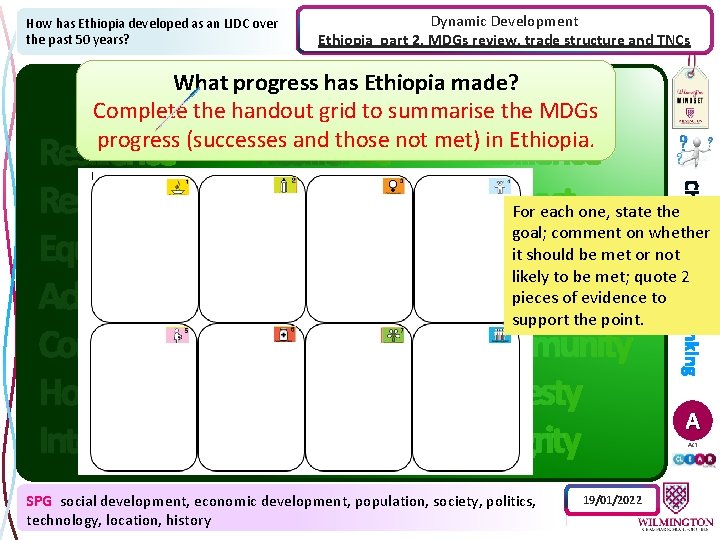
How has Ethiopia developed as an LIDC over the past 50 years? Dynamic Development Ethiopia part 2. MDGs review, trade structure and TNCs What progress has Ethiopia made? Complete the handout grid to summarise the MDGs progress (successes and those not met) in Ethiopia. For each one, state the goal; comment on whether it should be met or not likely to be met; quote 2 pieces of evidence to support the point. A Act SPG social development, economic development, population, society, politics, technology, location, history 19/01/2022
How has Ethiopia developed as an LIDC over the past 50 years? Dynamic Development Ethiopia part 2. MDGs review, trade structure and TNCs Mini Assessment Homework: To prepare for next lesson. To what extent do you think that the MDGs have benefitted Ethiopia? Give reasons for your decision (6 marks) A Act SPG social development, economic development, population, society, politics, technology, location, history 19/01/2022
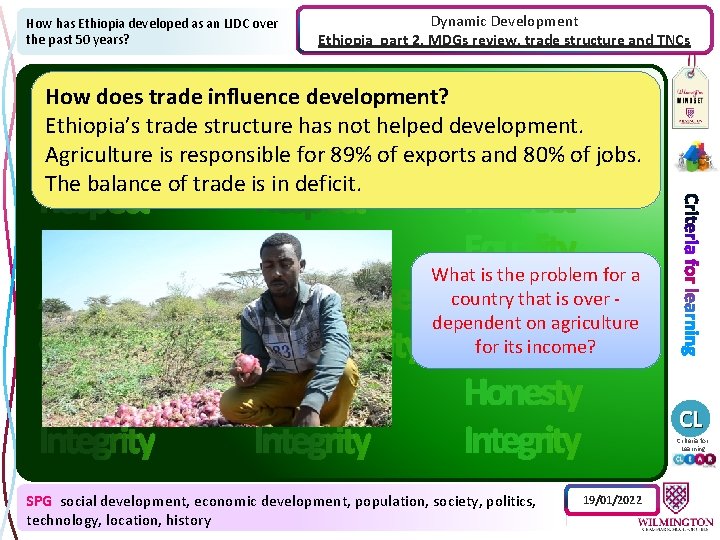
How has Ethiopia developed as an LIDC over the past 50 years? Dynamic Development Ethiopia part 2. MDGs review, trade structure and TNCs How does trade influence development? Ethiopia’s trade structure has not helped development. Agriculture is responsible for 89% of exports and 80% of jobs. The balance of trade is in deficit. What is the problem for a country that is over dependent on agriculture for its income? CL Criteria for Learning SPG social development, economic development, population, society, politics, technology, location, history 19/01/2022
How has Ethiopia developed as an LIDC over the past 50 years? Dynamic Development Ethiopia part 2. MDGs review, trade structure and TNCs One reason why Ethiopia is poor is because it depends for its income on the sale of primary products (raw materials) such as …. (read page 190 and list the main commodities). Such products are often vulnerable to two key influences – (Explain: see page 190) Take it further: complete the last box with your own explaination E Engage SPG social development, economic development, population, society, politics, technology, location, history 19/01/2022
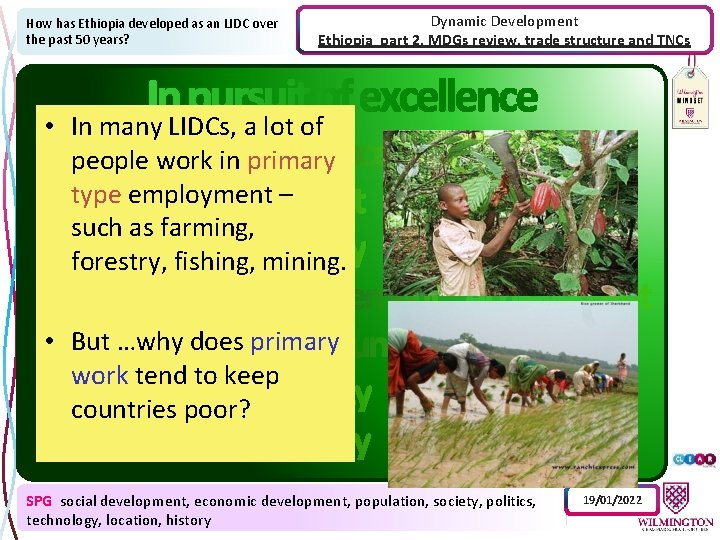
How has Ethiopia developed as an LIDC over the past 50 years? Dynamic Development Ethiopia part 2. MDGs review, trade structure and TNCs • In many LIDCs, a lot of people work in primary type employment – such as farming, forestry, fishing, mining. • But …why does primary work tend to keep countries poor? SPG social development, economic development, population, society, politics, technology, location, history 19/01/2022
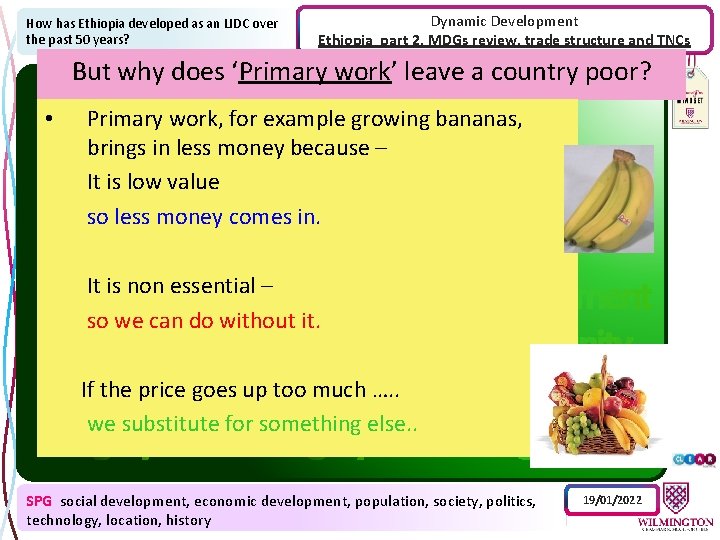
How has Ethiopia developed as an LIDC over the past 50 years? Dynamic Development Ethiopia part 2. MDGs review, trade structure and TNCs But why does ‘Primary work’ leave a country poor? • Primary work, for example growing bananas, brings in less money because – It is low value so less money comes in. It is non essential – so we can do without it. If the price goes up too much …. . we substitute for something else. . SPG social development, economic development, population, society, politics, technology, location, history 19/01/2022
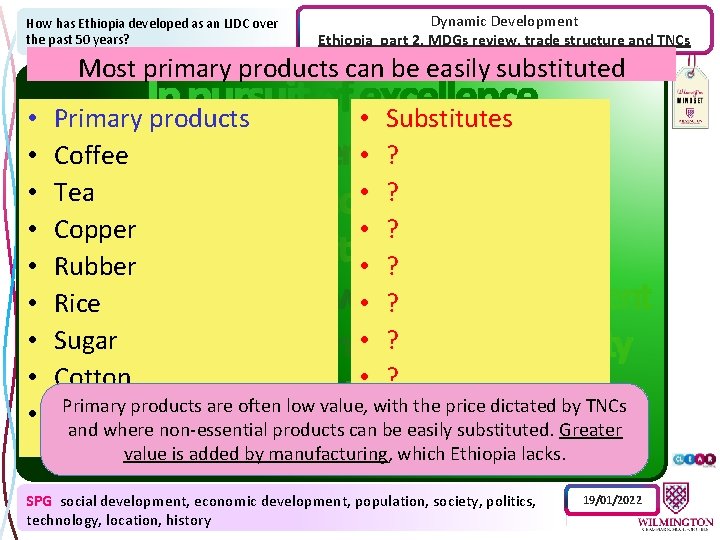
How has Ethiopia developed as an LIDC over the past 50 years? Dynamic Development Ethiopia part 2. MDGs review, trade structure and TNCs Most primary products can be easily substituted • • • Primary products • Substitutes Coffee • ? Tea • ? Copper • ? Rubber • ? Rice • ? Sugar • ? Cotton • ? Primary products are often low value, with the price dictated by TNCs Bananas • ? and where non-essential products can be easily substituted. Greater value is added by manufacturing, which Ethiopia lacks. SPG social development, economic development, population, society, politics, technology, location, history 19/01/2022
How has Ethiopia developed as an LIDC over the past 50 years? Dynamic Development Ethiopia part 2. MDGs review, trade structure and TNCs One very important product from Ethiopia is coffee. But this product does not earn much money for Ethiopia because – https: //www. youtube. com/watch? v=t 4 l. O-EFQK_g https: //www. youtube. com/watch? v=cf. VS 1 vb. Xy. Xo What are the messages of these clips? E Engage SPG social development, economic development, population, society, politics, technology, location, history 19/01/2022
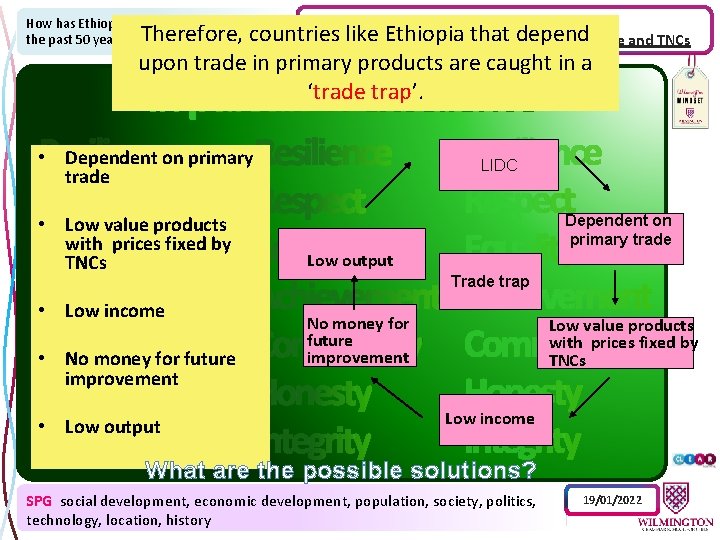
Dynamic Development countries like part Ethiopia 2. MDGs that review, depend trade structure and TNCs How has Ethiopia developed as an LIDC over the past 50 years? Therefore, upon trade in primary products are caught in a ‘trade trap’. • Dependent on primary trade • Low value products with prices fixed by TNCs • Low income • No money for future improvement • Low output LIDC Dependent on primary trade Low output Trade trap No money for future improvement Low value products with prices fixed by TNCs Low income What are the possible solutions? SPG social development, economic development, population, society, politics, technology, location, history 19/01/2022
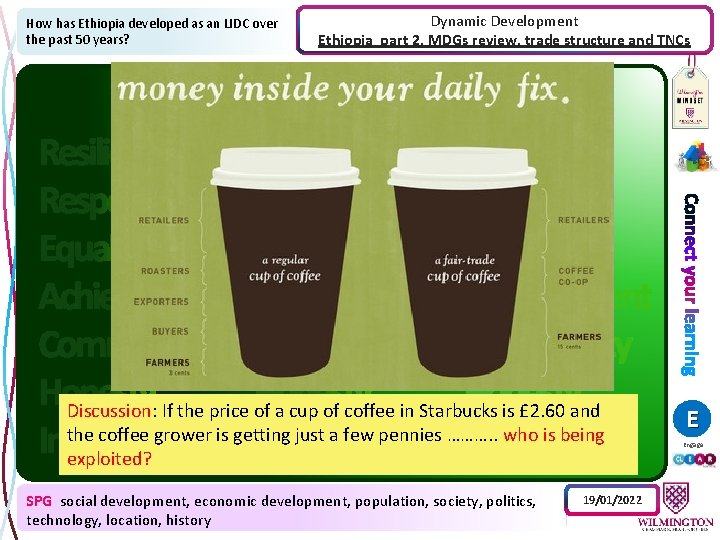
How has Ethiopia developed as an LIDC over the past 50 years? Dynamic Development Ethiopia part 2. MDGs review, trade structure and TNCs Discussion: If the price of a cup of coffee in Starbucks is £ 2. 60 and the coffee grower is getting just a few pennies ………. . who is being exploited? SPG social development, economic development, population, society, politics, technology, location, history 19/01/2022 E Engage
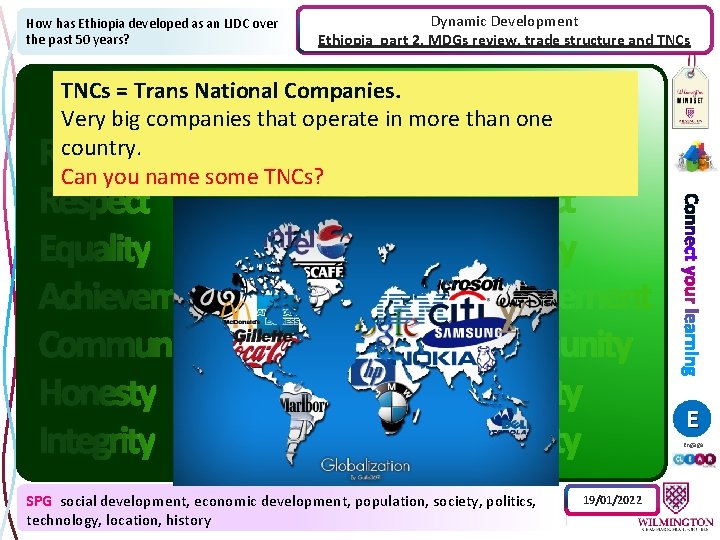
How has Ethiopia developed as an LIDC over the past 50 years? Dynamic Development Ethiopia part 2. MDGs review, trade structure and TNCs = Trans National Companies. Very big companies that operate in more than one country. Can you name some TNCs? E Engage SPG social development, economic development, population, society, politics, technology, location, history 19/01/2022
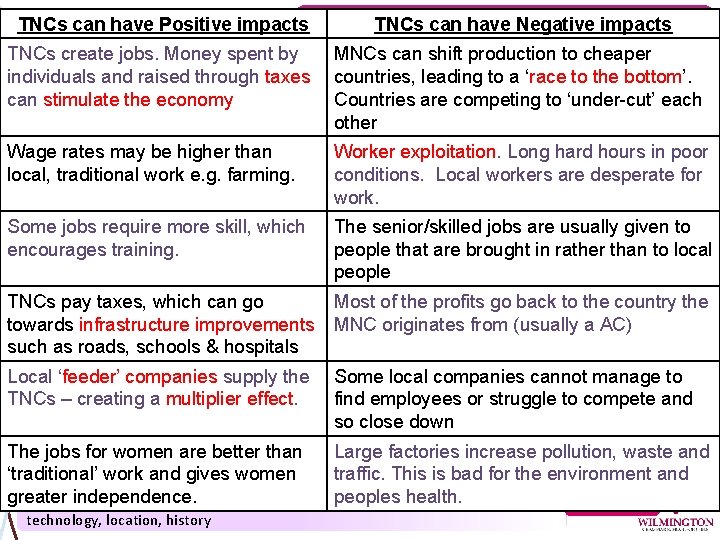
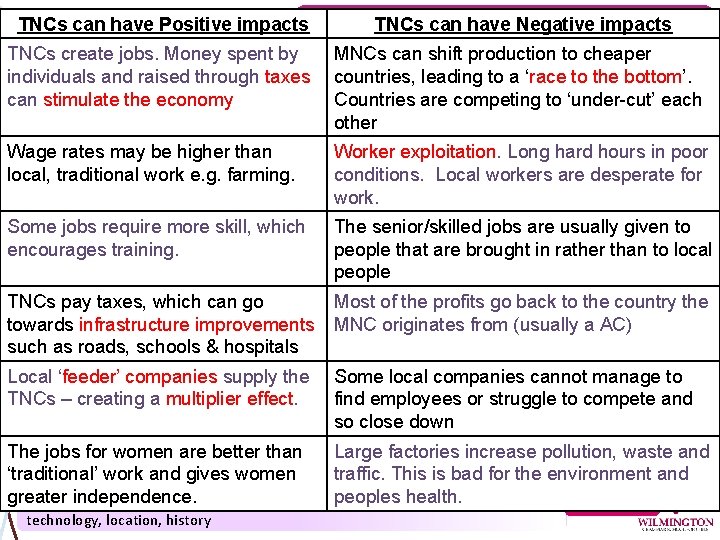
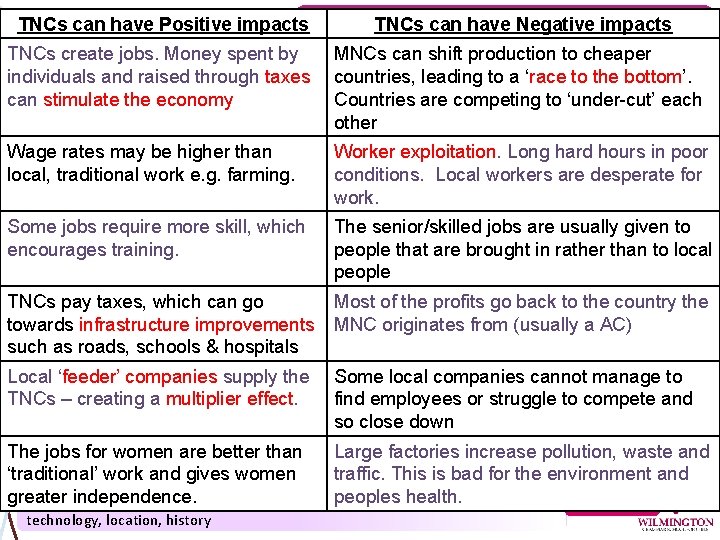
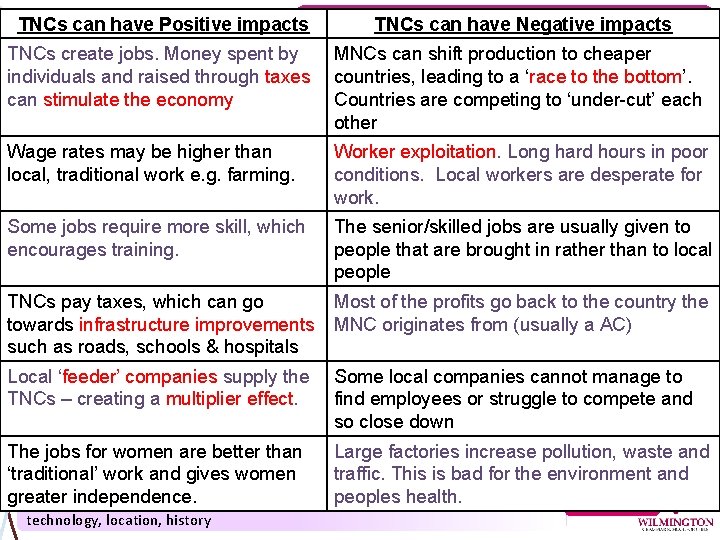
How hascan Ethiopia developed as an LIDC over TNCs have Positive impacts the past 50 years? TNCs create jobs. Money spent by individuals and raised through taxes can stimulate the economy Dynamic Development TNCs can have Negative impacts Ethiopia part 2. MDGs review, trade structure and TNCs MNCs can shift production to cheaper countries, leading to a ‘race to the bottom’. Countries are competing to ‘under-cut’ each other Wage rates may be higher than local, traditional work e. g. farming. Worker exploitation. Long hard hours in poor conditions. Local workers are desperate for work. Some jobs require more skill, which encourages training. The senior/skilled jobs are usually given to people that are brought in rather than to local people TNCs pay taxes, which can go towards infrastructure improvements such as roads, schools & hospitals Most of the profits go back to the country the MNC originates from (usually a AC) Local ‘feeder’ companies supply the TNCs – creating a multiplier effect. Some local companies cannot manage to find employees or struggle to compete and so close down The jobs for women are better than Large factories increase pollution, waste and ‘traditional’ work and gives women traffic. This is bad for the environment and greater independence. peoples health. 19/01/2022 SPG social development, economic development, population, society, politics, technology, location, history
How hascan Ethiopia developed as an LIDC over TNCs have Positive impacts the past 50 years? TNCs create jobs. Money spent by individuals and raised through taxes can stimulate the economy Dynamic Development TNCs can have Negative impacts Ethiopia part 2. MDGs review, trade structure and TNCs MNCs can shift production to cheaper countries, leading to a ‘race to the bottom’. Countries are competing to ‘under-cut’ each other Wage rates may be higher than local, traditional work e. g. farming. Worker exploitation. Long hard hours in poor conditions. Local workers are desperate for work. Some jobs require more skill, which encourages training. The senior/skilled jobs are usually given to people that are brought in rather than to local people TNCs pay taxes, which can go towards infrastructure improvements such as roads, schools & hospitals Most of the profits go back to the country the MNC originates from (usually a AC) Local ‘feeder’ companies supply the TNCs – creating a multiplier effect. Some local companies cannot manage to find employees or struggle to compete and so close down The jobs for women are better than Large factories increase pollution, waste and ‘traditional’ work and gives women traffic. This is bad for the environment and greater independence. peoples health. 19/01/2022 SPG social development, economic development, population, society, politics, technology, location, history
How hascan Ethiopia developed as an LIDC over TNCs have Positive impacts the past 50 years? TNCs create jobs. Money spent by individuals and raised through taxes can stimulate the economy Dynamic Development TNCs can have Negative impacts Ethiopia part 2. MDGs review, trade structure and TNCs MNCs can shift production to cheaper countries, leading to a ‘race to the bottom’. Countries are competing to ‘under-cut’ each other Wage rates may be higher than local, traditional work e. g. farming. Worker exploitation. Long hard hours in poor conditions. Local workers are desperate for work. Some jobs require more skill, which encourages training. The senior/skilled jobs are usually given to people that are brought in rather than to local people TNCs pay taxes, which can go towards infrastructure improvements such as roads, schools & hospitals Most of the profits go back to the country the MNC originates from (usually a AC) Local ‘feeder’ companies supply the TNCs – creating a multiplier effect. Some local companies cannot manage to find employees or struggle to compete and so close down The jobs for women are better than Large factories increase pollution, waste and ‘traditional’ work and gives women traffic. This is bad for the environment and greater independence. peoples health. 19/01/2022 SPG social development, economic development, population, society, politics, technology, location, history
How hascan Ethiopia developed as an LIDC over TNCs have Positive impacts the past 50 years? TNCs create jobs. Money spent by individuals and raised through taxes can stimulate the economy Dynamic Development TNCs can have Negative impacts Ethiopia part 2. MDGs review, trade structure and TNCs MNCs can shift production to cheaper countries, leading to a ‘race to the bottom’. Countries are competing to ‘under-cut’ each other Wage rates may be higher than local, traditional work e. g. farming. Worker exploitation. Long hard hours in poor conditions. Local workers are desperate for work. Some jobs require more skill, which encourages training. The senior/skilled jobs are usually given to people that are brought in rather than to local people TNCs pay taxes, which can go towards infrastructure improvements such as roads, schools & hospitals Most of the profits go back to the country the MNC originates from (usually a AC) Local ‘feeder’ companies supply the TNCs – creating a multiplier effect. Some local companies cannot manage to find employees or struggle to compete and so close down The jobs for women are better than Large factories increase pollution, waste and ‘traditional’ work and gives women traffic. This is bad for the environment and greater independence. peoples health. 19/01/2022 SPG social development, economic development, population, society, politics, technology, location, history