
How geopolitics have been implemented in the North
How geopolitics have been implemented in the North: historical perspective Ilya Solomeshch Petr. SU 7 th International Summer School in Karelia 2010 11. 05. 2010
‘Does history matter? ’ • Ontological, cognitive and pedagogical interrelations between political sciences, IR studies and history • Several regionally oriented and chronologically scattered cases • Not a word about geopolitical theories…
Two basic ways of approaching history knowledge in political discourse: • Ignoring history and ‘inventing a bike’ • Using historical facts as a facultative illustration
Cases • TRADE, STATE and POWER: – Hansa – Pomor trade – Karelian peddler trade • History based (geo)political discourse and speculative practices in the North • “The Greater Finland” project(s): geopolitics in practice?
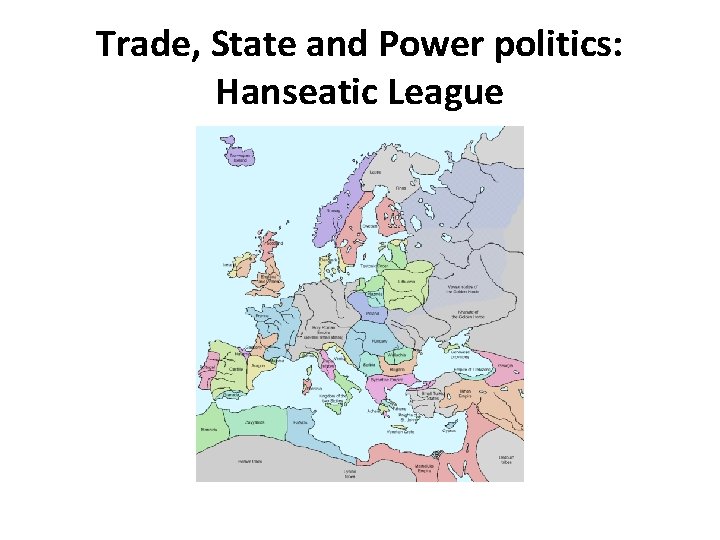
Trade, State and Power politics: Hanseatic League
Hansa: basic facts • Where: along the coastal line of Northern Europe, from the Baltic to the North Sea, and also inland • When: ca. 13 th – 17 th centuries, i. e. the Late Middle Ages and Early Modern Time • What: A. Economic and political alliance of trading cities and their guilds that established and maintained a trade monopoly • What: B. Own law system established , own protection and mutual aid system furnished -- a sort of a political autonomy and, in some cases, political entities of their own created
Hansa: Common features of the Hanseatic cities’ structure • Despite of generally fluid structure… • Most of the Hansa cities either started as independent, or gained independence through joining the League • Strategic locations along trade routes • Economic power combined with military might… Used not only against pirates, but also against states (war against Denmark, 13611370)
Hansa: reasons for decline (by the end of the 16 th cent. ) • Internal contradictions • New (and renewed) territorial states as an eventual rival • New financial and credit mechanisms in Europe
HANSA in the 21 th century? • Hanseatic rhetorics in the Baltic Sea region • Instrument of building new bridges between East and West? • Involvement of supraregional actors
Pomor trade: basic facts • When: 18 th – beginning of the 20 th centuries • What: Grain for Fish, usually barter-based exchange, compensatory function prevailing • Where: Sea-based logistics – the Barens Sea, the White Sea • Controversively perceived and approached by the States • Dying away by (but not necessarily because of) 1917
Karelian Peddler Trade • What: Broad spectrum of goods, from grain and textile till coffee and sewing-machines • Where: Karelia and Finland, waterways-based logistics • Seasonal, compensatory function prevailing • Low average earnings • Few most successful peddlers settled in Finland • Controversively perceived by the State • Dying away by (but not necessarily because of) 1917 • Random border-crossings even in the 1930 s
Case: the Greater Finland project • The White Greater Finland Karelian irredenta – Natural borders – Ethnic community of the Finns • Implementation attempts – Panfennism, late 19 th – early 20 th cent. – ‘Tribal’ wars, 1918 -22 – Äänislinna 1941 -44. . . – Euregio Karelia? ? ?
Case: the Greater Finland project (2) • The Red Greater Finland Karelian statehood (1920 -) – The Red Finns’ ideas and practice in Karelia – Clear references to the ideas of Kjellen and Ratzell • Blamed for bourgeois nationalism… • Karelian real autonomy ended up with the start of centralisation of the Soviet Union by the late 1920 s.
Cultural interaction through contacts • Language • Habits and everyday life • Transfer of skills
Perceptions, images, stereotypes The neighbour is often identified with its State, not with ethnicity, and is the Other in any case… • Laukkuryssä for [Russian] Karelians in Finland • Ruočči for the Finns, … and Ruoččiheinä for the thisle in [Russian] Karelia
Contacts in the shadow of the State policies (1) • Contact zone including vast borderlands of neigbouring states, from the Arctic Ocean till Karelian Isthmus and the Baltic Sea basine • Dynamic, • Multiethnic, • Multiconfessional • Within each state, Centre-Periphery links emphasised, [cross-border] Periphery- Periphery links neglected / limited • Security based policy / discourse prevailing
Contacts in the shadow of the State policies (2) • Transborder East-West contacts despite, but not owing to the State policy • Compensatory function prevailing, both in material and in cultural spheres
- Slides: 17