
How fortunate for leaders that men do not




- Slides: 16
“How fortunate for leaders that men do not think” Adolf Hitler Science and industry will become the weapons of demagogues.
History of Metropolis is a silent science-fiction movie released in 1927 by Fritz Lang, a master of German Expressionism. Set in a futuristic dystopia divided into two distinct and separate classes—the thinkers and the workers. Lang's film is the summit of German Expressionism, the combination of stylized sets, dramatic camera angles, bold shadows and frankly artificial theatrics
Originated in Europe in the 1920 s, and is broadly defined as the rejection of Western conventions, and the depiction of reality that is widely distorted for emotional effect. Heavily influenced by artists such as Vincent van Gogh, Edvard Munch, and El Greco, Expressionists were less concerned with producing aesthetically pleasing compositions as they were with creating powerful reactions to their work through the use of bright, clashing colors, flat shapes, and jagged brushstrokes. In its nature, the movement was interested in the relationship between art and society, and encompassed a broad range of fields, including architecture, painting, and film. Similar to Expressionist paintings, Expressionist films sought to convey the inner, subjective experience of its subjects.
The exaggerated movements of the characters, the angular, crowded skyline, and the sharp contrasts between the upper and lower city, all adhere to the Expressionist tradition. Expressionist film in the 1920 s was based on the premise that film becomes art only to the extent that the film image differs from reality. This particular interpretation of cinema-as-art would go on to influence some of the most important filmmakers of the 20 th century, including Alfred Hitchcock, Werner Herzog, and Tim Burton.
The movie opens by showing the workers and their city, situated deep below the earth’s surface. They are shown dressed alike, walking in sync, holding their heads down in submission, resignation and desperation. Throughout the movie, the human cattle is depicted as being physically and mentally exhausted, and highly impressionable.
Metropolis was released in 1927 and can be considered symptomatic of the era. It was the time of the Weimar Republic in Germany. After World War I, the country had been forced to comply with the conditions of the Treaty of Versailles. This was a harsh Treaty imposed by the Allied forces which meant Germany had to denounce its monarchy; reduce its armed forces to a small infantry unit; pay large reparation fees to the Allies; and release large areas of particularly fertile or mineral-rich land to the Allied countries. Many Germans felt they had their state identity stripped from them; there was nothing to fill them with pride anymore: no monarchy, no great industries, no empire.
Some believed the Allied forces had unfairly punished Germany, over other enemies, because they had seen the growing German empire as a threat and wanted to diminish it. In the immediate post-war era Germany was thrown into political chaos, the Weimar Republic was created by the Allies to rule the country; however the government was always a coalition. In 1919 the Communists revolted in the streets of Berlin; Fascism grew; there were continuous riots in the streets, particularly when these two political poles clashed.
The coalition governments never lasted long; at times there could be more than 11 parties involved in ruling the country. The average length of a government holding control was 9 months. At the same time, Germany faced hyper-inflation from the reparations and war damage, which was later made worse by the Wall Street crash of 1929. There are famous images of people carrying their money in wheelbarrows to buy a loaf of bread, or burning money to keep warm because it was worth more as fuel.
The German people were living in a nightmare state and many filmmakers exposed this in their work. One particular style was popular during this era, a style that would be called German Expressionism. The artists and filmmakers who created expressionist works did not follow a manifesto, like the surrealist, nor did they consider it a genre (in fact the texts spanned a number of genres), however it was a distinct style that reflected the nightmare conditions of Weimar Germany.
Character profiles http: //pivarski. watson. org/metropolis /People/index. html
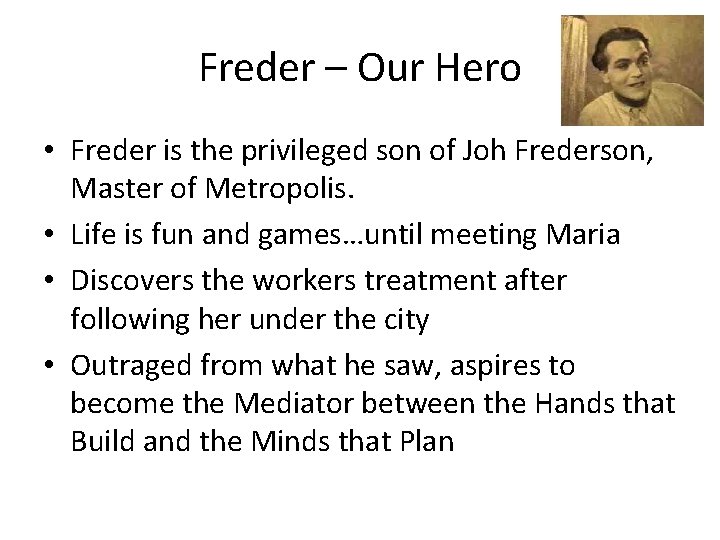
Freder – Our Hero • Freder is the privileged son of Joh Frederson, Master of Metropolis. • Life is fun and games…until meeting Maria • Discovers the workers treatment after following her under the city • Outraged from what he saw, aspires to become the Mediator between the Hands that Build and the Minds that Plan
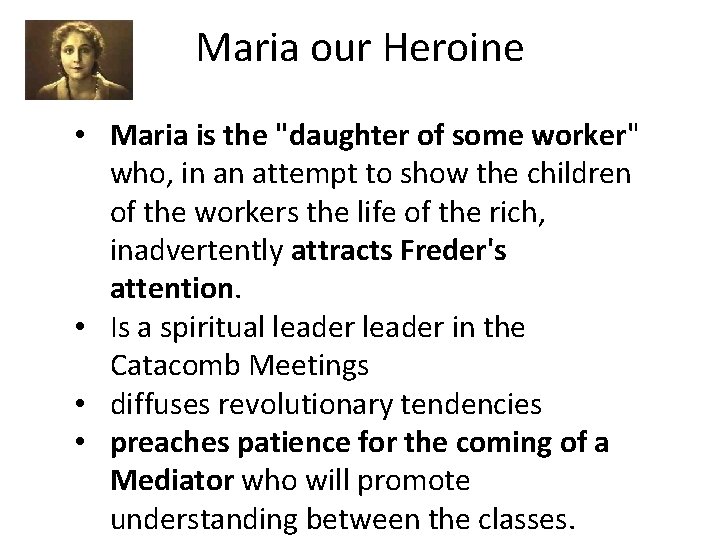
Maria our Heroine • Maria is the "daughter of some worker" who, in an attempt to show the children of the workers the life of the rich, inadvertently attracts Freder's attention. • Is a spiritual leader in the Catacomb Meetings • diffuses revolutionary tendencies • preaches patience for the coming of a Mediator who will promote understanding between the classes.
Rotwangs Robot • Needs to replace his lost Hel • Rotwang the mad scientist built an evil robot. • Rotwang gives the robot Marias likeness to influence the workers • Doesn’t work out, robot is uncontrollabe and it eventually desires chaos and destruction. • Robot brings on riots, destroys the engine of Metropolis, floods the workers city.
Rotwang the evil Scientist • Former friend of Frederson • Lost Hel in rivalry (Hel is Freders mother) • Result is he lives in small house in middle of city, as a recluse. • Creates gadgets that no Man was ever meant to know.