
How Enterprise Decision Management EDM Capabilities Enable Customer
How Enterprise Decision Management (EDM) Capabilities Enable Customer Centric Organizations Tony Branda Executive Head of Business Analysis, RBS Citizens NA December, 2008
Agenda I. Why Enterprise Decision Management? 1. Retail Bank Data-Mining Evolution 2. Level Setting: Business Intelligence and analytics 3. The Evolution in World Class Customer Mgt. 4. Best Practices in Customer Centric Architecture 5. Killer Customer Applications 6. Vision 7. Who Is Your Customer? 8. What Does Top Analytical Talent Need? 9. What Is The Impact To Your Bottom Line? II. Steps To Deploy EDM 1. Assess Your Organization 2. Create A Vision 3. Create A Phased Plan 4. Procure Executive Sponsorship 5. Enact The Right Governance 6. Implementation Considerations III. Major Pitfalls 1. Top Ten Reasons EDM Projects Fail 2
Retail Bank Data-Mining Evolution • As Retail Banks move from focusing on pushing products to managing customer relationships, their approach to data analytics has gone from being one dimensional to multi-dimensional • The multi-dimensional nature of operating at a customer level has forced a more collaborative organization and common infrastructure to maximize customer value and experience in addition to shareholder value • Certain lines of business by their very nature have been early adopters of analytics to drive revenue growth. The Commodity nature of businesses like Cards and HELOC have facilitated heavy data-mining to differentiate themselves in commodity markets • Customer Centricity will best leverage economies of skill and scale derived from analytical platforms • Methodologies, techniques and best practices have proven transferable to other retail finance products 3
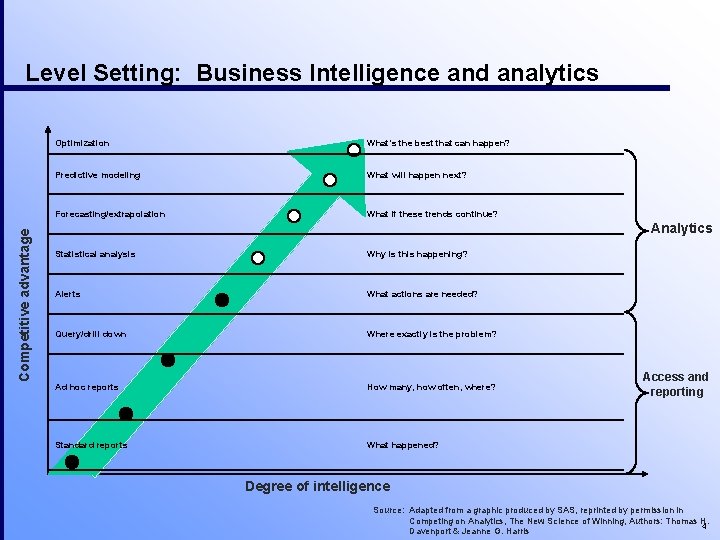
Competitive advantage Level Setting: Business Intelligence and analytics Optimization What’s the best that can happen? Predictive modeling What will happen next? Forecasting/extrapolation What if these trends continue? Analytics Statistical analysis Why is this happening? Alerts What actions are needed? Query/drill down Where exactly is the problem? Ad hoc reports How many, how often, where? Standard reports What happened? Access and reporting Degree of intelligence Source: Adapted from a graphic produced by SAS, reprinted by permission in Competing on Analytics, The New Science of Winning, Authors: Thomas H. 4 Davenport & Jeanne G. Harris
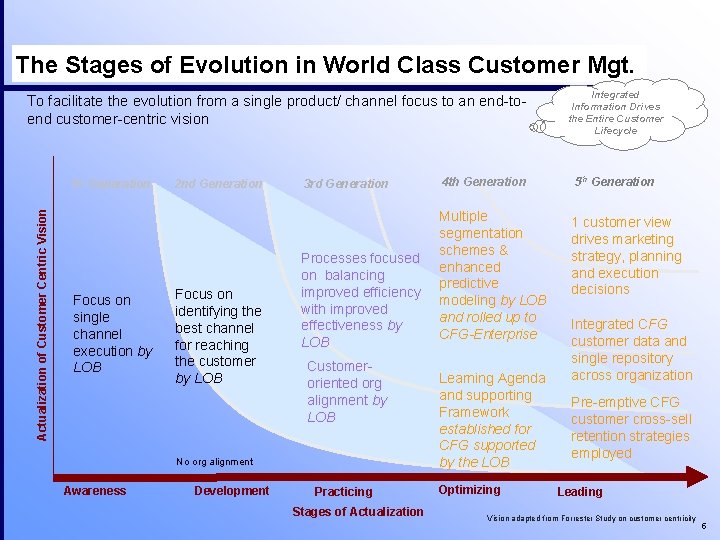
The Stages of Evolution in World Class Customer Mgt. To facilitate the evolution from a single product/ channel focus to an end-toend customer-centric vision Actualization of Customer Centric Vision 1 st Generation Focus on single channel execution by LOB 2 nd Generation Focus on identifying the best channel for reaching the customer by LOB 3 rd Generation Processes focused on balancing improved efficiency with improved effectiveness by LOB Customeroriented org alignment by LOB No org alignment Awareness Development Practicing Stages of Actualization Integrated Information Drives the Entire Customer Lifecycle 4 th Generation 5 th Generation Multiple segmentation schemes & enhanced predictive modeling by LOB and rolled up to CFG-Enterprise 1 customer view drives marketing strategy, planning and execution decisions Learning Agenda and supporting Framework established for CFG supported by the LOB Optimizing Integrated CFG customer data and single repository across organization Pre-emptive CFG customer cross-sell retention strategies employed Leading Vision adapted from Forrester Study on customer centricity 5
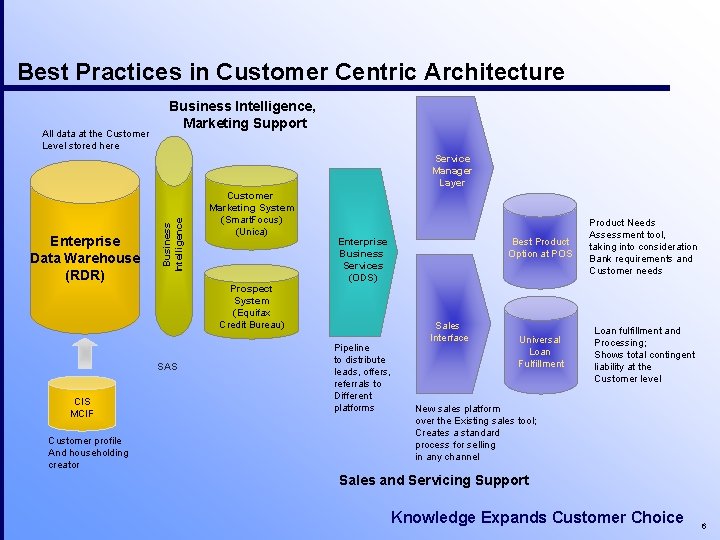
Best Practices in Customer Centric Architecture All data at the Customer Level stored here Business Intelligence, Marketing Support Enterprise Data Warehouse (RDR) Business Intelligence Service Manager Layer Customer Marketing System (Smart. Focus) (Unica) Enterprise Business Services (ODS) Prospect System (Equifax Credit Bureau) SAS CIS MCIF Customer profile And householding creator Pipeline to distribute leads, offers, referrals to Different platforms Sales Interface Best Product Option at POS Product Needs Assessment tool, taking into consideration Bank requirements and Customer needs Universal Loan Fulfillment Loan fulfillment and Processing; Shows total contingent liability at the Customer level New sales platform over the Existing sales tool; Creates a standard process for selling in any channel Sales and Servicing Support Knowledge Expands Customer Choice 6
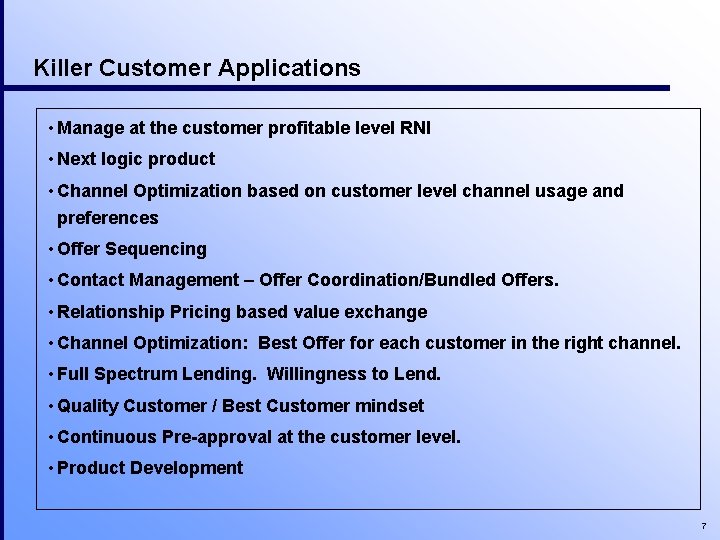
Killer Customer Applications • Manage at the customer profitable level RNI • Next logic product • Channel Optimization based on customer level channel usage and preferences • Offer Sequencing • Contact Management – Offer Coordination/Bundled Offers. • Relationship Pricing based value exchange • Channel Optimization: Best Offer for each customer in the right channel. • Full Spectrum Lending. Willingness to Lend. • Quality Customer / Best Customer mindset • Continuous Pre-approval at the customer level. • Product Development 7
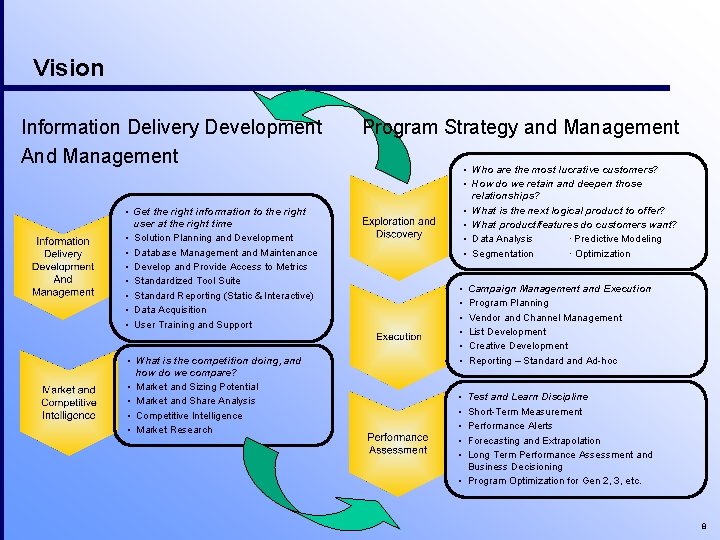
Vision Information Delivery Development And Management • Get the right information to the right user at the right time • Solution Planning and Development • Database Management and Maintenance • Develop and Provide Access to Metrics • Standardized Tool Suite • Standard Reporting (Static & Interactive) • Data Acquisition • User Training and Support • What is the competition doing, and how do we compare? • Market and Sizing Potential • Market and Share Analysis • Competitive Intelligence • Market Research Program Strategy and Management • Who are the most lucrative customers? • How do we retain and deepen those relationships? • What is the next logical product to offer? • What product/features do customers want? • Data Analysis ∙ Predictive Modeling • Segmentation ∙ Optimization • • • Campaign Management and Execution Program Planning Vendor and Channel Management List Development Creative Development Reporting – Standard and Ad-hoc • • • Test and Learn Discipline Short-Term Measurement Performance Alerts Forecasting and Extrapolation Long Term Performance Assessment and Business Decisioning • Program Optimization for Gen 2, 3, etc. 8
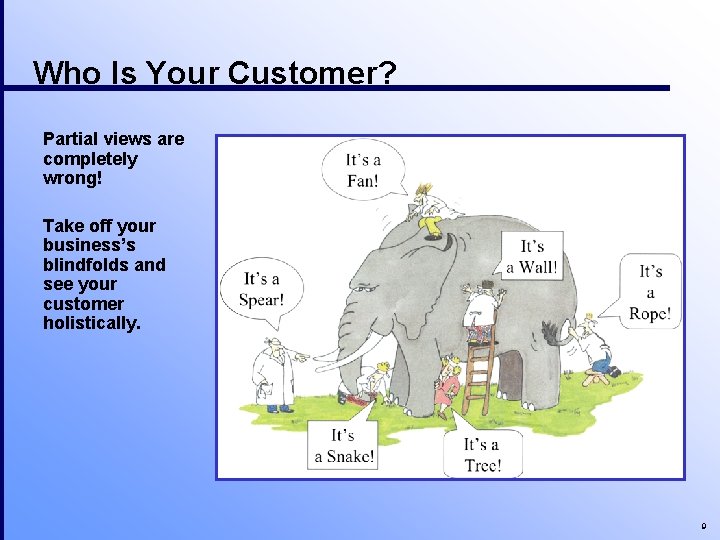
Who Is Your Customer? Partial views are completely wrong! Take off your business’s blindfolds and see your customer holistically. 9
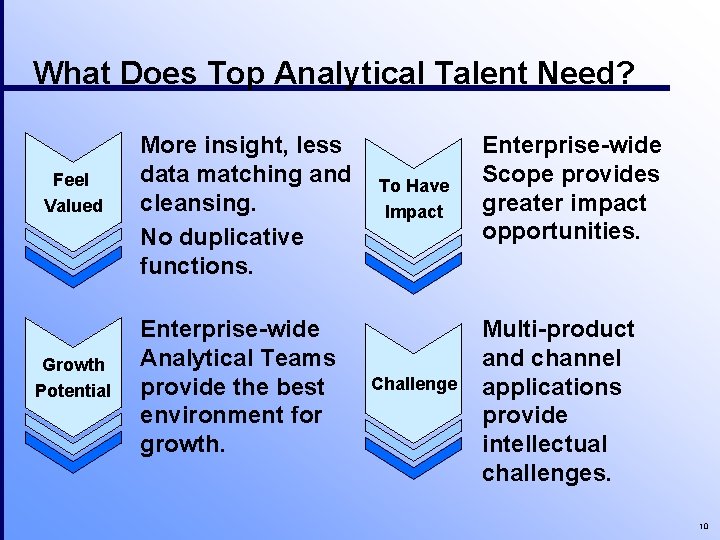
What Does Top Analytical Talent Need? Feel Valued Growth Potential More insight, less data matching and cleansing. No duplicative functions. Enterprise-wide Analytical Teams provide the best environment for growth. To Have Impact Challenge Enterprise-wide Scope provides greater impact opportunities. Multi-product and channel applications provide intellectual challenges. 10
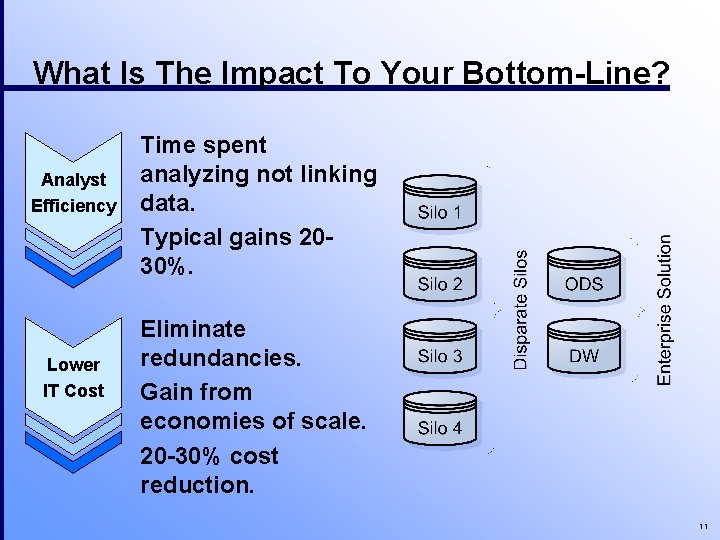
What Is The Impact To Your Bottom-Line? Analyst Efficiency Lower IT Cost Time spent analyzing not linking data. Typical gains 2030%. Eliminate redundancies. Gain from economies of scale. 20 -30% cost reduction. 11
Agenda I. Why Enterprise Decision Management? 1. Retail Bank Data-Mining Evolution 2. Level Setting: Business Intelligence and analytics 3. The Evolution in World Class Customer Mgt. 4. Best Practices in Customer Centric Architecture 5. Killer Customer Applications 6. Vision 7. Who Is Your Customer? 8. What Does Top Analytical Talent Need? 9. What Is The Impact To Your Bottom Line? II. Steps To Deploy EDM 1. Assess Your Organization 2. Create A Vision 3. Create A Phased Plan 4. Procure Executive Sponsorship 5. Enact The Right Governance 6. Implementation Considerations III. Major Pitfalls 1. Top Ten Reasons EDM Projects Fail 12
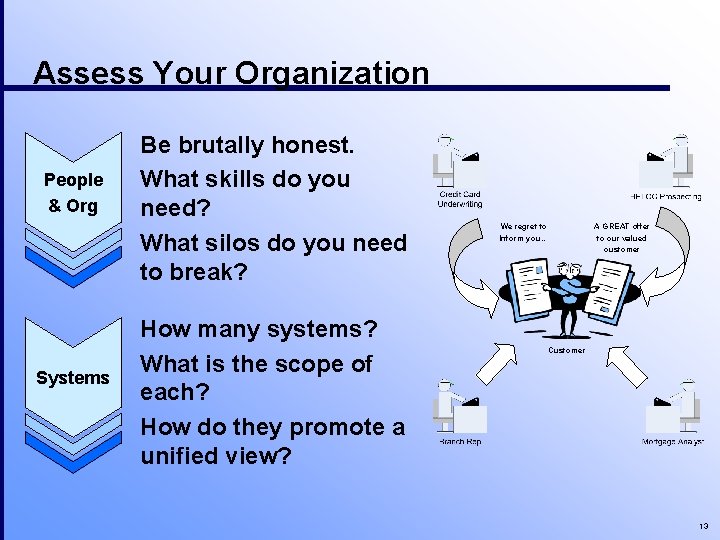
Assess Your Organization People & Org Systems Be brutally honest. What skills do you need? What silos do you need to break? How many systems? What is the scope of each? How do they promote a unified view? We regret to Inform you… A GREAT offer to our valued customer Customer 13
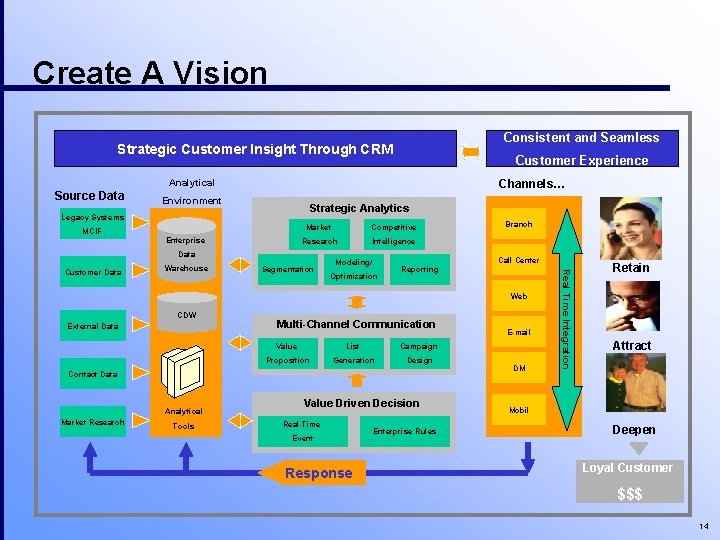
Create A Vision Consistent and Seamless Strategic Customer Insight Through CRM Customer Experience Analytical Source Data Channels… Environment Strategic Analytics Legacy Systems MCIF Enterprise Market Competitive Research Intelligence Data Warehouse Segmentation Call Center Modeling/ Optimization Reporting Web CDW External Data Multi-Channel Communication Value List Campaign Proposition Generation Design Contact Data Analytical Market Research Tools Value Driven Decision Real-Time Event Response Enterprise Rules E-mail DM Real Time Integration Customer Data Branch Retain Attract Mobil Deepen Loyal Customer $$$ 14
Create A Phased Plan • The vision is vital. It will avoid “dump and runs”. • The phased plan is what you will sell to finance partners. • Each phase should have positive ROI independent of all subsequent phases. • All phases should add up to the vision. 15
Procure Executive Sponsorship ØExecutive support is key because it: Ø Accelerates analytical growth by eliminating diversionary paths to growth. Ø Mitigates risk of reaching dead-end terminal states. Source: Competing on Analytics: Davenport 16
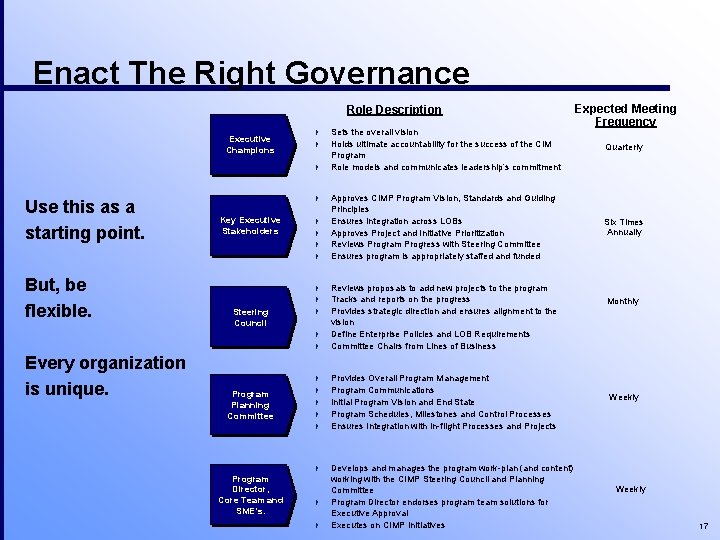
Enact The Right Governance Role Description Executive Champions 4 Sets the overall vision 4 Holds ultimate accountability for the success of the CIM 4 Use this as a starting point. But, be flexible. Program Role models and communicates leadership’s commitment Expected Meeting Frequency Quarterly 4 Approves CIMP Program Vision, Standards and Guiding Key Executive Stakeholders Steering Council 4 4 Principles Ensures integration across LOBs Approves Project and Initiative Prioritization Reviews Program Progress with Steering Committee Ensures program is appropriately staffed and funded 4 Reviews proposals to add new projects to the program 4 Tracks and reports on the progress 4 Provides strategic direction and ensures alignment to the Six Times Annually Monthly vision 4 Define Enterprise Policies and LOB Requirements 4 Committee Chairs from Lines of Business Every organization is unique. Program Planning Committee 4 4 4 Provides Overall Program Management Program Communications Initial Program Vision and End State Program Schedules, Milestones and Control Processes Ensures Integration with In-flight Processes and Projects Weekly 4 Develops and manages the program work-plan (and content) Program Director, Core Team and SME’s. 4 4 working with the CIMP Steering Council and Planning Committee Program Director endorses program team solutions for Executive Approval Executes on CIMP Initiatives Weekly 17
Enact The Right Governance (Cont’) The Org should be carefully crafted to ensure that EDM is truly enterprise-wide in scope. 18
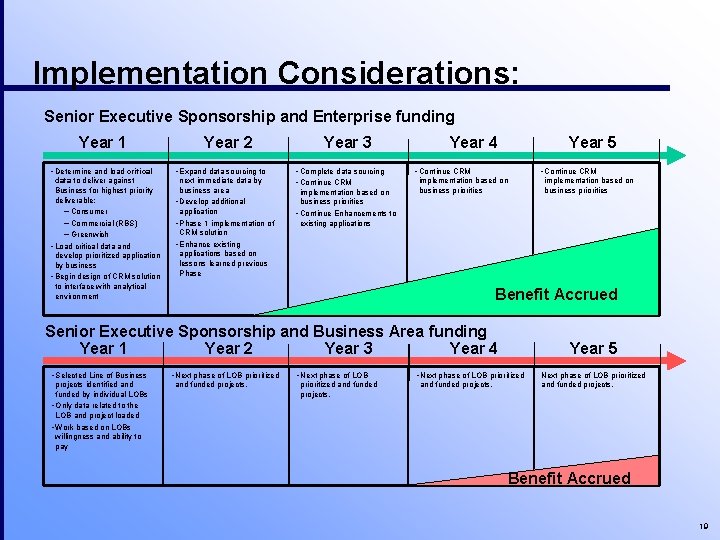
Implementation Considerations: Senior Executive Sponsorship and Enterprise funding Year 1 Year 2 • Determine and load critical • Expand data sourcing to data to deliver against Business for highest priority deliverable: – Consumer – Commercial (RBS) – Greenwich • Load critical data and develop prioritized application by business • Begin design of CRM solution to interface with analytical environment next immediate data by business area • Develop additional application • Phase 1 implementation of CRM solution • Enhance existing applications based on lessons learned previous Phase Year 3 • Complete data sourcing • Continue CRM implementation based on business priorities • Continue Enhancements to existing applications Year 4 Year 5 • Continue CRM implementation based on business priorities Benefit Accrued Senior Executive Sponsorship and Business Area funding Year 1 Year 2 Year 3 Year 4 • Selected Line of Business projects identified and funded by individual LOBs • Only data related to the LOB and project loaded • Work based on LOBs willingness and ability to pay implementation based on business priorities • Next phase of LOB prioritized and funded projects. Year 5 • Next phase of LOB prioritized and funded projects. Benefit Accrued 19
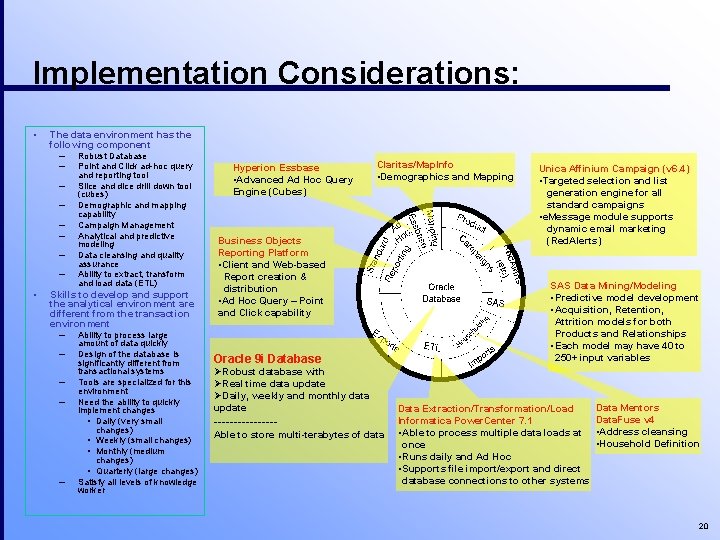
Implementation Considerations: • The data environment has the following component – – – – • Robust Database Point and Click ad-hoc query and reporting tool Slice and dice drill down tool (cubes) Demographic and mapping capability Campaign Management Analytical and predictive modeling Data cleansing and quality assurance Ability to extract, transform and load data (ETL) Skills to develop and support the analytical environment are different from the transaction environment – – – Ability to process large amount of data quickly Design of the database is significantly different from transactional systems Tools are specialized for this environment Need the ability to quickly implement changes • Daily (very small changes) • Weekly (small changes) • Monthly (medium changes) • Quarterly (large changes) Satisfy all levels of knowledge worker Hyperion Essbase • Advanced Ad Hoc Query Engine (Cubes) Claritas/Map. Info • Demographics and Mapping Business Objects Reporting Platform • Client and Web-based Report creation & distribution • Ad Hoc Query – Point and Click capability Oracle 9 i Database ØRobust database with ØReal time data update ØDaily, weekly and monthly data update --------Able to store multi-terabytes of data Unica Affinium Campaign (v 6. 4) • Targeted selection and list generation engine for all standard campaigns • e. Message module supports dynamic email marketing (Red. Alerts) SAS Data Mining/Modeling • Predictive model development • Acquisition, Retention, Attrition models for both Products and Relationships • Each model may have 40 to 250+ input variables Data Extraction/Transformation/Load Informatica Power. Center 7. 1 • Able to process multiple data loads at once • Runs daily and Ad Hoc • Supports file import/export and direct database connections to other systems Data Mentors Data. Fuse v 4 • Address cleansing • Household Definition 20
Agenda I. Why Enterprise Decision Management? 1. Retail Bank Data-Mining Evolution 2. Level Setting: Business Intelligence and analytics 3. The Evolution in World Class Customer Mgt. 4. Best Practices in Customer Centric Architecture 5. Killer Customer Applications 6. Vision 7. Who Is Your Customer? 8. What Does Top Analytical Talent Need? 9. What Is The Impact To Your Bottom Line? II. Steps To Deploy EDM 1. Assess Your Organization 2. Create A Vision 3. Create A Phased Plan 4. Procure Executive Sponsorship 5. Enact The Right Governance 6. Implementation Considerations III. Major Pitfalls 1. Top Ten Reasons EDM Projects Fail 21
Major Pitfalls • • Lack of Support at the Most Senior Levels of the Organization. No Mandate or Top Down driven approach to developing a EDM capability and lack of understanding of how it drives growth or enables the customer experience. Mistaking CIM/CRM or Data Warehouse initiative for a Technology project and not a business initiative. Not recognizing CRM/CIM as a separate discipline that includes marketing, risk, ops and IT skills but is also broader than any one of these. Not selecting the EDM head carefully. This is a demanding job that includes: – Budget oversight of such a large initiative. IT spend can get out of control. – Broad expertise with technology, techniques (modeling, etc) and vision. 22
Major Pitfalls • • When companies assume that building the capability internally with IT is the only option when several ASP or hosted solutions may provide a better value equation and speed to market. Taking a “Build it and they will come” or “Big Bang” approach. – EDM Projects need to include an End State/Vision. – A Phased Implementation is always better. This can be done in several ways. By Subject Area, By Data Type, By Business Line etc. • Decoupling the analytical areas who are the users from the database itself. Adoption is always quicker when both teams are together and learning’s are self contained. 23
Major Pitfalls • • When companies assume that building the capability internally with IT is the only option when several ASP or hosted solutions may provide a better value equation and speed to market. Taking a “Build it and they will come” or “Big Bang” approach. – EDM Projects need to include an End State/Vision. – A Phased Implementation is always better. This can be done in several ways. By Subject Area, By Data Type, By Business Line etc. • • • Decoupling the analytical areas who are the users from the database itself. Adoption is always quicker when both teams are together and learning’s are self contained. Not defining any quick wins from the project. Holding EDM to a one year ROI. This is a long-run investment with major milestones and achievements along the way, but each phase will only pay off in 2 -3 years. 24
Conclusions: • The customer centric nature of retail banking today is driving more complexity in management of data and more sophisticated business analytics • Knowledge sharing and collaboration across geographies, lines of business and platforms is an important part of achieving this vision • Optimization techniques can be a helpful tool in achieving the maximum return on customer • Technology has increased response/activation and decreased the customer annoyance factor. 25
Appendices A. Biographies: Tony Branda B. Customer Centricity Case Study: Relationship Indicator C. Optimization Handles the Increasing Complexity Of Our Marketplace 26

Biography and Case Studies 27
Biographies Tony Branda • Tony Branda leads the Business Analysis team within RBS National Bank. The Business Analysis team provides world class business insights for internal clients and partners through the use of leading edge data-mining techniques and tools. Tony joined RBSNB in June of 2006 • Prior to RBSNB, Tony was Senior Vice President and Program Director for a Division wide customer information strategy at Wells Fargo. Tony’s strategic planning unit created the enterprise wide approach to Customer Data, Business Intelligence and Marketing Infrastructure. Tony built out a 30 million customer cross sell marketing platform and associated analytics as well as a customer experience enhancing contract strategy. • Prior to Wells Fargo, Tony Branda was Senior Vice President and Team Leader for Consumer Real Estate Database Marketing as well as Enterprise Statistical Modeling at Bank of America. • Tony Branda has held several key positions in financial services at American Express and MBNA • Tony Branda received his B. B. A and M. B. A in Marketing from Pace University. He received a Certificate in Direct Marketing from New York University 28
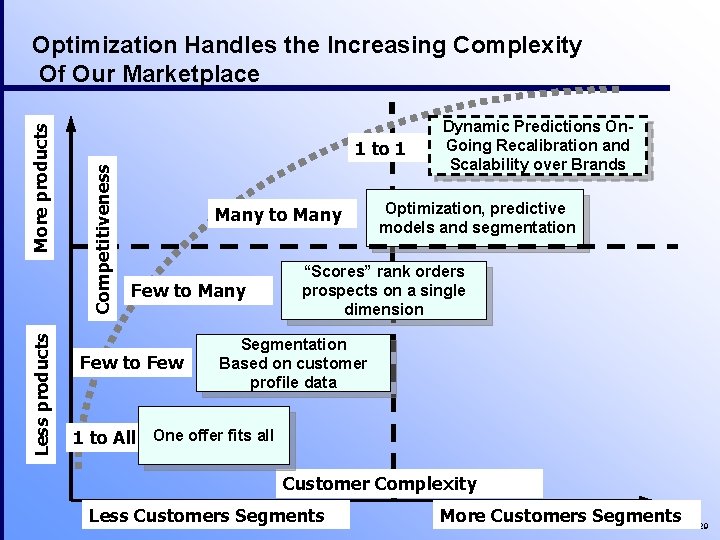
Less products 1 to 1 Competitiveness More products Optimization Handles the Increasing Complexity Of Our Marketplace Many to Many Few to Few Dynamic Predictions On. Going Recalibration and Scalability over Brands Optimization, predictive models and segmentation “Scores” rank orders prospects on a single dimension Segmentation Based on customer profile data 1 to All One offer fits all Customer Complexity Less Customers Segments More Customers Segments 29
- Slides: 29