
How effective is Attention Autism in developing communication


- Slides: 12
How effective is Attention Autism in developing communication for preverbal autistic pupils? Tom Stacey
How I settled on my question Area of interest developing language communication skills with my pupils. Highlighted a difficulty I had within this area engaging with pre verbal children and supporting them in language communication development Began reading around this issue lack of research/intervention How effective is Attention Autism in developing communication for pre-verbal autistic pupils?
Attention Autism Developed by Gina Davies, aim is to develop communication, interaction and attention in children on the autism spectrum. Sessions follow a clear structure and are designed to be motivating. The sessions are split in to 4 different stages that build on each and get progressivly more complex. Each stage targets a specific skill required for effective communication. • Stage one- orientation and response • Stage two- sustain attention • Stage 3 – shifting attention • Stage 4 – shift and refocus for the purpose of my research and given the communication difficulties of my participant I was only interested in stage one. This is also referred to as the bucket stage previous research Morgan (2011), Buckingham (2012) shown positive results, in terms of improving communication skills in preverbal children.
Aims of Research • My first research aim was is to see if real communication progress could be made through the use of ‘Attention Autism‘. • My second aim was to see if the communication skills taught through the sessions could be transferred into a wider context-
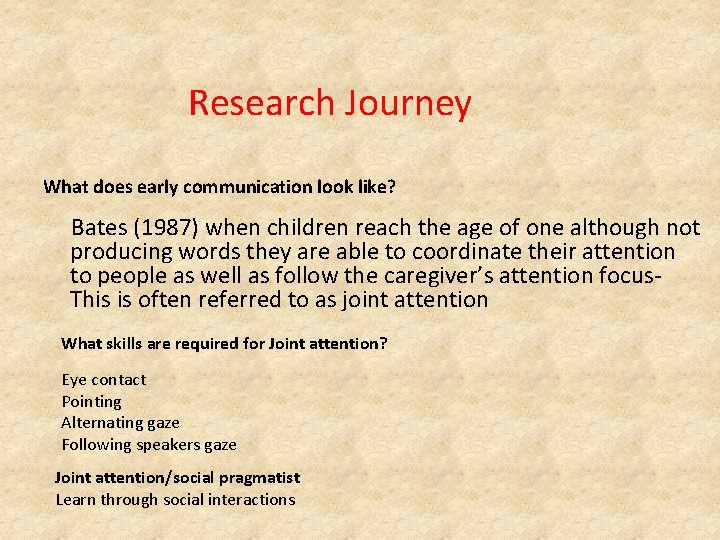
Research Journey What does early communication look like? Bates (1987) when children reach the age of one although not producing words they are able to coordinate their attention to people as well as follow the caregiver’s attention focus. This is often referred to as joint attention What skills are required for Joint attention? Eye contact Pointing Alternating gaze Following speakers gaze Joint attention/social pragmatist Learn through social interactions
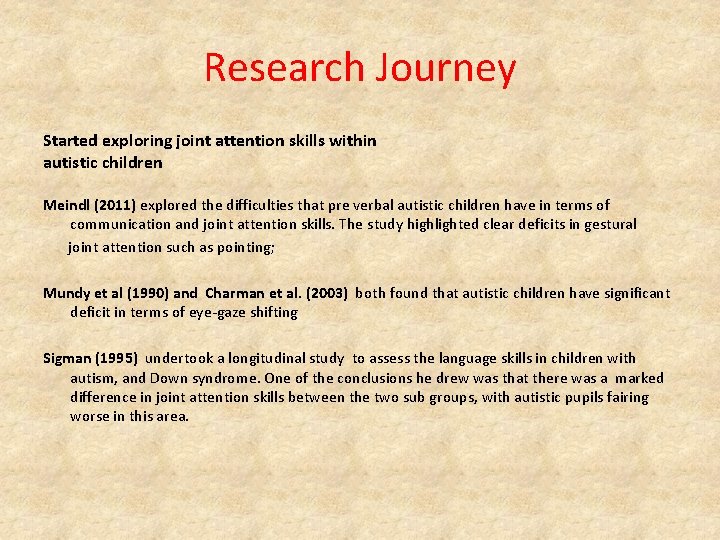
Research Journey Started exploring joint attention skills within autistic children Meindl (2011) explored the difficulties that pre verbal autistic children have in terms of communication and joint attention skills. The study highlighted clear deficits in gestural joint attention such as pointing; Mundy et al (1990) and Charman et al. (2003) both found that autistic children have significant deficit in terms of eye-gaze shifting Sigman (1995) undertook a longitudinal study to assess the language skills in children with autism, and Down syndrome. One of the conclusions he drew was that there was a marked difference in joint attention skills between the two sub groups, with autistic pupils fairing worse in this area.
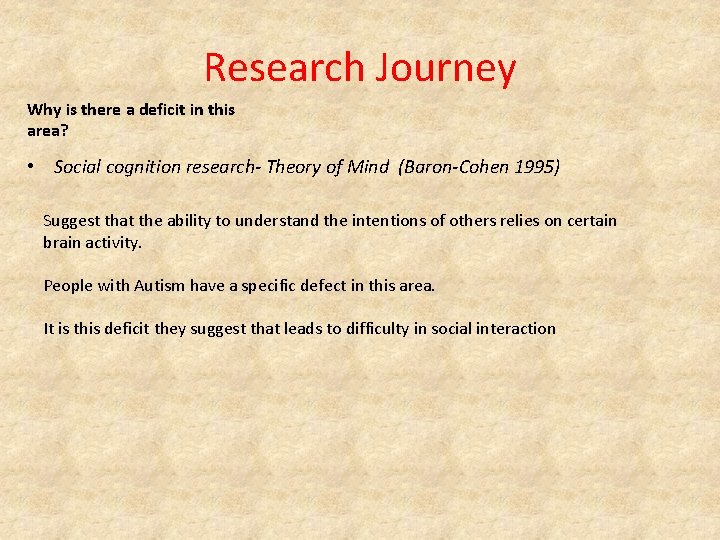
Research Journey Why is there a deficit in this area? • Social cognition research- Theory of Mind (Baron-Cohen 1995) Suggest that the ability to understand the intentions of others relies on certain brain activity. People with Autism have a specific defect in this area. It is this deficit they suggest that leads to difficulty in social interaction
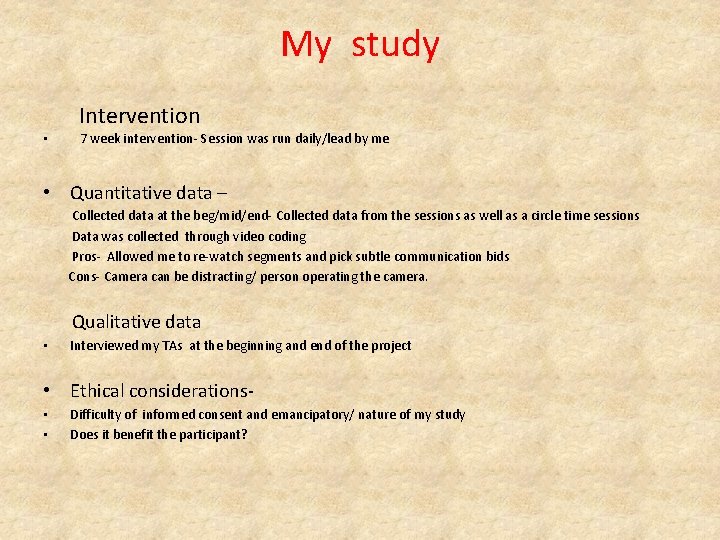
My study Intervention • 7 week intervention- Session was run daily/lead by me • Quantitative data – Collected data at the beg/mid/end- Collected data from the sessions as well as a circle time sessions Data was collected through video coding Pros- Allowed me to re-watch segments and pick subtle communication bids Cons- Camera can be distracting/ person operating the camera. Qualitative data • Interviewed my TAs at the beginning and end of the project • Ethical considerations • • Difficulty of informed consent and emancipatory/ nature of my study Does it benefit the participant?
My results Quantitative data Has real communication progress been made through the use of ‘Attention Autism? Quantitative- My data findings were positive in that they showed a marked improvement in child X’s early communication skills during the Attention Autism sessions. Base line point Six week Point increase as score assessment score percentage Eye contact (IJA) 7 11 63% Alternating gaze 5 8 62% Pointing (IJA) 0 0 0% Following line of 4 7 57% (IJA) regard (RJA) Qualitative The anecdotal evidence generated by my interviews would also point to an improvement in this area. When asked the question ‘Have you seen a noticeable improvement in his attention/communication during the sessions? ’ TA 1 replied: Yes definitely. I remember when you first did it and he kept getting up and showed little engagement. Now he will remain focused through most of the sessions
My results • Have the communication skills taught through the sessions been transferred into a wider context? • Quantitative data Not conclusive - did not show any real improvement. • Qualitative The testimonies of the teaching staff though were again not conclusive and did not suggest a huge improvement in child x ability to generalise. Possible reasons?
Difficulties Transitioning between class teacher/insider researcher Conflict of roles Time management/data collection Inexperienced researcher
Next steps • Any future research project looking at this area would have to be considerably longer in length. Use of a control group. Larger in size • Continue to use AA within the school/ support train staff in effective delivery.