
HOW DRUGS WORK How Drugs Work A drug
- Slides: 12
HOW DRUGS WORK
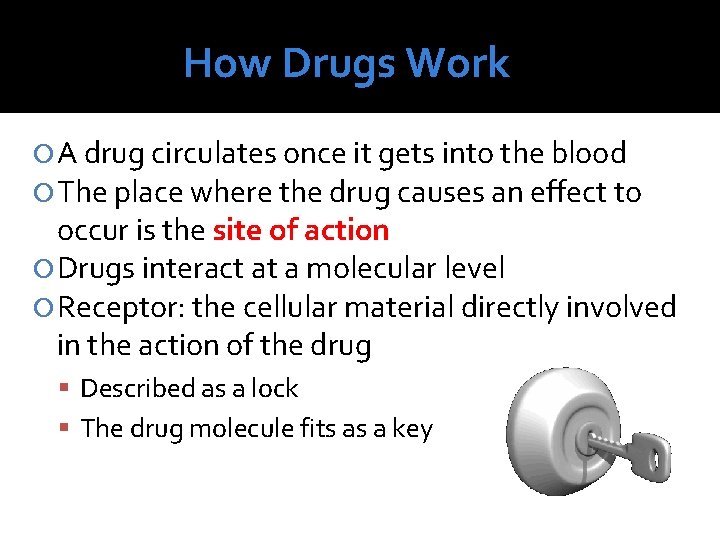
How Drugs Work A drug circulates once it gets into the blood The place where the drug causes an effect to occur is the site of action Drugs interact at a molecular level Receptor: the cellular material directly involved in the action of the drug Described as a lock The drug molecule fits as a key
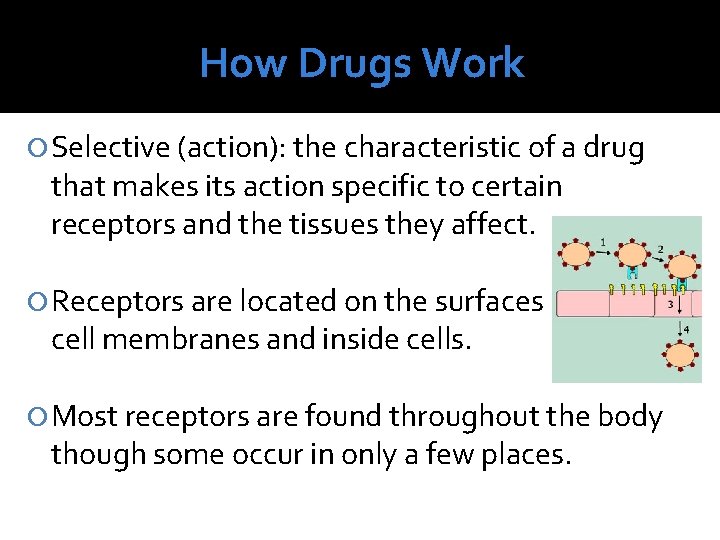
How Drugs Work Selective (action): the characteristic of a drug that makes its action specific to certain receptors and the tissues they affect. Receptors are located on the surfaces cell membranes and inside cells. of Most receptors are found throughout the body though some occur in only a few places.
When drugs interact with the site of action, they can: Act through physical action React chemically (antacids) Modify the metabolic activity of pathogens (antibiotics) Change the osmolarity of blood and draw water out of tissue and into the blood (diuretics) Join with other chemicals to form a complex substance that is more easily excreted Modify the biochemical or metabolic process of the body’s cells or enzyme systems
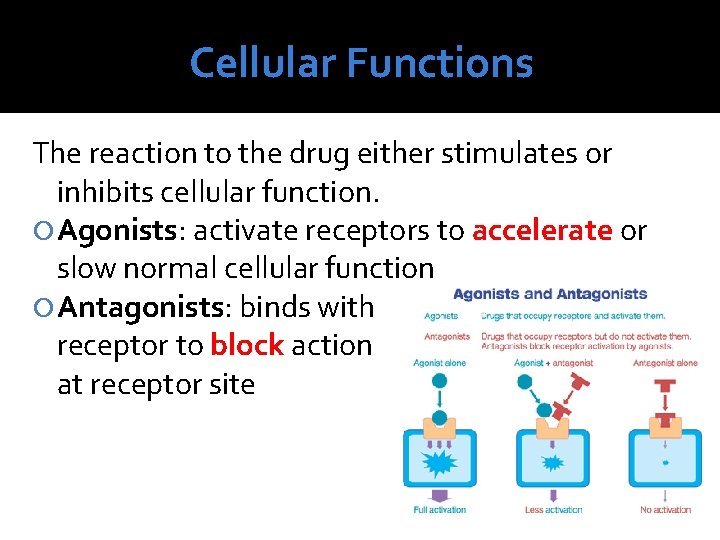
Cellular Functions The reaction to the drug either stimulates or inhibits cellular function. Agonists: activate receptors to accelerate or slow normal cellular function Antagonists: binds with receptor to block action at receptor site
Cellular Functions Extended stimulation of cells with an agonist can reduce the number or sensitivity of the receptor. Extended inhibition of cell functions with an antagonist can increase the number of sensitivity receptors. This is why some drugs must be gradually discontinued.
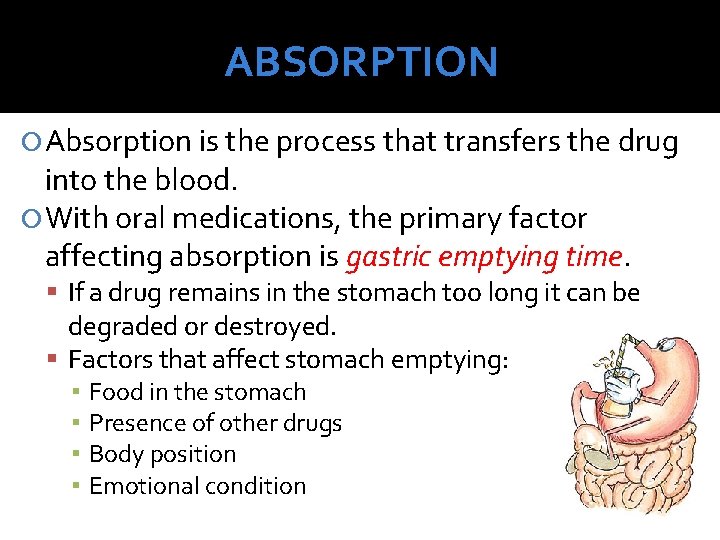
ABSORPTION Absorption is the process that transfers the drug into the blood. With oral medications, the primary factor affecting absorption is gastric emptying time. If a drug remains in the stomach too long it can be degraded or destroyed. Factors that affect stomach emptying: ▪ ▪ Food in the stomach Presence of other drugs Body position Emotional condition
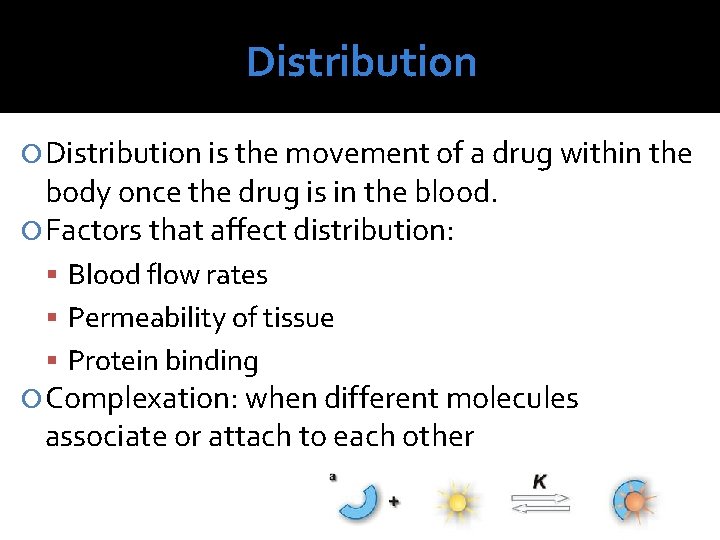
Distribution is the movement of a drug within the body once the drug is in the blood. Factors that affect distribution: Blood flow rates Permeability of tissue Protein binding Complexation: when different molecules associate or attach to each other
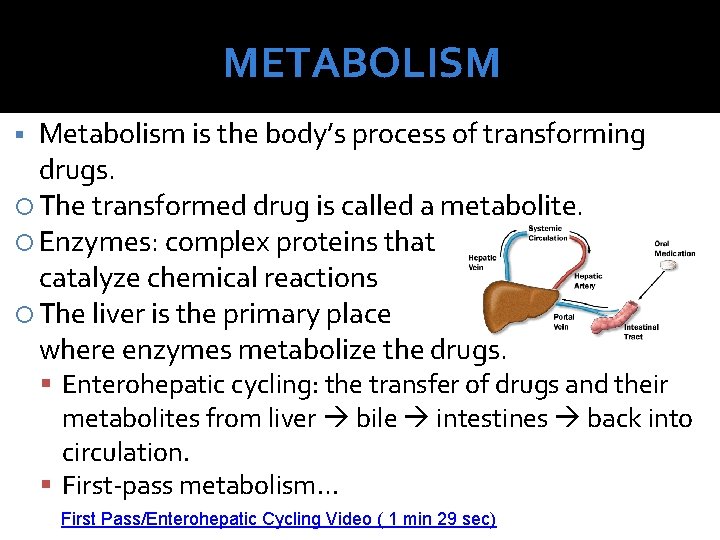
METABOLISM Metabolism is the body’s process of transforming drugs. The transformed drug is called a metabolite. Enzymes: complex proteins that catalyze chemical reactions The liver is the primary place where enzymes metabolize the drugs. Enterohepatic cycling: the transfer of drugs and their metabolites from liver bile intestines back into circulation. First-pass metabolism… First Pass/Enterohepatic Cycling Video ( 1 min 29 sec)
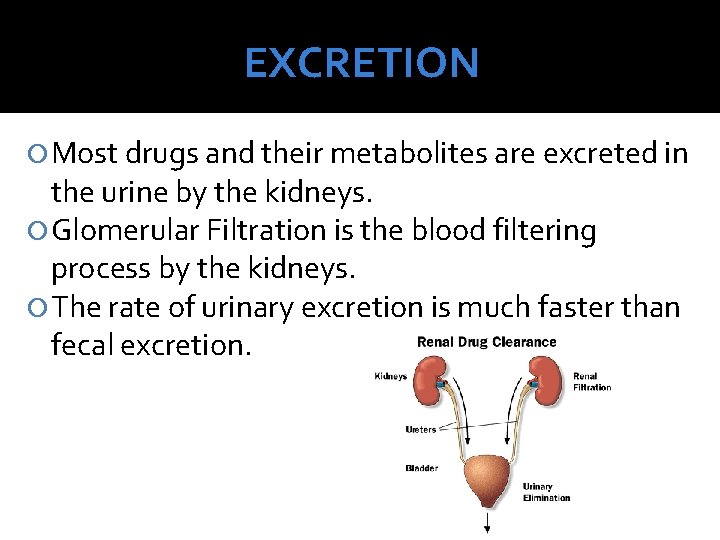
EXCRETION Most drugs and their metabolites are excreted in the urine by the kidneys. Glomerular Filtration is the blood filtering process by the kidneys. The rate of urinary excretion is much faster than fecal excretion.
Bioavailability Definition: the comparison of bioavailability between two dosage forms. Bioavailability: the relative amount of an administrated dose that reaches the general circulation and the rate at which this occurs. Drugs made by different manufacturers can have different a bioavailability. But if the differences are not significant the products are bioequivalent.
BIOAVAILABILITY & BIOEQUIVALENCE In pharmacology, bioavailability (BA) is used to describe the fraction of an administered dose of an unchanged drug that reaches the systemic circulation. When a drug is administered IV, its bioavailability is 100%. When a medication is administered via other routes (such as orally), its bioavailability decreases (due to incomplete absorption and first-pass metabolism. It may vary from patient to patient. Bioavailability must be considered when calculating dosages for non-intravenous routes of administration. Drugs made by different manufacturers can have different a bioavailability. If the differences are not significant the products are bioequivalent.