
How does your voice work How can you
![Speak UP project [pro-JECT]: To send your voice through space with quality as well](https://slidetodoc.com/presentation_image_h2/4d9a81da4bedb3407dd45d55c316f5a6/image-2.jpg "Speak UP project [pro-JECT]: To send your voice through space with quality as well")
- Slides: 43
How does your voice work? How can you effectively use your voice to enhance your ability to speak in front of people?
Speak UP project [pro-JECT]: To send your voice through space with quality as well as volume.
Your Voice l There are so many ways to use your voice. You can make it loud or soft, deep or high, angry or soothing. The differences are significant. A booming voice commands your audience’s immediate attention. A timid, barely audible squeak sets them on edge as they try to catch every word, while a rambling monotone might very well put them to sleep. Though there are differences in how you use your voice when you’re performing on a stage or speaking into an ultra-sensitive microphone on a film set, both require a voice that communicates with expression.
Breathing – hey, we all do it! l It all has to do with breathing. You pull the air into your lungs, then push it out, over and over again. Sounds simple enough. Becoming aware of your breathing and getting control of how you breathe are key to speaking and singing effectively onstage. These can be achieved through training to get over any bad habits you might have with your natural voice, including a hard-to-understand accent and a tendency to speak in a singsong rhythm.
Four Properties of Speech l Respiration - breathing, moving air in and out of your lungs l Phonation – the process of producing sound as air passes from your lungs through the larynx (voice box, just behind the adams apple
Four Properties of Speech, cont. Resonation – how the sound produced by your voice box is made louder; you have resonators (open spaces that work like amplifiers) in your chest cavity, your mouth, and your nose and sinus cavities. l Articulation – how the sounds are shaped into recognizable words; your articulators are your lips, teeth, tongue, hard and soft palates, lower jaw, and uvula – the wiggly thing hanging down at the very back of your throat. l
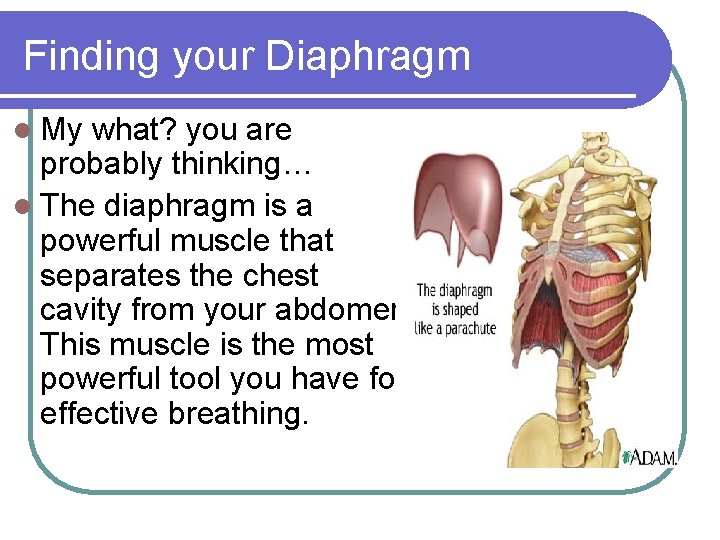
Finding your Diaphragm l My what? you are probably thinking… l The diaphragm is a powerful muscle that separates the chest cavity from your abdomen. This muscle is the most powerful tool you have for effective breathing.
Finding your Diaphragm, cont. We are going to conduct a two-part breathing experiment. l Part One: Strike up a casual conversation with a friend – about the weather, school, whatever. As you’re talking, put one hand on your stomach and the other on your chest. You’ll notice that when you inhale, your stomach contracts and your chest expands, sending tiny waves of tension up through your shoulders and throat. This little bit of gripping – barely noticeable during a calm chat – causes strain when you try to project your voice across a stage. l
Finding your Diaphragm, cont. Part Two: Find a space to stand where you have a little bit of room to move. We are going to do 25 jumping jacks. We will count them off together. ready? l Now put one hand on your stomach and the other on your chest. Something is different. This time, it’s your stomach that is expanding – like a giant bellows – while your chest, shoulders, and neck stay pretty calm. You are breathing from your diaphragm. l
Why Diaphragmatic Breathing? l Diaphragmatic breathing is the most efficient form of breathing: your body’s way of moving lots of air into and out of your lungs. Once you become accustomed to breathing this way – and you don’t need to be gulping for air to do so – you’ll find that your voice is more relaxed and has more sensitivity, power, and flexibility.
Working with one breath l. We are going to learn several tongue twisters and see if we can work towards saying them using only one breath.
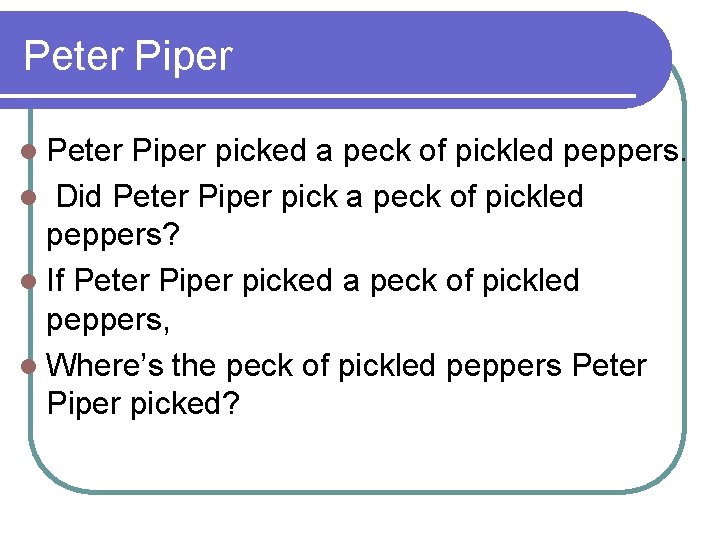
Peter Piper l Peter Piper picked a peck of pickled peppers. l Did Peter Piper pick a peck of pickled peppers? l If Peter Piper picked a peck of pickled peppers, l Where’s the peck of pickled peppers Peter Piper picked?
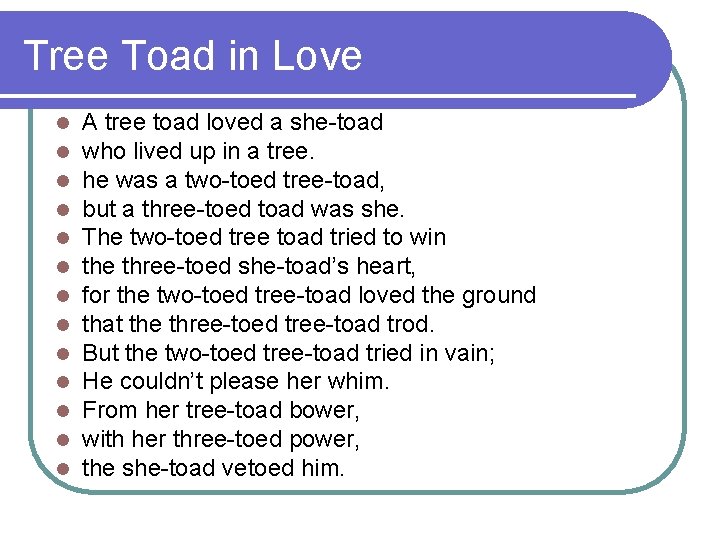
Tree Toad in Love l l l l A tree toad loved a she-toad who lived up in a tree. he was a two-toed tree-toad, but a three-toed toad was she. The two-toed tree toad tried to win the three-toed she-toad’s heart, for the two-toed tree-toad loved the ground that the three-toed tree-toad trod. But the two-toed tree-toad tried in vain; He couldn’t please her whim. From her tree-toad bower, with her three-toed power, the she-toad vetoed him.
Tongue Stretch This exercise gives you a sense of how to relax and open your throat so the vowel sounds (a, e, i, o, u) can travel freely from your vocal chords to your resonators. Sounds can actually get stuck in your throat or way back in your mouth, giving your voice a whiny, nasal quality. l I want you to sit up tall, with your legs comfortably crossed. l Open your mouth slightly as you place the tip of your tongue against the inside top of your lower teeth. Then push your tongue out between your upper and lower teeth until you feel a stretch at your tongue’s root. l Now try running through the vowel sounds and see how easily the sounds bounce around the inside of your mouth. l
Make like a Bellows This exercise helps you learn to breath from your diaphragm. l I want you to make sure the textbook you brought with you is next to you as you lie back down on the floor on your back with your legs and arms comfortably extended. l l l Concentrate on your breathing as you feel your weight sink into the floor. After a moment or two, your body should feel like pudding. Pick up the textbook next to you and set it gently on your stomach. Feel it lift and lower as you inhale and exhale. Breathe on my counts inhale………………exhale Now it is time to vocalize. As you exhale, make an ahhhhh sound. Don’t say ahhhhh with your mouth. Allow it to come flowing out from the bottom of your ribcage along with your breath. If you are doing this. . then congratulations! You are breathing with your diaphragm!
What are Articulators? You remember that Articulation is the process of shaping sounds into words. This is done through use of your articulators. l Your articulators shape the sound into syllables and words that enable us to show a wide range of thoughts and emotions to our audience whether in theatre or in our living room. l The seven articulators are: l l l l teeth lips tongue lower jaw hard palate soft palate uvula
Warming up your Articulators l There are two types of consonant sounds. l l explosives – these are made when the air is stopped, then released along with the sound. Put your fingers in front of your lips and make these sounds with me: p, t, k, ch. Feel the little jet of air that shoots out of your mouth? Now try b, d, and g. You still get the burst, but softer. continuants – these are consonant sounds that are accompanied by breath. Say these with me m, n, ng, air is blocked by your lips or tongue but passes through your nose. Say l, and r. The tip of your tongue creates a tiny roadblock for the air passing between your lips.
What a ta do… l What a ta do to die today at a minute or two till two l a thing distinctly hard to say, yet harder still to do. l for we beat a tattoo at a twenty till two with a ra ta ta to. l and the dragon will come when he hears the drum l at a minute or two till two today at a minute or two till two.
Her Majesty Victoria l Please hello, I come with greetings from her Majesty Victoria l Who hearing how you’re trading now, sings Halleluiah Gloria. l And sends me to convey to you her positive euphoria l As well as little gifts from Britain’s various emporia.
Consonant Sounds l What are the two types of consonant sounds? explosives – these are made when the air is stopped, then released along with the sound. l continuants – these are consonant sounds that are accompanied by breath. l
Mr. See’s Saw l l l l l Mr. See owned a saw. And Mr. Soar owned a seesaw. Now, See’s sawed Soar’s seesaw Before Soar saw See, Which made Soar sore. Had Soar seen See’s saw Before See sawed Soar’s seesaw, See’s saw would not have sawed Soar’s seesaw. But it was sad to see Soar so sore Just because See’s sawed Soar’s seesaw.
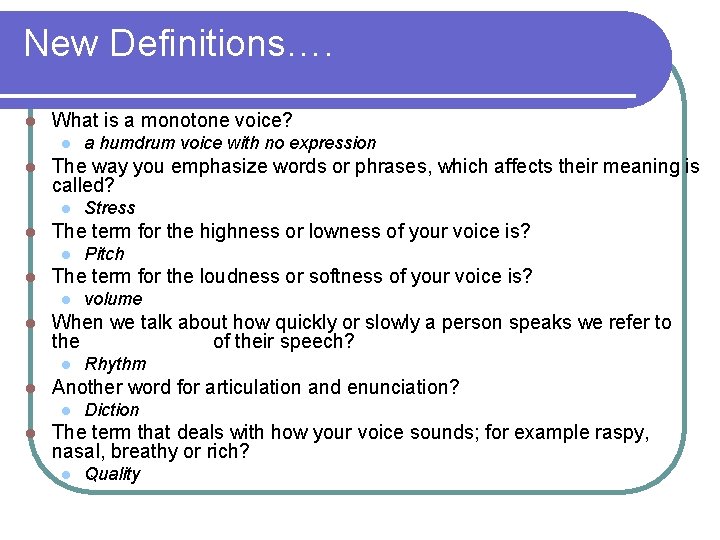
New Definitions…. l What is a monotone voice? l l The way you emphasize words or phrases, which affects their meaning is called? l l Rhythm Another word for articulation and enunciation? l l volume When we talk about how quickly or slowly a person speaks we refer to the of their speech? l l Pitch The term for the loudness or softness of your voice is? l l Stress The term for the highness or lowness of your voice is? l l a humdrum voice with no expression Diction The term that deals with how your voice sounds; for example raspy, nasal, breathy or rich? l Quality
Putting your voice to work You know how irritating it can be to listen to people speak in monotone (a humdrum voice with no expression). Their words sound flat and dull, and itcan-be-diff-i-cult-to-stay-in-ter-est-ed-in-what-theyare-say-ing – which is a definite negative for an actor. Fortunately, you can control and vary your tone of voice through a combination of stress, pitch, rhythm, diction, and quality. l An understanding of how these variations can help your voice be more expressive will come in handy when you perform as an actor or public speaking. l
Stress l The way you emphasize words or phrases, which affects their meaning. l We are going to read the sentences on the following slide out loud. The first time through, STRESS the words that are in capital letters. Notice how the different stresses change the meaning of the sentence.
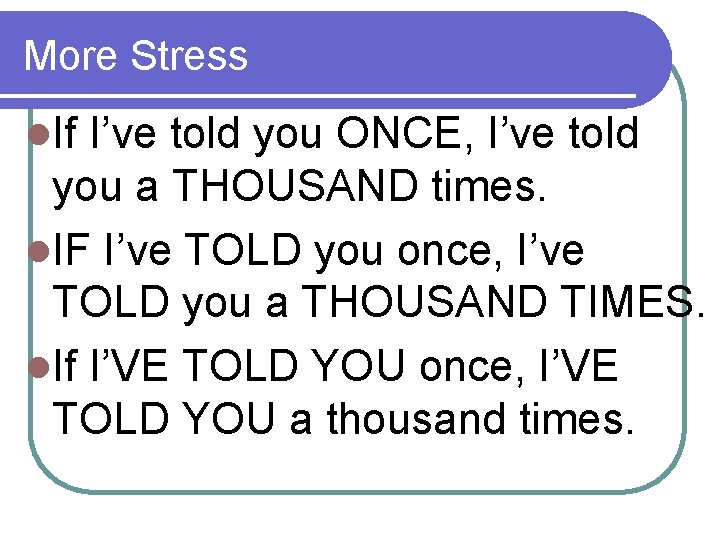
More Stress l. If I’ve told you ONCE, I’ve told you a THOUSAND times. l. IF I’ve TOLD you once, I’ve TOLD you a THOUSAND TIMES. l. If I’VE TOLD YOU once, I’VE TOLD YOU a thousand times.
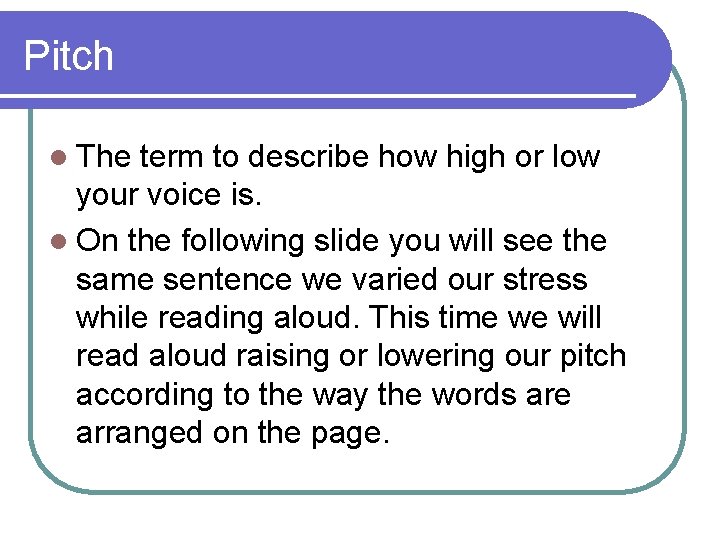
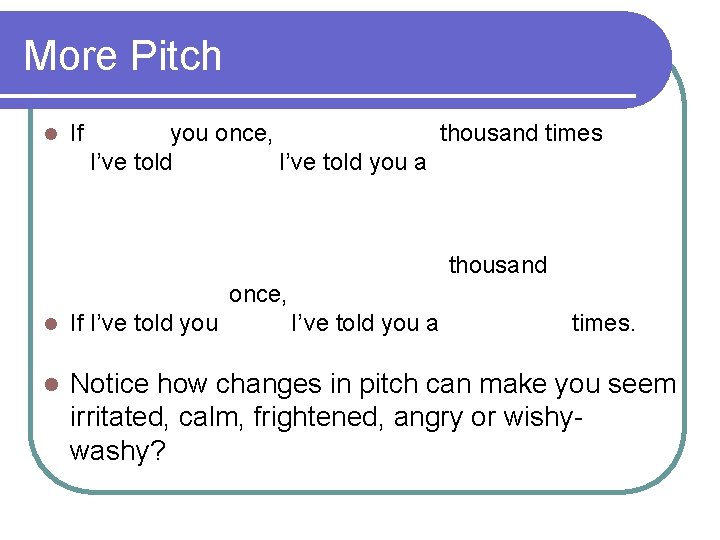
Pitch l The term to describe how high or low your voice is. l On the following slide you will see the same sentence we varied our stress while reading aloud. This time we will read aloud raising or lowering our pitch according to the way the words are arranged on the page.
More Pitch l If you once, thousand times I’ve told you a thousand once, l If I’ve told you a times. l Notice how changes in pitch can make you seem irritated, calm, frightened, angry or wishywashy?
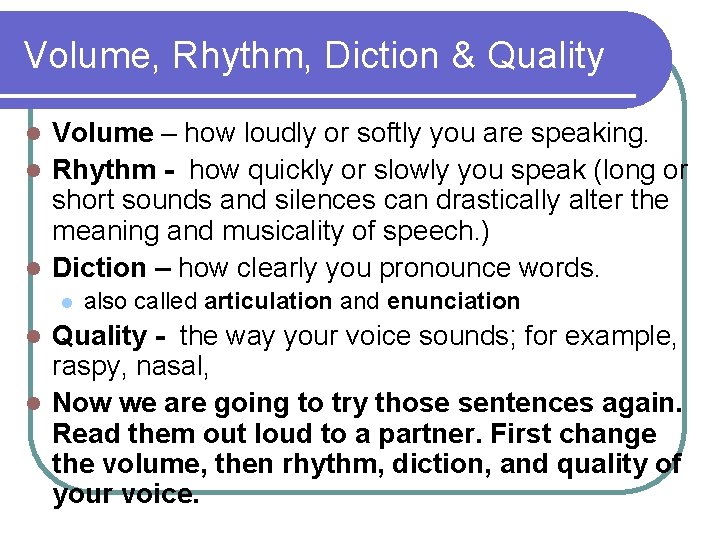
Volume, Rhythm, Diction & Quality Volume – how loudly or softly you are speaking. l Rhythm - how quickly or slowly you speak (long or short sounds and silences can drastically alter the meaning and musicality of speech. ) l Diction – how clearly you pronounce words. l l also called articulation and enunciation Quality - the way your voice sounds; for example, raspy, nasal, l Now we are going to try those sentences again. Read them out loud to a partner. First change the volume, then rhythm, diction, and quality of your voice. l
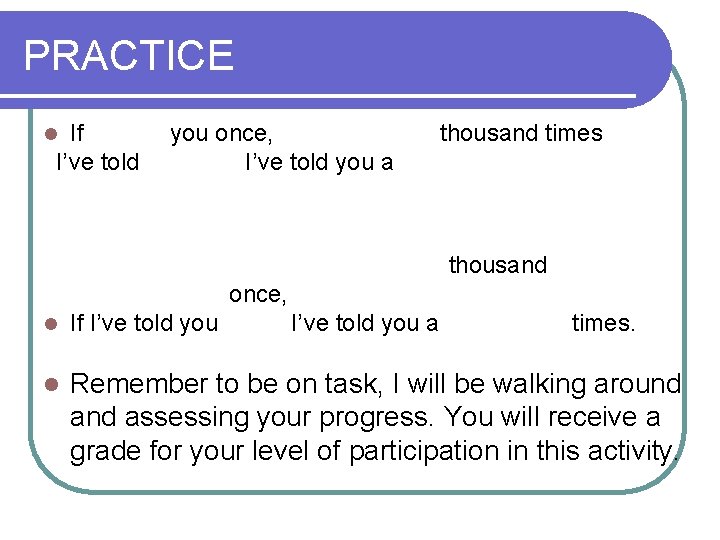
PRACTICE If I’ve told l you once, I’ve told you a thousand times thousand once, l If I’ve told you a times. l Remember to be on task, I will be walking around assessing your progress. You will receive a grade for your level of participation in this activity.
Projection l Part of training your voice for the stage or for public speaking is learning how to make it big and full so that it can travel all the way to the very last row in the audience. l One way, the wrong way, is to scream every word. Not only is it inefficient, it is irritating – to your fellow actors and to your audience. Most of us wouldn’t choose to listen to hours of shouting if we didn’t have to. l Your goal is to project your voice without harming your vocal chords.
Still Projecting l Imagine your voice as a projectile missile, soaring toward its goal. l a Commanding voice doesn’t need a large body to project it. Think of the actor Al Pacino, a relatively small person with an undeniably big voice.
Projecting onward…. . l Projection is not simply about making your voice loud enough to be heard; it is also about active communication with your audience. l If you really tune in to the audience you will be able to project your performance while sensing and responding to the energy of the audience.
Projection Exercise l Pick a spot right next to you. another spot in the middle distance, maybe half way across the room. l Find a third spot all the way across the room. l Try to place your voice at each of these points without raising your volume. Use your intention (desire) to place your voice and focus where you want it to go.
Shout it out l If a role requires that you yell or scream, put your all-powerful diaphragm to work. The more air you supply to your voice, the greater sound you can achieve. Relax your jaw and open your throat so that the sounds can flow out of your mouth. Use the vowels to carry the tone, and the consonants to keep your words clear. l NO, I DO No. T wan. T To g. O!
Still Shouting? When trying to project, think of sending your voice to the very back row of the audience. l Don’t force it, instead, concentrate on the energy and emotion of the words. If nerves are making you rush, not only will your diction suffer, you might become shrill and incapable of sustaining the proper volume. l Remember, stay calm and recite your lines as you rehearsed them without adding pauses, stops, or running together of your words. l Above all else – keep breathing! l
Stage Whisper l Imagine the following: l It’s 4 Am A pale shaft of moonlight streams through an open window illuminating your path as you, a world-famous private investigator, slink through the hallway of Madonna’s mansion trying to find proof that she stole the lyrics from Queen Latifah’s newest hit. Madonna is fast asleep. As you pass the room of the nanny your assistant bumps into a Giant statue of Marilyn Monroe, you whisper to assistant “shhhhh, I think I hear someone coming. ” The audience is immediately nervous, wondering if the Nanny will awaken and rouse Madonna from her heavenly slumber. Wait a minute. If they are whispering, how can anybody beyond the first row hear what you are saying? ? ? l It is because you are not really whispering. You’re creating the impression of a whisper through your body language, facial expression, and tone of voice. l You use a lot of phonation to create a stage whisper. Lets practice some stage whispers with a partner. l
Accents In the musical ‘My Fair Lady’ Professor Henry Higgins (who spends his time studying how people speak) comes across the poor flowerseller Eliza Dolittle. Her working-class accent, known as Cockney, offends his upper class ears. l Henry Higgins obviously doesn’t appreciate how Eliza shapes her vowels and consonants, and he isnt at all interested in the variety of her speech. But as an actor – you should be interested and you would want to be able to answer her in kind if she asked you “OW AW yuh, DAWlin? ” (translation – how are you darling) l
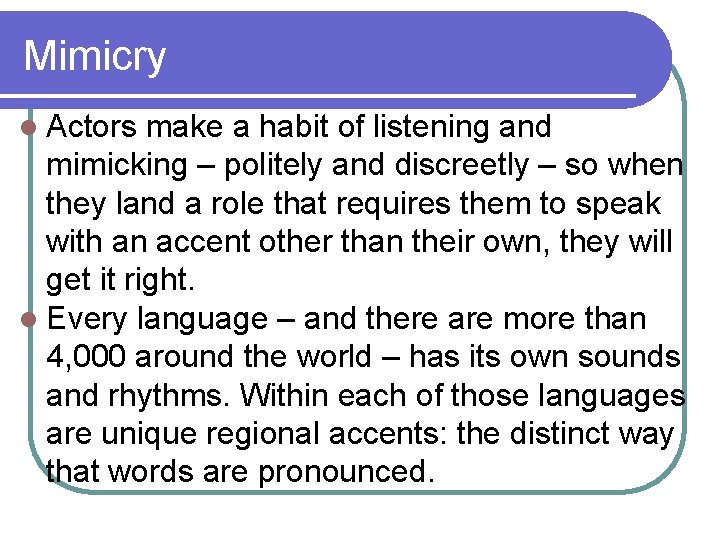
Mimicry l Actors make a habit of listening and mimicking – politely and discreetly – so when they land a role that requires them to speak with an accent other than their own, they will get it right. l Every language – and there are more than 4, 000 around the world – has its own sounds and rhythms. Within each of those languages are unique regional accents: the distinct way that words are pronounced.
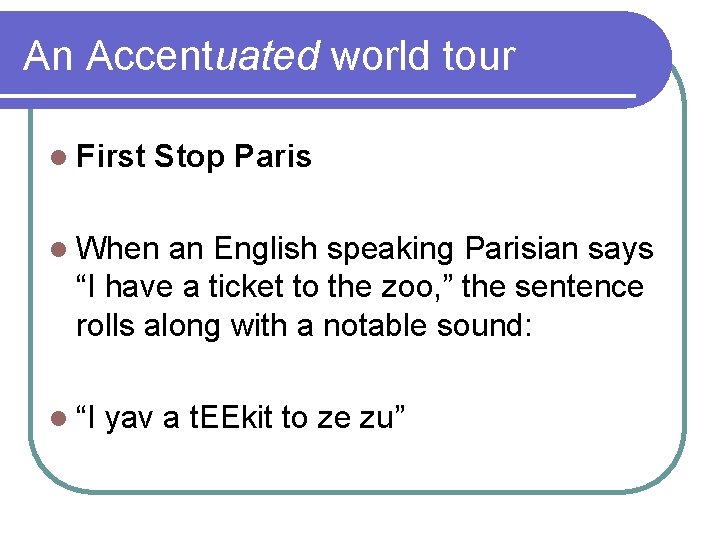
An Accentuated world tour l First Stop Paris l When an English speaking Parisian says “I have a ticket to the zoo, ” the sentence rolls along with a notable sound: l “I yav a t. EEkit to ze zu”
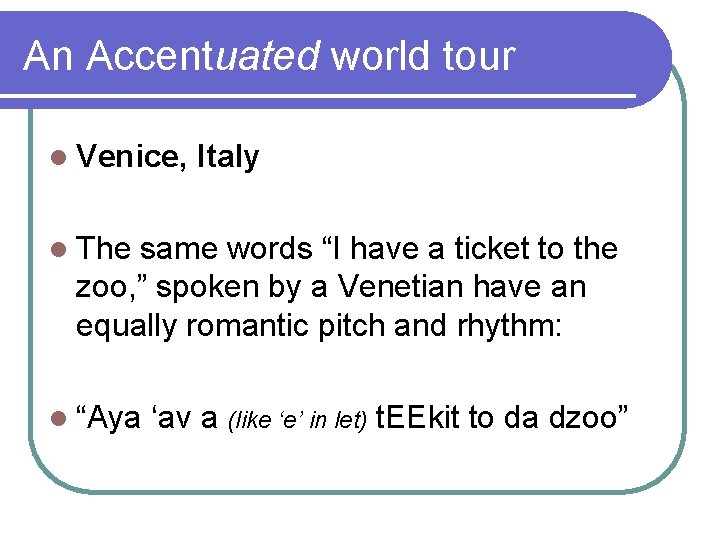
An Accentuated world tour l Venice, Italy l The same words “I have a ticket to the zoo, ” spoken by a Venetian have an equally romantic pitch and rhythm: l “Aya ‘av a (like ‘e’ in let) t. EEkit to da dzoo”
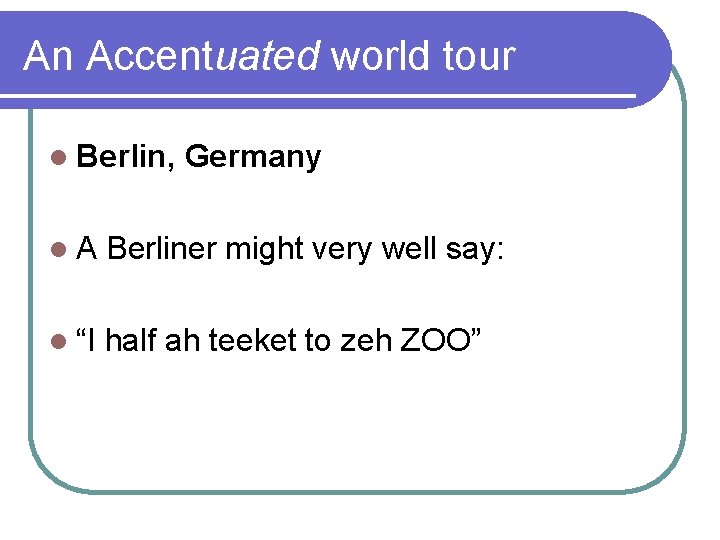
An Accentuated world tour l Berlin, Germany l. A Berliner might very well say: l “I half ah teeket to zeh ZOO”
An Accentuated world tour l New l In York, US New York City you might hear: l “Oay Hav a ticket ta da zoo”
Standard American English l Most professionals, especially journalists, have been coached to speak with, what is known as a Standard American English accent, which means they speak without a trace of regionalism. In other words, even though they may have grown up in Boston, Massachusetts, the Deep South, or the Midwest their accent does not give away their roots. Listen to the evening news and try to imitate the Standard American English you hear spoken. It will serve you well in your future professional life to be able to turn off your Southern accents in a workplace environment.