
How does the Semantic Web Work Ivan Herman
How does the Semantic Web Work? Ivan Herman, W 3 C, “Semantic Café”, organized by the W 3 C Brazil Office São Paulo, Brazil, 2010 -10 -15
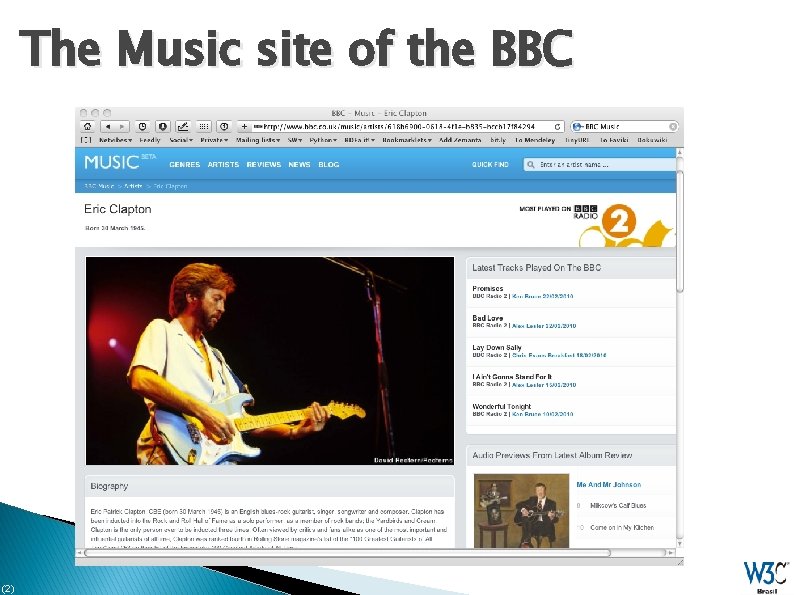
The Music site of the BBC (2)
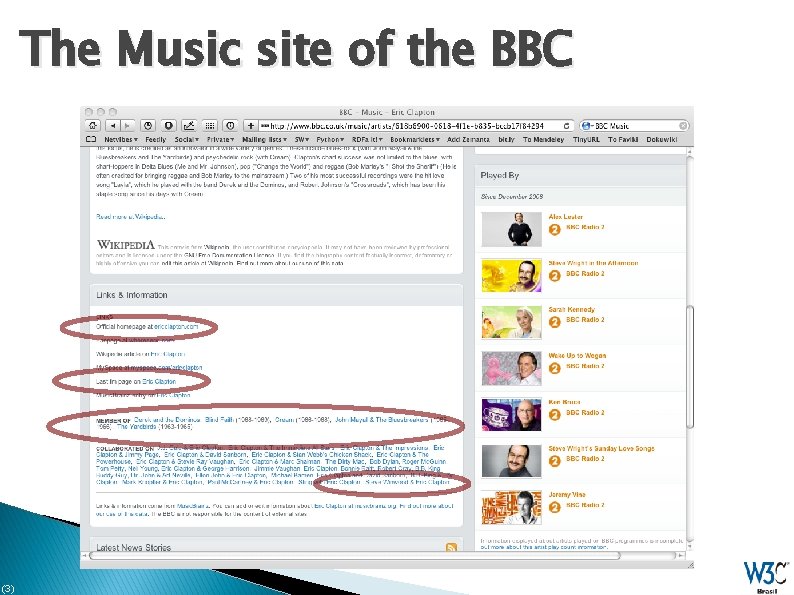
The Music site of the BBC (3)
How to build such a site 1. � Site editors roam the Web for new facts ◦ may discover further links while roaming � They update the site manually � And the site gets soon out-of-date (4)
How to build such a site 2. � Editors roam the Web for new data published on Web sites � “Scrape” the sites with a program to extract the information ◦ Ie, write some code to incorporate the new data � Easily (5) get out of date again…
How to build such a site 3. � Editors roam the Web for new data via API-s � Understand those… ◦ input, output arguments, datatypes used, etc � Write some code to incorporate the new data � Easily get out of date again… (6)
The choice of the BBC � Use external, public datasets ◦ Wikipedia, Music. Brainz, … � They are available as data ◦ not API-s or hidden on a Web site ◦ data can be extracted using, eg, HTTP requests or standard queries (7)
In short… � Use the Web of Data as a Content Management System � Use the community at large as content editors (8)
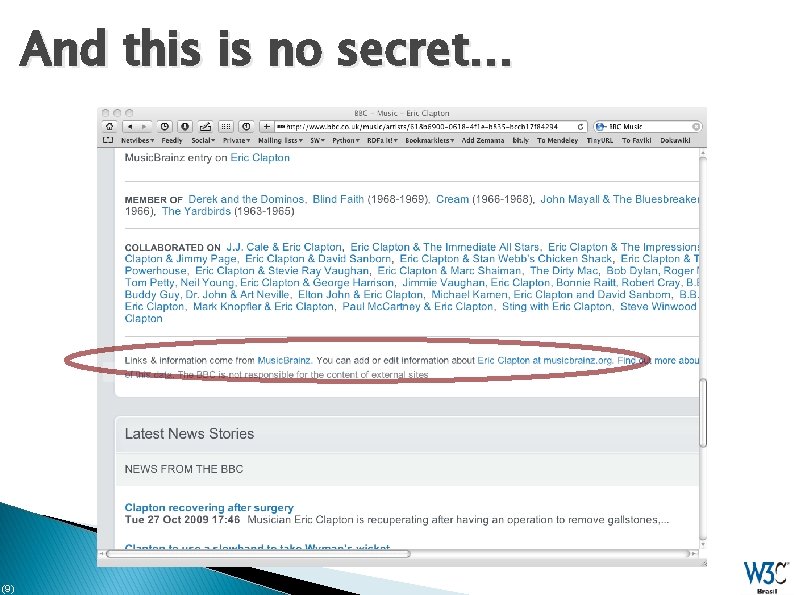
And this is no secret… (9)
Data on the Web � There are more an more data on the Web ◦ government data, health related data, general knowledge, company information, flight information, restaurants, … � More and more applications rely on the availability of that data (10)
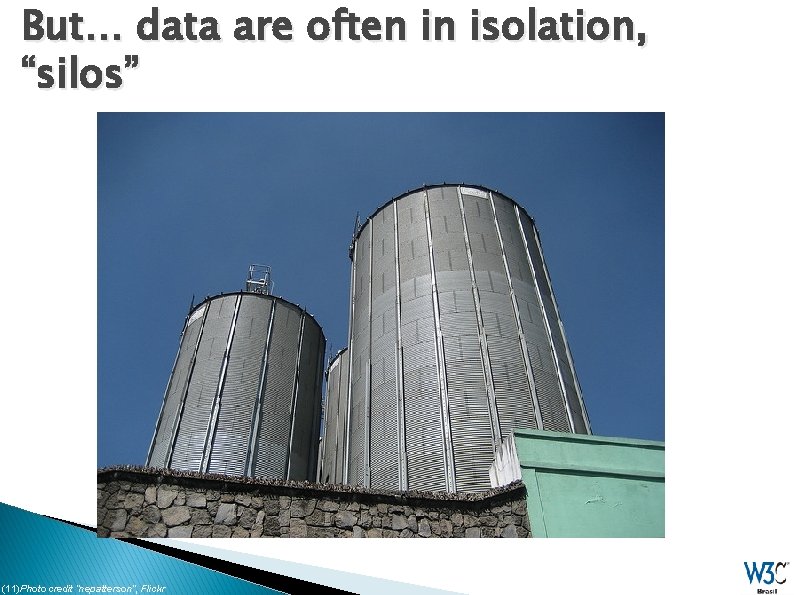
But… data are often in isolation, “silos” (11)Photo credit “nepatterson”, Flickr
Imagine… �A “Web” where ◦ documents are available for download on the Internet ◦ but there would be no hyperlinks among them (12)
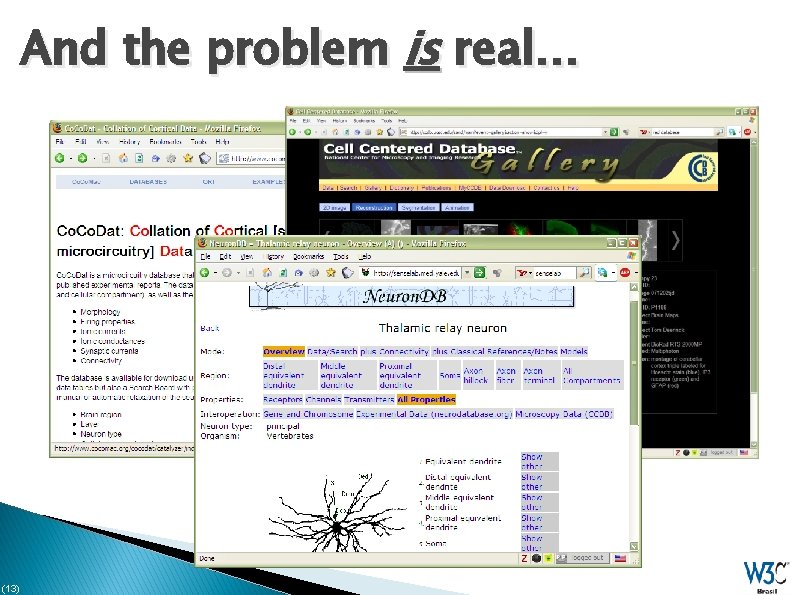
And the problem is real… (13)
Data on the Web is not enough… � We need a proper infrastructure for a real Web of Data ◦ data is available on the Web ◦ data are interlinked over the Web (“Linked Data”) � I. e. , (14) data can be integrated over the Web
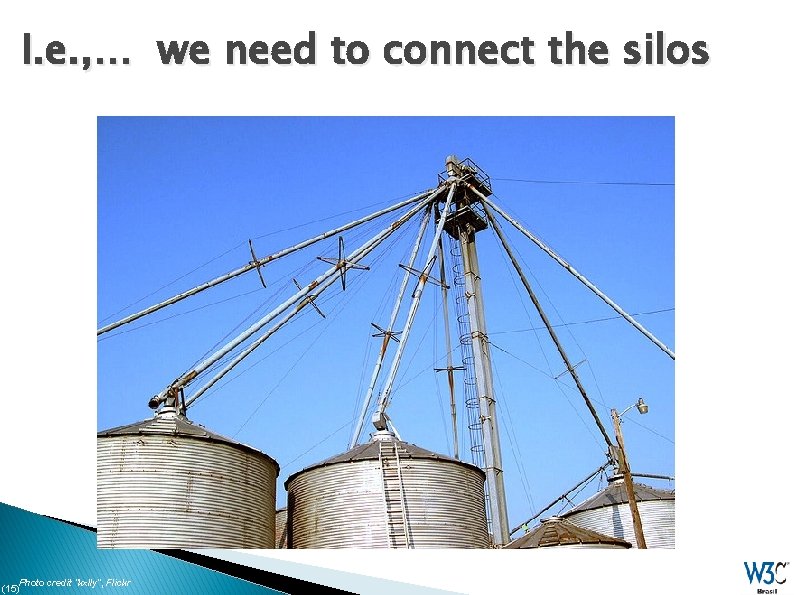
I. e. , … we need to connect the silos Photo credit “kxlly”, Flickr (15)
In what follows… � We will use a simplistic example to introduce the main Semantic Web concepts (16)
The rough structure of data integration � Map the various data onto an abstract data representation ◦ make the data independent of its internal representation… � Merge the resulting representations � Start making queries on the whole! ◦ queries not possible on the individual data sets (17)
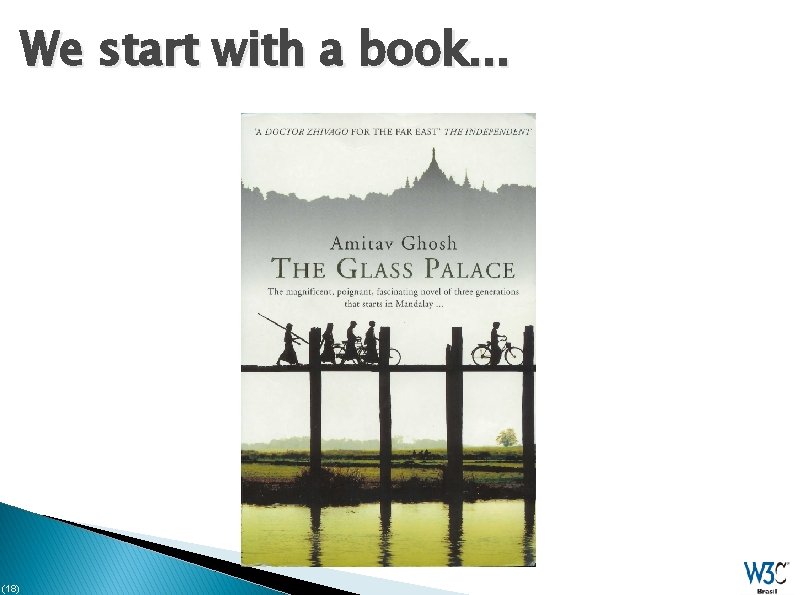
We start with a book. . . (18)
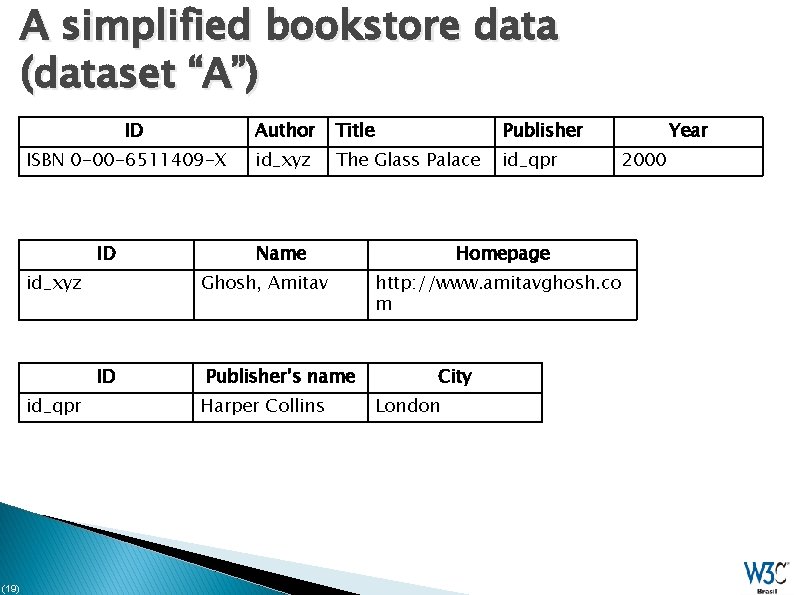
A simplified bookstore data (dataset “A”) ID ISBN 0 -00 -6511409 -X ID id_xyz (19) Title Publisher id_xyz The Glass Palace id_qpr Name Ghosh, Amitav ID id_qpr Author Publisher’s name Harper Collins Homepage http: //www. amitavghosh. co m City London Year 2000
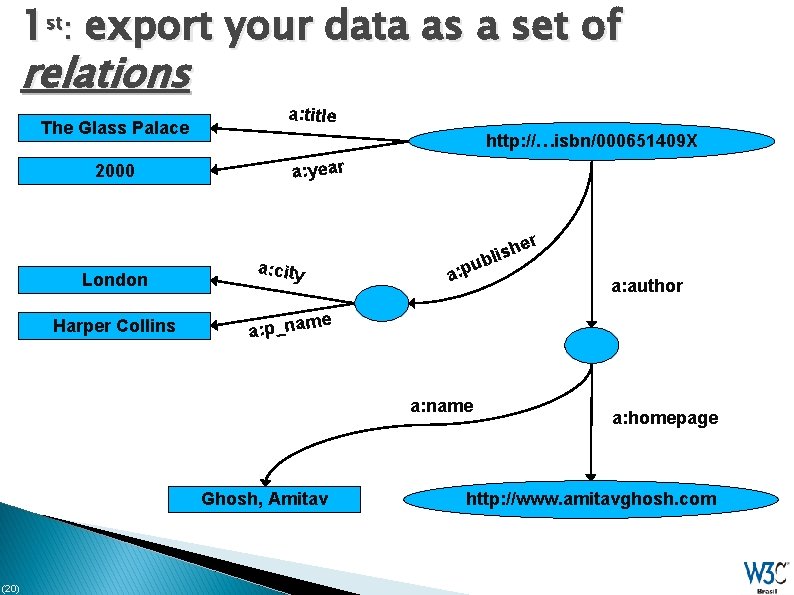
1 st: export your data as a set of relations The Glass Palace 2000 London Harper Collins a: title http: //…isbn/000651409 X a: year a: city er h s bli u a: p e a: p_nam a: name Ghosh, Amitav (20) a: author a: homepage http: //www. amitavghosh. com
Some notes on the exporting the data � Data export does not necessarily mean physical conversion of the data ◦ relations can be generated on-the-fly at query time �via SQL “bridges” �scraping HTML pages �extracting data from Excel sheets �etc. � One (21) can export part of the data
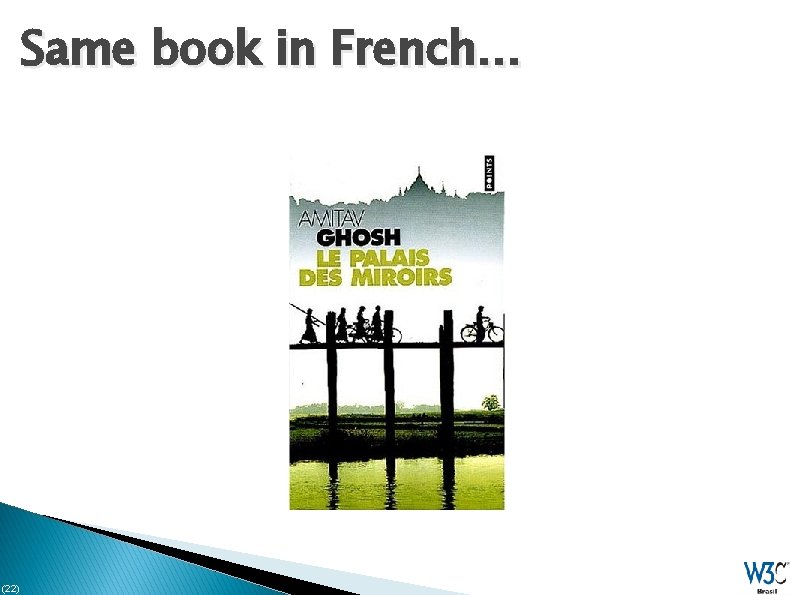
Same book in French… (22)
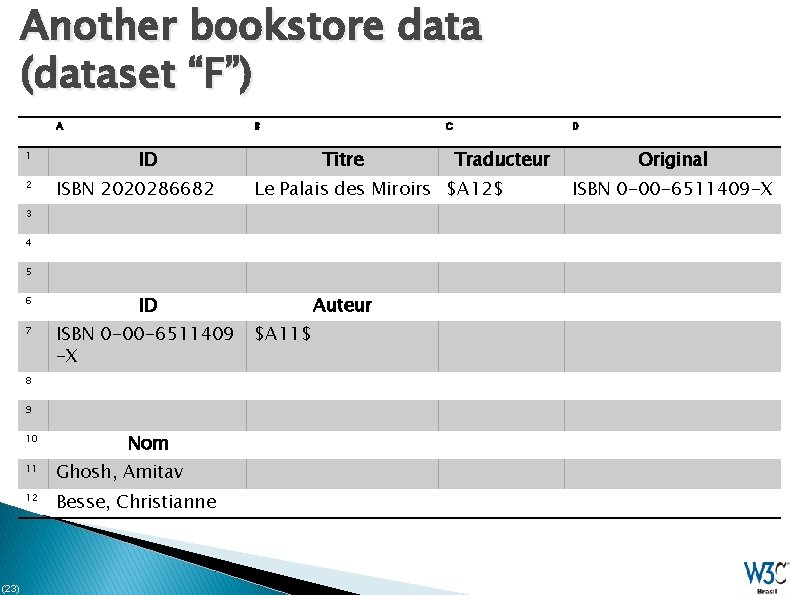
Another bookstore data (dataset “F”) A 1 2 B ID ISBN 2020286682 C Titre 4 5 ID 7 ISBN 0 -00 -6511409 -X 8 9 10 (23) Nom 11 Ghosh, Amitav 12 Besse, Christianne Traducteur Le Palais des Miroirs $A 12$ 3 6 D Auteur $A 11$ Original ISBN 0 -00 -6511409 -X
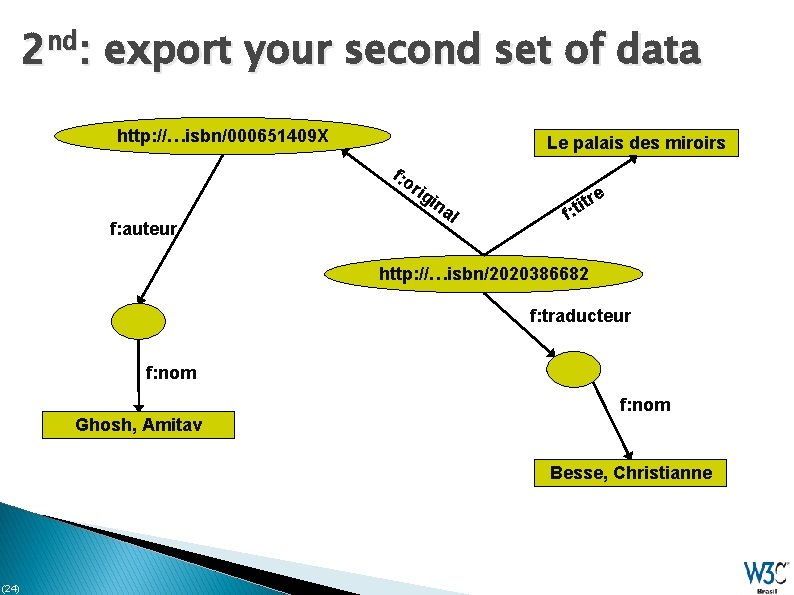
2 nd: export your second set of data http: //…isbn/000651409 X Le palais des miroirs f: o rig in f: auteur al re it f: t http: //…isbn/2020386682 f: traducteur f: nom Ghosh, Amitav f: nom Besse, Christianne (24)
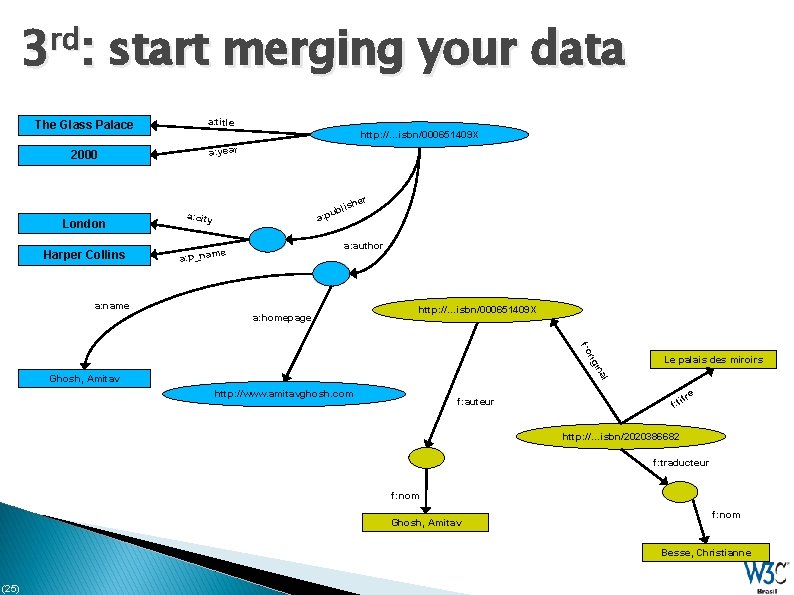
rd 3 : start merging your data The Glass Palace a: title 2000 a: year http: //…isbn/000651409 X her London Harper Collins lis pub a: city a: author e a: p_nam a: name a: homepage http: //…isbn/000651409 X f: o ina rig Le palais des miroirs l Ghosh, Amitav http: //www. amitavghosh. com f: auteur f: t e itr http: //…isbn/2020386682 f: traducteur f: nom Ghosh, Amitav f: nom Besse, Christianne (25)
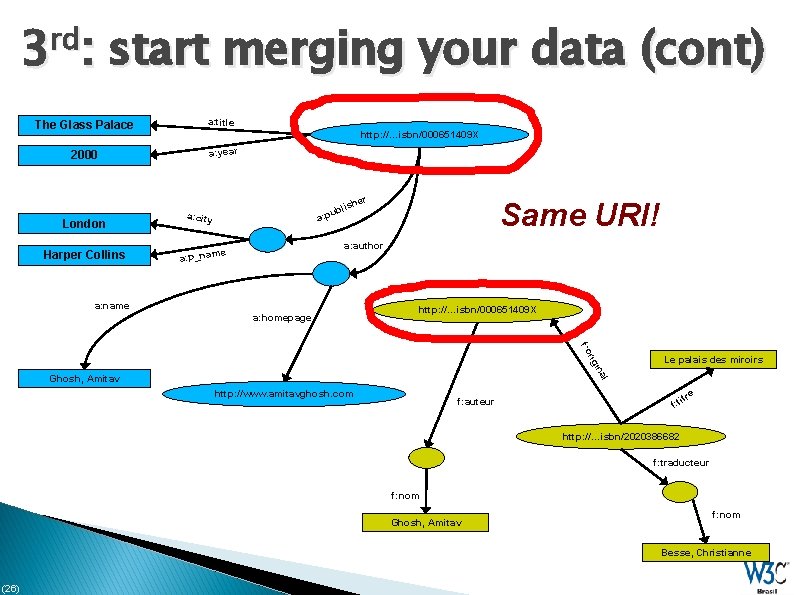
rd 3 : start merging your data (cont) The Glass Palace a: title 2000 a: year http: //…isbn/000651409 X her London Harper Collins Same URI! lis pub a: city a: author e a: p_nam a: name a: homepage http: //…isbn/000651409 X f: o ina rig Le palais des miroirs l Ghosh, Amitav http: //www. amitavghosh. com f: auteur f: t e itr http: //…isbn/2020386682 f: traducteur f: nom Ghosh, Amitav f: nom Besse, Christianne (26)
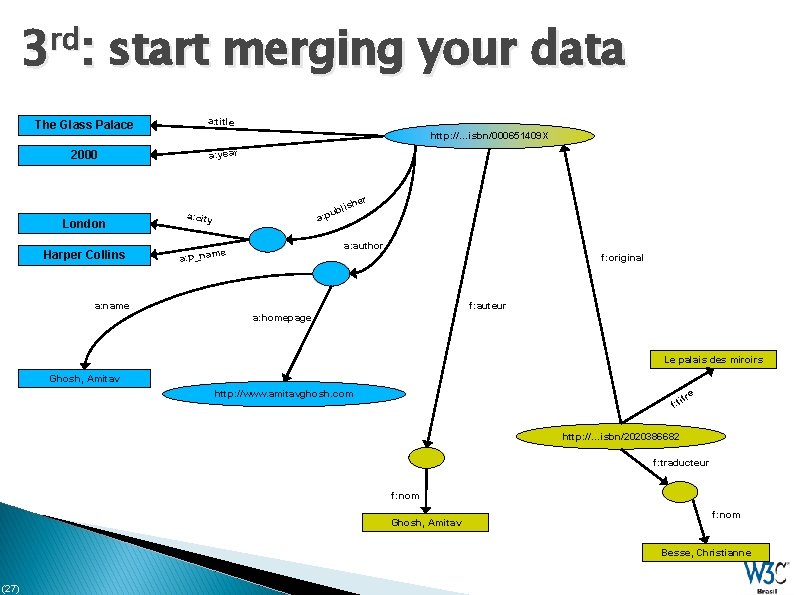
rd 3 : start merging your data The Glass Palace a: title 2000 a: year http: //…isbn/000651409 X her London Harper Collins is ubl a: p a: city a: author e a: p_nam f: original a: name f: auteur a: homepage Le palais des miroirs Ghosh, Amitav http: //www. amitavghosh. com f: t e itr http: //…isbn/2020386682 f: traducteur f: nom Ghosh, Amitav f: nom Besse, Christianne (27)
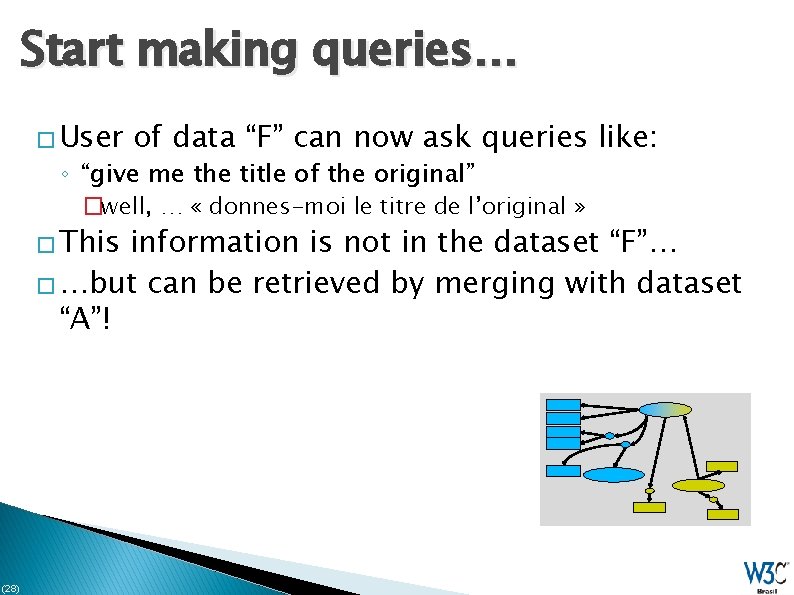
Start making queries… � User of data “F” can now ask queries like: ◦ “give me the title of the original” �well, … « donnes-moi le titre de l’original » � This information is not in the dataset “F”… � …but can be retrieved by merging with dataset “A”! (28)
However, more can be achieved… � We “feel” that a: author and f: auteur should be the same � But an automatic merge doest not know that! � Let us add some extra information to the merged data: ◦ a: author same as f: auteur ◦ both identify a “Person” ◦ a term that a community may have already defined: �a “Person” is uniquely identified by his/her name and, say, homepage �it can be used as a “category” for certain type of resources (29)
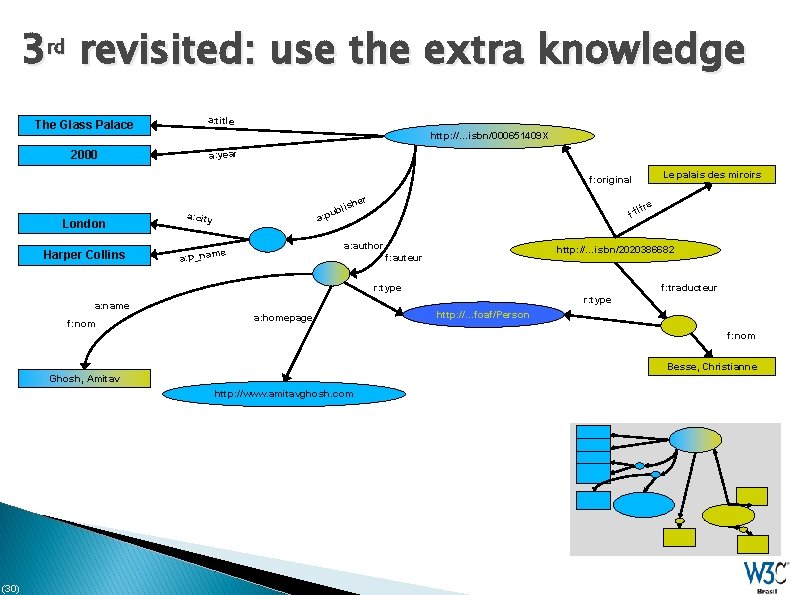
3 rd revisited: use the extra knowledge The Glass Palace a: title 2000 a: year http: //…isbn/000651409 X Le palais des miroirs f: original her London Harper Collins tre lis pub a: city f: ti a: author e a: p_nam http: //…isbn/2020386682 f: auteur r: type a: name f: nom f: traducteur r: type a: homepage http: //…foaf/Person f: nom Besse, Christianne Ghosh, Amitav http: //www. amitavghosh. com (30)
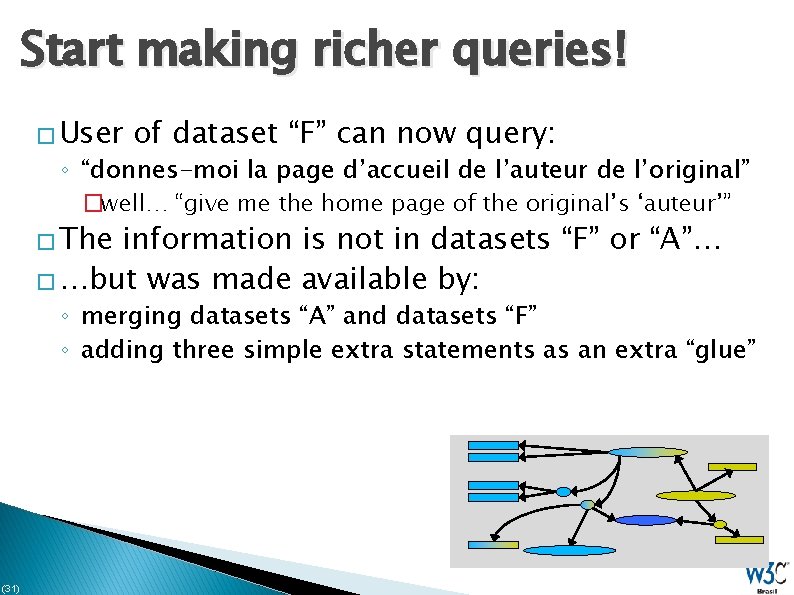
Start making richer queries! � User of dataset “F” can now query: ◦ “donnes-moi la page d’accueil de l’auteur de l’original” �well… “give me the home page of the original’s ‘auteur’” � The information is not in datasets “F” or “A”… � …but was made available by: ◦ merging datasets “A” and datasets “F” ◦ adding three simple extra statements as an extra “glue” (31)
Combine with different datasets � Using, e. g. , the “Person”, the dataset can be combined with other sources � For example, data in Wikipedia can be extracted using dedicated tools ◦ e. g. , the “dbpedia” project can extract the “infobox” information from Wikipedia already… (32)
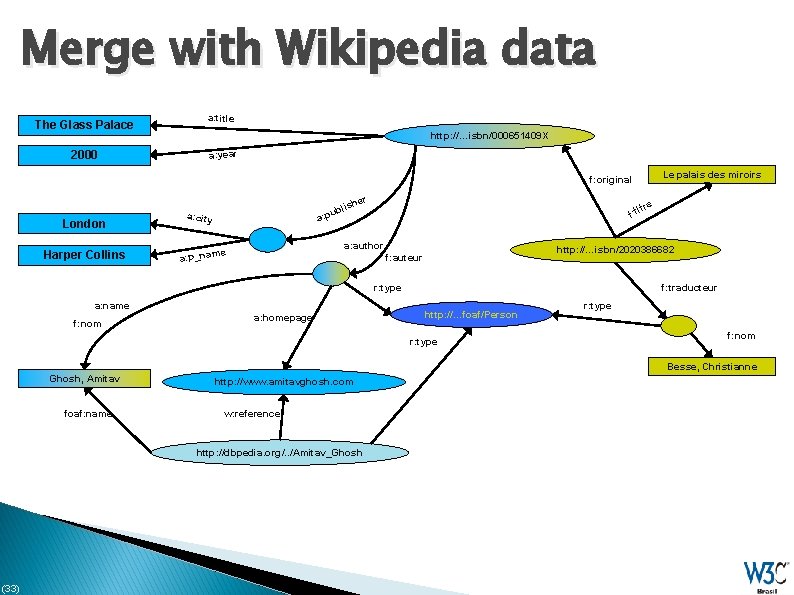
Merge with Wikipedia data The Glass Palace 2000 a: title http: //…isbn/000651409 X a: year Le palais des miroirs f: original her London Harper Collins tre lis pub a: city f: ti a: author e a: p_nam http: //…isbn/2020386682 f: auteur r: type a: name f: nom a: homepage f: traducteur http: //…foaf/Person r: type f: nom Besse, Christianne Ghosh, Amitav foaf: name http: //www. amitavghosh. com w: reference http: //dbpedia. org/. . /Amitav_Ghosh (33)
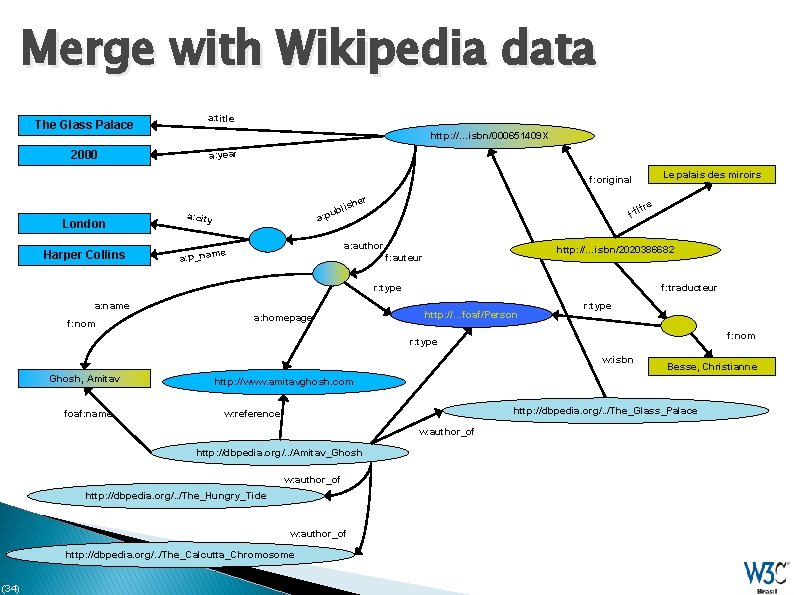
Merge with Wikipedia data The Glass Palace 2000 a: title http: //…isbn/000651409 X a: year Le palais des miroirs f: original her London Harper Collins tre lis pub a: city f: ti a: author e a: p_nam http: //…isbn/2020386682 f: auteur r: type a: name f: nom a: homepage f: traducteur http: //…foaf/Person r: type f: nom r: type w: isbn Ghosh, Amitav foaf: name http: //www. amitavghosh. com http: //dbpedia. org/. . /The_Glass_Palace w: reference w: author_of http: //dbpedia. org/. . /Amitav_Ghosh w: author_of http: //dbpedia. org/. . /The_Hungry_Tide w: author_of http: //dbpedia. org/. . /The_Calcutta_Chromosome (34) Besse, Christianne
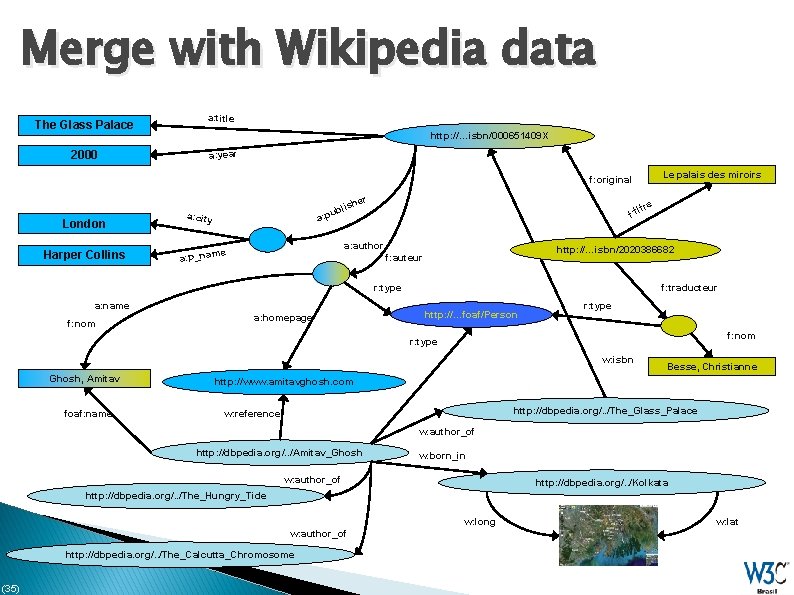
Merge with Wikipedia data The Glass Palace 2000 a: title http: //…isbn/000651409 X a: year Le palais des miroirs f: original her London Harper Collins tre lis pub a: city f: ti a: author e a: p_nam http: //…isbn/2020386682 f: auteur r: type a: name f: nom a: homepage f: traducteur http: //…foaf/Person r: type f: nom r: type w: isbn Ghosh, Amitav foaf: name Besse, Christianne http: //www. amitavghosh. com http: //dbpedia. org/. . /The_Glass_Palace w: reference w: author_of http: //dbpedia. org/. . /Amitav_Ghosh w: born_in w: author_of http: //dbpedia. org/. . /Kolkata http: //dbpedia. org/. . /The_Hungry_Tide w: long w: author_of http: //dbpedia. org/. . /The_Calcutta_Chromosome (35) w: lat
Is that surprising? � It may look like it but, in fact, it should not be… � What happened via automatic means is done every day by Web users! � The difference: a bit of extra rigour so that machines could do this, too (36)
What did we do? � We combined different datasets that ◦ are somewhere on the web ◦ are of different formats (mysql, excel sheet, etc) ◦ have different names for relations � We could combine the data because some URI-s were identical (the ISBN-s in this case) (37)
What did we do? � We could add some simple additional information (the “glue”), also using common terminologies that a community has produced � As a result, new relations could be found and retrieved (38)
It could become even more powerful � We could add extra knowledge to the merged datasets ◦ e. g. , a full classification of various types of library data ◦ geographical information ◦ etc. � This in is where ontologies, extra rules, etc, come ◦ ontologies/rule sets can be relatively simple and small, or huge, or anything in between… � Even more powerful queries can be asked as a result (39)
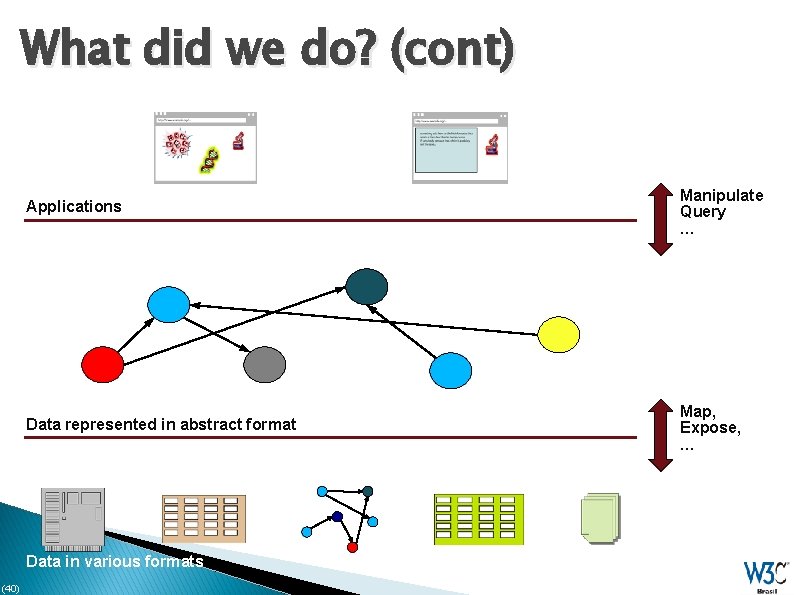
What did we do? (cont) Applications Manipulate Query … Data represented in abstract format Map, Expose, … Data in various formats (40)
So what is the Semantic Web? � The Semantic Web is a collection of technologies to make such integration of Linked Data possible! (41)
Details: many different technologies � an abstract model for the relational graphs: RDF � add/extract RDF information to/from XML, (X)HTML: GRDDL, RDFa � a query language adapted for graphs: SPARQL � characterize the relationships and resources: RDFS, OWL, SKOS, Rules ◦ applications may choose among the different technologies � reuse of existing “ontologies” that others have produced (FOAF in our case) (42)
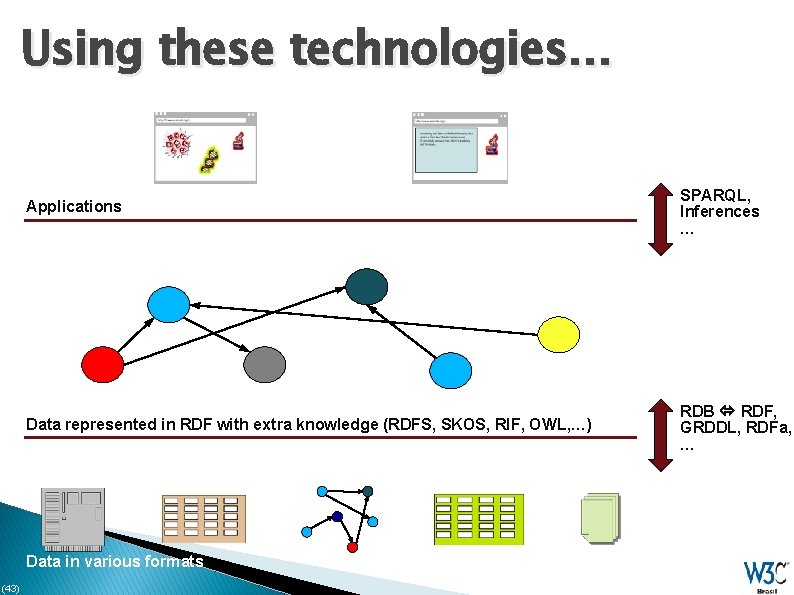
Using these technologies… Applications SPARQL, Inferences … Data represented in RDF with extra knowledge (RDFS, SKOS, RIF, OWL, …) RDB RDF, GRDDL, RDFa, … Data in various formats (43)
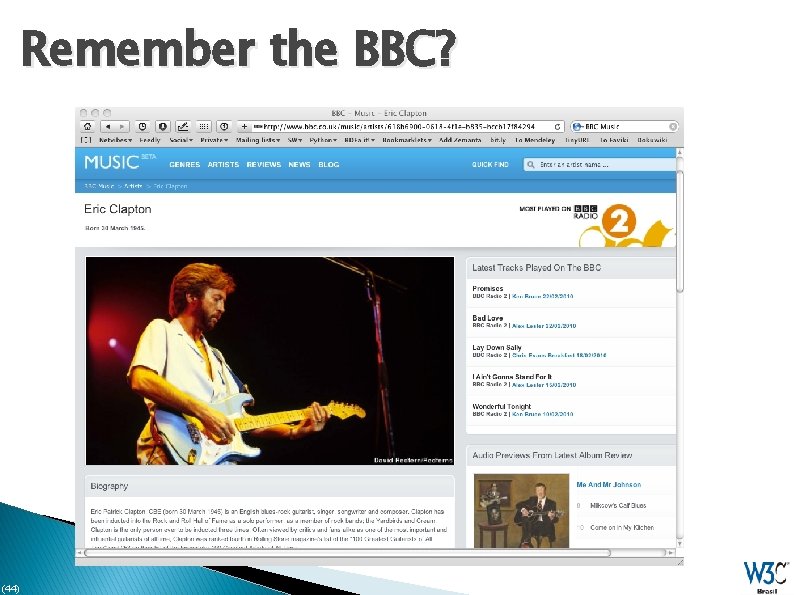
Remember the BBC? (44)
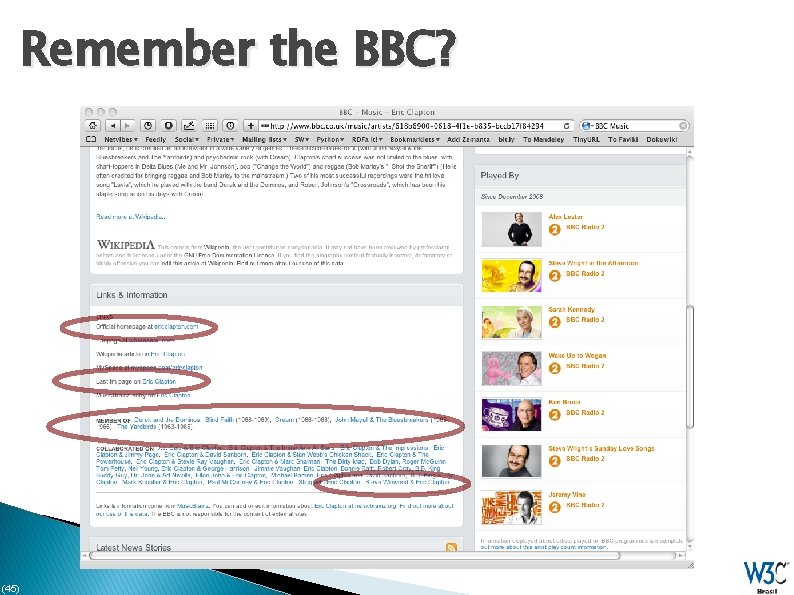
Remember the BBC? (45)
What happens is… � Datasets (e. g. , Music. Brainz) are published in RDF � Some simple vocabularies are involved � Those datasets can be queried together via SPARQL � The result can be displayed following the BBC style (46)
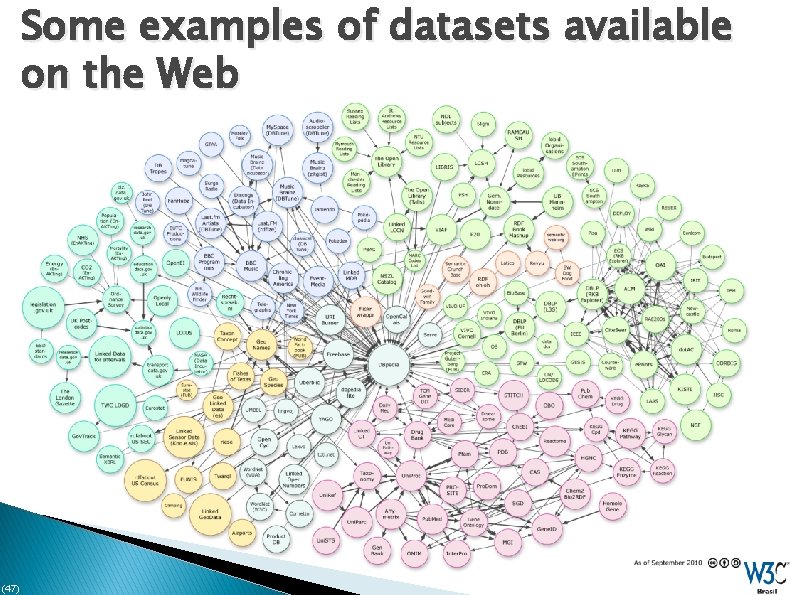
Some examples of datasets available on the Web (47)
What has been achieved so far? �A set of core technologies are in place � Lots of data (billions of relationships) are available in standard format ◦ see the Linked Open Data Cloud (48)
What has been achieved so far? � There is a vibrant community of ◦ academics: universities of Southampton, Oxford, Stanford, PUC ◦ small startups: Garlik, Talis, C&P, Top. Quandrant, Cambridge Semantics, Open. Link, … ◦ major companies: Oracle, IBM, SAP, … ◦ users of Semantic Web data: Google, Facebook, Yahoo! ◦ publishers of Semantic Web data: New York Times, US Library of Congress, open governmental data (US, UK, France, …) (49)
And, of course, applications emerge � Companies, technology: institutions begin to use the ◦ BBC, Vodafone, Siemens, NASA, Best. Buy, Tesco, Korean National Archives, Pfizer, Chevron, … �see http: //www. w 3. org/2001/sw/Use. Cases � Truth must be said: we still have a way to go ◦ deployment may still be experimental, or on some specific places only (50)
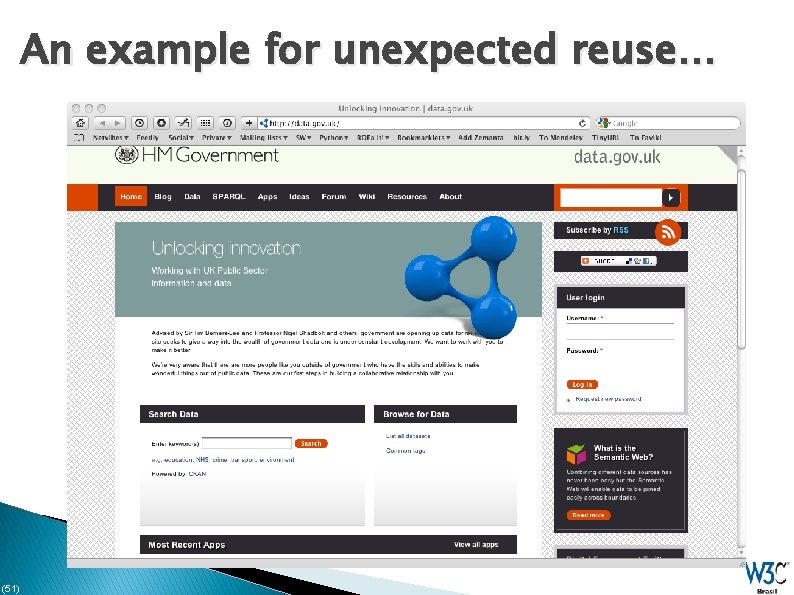
An example for unexpected reuse… (51)
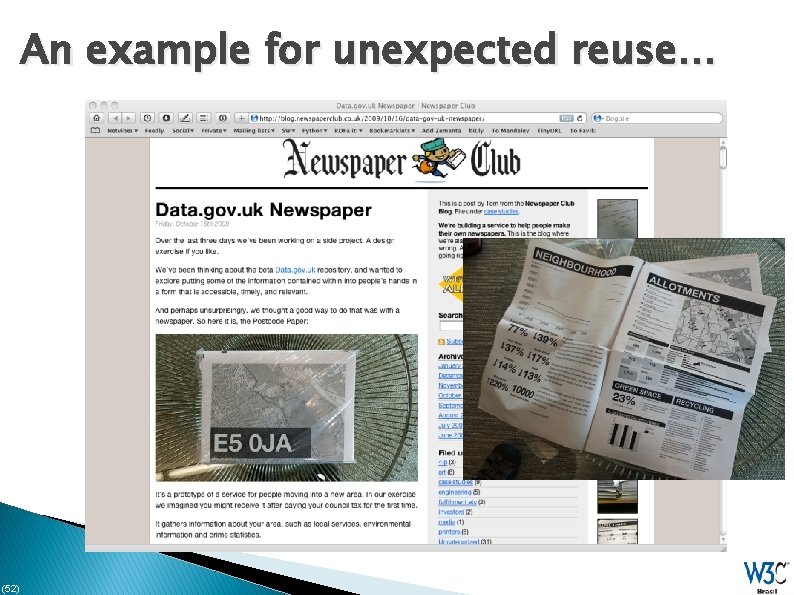
An example for unexpected reuse… (52)
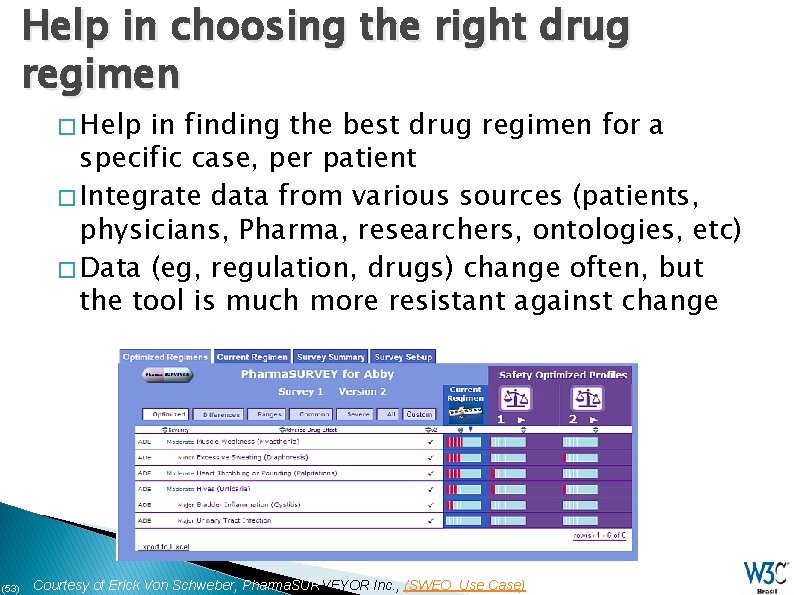
Help in choosing the right drug regimen � Help in finding the best drug regimen for a specific case, per patient � Integrate data from various sources (patients, physicians, Pharma, researchers, ontologies, etc) � Data (eg, regulation, drugs) change often, but the tool is much more resistant against change (53) Courtesy of Erick Von Schweber, Pharma. SURVEYOR Inc. , (SWEO Use Case)
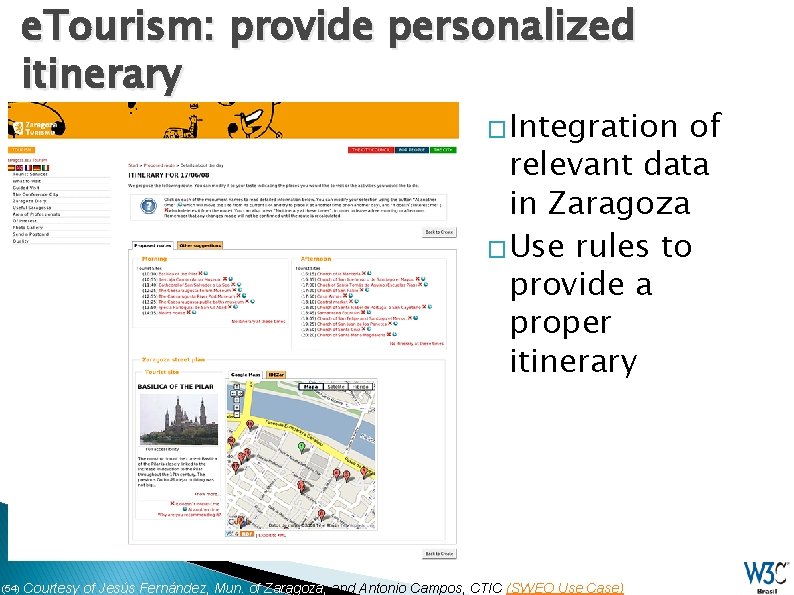
e. Tourism: provide personalized itinerary �Integration of relevant data in Zaragoza �Use rules to provide a proper itinerary (54) Courtesy of Jesús Fernández, Mun. of Zaragoza, and Antonio Campos, CTIC (SWEO Use Case)
Everything is not rosy, of course… � Tools have to improve � There is a lack of knowledgeable experts ◦ scaling for very large datasets ◦ quality check for data ◦ etc ◦ this makes the initial “step” tedious ◦ leads to a lack of understanding of the technology � But (55) we are getting there!
Why is all this good? �A huge amount of data (“information”) is available on the Web � Sites struggle with the dual task of: ◦ providing quality data ◦ providing usable and attractive interfaces to access that data (56)
Why is all this good? � Semantic Web technologies allow a separation of tasks: publish quality, interlinked datasets 2. “mash-up” datasets for a better user experience 1. “Raw Data Now!” Tim Berners-Lee, TED Talk, 2009 http: //bit. ly/dg 7 H 7 Z (57)
Why is all this good? � The “network effect” is also valid for data � There are unexpected usages of data that authors may not even have thought of � “Curating”, using, exploiting the data requires a different expertise (58)
Thank you for your attention! These slides are also available on the Web: http: //www. w 3. org/2010/Talks/1015 -Sau. Paulo-Sem. Cafe-IH/ (59)
- Slides: 59