
HOW DOES PISA WORKS FOR MATHS The Mathematisation

- Slides: 29
HOW DOES PISA WORKS FOR MATHS (The Mathematisation Cycle) According to the PISA mathematics framework Organisation for Economic Co-operation and Development (OECD, 2003), Mathematisation is a five stage process:
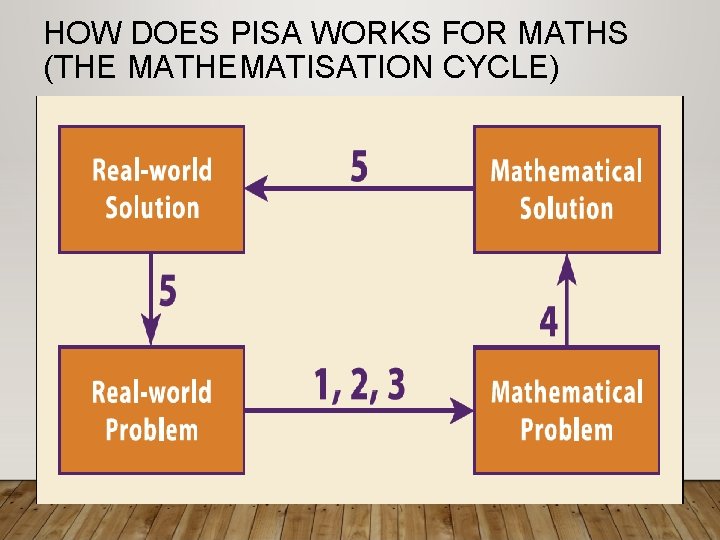
MATHEMATISATION IS A FIVE STAGE PROCESS: • According to the PISA mathematics framework (OECD, 2003), 1. Starting with a problem situated in a real-world context; 2. Organizing Concepts; the problem according to mathematical 3. Gradually ‘trimming away the reality’ by making assumptions about which features of the problem are important, and then generalising and formalising the problem; 4. Solving the mathematical problem; 5. Making sense of the mathematical solution in terms of the real situation.
HOW DOES PISA WORKS FOR MATHS (THE MATHEMATISATION CYCLE)
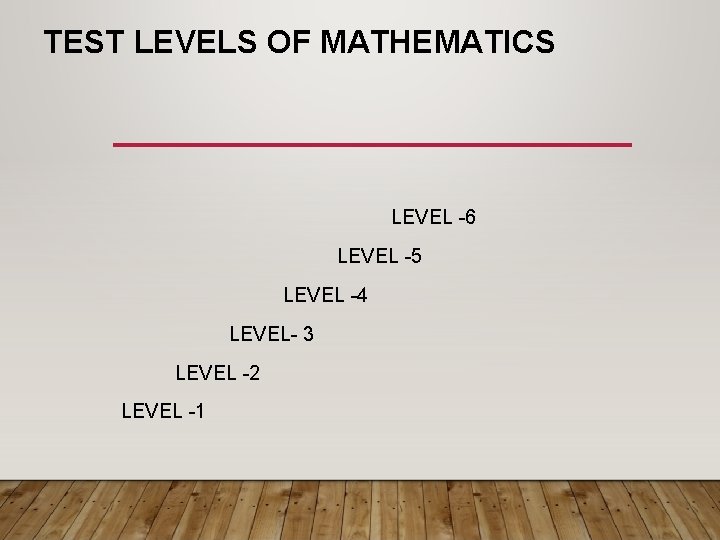
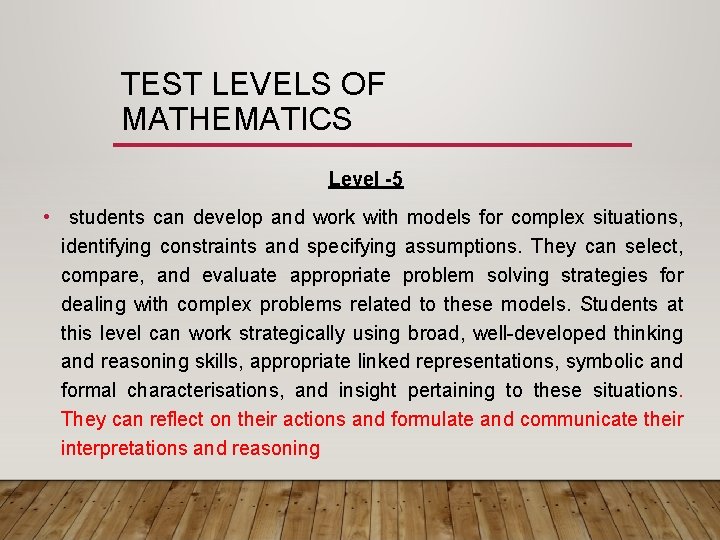
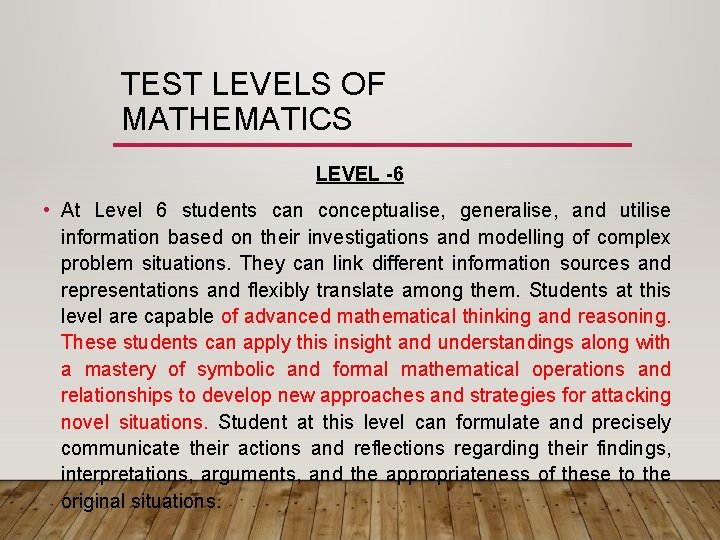
TEST LEVELS OF MATHEMATICS LEVEL -6 LEVEL -5 LEVEL -4 LEVEL- 3 LEVEL -2 LEVEL -1
TEST LEVELS OF MATHEMATICS LEVEL -1 • At Level 1 students can answer questions involving familiar contexts where all relevant information is present and the questions are clearly defined. They are able to identify information and to carry out routine procedures according to direct instructions in explicit situations. They can perform actions that are obvious and follow immediately from the given stimuli.
TEST LEVELS OF MATHEMATICS LEVEL- 2 • At Level 2 students can interpret and recognise situations in contexts that require no more than direct inference. They can extract relevant information from a single source and make use of a single representational mode. Students at this level can employ basic algorithms, formulae, procedures, or conventions. They are capable of direct reasoning and making literal interpretations of the results.
TEST LEVELS OF MATHEMATICS LEVEL -3 • At Level 3 students can execute clearly described procedures, including those that require sequential decisions. They can select and apply simple problem solving strategies. Students at this level can interpret and use representations based on different information sources and reason directly from them. They can develop short communications reporting their interpretations, results and reasoning.
TEST LEVELS OF MATHEMATICS LEVEL -4 • At Level 4 students can work effectively with explicit models for complex concrete situations that may involve constraints or call for making assumptions. They can select and integrate different representations, including symbolic, linking them directly to aspects of real-world situations. Students at this level can utilise well-developed skills and reason flexibly, with some insight, in these contexts. They can construct and communicate explanations and arguments based on their interpretations, arguments, and actions.
TEST LEVELS OF MATHEMATICS Level -5 • students can develop and work with models for complex situations, identifying constraints and specifying assumptions. They can select, compare, and evaluate appropriate problem solving strategies for dealing with complex problems related to these models. Students at this level can work strategically using broad, well-developed thinking and reasoning skills, appropriate linked representations, symbolic and formal characterisations, and insight pertaining to these situations. They can reflect on their actions and formulate and communicate their interpretations and reasoning
TEST LEVELS OF MATHEMATICS LEVEL -6 • At Level 6 students can conceptualise, generalise, and utilise information based on their investigations and modelling of complex problem situations. They can link different information sources and representations and flexibly translate among them. Students at this level are capable of advanced mathematical thinking and reasoning. These students can apply this insight and understandings along with a mastery of symbolic and formal mathematical operations and relationships to develop new approaches and strategies for attacking novel situations. Student at this level can formulate and precisely communicate their actions and reflections regarding their findings, interpretations, arguments, and the appropriateness of these to the original situations.
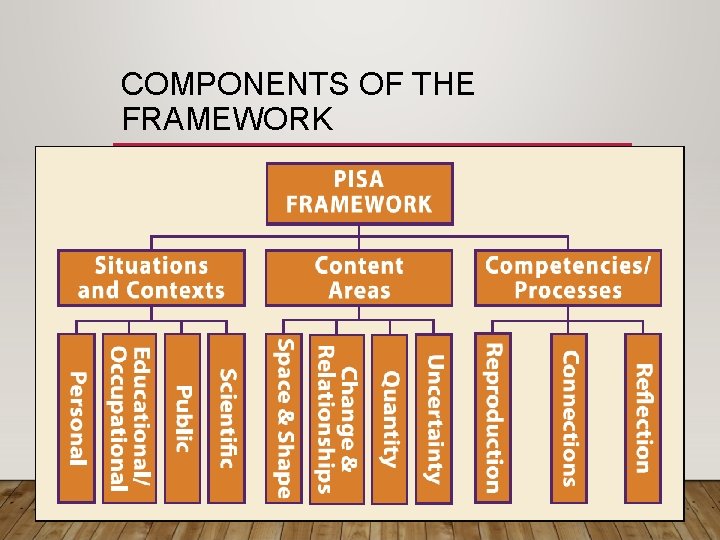
COMPONENTS OF THE FRAMEWORK
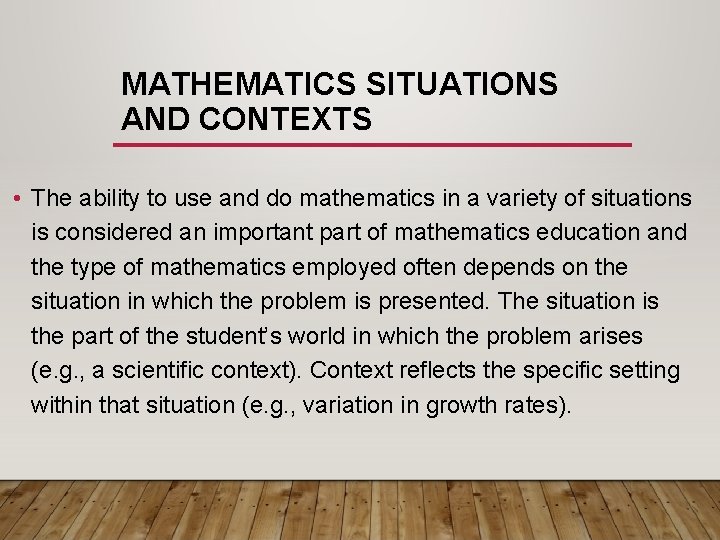
MATHEMATICS SITUATIONS AND CONTEXTS • The ability to use and do mathematics in a variety of situations is considered an important part of mathematics education and the type of mathematics employed often depends on the situation in which the problem is presented. The situation is the part of the student’s world in which the problem arises (e. g. , a scientific context). Context reflects the specific setting within that situation (e. g. , variation in growth rates).
MATHEMATICS CONTENT AREAS • Space & Shape – recognising and understanding geometric patterns and identifying such patterns in abstract and real-world representations; • Change & Relationships – recognising relationships between variables and thinking in terms of and about relationships in a variety of forms including symbolic, algebraic, graphical, tabular, and geometric; • Quantity – understanding relative size, recognising numerical patterns and using numbers to represent quantities and quantifiable attributes of real-world objects; • Uncertainty – solving problems relating to data and chance, which correspond to statistics and probability in school mathematics curricula, respectively.
MATHEMATICS COMPETENCIES/PROCESSES • PISA identifies eight types of cognitive processes involved in mathematisation – ØReasoning ; ØArgumentation ; ØCommunication ; ØModelling ; ØProblem -posing and -solving; ØRepresentation ; ØUsing symbolic, formal and technical language and operations;
WHAT IS A PISA MATHEMATICS QUESTION LIKE? • Each student completed a paper-and-pencil test that included a range of mathematics questions. Different item formats (or types of questions) were used to reflect the variety of ways mathematics can be presented and assessed: ØTraditional multiple-choice items, in which the student selects a response from among several alternatives [20% of items]. ØComplex multiple-choice items, in which the student chooses responses for a series of items (e. g. , true/false statements) [13%].
WHAT IS A PISA MATHEMATICS QUESTION LIKE? Ø Closed-constructed response items, in which the answer is given in numeric or other form, and can be scored against precisely-defined criteria [15%]. Ø Short-response items, in which the student writes a brief answer to a question. Unlike closed-constructed response items, there may be a range of possible correct responses [27%]. Ø Open-constructed response items, in which the student provides a longer written response. There is usually a broad range of possible correct responses. Unlike other item types, the scoring of these questions typically requires significant judgement on the part of trained markers [25%].
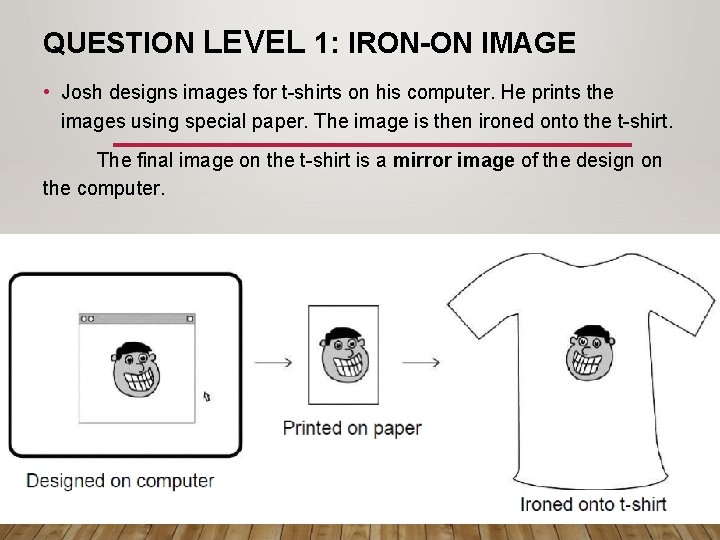
QUESTION LEVEL 1: IRON-ON IMAGE • Josh designs images for t-shirts on his computer. He prints the images using special paper. The image is then ironed onto the t-shirt. The final image on the t-shirt is a mirror image of the design on the computer.
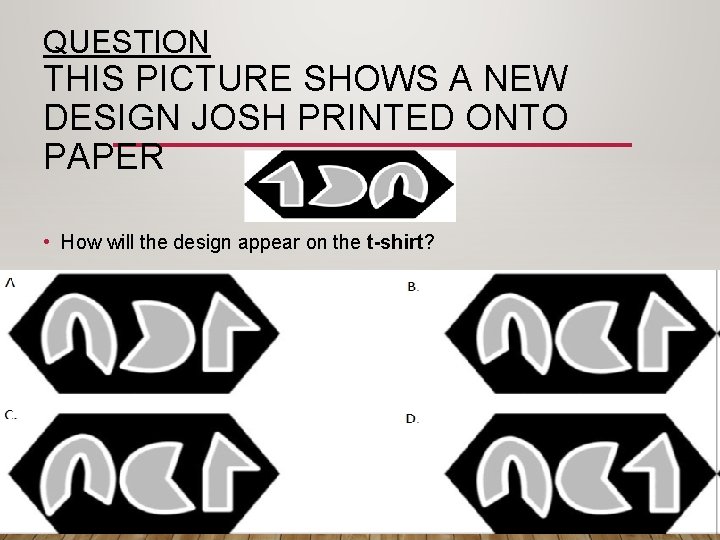
QUESTION THIS PICTURE SHOWS A NEW DESIGN JOSH PRINTED ONTO PAPER • How will the design appear on the t-shirt?
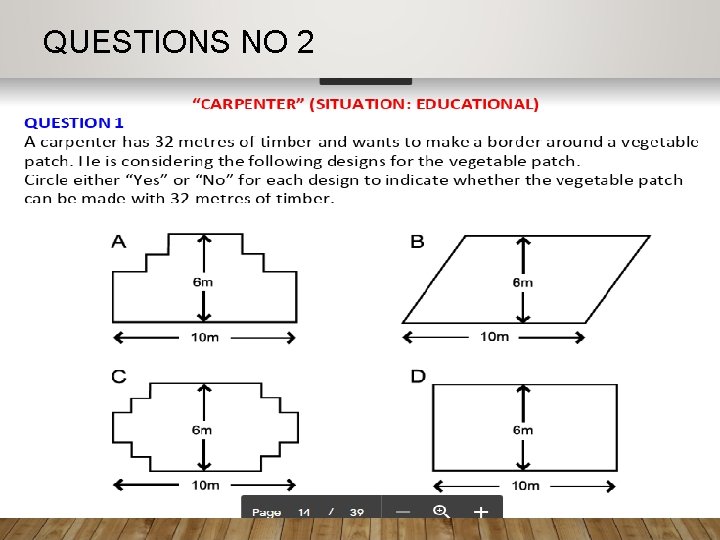
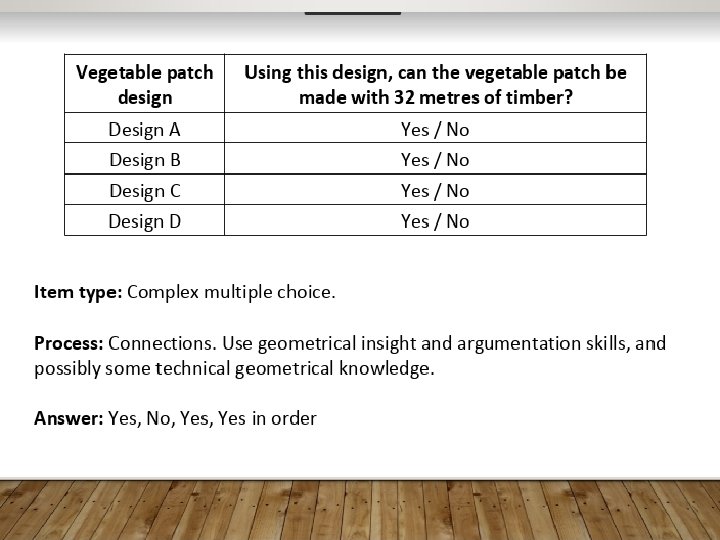
QUESTIONS NO 2
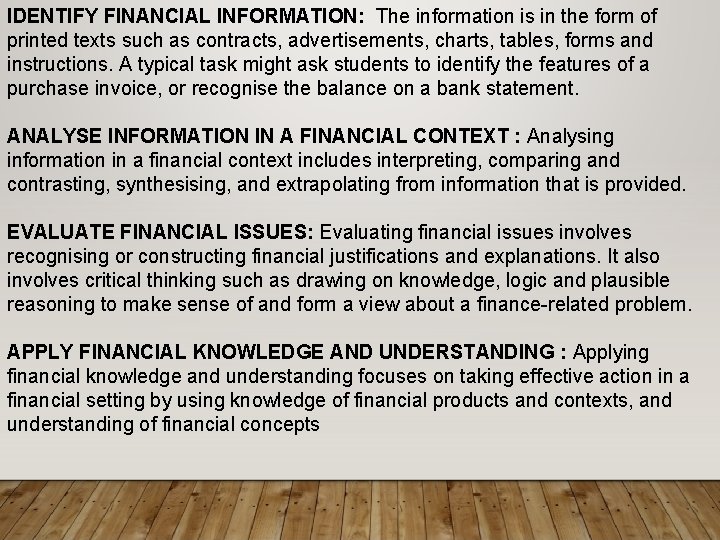
IDENTIFY FINANCIAL INFORMATION: The information is in the form of printed texts such as contracts, advertisements, charts, tables, forms and instructions. A typical task might ask students to identify the features of a purchase invoice, or recognise the balance on a bank statement. ANALYSE INFORMATION IN A FINANCIAL CONTEXT : Analysing information in a financial context includes interpreting, comparing and contrasting, synthesising, and extrapolating from information that is provided. EVALUATE FINANCIAL ISSUES: Evaluating financial issues involves recognising or constructing financial justifications and explanations. It also involves critical thinking such as drawing on knowledge, logic and plausible reasoning to make sense of and form a view about a finance-related problem. APPLY FINANCIAL KNOWLEDGE AND UNDERSTANDING : Applying financial knowledge and understanding focuses on taking effective action in a financial setting by using knowledge of financial products and contexts, and understanding of financial concepts
PISA FINANCIAL LITERACY QUESTIONS
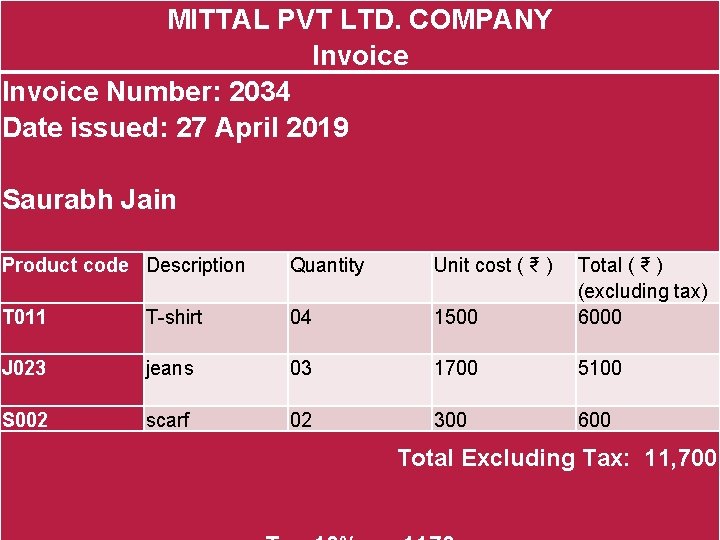
MITTAL PVT LTD. COMPANY Invoice Number: 2034 Date issued: 27 April 2019 Saurabh Jain Product code Description Quantity Unit cost ( ₹ ) T 011 T-shirt 04 1500 Total ( ₹ ) (excluding tax) 6000 J 023 jeans 03 1700 5100 S 002 scarf 02 300 600 Total Excluding Tax: 11, 700
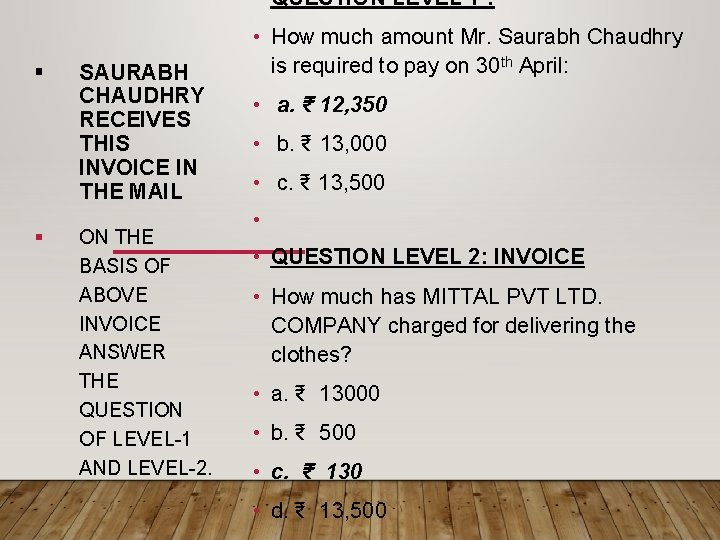
• QUESTION LEVEL 1 : § § SAURABH CHAUDHRY RECEIVES THIS INVOICE IN THE MAIL ON THE BASIS OF ABOVE INVOICE ANSWER THE QUESTION OF LEVEL-1 AND LEVEL-2. • How much amount Mr. Saurabh Chaudhry is required to pay on 30 th April: • a. ₹ 12, 350 • b. ₹ 13, 000 • c. ₹ 13, 500 • • QUESTION LEVEL 2: INVOICE • How much has MITTAL PVT LTD. COMPANY charged for delivering the clothes? • a. ₹ 13000 • b. ₹ 500 • c. ₹ 130 • d. ₹ 13, 500
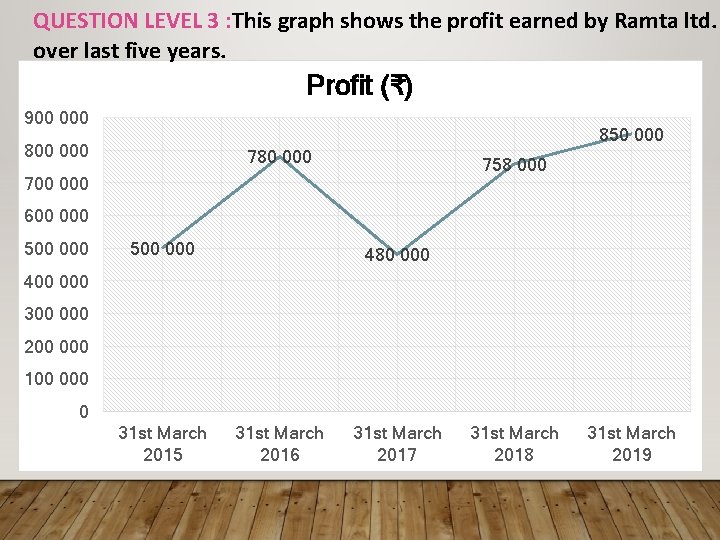
QUESTION LEVEL 3 : This graph shows the profit earned by Ramta ltd. over last five years. Profit (₹) 900 000 850 000 800 000 780 000 758 000 700 000 600 000 500 000 480 000 400 000 300 000 200 000 100 0 31 st March 2015 31 st March 2016 31 st March 2017 31 st March 2018 31 st March 2019
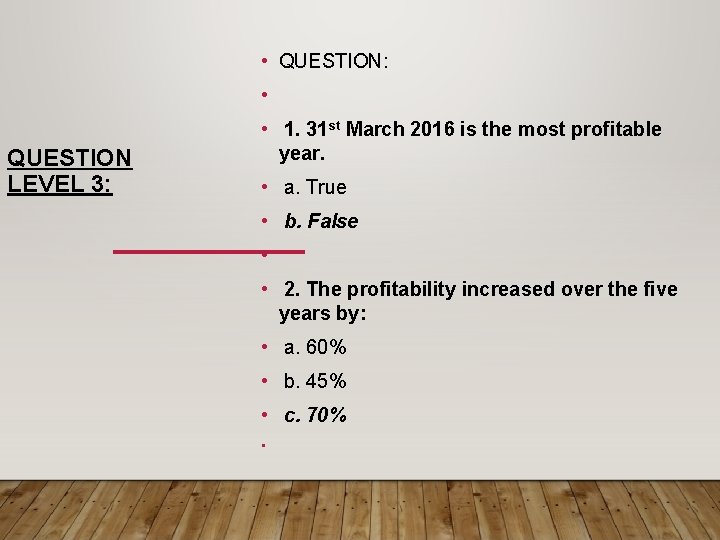
• QUESTION: • QUESTION LEVEL 3: • 1. 31 st March 2016 is the most profitable year. • a. True • b. False • • 2. The profitability increased over the five years by: • a. 60% • b. 45% • c. 70% •
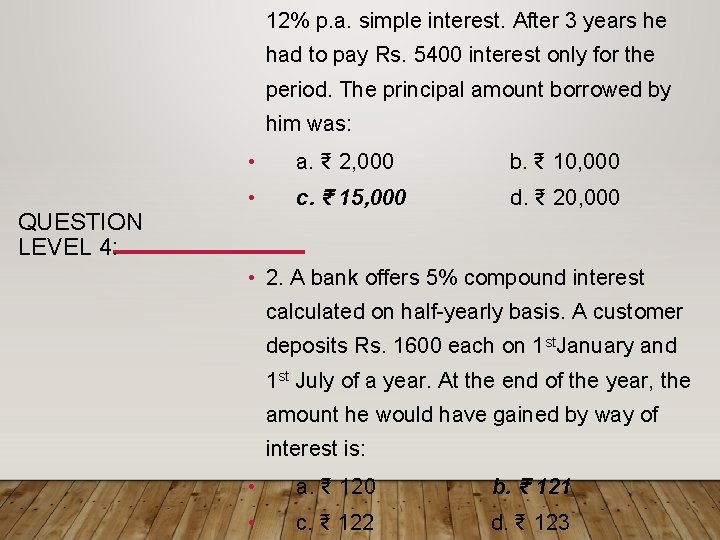
12% p. a. simple interest. After 3 years he had to pay Rs. 5400 interest only for the period. The principal amount borrowed by him was: QUESTION LEVEL 4: • a. ₹ 2, 000 b. ₹ 10, 000 • c. ₹ 15, 000 d. ₹ 20, 000 • 2. A bank offers 5% compound interest calculated on half-yearly basis. A customer deposits Rs. 1600 each on 1 st. January and 1 st July of a year. At the end of the year, the amount he would have gained by way of interest is: • a. ₹ 120 b. ₹ 121 • c. ₹ 122 d. ₹ 123
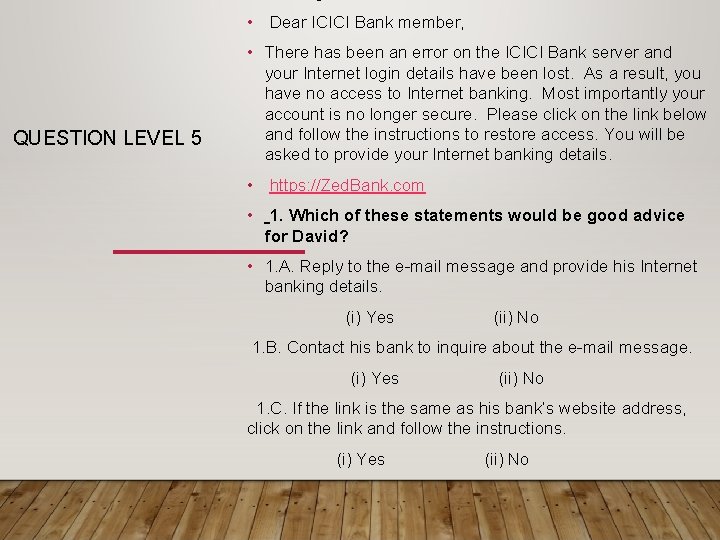
• Dear ICICI Bank member, QUESTION LEVEL 5 • There has been an error on the ICICI Bank server and your Internet login details have been lost. As a result, you have no access to Internet banking. Most importantly your account is no longer secure. Please click on the link below and follow the instructions to restore access. You will be asked to provide your Internet banking details. • https: //Zed. Bank. com • 1. Which of these statements would be good advice for David? • 1. A. Reply to the e-mail message and provide his Internet banking details. (i) Yes (ii) No 1. B. Contact his bank to inquire about the e-mail message. (i) Yes (ii) No 1. C. If the link is the same as his bank’s website address, click on the link and follow the instructions. (i) Yes (ii) No