
How does Newtons law of gravity extend Keplers
- Slides: 8
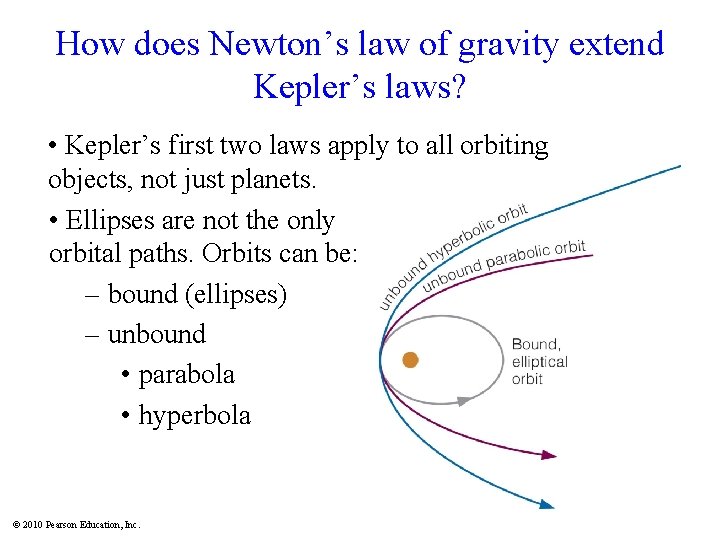
How does Newton’s law of gravity extend Kepler’s laws? • Kepler’s first two laws apply to all orbiting objects, not just planets. • Ellipses are not the only orbital paths. Orbits can be: – bound (ellipses) – unbound • parabola • hyperbola © 2010 Pearson Education, Inc.
Newton and Kepler’s Third Law Newton’s laws of gravity and Kepler’s 3 rd law allow one to calculate the total mass of the system knowing the orbital period and average orbital distance of the system. Examples: • Earth’s orbital period (1 year) and average distance (1 AU) tell us the Sun’s mass. © 2010 Pearson Education, Inc.
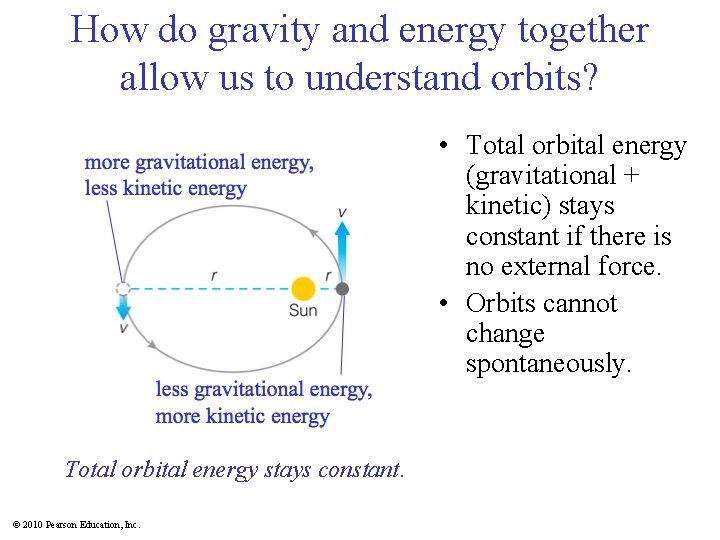
How do gravity and energy together allow us to understand orbits? • Total orbital energy (gravitational + kinetic) stays constant if there is no external force. • Orbits cannot change spontaneously. Total orbital energy stays constant. © 2010 Pearson Education, Inc.
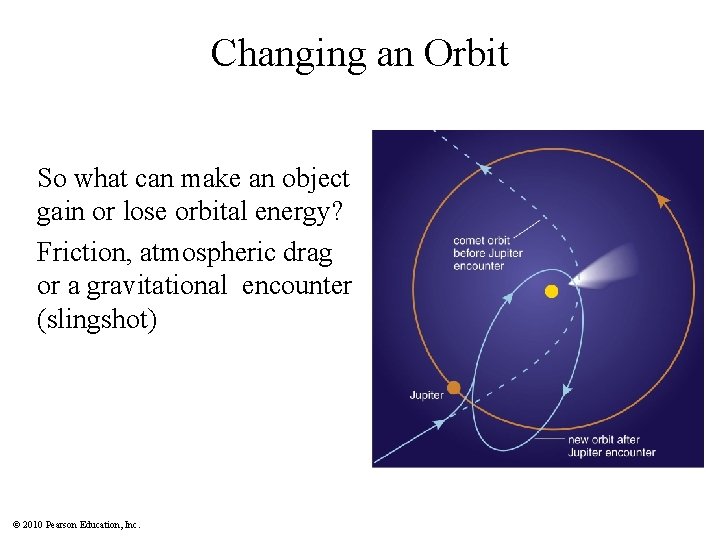
Changing an Orbit So what can make an object gain or lose orbital energy? Friction, atmospheric drag or a gravitational encounter (slingshot) © 2010 Pearson Education, Inc.
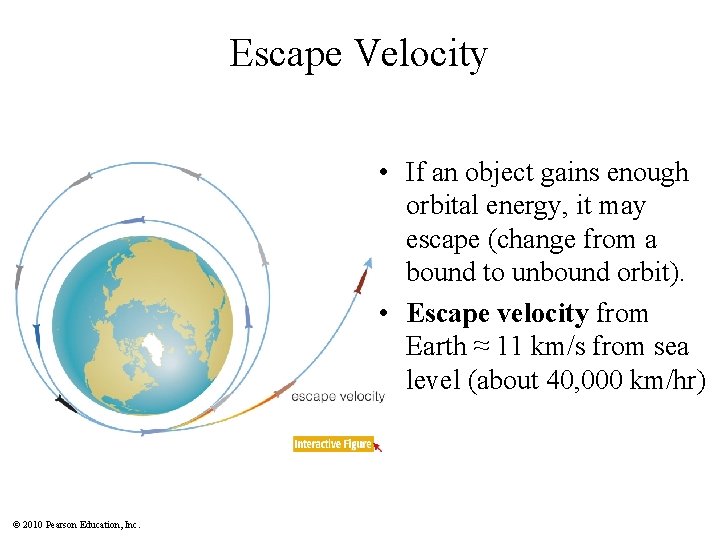
Escape Velocity • If an object gains enough orbital energy, it may escape (change from a bound to unbound orbit). • Escape velocity from Earth ≈ 11 km/s from sea level (about 40, 000 km/hr) © 2010 Pearson Education, Inc.
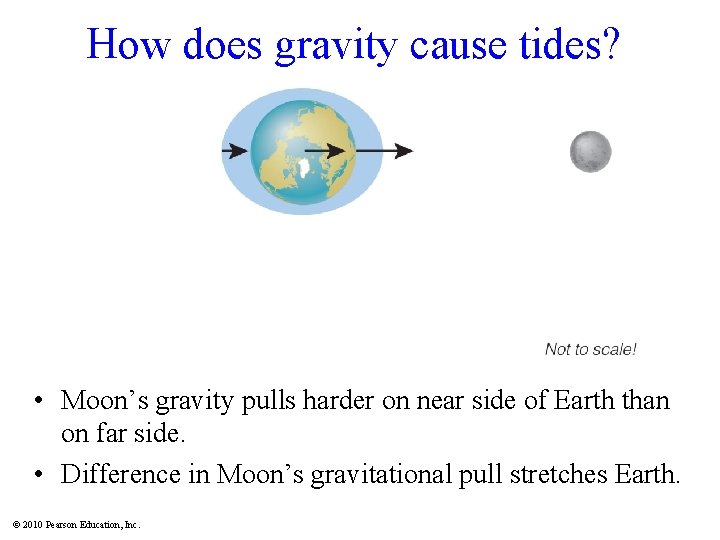
How does gravity cause tides? • Moon’s gravity pulls harder on near side of Earth than on far side. • Difference in Moon’s gravitational pull stretches Earth. © 2010 Pearson Education, Inc.
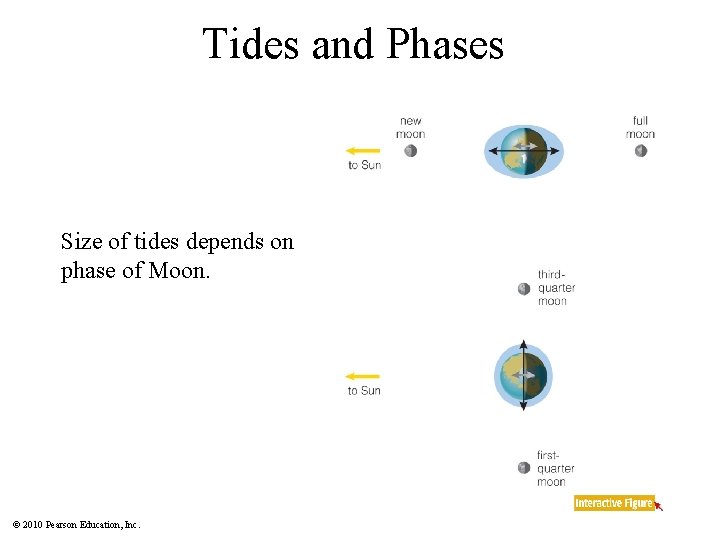
Tides and Phases Size of tides depends on phase of Moon. © 2010 Pearson Education, Inc.
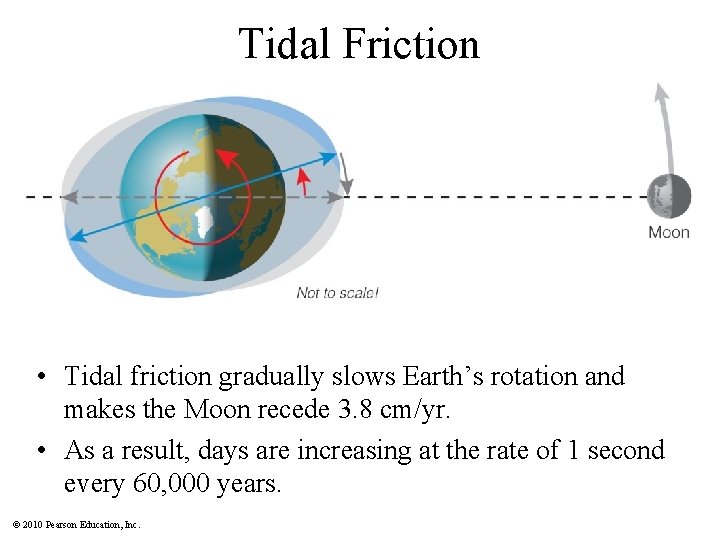
Tidal Friction • Tidal friction gradually slows Earth’s rotation and makes the Moon recede 3. 8 cm/yr. • As a result, days are increasing at the rate of 1 second every 60, 000 years. © 2010 Pearson Education, Inc.