
How does network position affect firms innovation Connecting
- Slides: 26
How does network position affect firms’ innovation? Connecting RCN data to the Community Innovation Survey Joar Kvamsås
Research collaboration networks and innovation • Innovation comes from a ‘variety in cognition’ (Schumpeter 1939) • Innovation can arise from the recombination of internal and external knowledge • The effect of network position on firm-level innovation can be measured by combining RCN data with other data sources
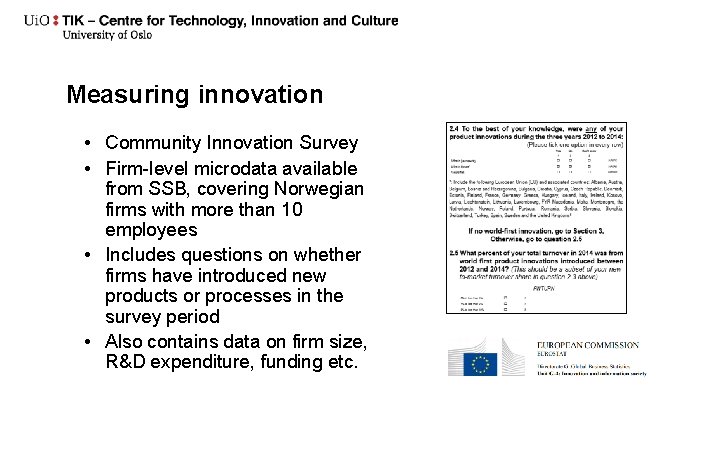
Measuring innovation • Community Innovation Survey • Firm-level microdata available from SSB, covering Norwegian firms with more than 10 employees • Includes questions on whether firms have introduced new products or processes in the survey period • Also contains data on firm size, R&D expenditure, funding etc.
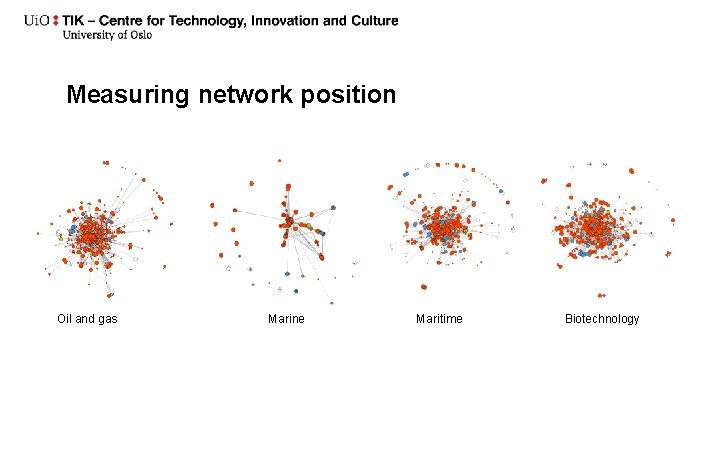
Measuring network position Oil and gas Marine Maritime Biotechnology
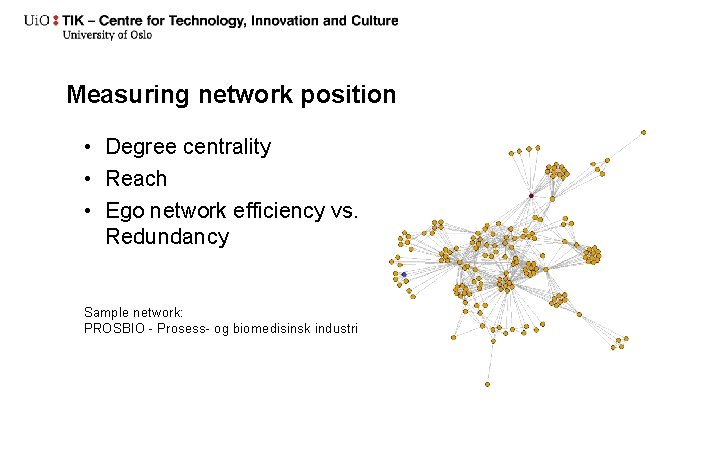
Measuring network position • Degree centrality • Reach • Ego network efficiency vs. Redundancy Sample network: PROSBIO - Prosess- og biomedisinsk industri
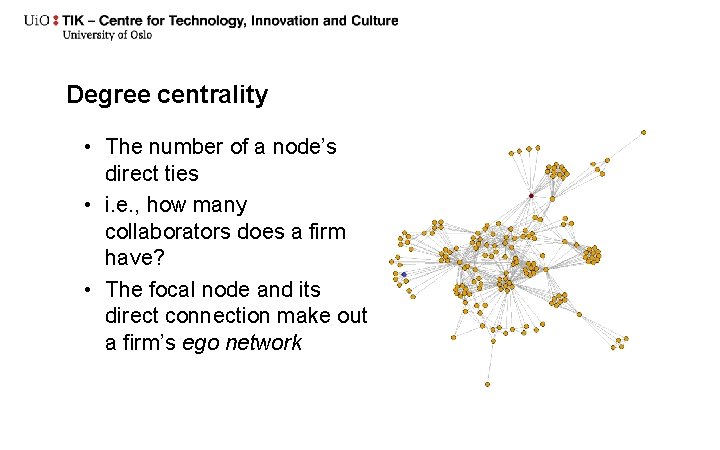
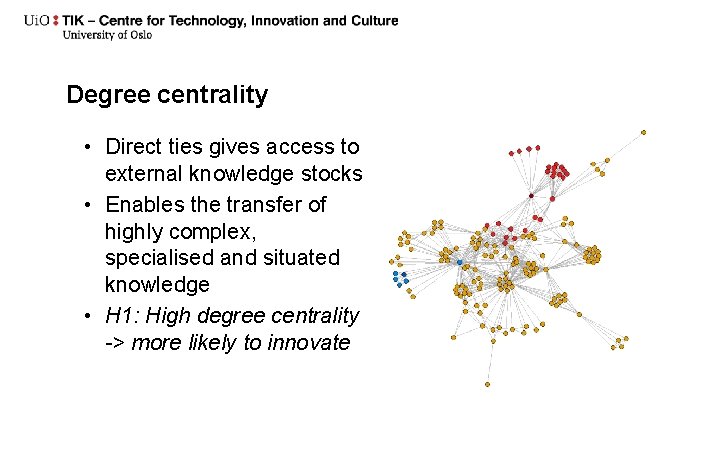
Degree centrality • The number of a node’s direct ties • i. e. , how many collaborators does a firm have? • The focal node and its direct connection make out a firm’s ego network
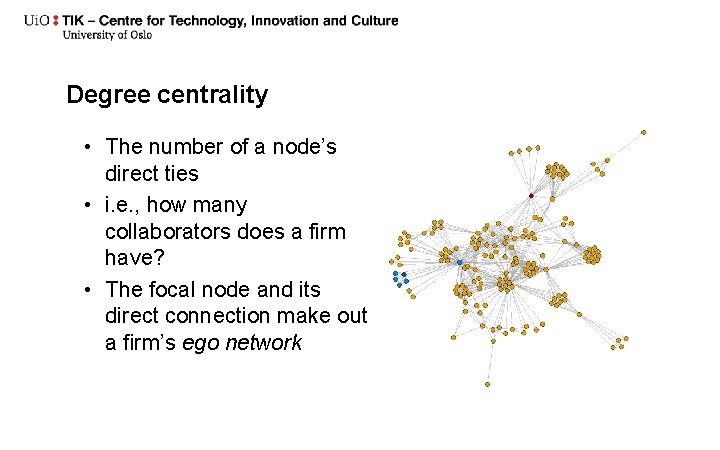
Degree centrality • The number of a node’s direct ties • i. e. , how many collaborators does a firm have? • The focal node and its direct connection make out a firm’s ego network
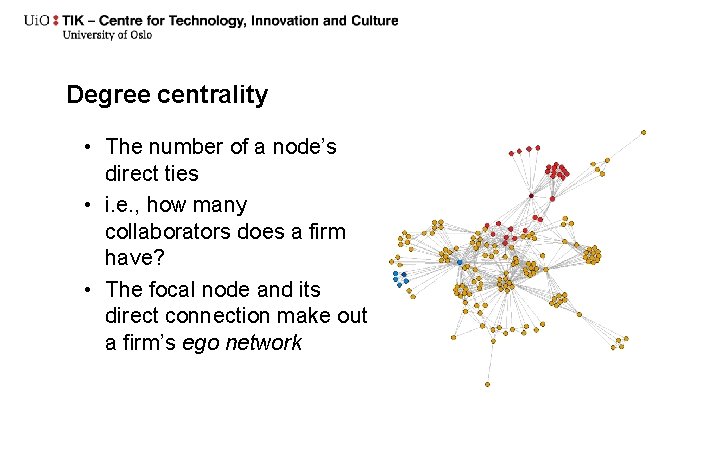
Degree centrality • The number of a node’s direct ties • i. e. , how many collaborators does a firm have? • The focal node and its direct connection make out a firm’s ego network
Degree centrality • Direct ties gives access to external knowledge stocks • Enables the transfer of highly complex, specialised and situated knowledge • H 1: High degree centrality -> more likely to innovate
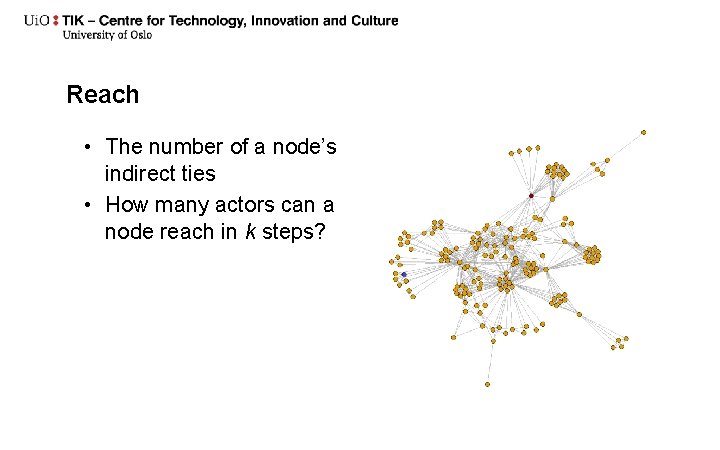
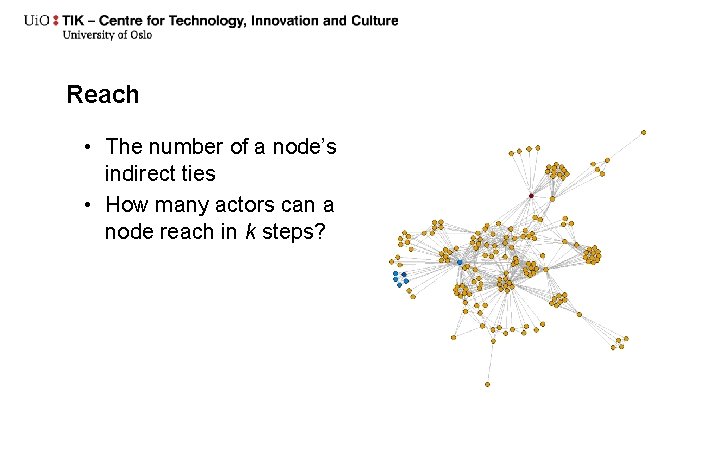
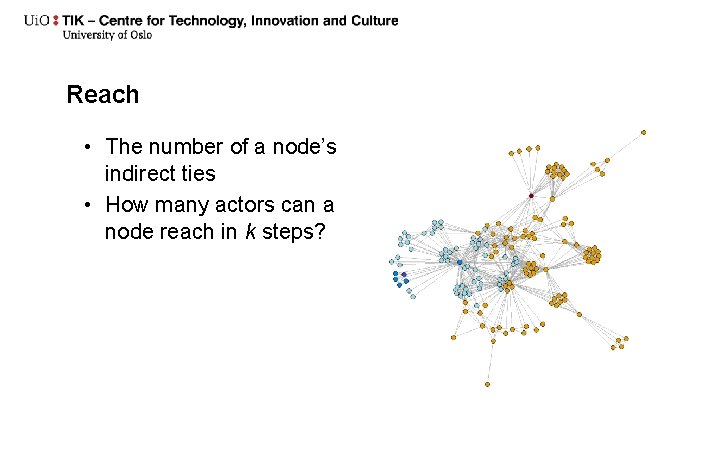
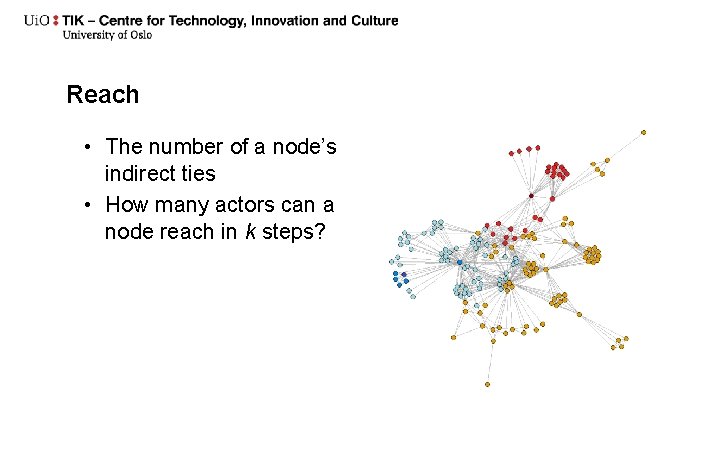
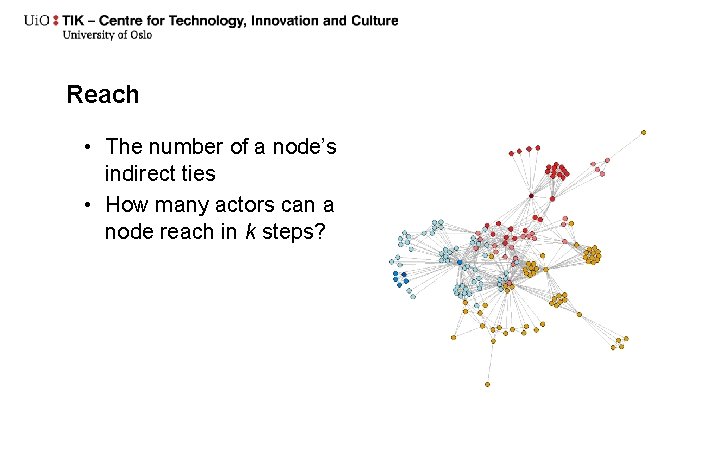
Reach • The number of a node’s indirect ties • How many actors can a node reach in k steps?
Reach • The number of a node’s indirect ties • How many actors can a node reach in k steps?
Reach • The number of a node’s indirect ties • How many actors can a node reach in k steps?
Reach • The number of a node’s indirect ties • How many actors can a node reach in k steps?
Reach • The number of a node’s indirect ties • How many actors can a node reach in k steps?
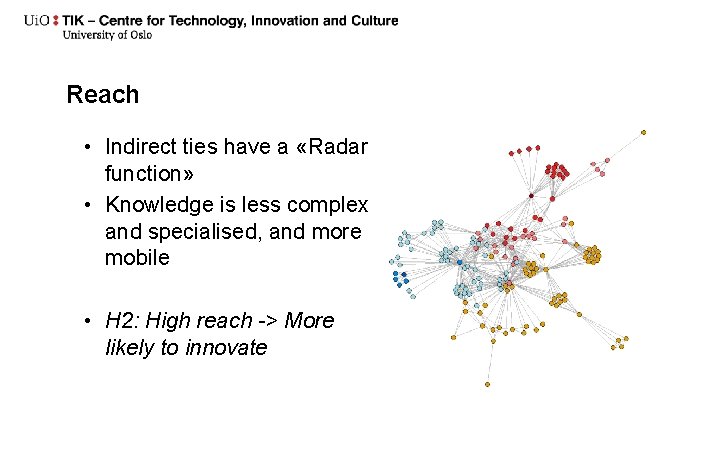
Reach • Indirect ties have a «Radar function» • Knowledge is less complex and specialised, and more mobile • H 2: High reach -> More likely to innovate
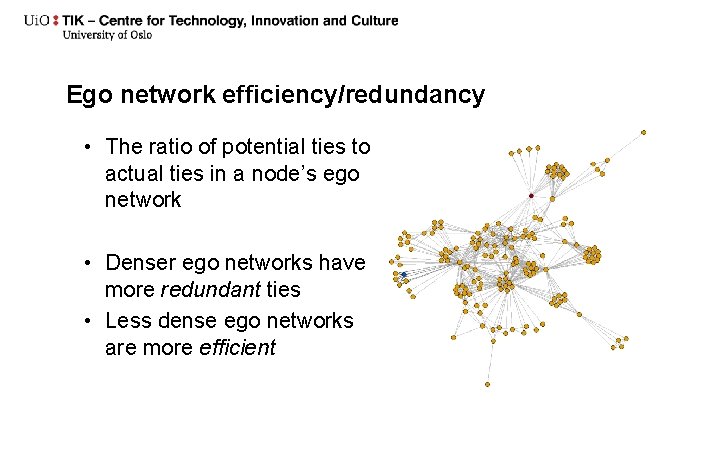
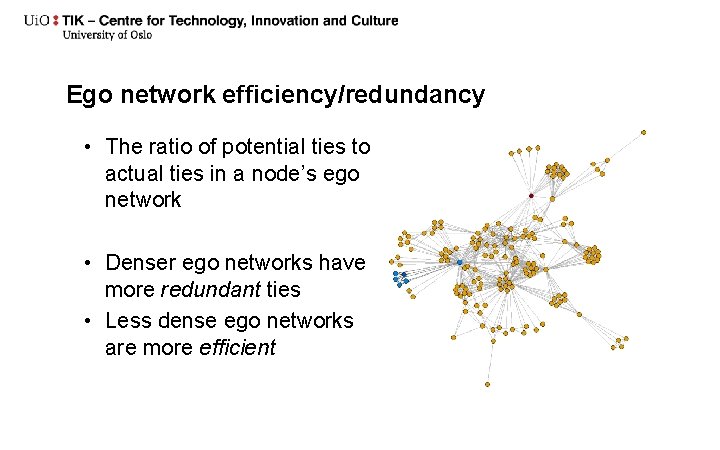
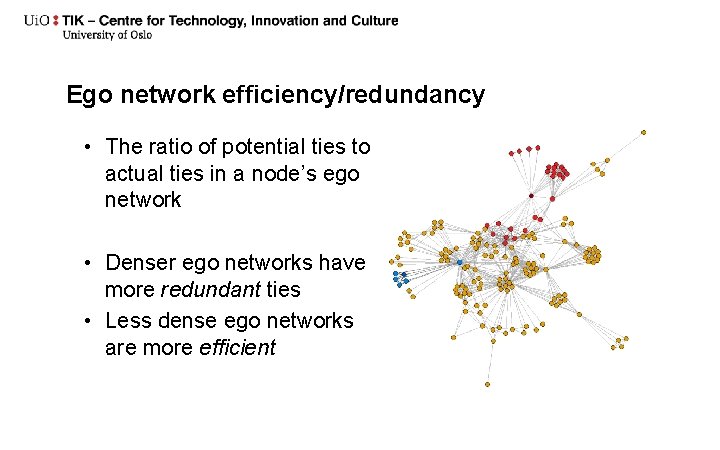
Ego network efficiency/redundancy • The ratio of potential ties to actual ties in a node’s ego network • Denser ego networks have more redundant ties • Less dense ego networks are more efficient
Ego network efficiency/redundancy • The ratio of potential ties to actual ties in a node’s ego network • Denser ego networks have more redundant ties • Less dense ego networks are more efficient
Ego network efficiency/redundancy • The ratio of potential ties to actual ties in a node’s ego network • Denser ego networks have more redundant ties • Less dense ego networks are more efficient
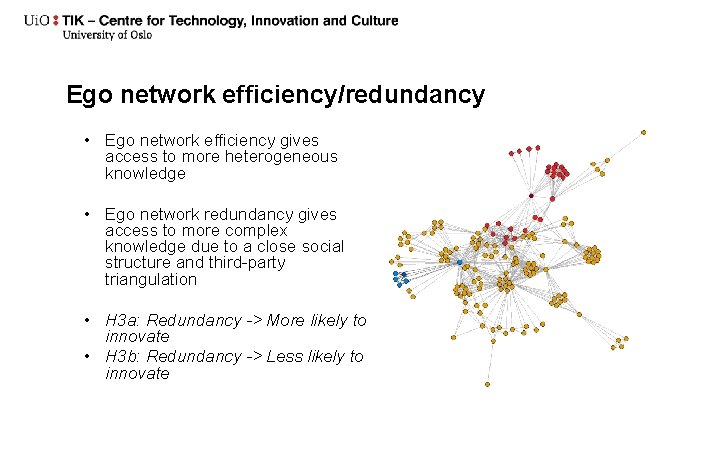
Ego network efficiency/redundancy • Ego network efficiency gives access to more heterogeneous knowledge • Ego network redundancy gives access to more complex knowledge due to a close social structure and third-party triangulation • H 3 a: Redundancy -> More likely to innovate • H 3 b: Redundancy -> Less likely to innovate
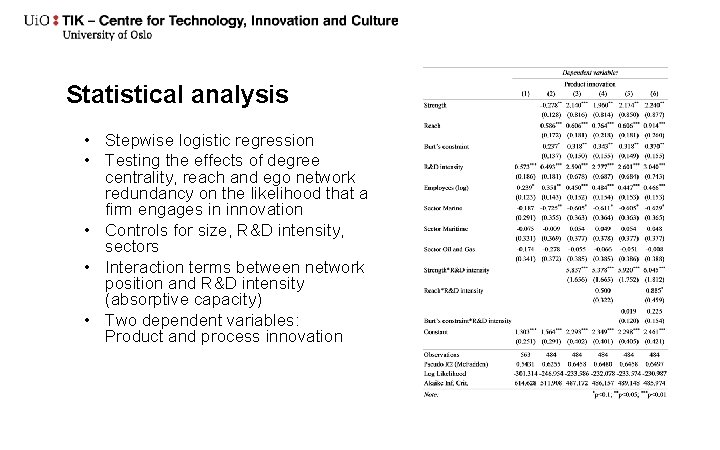
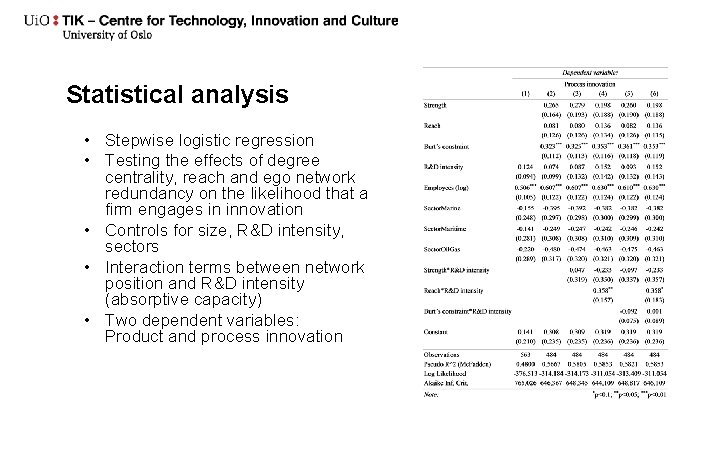
Statistical analysis • Stepwise logistic regression • Testing the effects of degree centrality, reach and ego network redundancy on the likelihood that a firm engages in innovation • Controls for size, R&D intensity, sectors • Interaction terms between network position and R&D intensity (absorptive capacity) • Two dependent variables: Product and process innovation
Statistical analysis • Stepwise logistic regression • Testing the effects of degree centrality, reach and ego network redundancy on the likelihood that a firm engages in innovation • Controls for size, R&D intensity, sectors • Interaction terms between network position and R&D intensity (absorptive capacity) • Two dependent variables: Product and process innovation
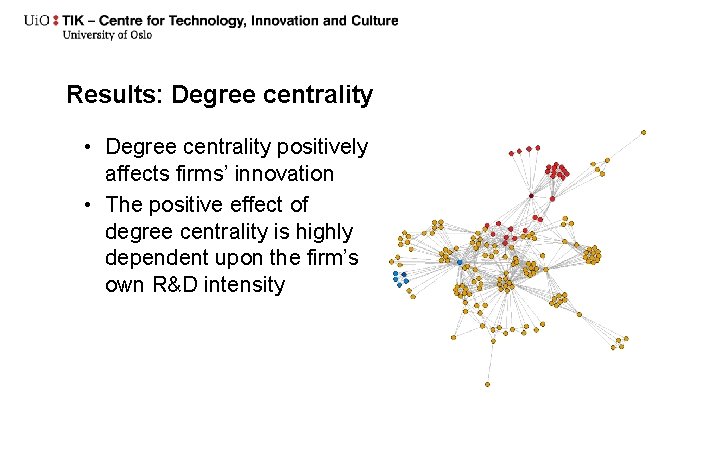
Results: Degree centrality • Degree centrality positively affects firms’ innovation • The positive effect of degree centrality is highly dependent upon the firm’s own R&D intensity
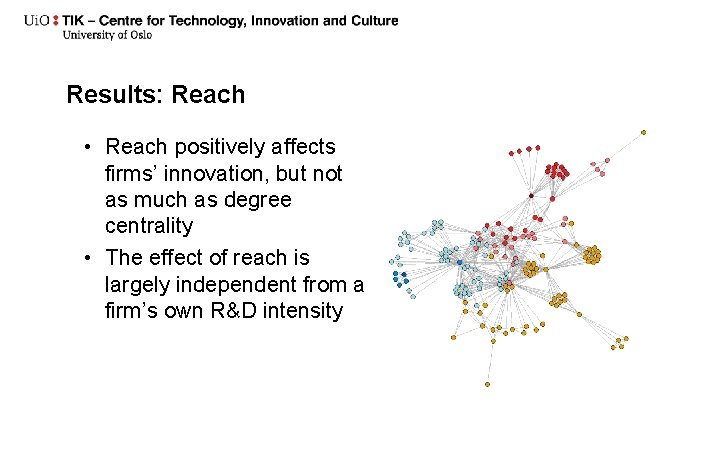
Results: Reach • Reach positively affects firms’ innovation, but not as much as degree centrality • The effect of reach is largely independent from a firm’s own R&D intensity
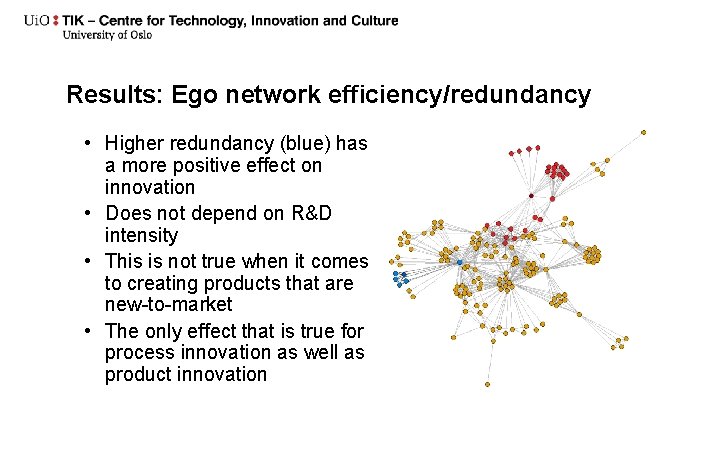
Results: Ego network efficiency/redundancy • Higher redundancy (blue) has a more positive effect on innovation • Does not depend on R&D intensity • This is not true when it comes to creating products that are new-to-market • The only effect that is true for process innovation as well as product innovation
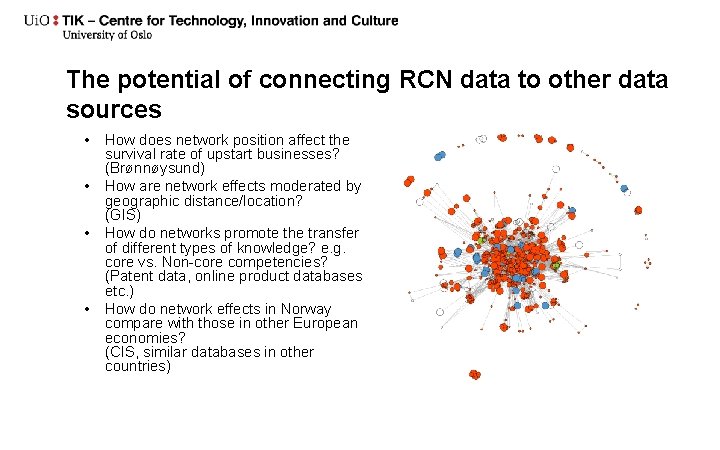
The potential of connecting RCN data to other data sources • • How does network position affect the survival rate of upstart businesses? (Brønnøysund) How are network effects moderated by geographic distance/location? (GIS) How do networks promote the transfer of different types of knowledge? e. g. core vs. Non-core competencies? (Patent data, online product databases etc. ) How do network effects in Norway compare with those in other European economies? (CIS, similar databases in other countries)
Thank you! joarkv@sv. uio. no