
How does DNA instruct cells to make PROTEINS
- Slides: 48
How does DNA instruct cells to make PROTEINS? 1
Part I DNA, Genes, and Proteins
DNA and genes • Some stretches of DNA are called genes. • Genes are stretches of nucleotide bases (DNA) that code for proteins. • Proteins are used to build cells and do much of the work inside cells.
Genes and Proteins • Each gene code is copied in the nucleus and taken to the cytoplasm. • Here the code is deciphered and converted into a string of amino acids (a protein) • Each different protein has its own gene, somewhere on the chromosome, that codes for it. 4
Part II COPYING THE GENE
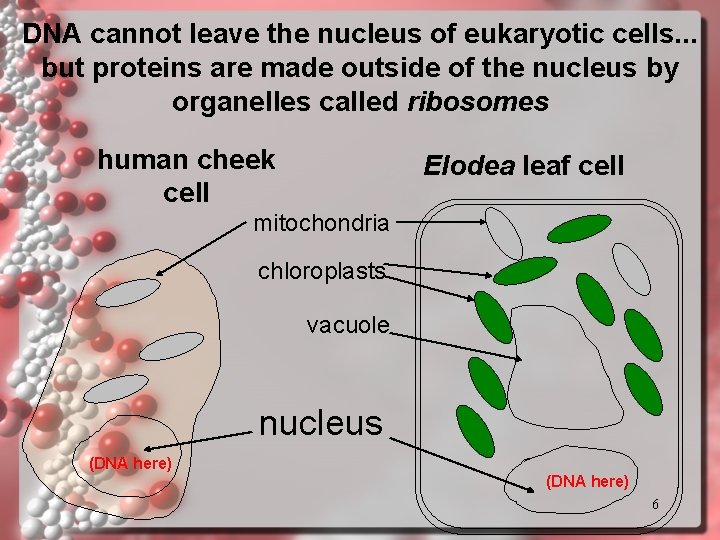
DNA cannot leave the nucleus of eukaryotic cells. . . but proteins are made outside of the nucleus by organelles called ribosomes human cheek cell Elodea leaf cell mitochondria chloroplasts vacuole nucleus (DNA here) 6
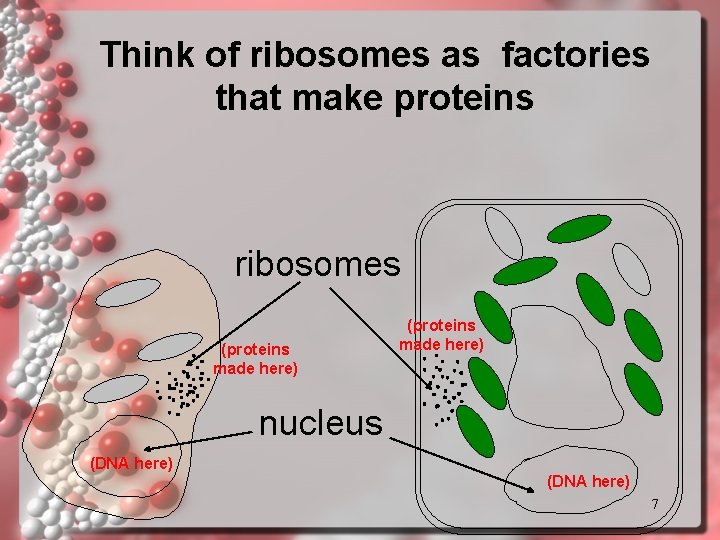
Think of ribosomes as factories that make proteins ribosomes (proteins made here) nucleus (DNA here) 7
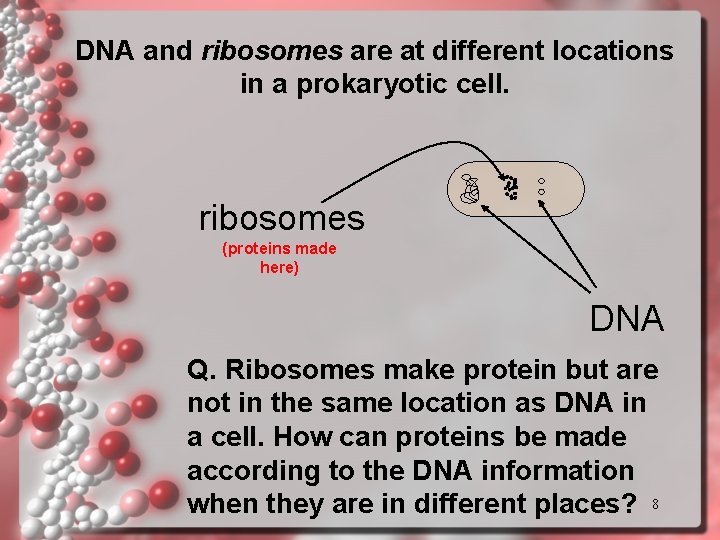
DNA and ribosomes are at different locations in a prokaryotic cell. ribosomes (proteins made here) DNA Q. Ribosomes make protein but are not in the same location as DNA in a cell. How can proteins be made according to the DNA information when they are in different places? 8
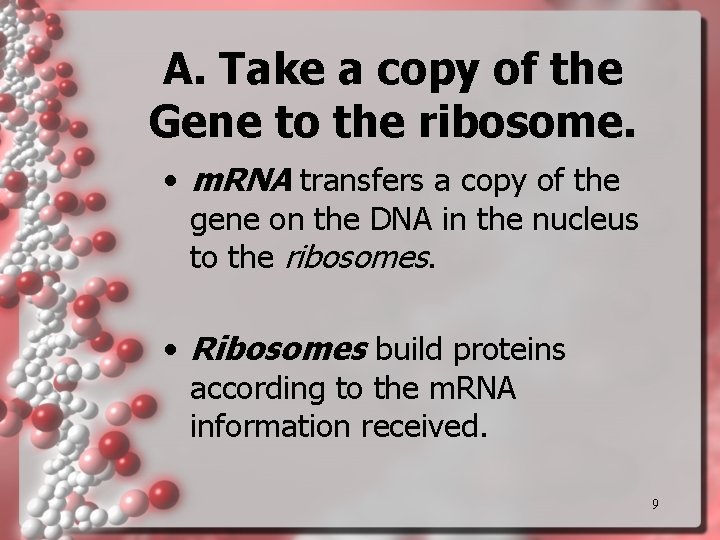
A. Take a copy of the Gene to the ribosome. • m. RNA transfers a copy of the gene on the DNA in the nucleus to the ribosomes. • Ribosomes build proteins according to the m. RNA information received. 9
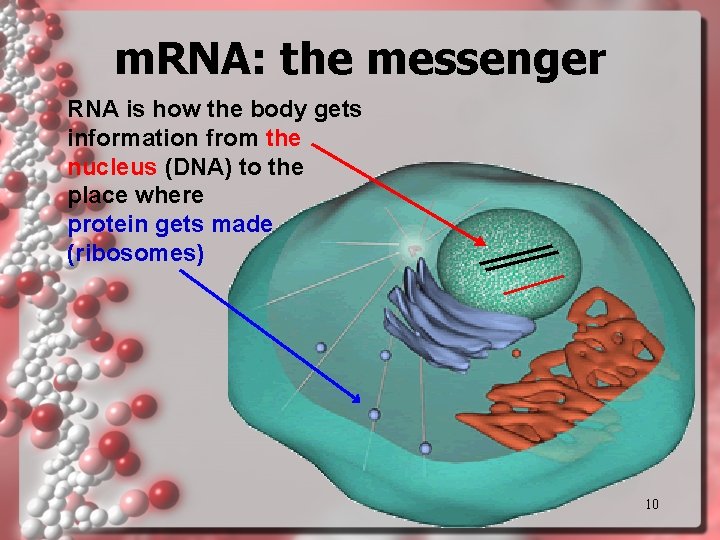
m. RNA: the messenger RNA is how the body gets information from the nucleus (DNA) to the place where protein gets made (ribosomes) 10
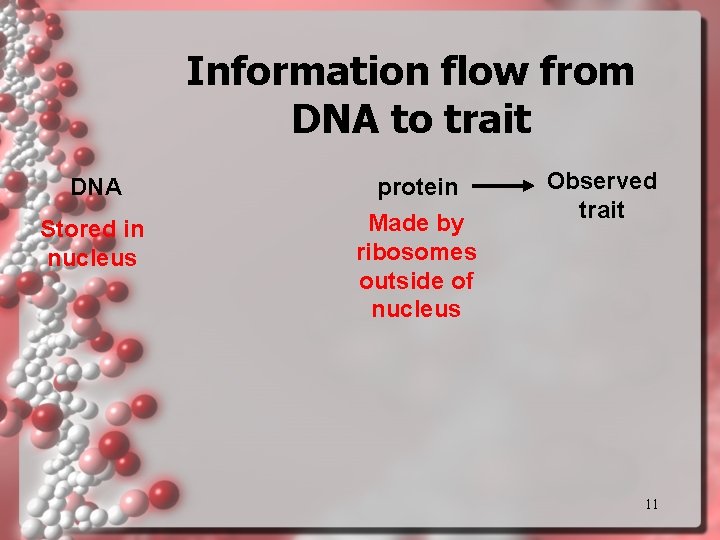
Information flow from DNA to trait DNA Stored in nucleus protein Made by ribosomes outside of nucleus Observed trait 11
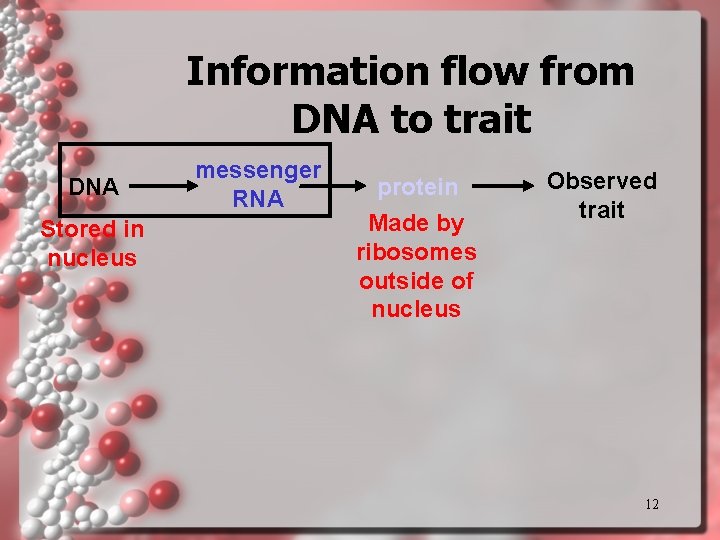
Information flow from DNA to trait DNA Stored in nucleus messenger RNA protein Made by ribosomes outside of nucleus Observed trait 12
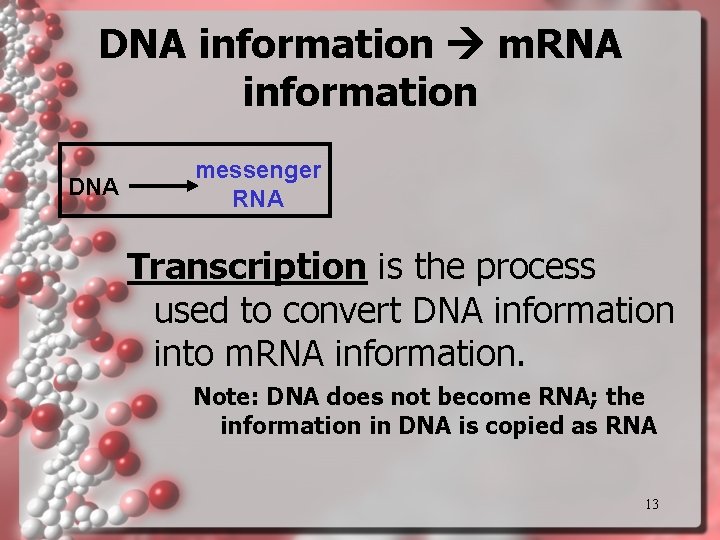
DNA information m. RNA information DNA messenger RNA Transcription is the process used to convert DNA information into m. RNA information. Note: DNA does not become RNA; the information in DNA is copied as RNA 13
Part III RNA (Ribonucleic acid) and Transcription
What is RNA, anyways? How is it different than DNA? 15
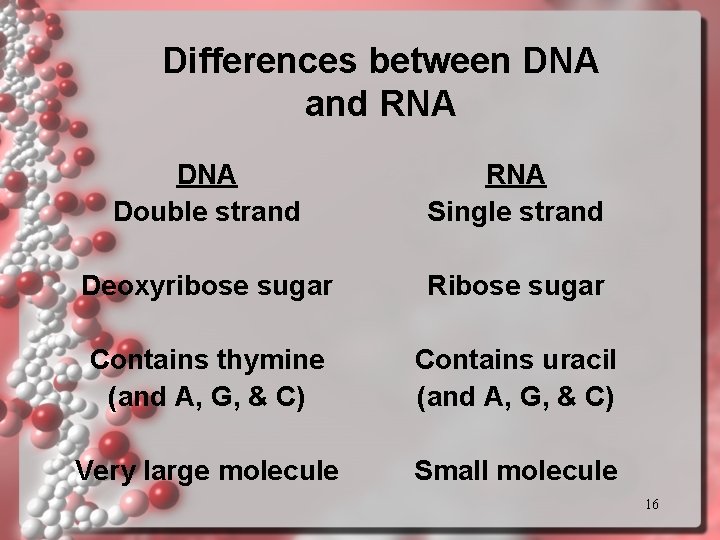
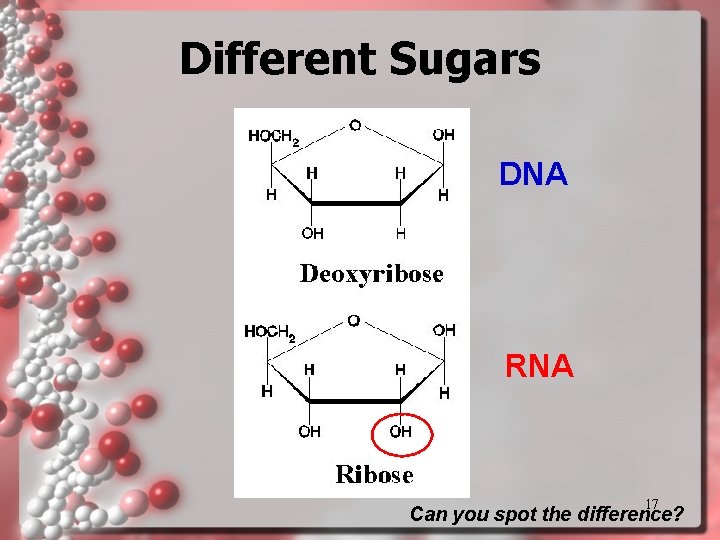
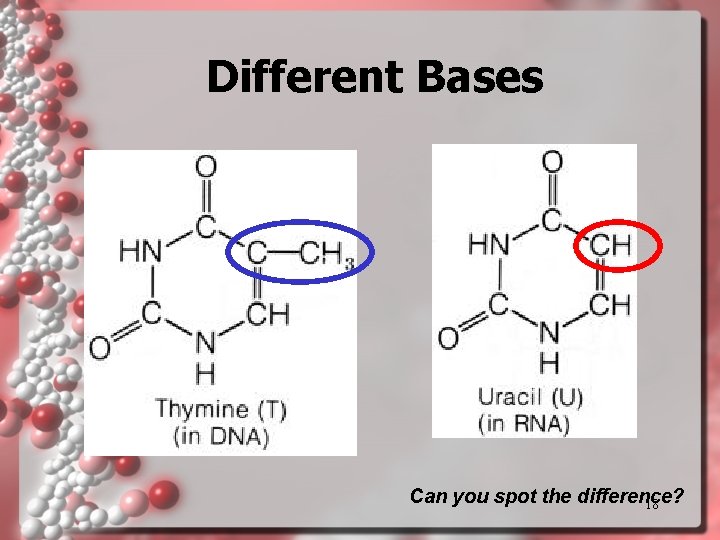
Differences between DNA and RNA Double strand RNA Single strand Deoxyribose sugar Ribose sugar Contains thymine (and A, G, & C) Contains uracil (and A, G, & C) Very large molecule Small molecule 16
Different Sugars DNA RNA 17 Can you spot the difference?
Different Bases Can you spot the difference? 18
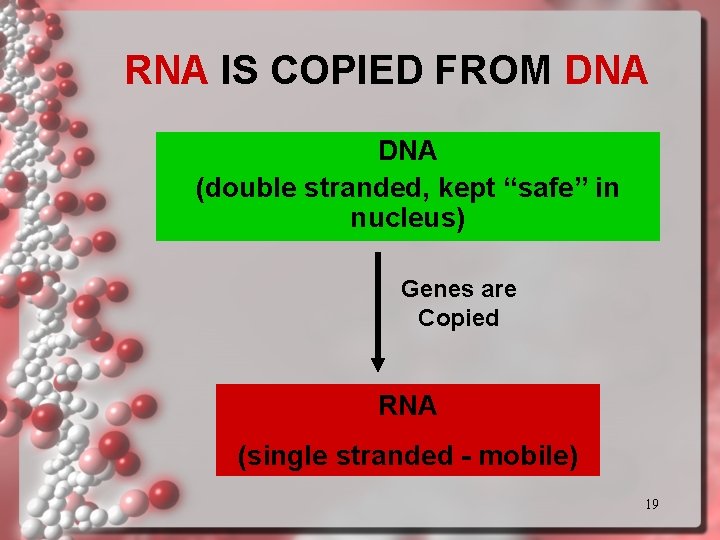
RNA IS COPIED FROM DNA (double stranded, kept “safe” in nucleus) Genes are Copied RNA (single stranded - mobile) 19
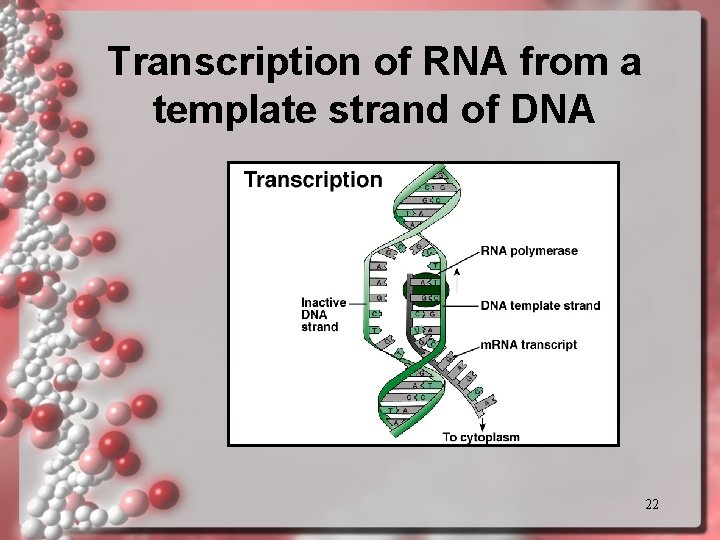
The Transcription process • Promoters are a specific set of bases on DNA that show where a gene begins. • For transcription to occur, the enzyme RNA polymerase binds to DNA at the promoter and separates the DNA strands • RNA Polymerase then uses one strand of DNA as a template to assemble nucleotides into a copy of the gene (m. RNA) 20
The Transcription Process • Terminators! Are a specific set of bases to show where the gene ends. • RNA polymerase stops copying the gene here, moves off to find another gene, the transcript is released and the DNA “zips” back up. 21
Transcription of RNA from a template strand of DNA 22
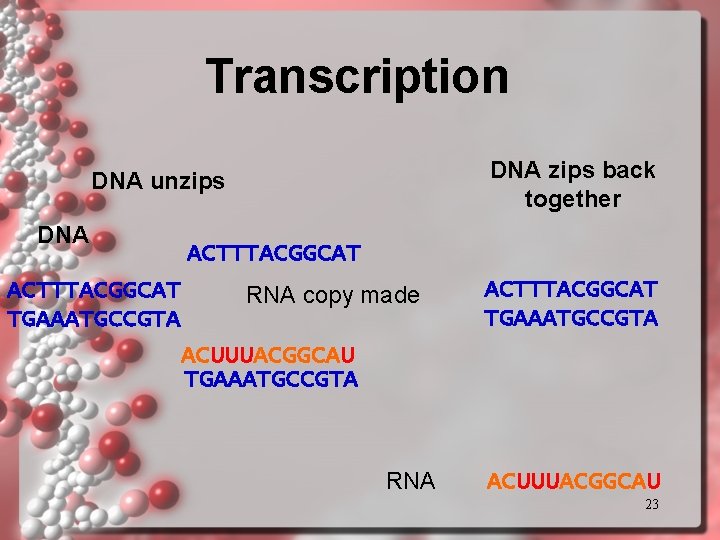
Transcription DNA zips back together DNA unzips DNA ACTTTACGGCAT TGAAATGCCGTA ACTTTACGGCAT RNA copy made ACTTTACGGCAT TGAAATGCCGTA ACUUUACGGCAU TGAAATGCCGTA RNA ACUUUACGGCAU 23
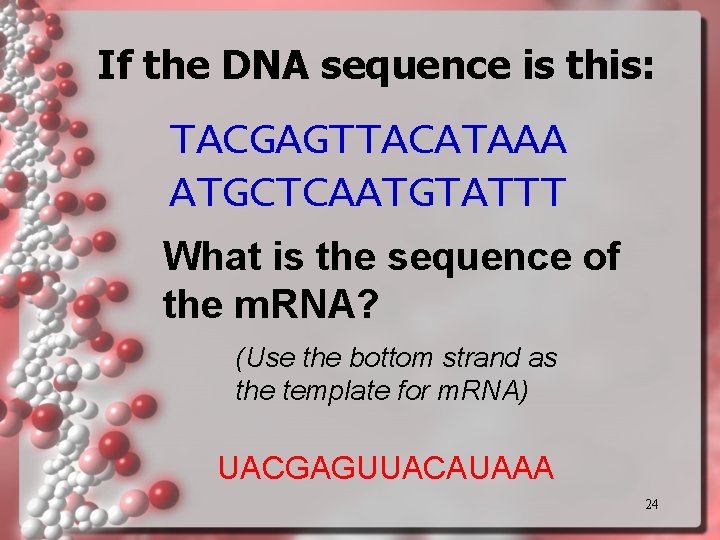
If the DNA sequence is this: TACGAGTTACATAAA ATGCTCAATGTATTT What is the sequence of the m. RNA? (Use the bottom strand as the template for m. RNA) UACGAGUUACAUAAA 24
Animation of Transcription • http: //www. fed. cuhk. edu. hk/~jo hnson/teaching/genetics/animati ons/transcription. htm 25
Part IV Decoding the m. RNA: What is the code?
The Genetic Code “The Problem” • Somehow we need to read the order of nucleotides on m. RNA and have that tell us the order of amino acids within each protein • As there are 20 amino acids and only 4 different bases each nucleotide on its own cant specify the position of a different amino acid 27
The genetic code “The solution” • If a word can only be a single letter long how many words can there be in the English language? • If we can have two letters form a word how many words can we make now? (aa, ab, ac, ba, bb, bc, etc. ) • If two nucleotides can code for an amino acid how many amino acids can we code for? • There are 64 possible ways to combine three nucleotides (43). More than enough to code for 20 amino acids. 28
The Codon • A codon is a set of three nucleotides on m. RNA and designates an amino acid • There are 20 amino acids, but 64 possible codons • So each amino acid may have more than one codon that codes for it. 29
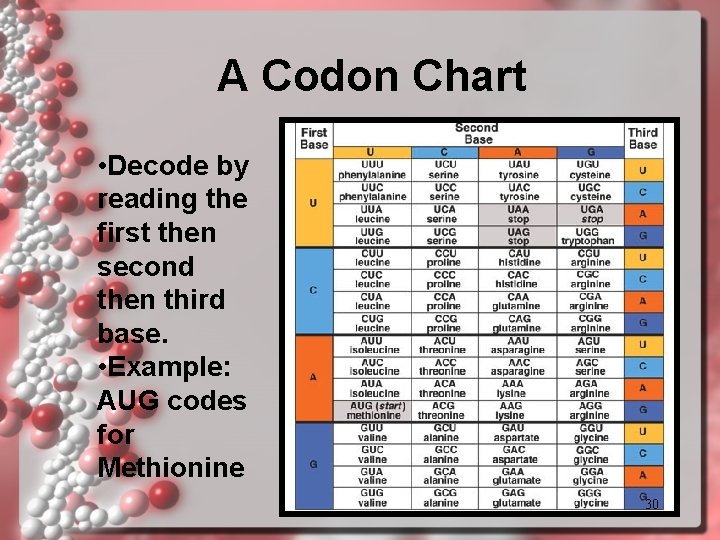
A Codon Chart • Decode by reading the first then second then third base. • Example: AUG codes for Methionine 30
Part IV Turning m. RNA into protein: Translation
Introducing…. Another RNA molecule; the final player in our story… t. RNA 32
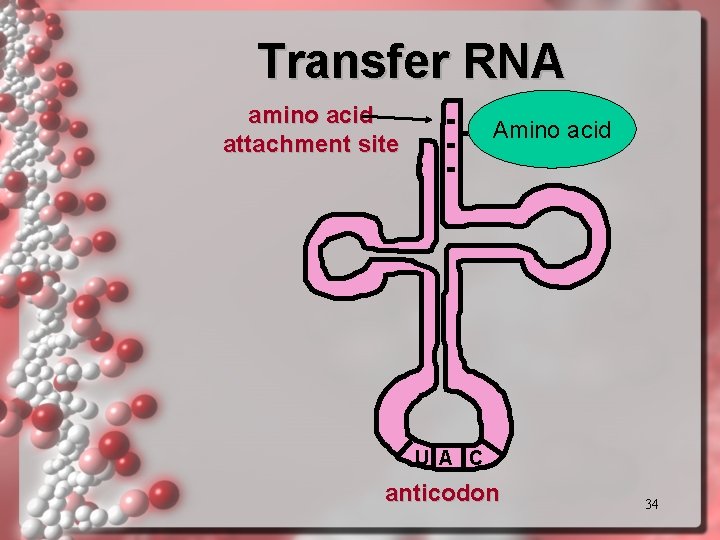
Transfer RNA (t. RNA) • An RNA molecule with attachment site at one end for an amino acid. • The opposite end has three nucleotide bases called the anticodon. • If there are 64 possible codons how many different t. RNA molecules do you think there are? 33
Transfer RNA amino acid attachment site Amino acid U A C anticodon 34
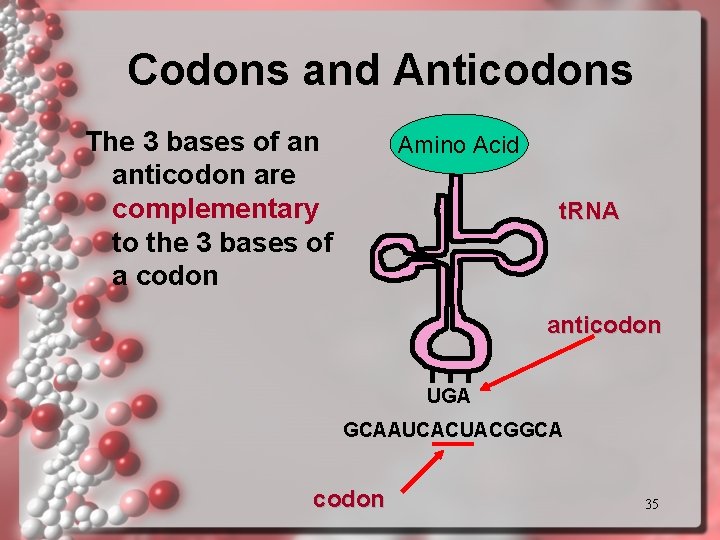
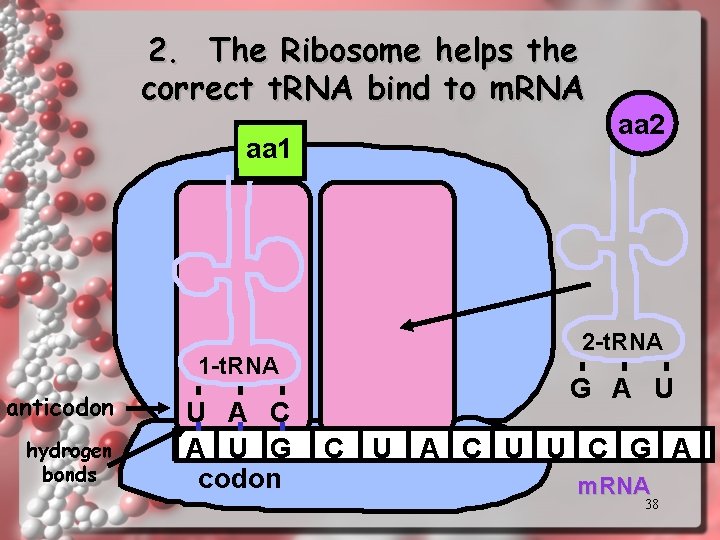
Codons and Anticodons The 3 bases of an anticodon are complementary to the 3 bases of a codon Amino Acid t. RNA anticodon UGA GCAAUCACUACGGCA codon 35
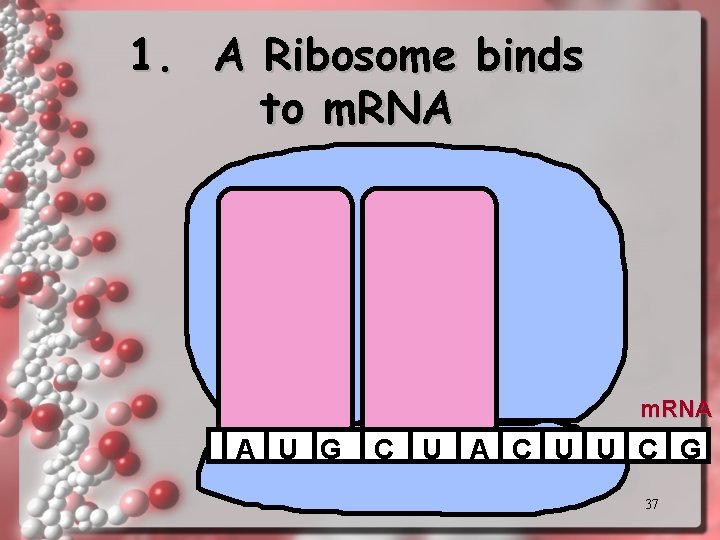
Translation • Translation is the process of of decoding the m. RNA into a protein. • Ribosomes read m. RNA three bases or 1 codon at a time and construct the proteins 36
1. A Ribosome binds to m. RNA A U G C U A C U U C G 37
2. The Ribosome helps the correct t. RNA bind to m. RNA aa 1 1 -t. RNA anticodon hydrogen bonds U A C A U G codon aa 2 2 -t. RNA G A U C U A C U U C G A m. RNA 38
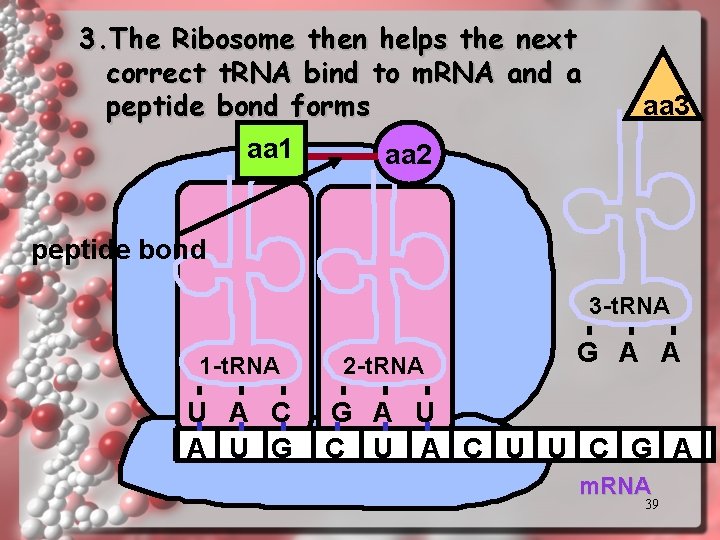
3. The Ribosome then helps the next correct t. RNA bind to m. RNA and a peptide bond forms aa 1 aa 2 aa 3 peptide bond 3 -t. RNA 1 -t. RNA U A C A U G 2 -t. RNA G A U C U A C U U C G A m. RNA 39
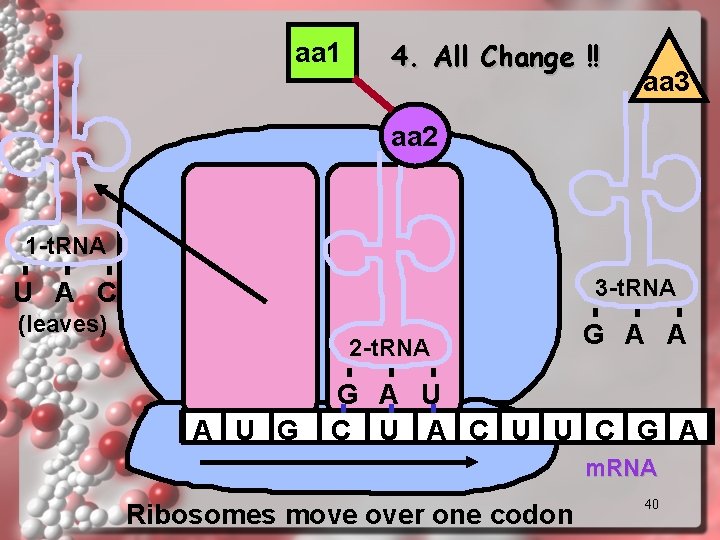
aa 1 4. All Change !! aa 3 aa 2 1 -t. RNA 3 -t. RNA U A C (leaves) 2 -t. RNA A U G G A A G A U C U A C U U C G A m. RNA Ribosomes move over one codon 40
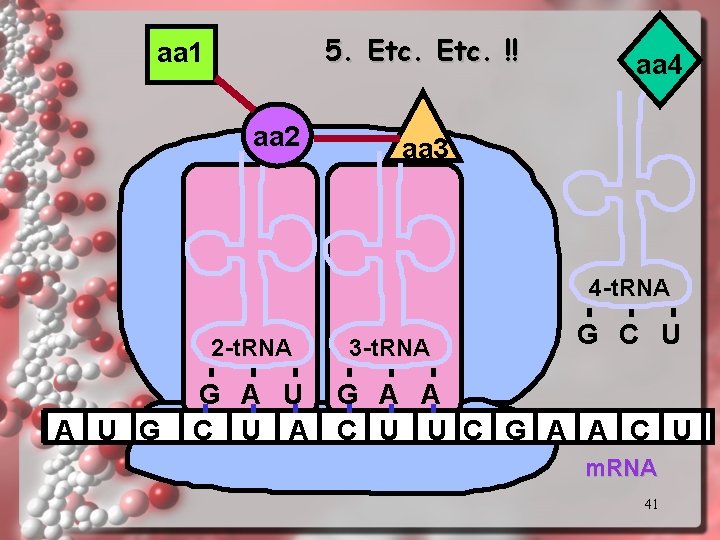
5. Etc. !! aa 1 aa 2 aa 4 aa 3 4 -t. RNA 2 -t. RNA A U G 3 -t. RNA G C U G A A C U U C G A A C U m. RNA 41
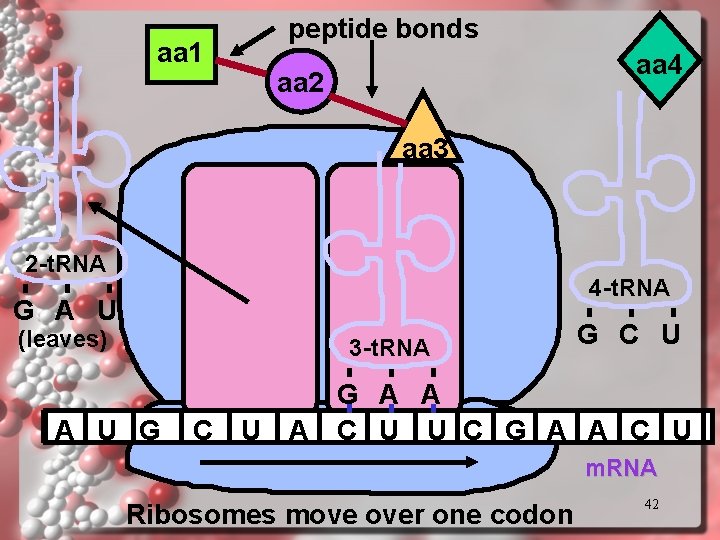
aa 1 peptide bonds aa 4 aa 2 aa 3 2 -t. RNA 4 -t. RNA G A U (leaves) 3 -t. RNA A U G G C U G A A C U U C G A A C U m. RNA Ribosomes move over one codon 42
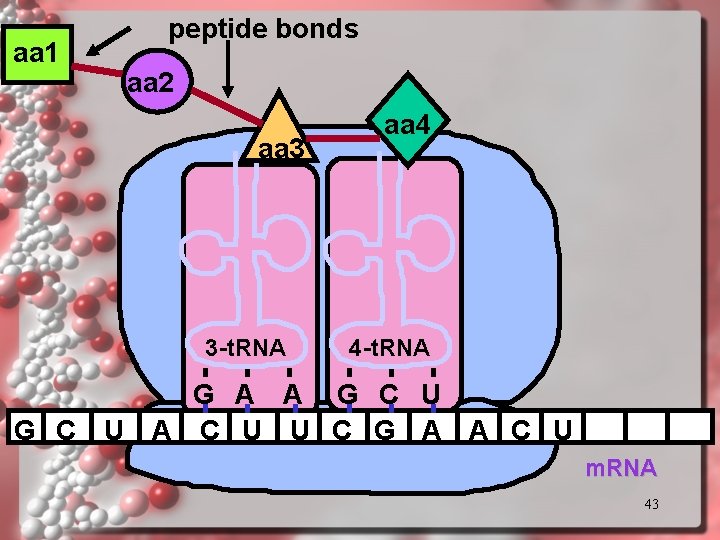
aa 1 peptide bonds aa 2 aa 3 3 -t. RNA aa 4 4 -t. RNA G A A G C U A C U U C G A A C U m. RNA 43
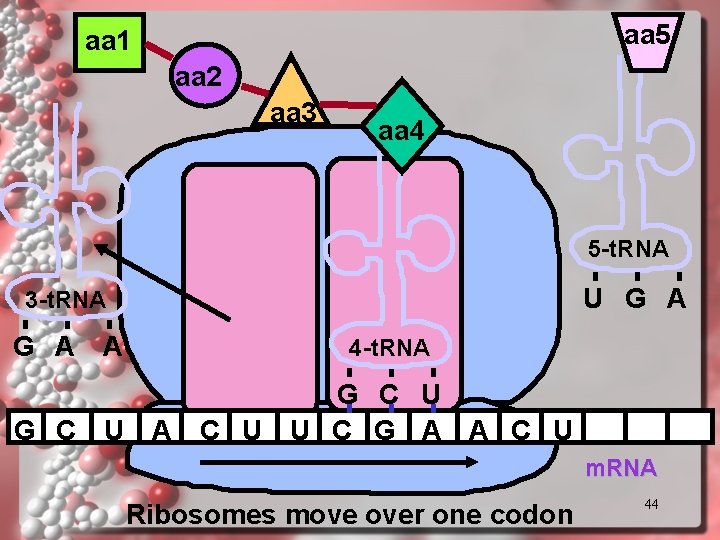
aa 5 aa 1 aa 2 aa 3 aa 4 5 -t. RNA U G A 3 -t. RNA G A A 4 -t. RNA G C U A C U U C G A A C U m. RNA Ribosomes move over one codon 44
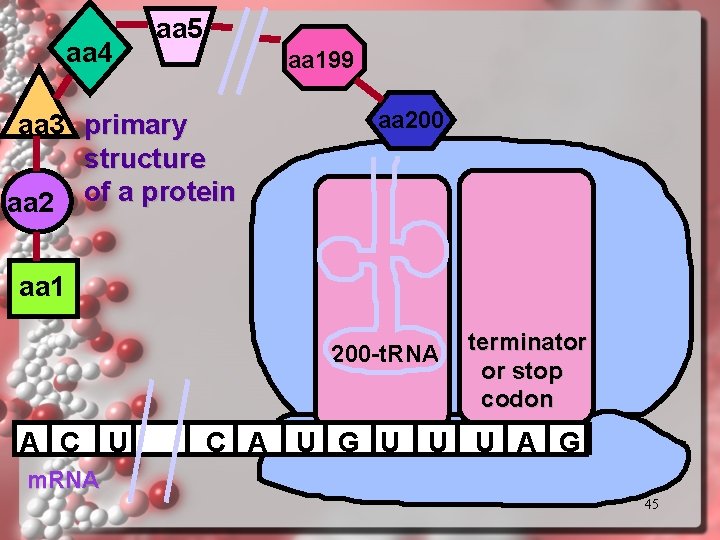
aa 4 aa 5 aa 199 aa 3 primary structure aa 2 of a protein aa 200 aa 1 200 -t. RNA A C U terminator or stop codon C A U G U U U A G m. RNA 45
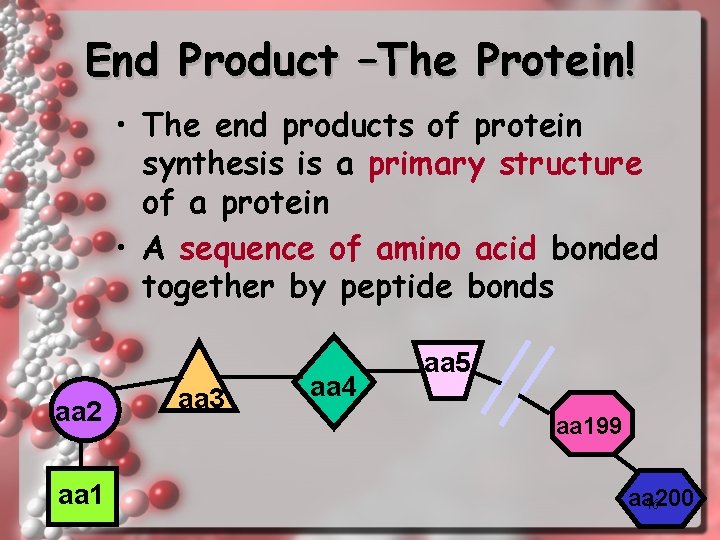
End Product –The Protein! • The end products of protein synthesis is a primary structure of a protein • A sequence of amino acid bonded together by peptide bonds aa 2 aa 1 aa 3 aa 4 aa 5 aa 199 aa 200 46
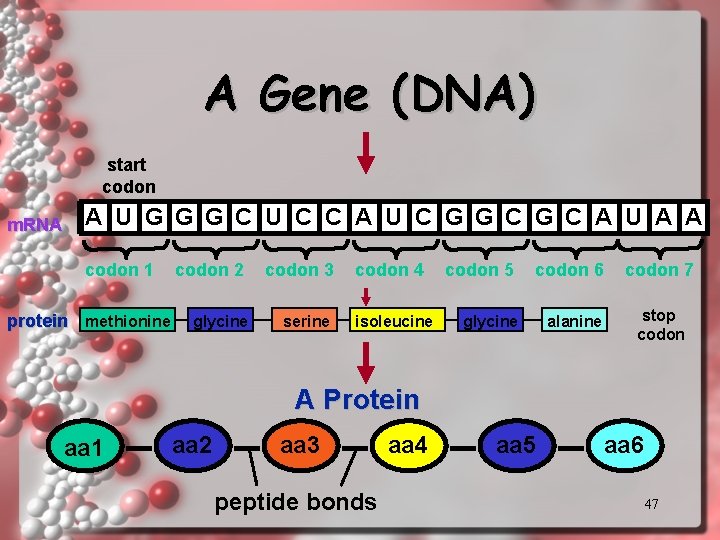
A Gene (DNA) start codon m. RNA A U G G G C U C C A U C G G C A U A A codon 1 protein methionine codon 2 codon 3 glycine serine codon 4 isoleucine codon 5 codon 6 glycine alanine codon 7 stop codon A Protein aa 1 aa 2 aa 3 peptide bonds aa 4 aa 5 aa 6 47
THE END!!! 48