
How does building homes or reducing poverty benefit
How does building homes or reducing poverty benefit me?
Society is impacted by a growing number of dysfunctional “uncivilized” people In this case, being civilized means having the capacity to place the greater good above personal needs, learning empathy and compassion creates these skills. Children who fail to develop these core faculties struggle to follow social orders that maintain the cohesion required for a civilized society to exist. These individuals: • are less likely to follow rules or respect boundaries • are less adapted to deal with the structured demands of society • may lack the executive function or learning skills to increase their earning potential • more likely to encounter additional hardships and substantial challenges Where did these “uncivilized” adults come from ? ? ?
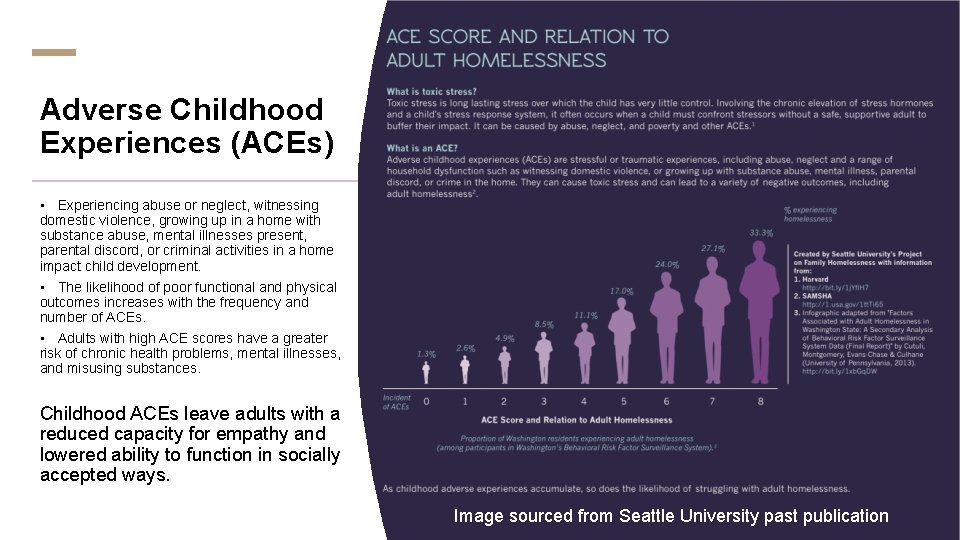
Adverse Childhood Experiences (ACEs) • Experiencing abuse or neglect, witnessing domestic violence, growing up in a home with substance abuse, mental illnesses present, parental discord, or criminal activities in a home impact child development. • The likelihood of poor functional and physical outcomes increases with the frequency and number of ACEs. • Adults with high ACE scores have a greater risk of chronic health problems, mental illnesses, and misusing substances. Childhood ACEs leave adults with a reduced capacity for empathy and lowered ability to function in socially accepted ways. Image sourced from Seattle University past publication
The CDC on ACE’s: • ACEs can have lasting, negative effects on health, well-being, and opportunity. These experiences can increase the risks of injury, sexually transmitted infections, maternal and child health problems, teen pregnancy, involvement in sex trafficking, and a wide range of chronic diseases and leading causes of death such as cancer, diabetes, heart disease, and suicide. • ACEs and associated conditions, such as living in under-resourced or racially segregated neighborhoods, frequently moving, and experiencing food insecurity, can cause toxic stress (extended or prolonged stress). Toxic stress from ACEs can change brain development and affect such things as attention, decision-making, learning, and response to stress. • Children growing up with toxic stress may have difficulty forming healthy and stable relationships. They may also have unstable work histories as adults and struggle with finances, jobs, and depression throughout life. These effects can also be passed on to their own children. Some children may face further exposure to toxic stress from historical and ongoing traumas due to systemic racism or the impacts of poverty resulting from limited educational and economic opportunities.
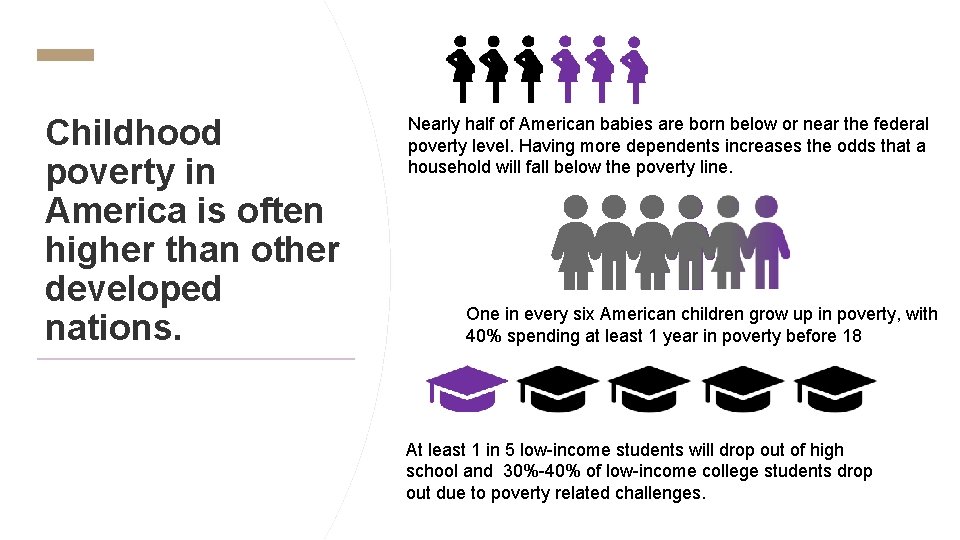
Childhood poverty in America is often higher than other developed nations. Nearly half of American babies are born below or near the federal poverty level. Having more dependents increases the odds that a household will fall below the poverty line. One in every six American children grow up in poverty, with 40% spending at least 1 year in poverty before 18 At least 1 in 5 low-income students will drop out of high school and 30%-40% of low-income college students drop out due to poverty related challenges.
Higher cost of living areas are prone to poverty related ACEs • Necessity of a dual income household structure limits parental interaction • Extended commuting from more affordable areas leads to more time in daycare • Parents may need to work overtime; accept poor shift hours • Benefit limits based on Federal Poverty Levels are low by cost-of-living comparison • Limited access to providers and extensive waits for care services
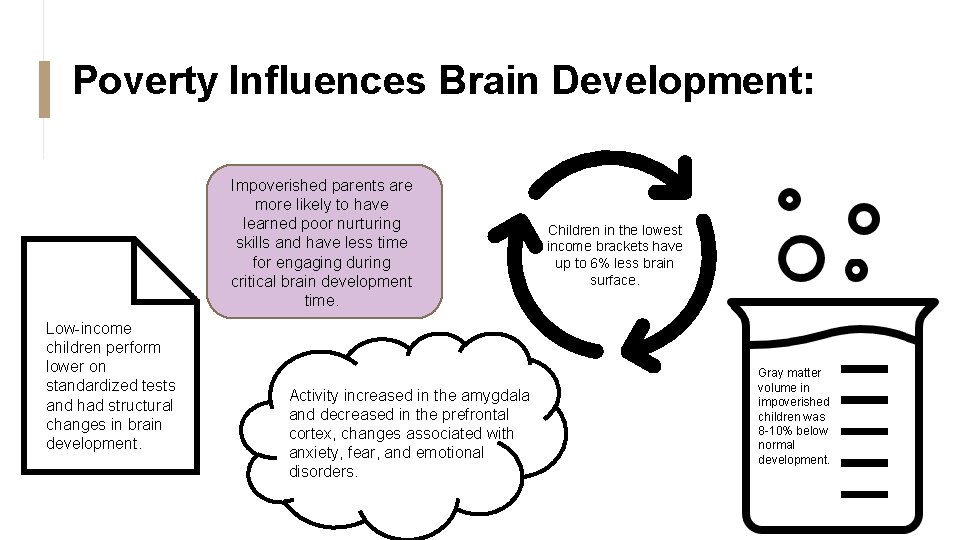
Poverty Influences Brain Development: Impoverished parents are more likely to have learned poor nurturing skills and have less time for engaging during critical brain development time. Low-income children perform lower on standardized tests and had structural changes in brain development. Activity increased in the amygdala and decreased in the prefrontal cortex, changes associated with anxiety, fear, and emotional disorders. Children in the lowest income brackets have up to 6% less brain surface. Gray matter volume in impoverished children was 8 -10% below normal development.
Early Childhood predictors of poverty: • Lower parent/guardian education attainment • Marital Status or traumatic loss of a parent or guardian • Unemployment or low employment status of parent/guardian • Documentation status of parent/guardian • Race, ethnicity, gender, or LGBTQ+ status • Incarceration or criminal history in the family unit • Disability, mental illness, or impaired health condition in the family unit
Poverty is magnified by: • Material Hardships within the family unit – economic disadvantage leads to greater risk of emergency situations causing catastrophic consequences. Extra late fees and penalty fines assessed on this class have greater impacts. • Relative Poverty Compared to Peers – below median income affords necessities, but the family unit cannot afford the normal activities and opportunities that average earners have access to. • Asset Poverty - a household’s inability to access wealth resources that are sufficient to provide for basic needs for a period of three months (no safety net). • Social Exclusion - the process in which individuals are blocked or denied full access to rights, opportunities and resources that are normally available to members of society and median income earners.
Institutional factors amplify the effects of poverty: • Lower quality classrooms, poorly funded schools, and limited special education services. • Lower job quality, higher job instability, greater demands on parents, less flexibility in working hours or poor working conditions. • No health coverage or public benefits, limited access to medical and mental health care. • Limited time, lack of transportation, and inability to access internet or phone service to secure available resource. • Increased neighborhood danger and lack of collective efficacy within neighborhood community.
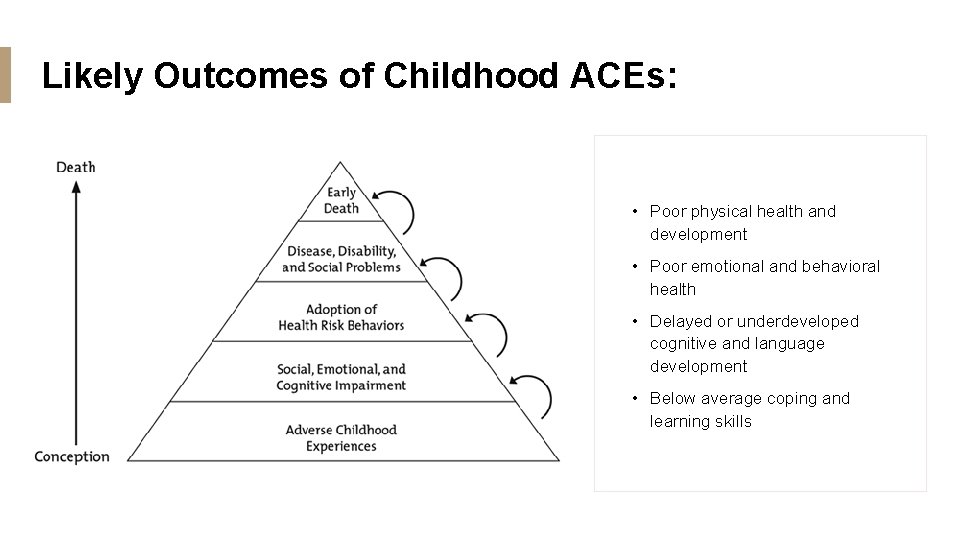
Likely Outcomes of Childhood ACEs: • Poor physical health and development • Poor emotional and behavioral health • Delayed or underdeveloped cognitive and language development • Below average coping and learning skills
Reducing the Effects of Toxic Stress • Increasing quality time with parent/guardian(s) • Improving the households physical and financial security • Reducing relational conflicts within the home or between parent/guardian and child
How does owning a home change the outcome for a low-income family? An owned home is not only an affordable, stable housing situation, it becomes a wealth building asset for future household financial stability as well. Building our homes in well planned locations with existing support for low-income households sets the stage for better futures while reversing effects of long-term systemic inequality disadvantaged communities have experienced. Along with being a stable, affordable place to live, a home becomes an asset that the owner is slowly investing their monthly payments in. Our focus on building homes for individuals earning less than 60% of the area median income assists otherwise stable households at relative and asset poverty levels in attaining stability and economic advancement. An owned property protects against loss of shelter that happens when these families approach the benefit cliff or experience a material hardship. This asset is a source of equity to borrow from in an emergency. It can be sold or reverse mortgaged as a source of retirement funds in old age and even inherited by the owners’ family. If the home appreciates in value, the owner “earns” additional investment income.
Ok, but, how does this affect me? The economic and social costs to families, communities, and society totals hundreds of billions of dollars each year. • A society that consistently fails to support the upbringing of such a large majority of the growing population will inevitably produce more socially dysfunctional adults. These adults often repeat the cycle with their own kids if they lack support or intervention. • These adults tend to require more resource allocation through publicly funded programs like shelters, drug treatment services, mental health services, justice system interventions and prison sentences. • Adults who lacked critical health care in their childhood will require more medical treatment and are more likely to have chronic conditions limiting their ability to work for needed income. • Low functionality leads to less competitive job skills, without resources, many utilize criminal activities to meet needs. Rising property or violent crimes and the increasing homeless population struggling to survive in public spaces affect everyone's quality of life. • Creating pathways for low-wage earning, stable households to successfully exit subsidized housing and reduce dependence on welfare benefits reduces the “public burden” while opening up existing subsidized units to other needy individuals trying to get established or reintegrate with society.
What can I do to help? • For the low price of nothing, help us by spreading the word about what we are doing and upcoming crowdfunding campaigns. Join our mailing list to be notified of progress and news. • Consider purchasing merchandise at our shop or making a donation. • We need help to get started and build a network of skilled, local sub-contractors who can share in our mission for future jobs. Send a referral or introduction to info@upmajam. com to connect. • Support other individuals, community building organizations, activities and programs in your own neighborhood.
- Slides: 15