
How does advanced technology such as Teen Biz
How does advanced technology such as Teen. Biz 3000 and Kidbiz 3000 increase students’ comprehension? Marilyn Balbuena RESSULTS Program University of Miami May 6, 2006
Overview • Kid. Biz 3000 and Teen. Biz 3000 are built on decades of scientific research into how children learn to read. They are based on findings of widely respected research studies in the field and approved by the National Reading Panel. Many of the students I work with have scored 2’s and low 3’s in their Florida Comprehension Achievement Test scores, many of which are English Second Language Learners Level I through V. These students are deficient readers requiring assistance on all aspects of the Big Five.
Table of Contents • • • Research Design Literature Review Theoretical Framework Methods Data Analysis Students’ Information Findings and Implications Reflections References
Research Design • How much does the software’s differentiated literacy solution assist the students to increase their reading comprehension? • How does the program motivate the students’ interest? • How will asking parents to sign a reading log verifying the articles read each month increase the students’ participation? Research Design
Literature Review • Fletcher and Atkinson’s (1972) recognized study developed programs for the use of computers assisting students’ learning task in the Stanford Computer Assisted Instruction Project. • Singhal (2002) states, “computer-assisted instruction and computer programs to teach reading hold great promise for becoming powerful instructional tools that increase students’ engagement in reading. ” • Bendixen and Hartely (2003) examined the relationship between epistemological beliefs (the beliefs about the nature of knowledge), metacognition (thinking about how we think) and student achievement in a hypermedia-learning environment. Literature Review
Theoretical Framework • • • Bridge needed to construct new language concepts for English Speaking Language learners Computer-assisted programs – Teenbiz 3000 • same basic article, but the content is customized to match each child's own reading level – ELLIS Academic 3. 0 • combines digital audio and video, voice recording Similarities in both languages – English “borrowed” words from the Spanish Language • Accurate word identifications contribute to meaningful absorption. Theoretical Framework
Methods • • • Jerry L. John’s Basic Reading Inventory Achieve 3000 Comprehension Test 2 -3 Reading assignments On-line multiple choice quizzes Tracking Reports PAR Work Sample Parental letters, logs and surveys Students’ e-mail and survey Method
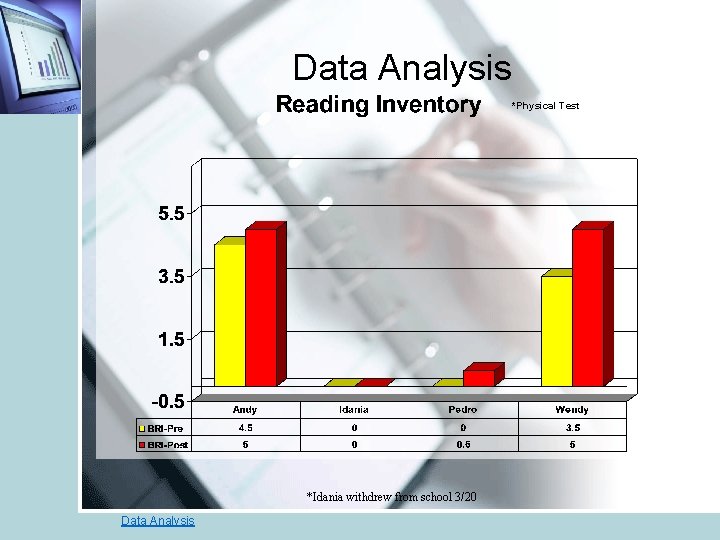
Data Analysis *Physical Test *Idania withdrew from school 3/20 Data Analysis
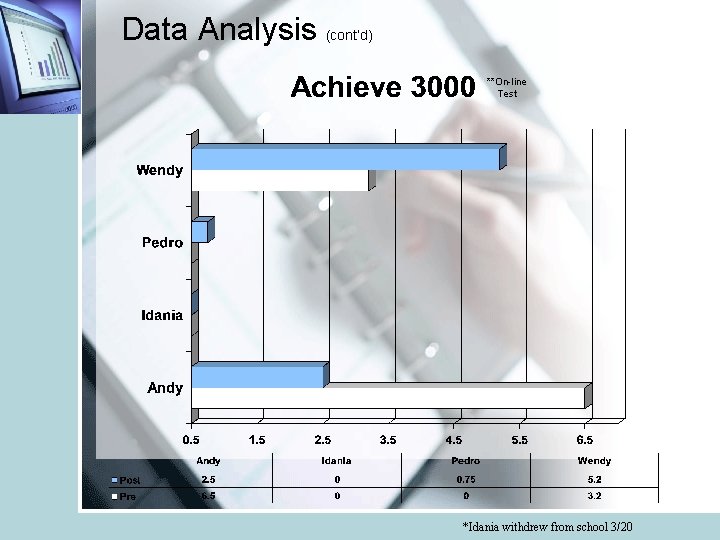
Data Analysis (cont’d) **On-line Test *Idania withdrew from school 3/20
Andy’s Information • PAR Logs • Continuum • Student Work – Multiple News Activities – Can You Picture This – A Nation’s Song PAR - A Continuum-Andy MC Activity Log Picture This MC Actiivity Nation’s MC Activity
Idania’s Information • PAR Logs • Continuum • Student Work – Multiple News Activities – A New Leader – N/A PAR - I Continuum-Idania MC Activity Log Leader MC Activity
Pedro’s Information • PAR Logs • Continuum • Student Work – Multiple News Activities – Too Much Homework? – King of the Trail PAR - P Continuum-Pedro MC Activity Log Homework MC Activity King MC Activity
Wendy’s Information • PAR Logs • Continuum • Student Work – Multiple News Activities – No Gold for Kim – Soft Drink War PAR-W Continuum-Wendy MC Activity Log No Gold MC Activity Soft Drink MC Activity
Findings and Implications • Inadequate progress in BRI-Post • On-line activities(quizzes) wide variations • Dramatic drop in Achieve 3000 Comprehension Quiz (Post) • Second attempt – rereading success (improvement) • Participated class discussions • Exposure to new vocabulary and concepts • Reinforcement Tool Findings & Implications
Reflections • I hear, and I forget. I see, and I remember. I do, and I understand. Chinese Proverb • You cannot teach a man anything; you can only help him find it within himself. Galielo Galilei
References • • Bendixen, L. , & Hartley, K. (2003). Successful learning with hypermedia: The role of epistemological beliefs and metacognitive awareness. Journal Educational Computing Research, 28(1), 15 -30. Blake, R. (1992). Second language reading on the computer. Association of Department of Foreign Languages Bulletin, 24(1), 17 -22. Bruner, Jerome (1966). Toward a Theory of Instruction, MA: Harvard University Press. Fitze, Michael (2006). Discourse and participation in ESL face-to-face and written electronic conferences. Language Learning & Technology, 10(1), 67 -86. Fletcher, J. D. , & Atkinson, R. C. (1972). Evaluation of the Stanford CAI program in initial reading. Journal of Educational Psychology, 63, 597 -602 Piaget, Jean (1972). The psychology of the child. New York: Basic Books. Singhal, Meena (2002). Reading and computer assisted instruction: Application and implications. Journal of Educational Multimedia and Hypermedia, 7(1), 281 -296.
- Slides: 16