
How does accent change our identity Can it







- Slides: 19
How does accent change our identity? Can it decide our future? Alex Baratta The University of Manchester alex. baratta@manchester. ac. uk
Getting started…. . • First, discuss with a classmate the various British accents that you simply do not like • Be prepared to explain, if not justify, your answer • Do we think of accents as being ‘sexy’, ‘ugly’, ‘annoying’, ‘trustworthy’, ‘common’ and so on? • Might the media play a part (e. g. Scottish accents are regarded as ‘trustworthy’ and are therefore used at call centres)?
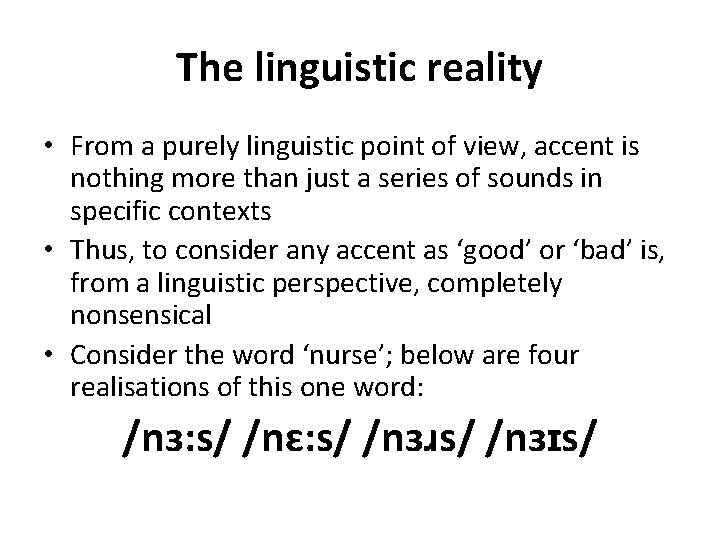
The linguistic reality • From a purely linguistic point of view, accent is nothing more than just a series of sounds in specific contexts • Thus, to consider any accent as ‘good’ or ‘bad’ is, from a linguistic perspective, completely nonsensical • Consider the word ‘nurse’; below are four realisations of this one word: /nɜ: s/ /nɛ: s/ /nɜɹs/ /nɜɪs/
The sociocultural reality • From the above perspective, however, we all know that certain accents can be perceived negatively (and some positively of course) • It’s not necessarily the sounds that people like/dislike; it’s what the accent represents • Thus, if an accent represents a stigmatised region, class and so on, then the accent, as a representation of such, becomes stigmatised • Likewise, so does the speaker
Do we have accent prejudice? • Listen to the following accent samples and be honest about how you perceive the speaker, based solely on his/her accent: http: //www. dialectsarchive. com/england-7 http: //www. dialectsarchive. com/south-africa-21 http: //www. dialectsarchive. com/brazil-1
The media and accent • Based on the key concepts thus far regarding accent and how we perceive others based on this, it is common to use accent to characterise people in film and TV in a specific way: https: //www. youtube. com/watch? v=vq. Ybh. Pr. TA f. M https: //www. youtube. com/watch? v=wl. Uc. Uf. Hkd Yk
Accent and identity • Many studies have recognized the link between accent and identity (Labov, 1966; Kerswill and Williams, 2000; Fairclough, 2001; Jones, 2001; Evans and Iverson, 2007; Tagliamonte and Molfenter, 2007; Becker, 2009; Kinzler, Shutts, De. Jesus and Spelke, 2009; Snell, 2010; Chisholm and Godley, 2011) • A key finding is that our accent shows allegiance to, and identification and solidarity with, a particular social group (e. g. Scouse, RP, North vs. South, Valpeak) • Accent also contributes to our personal identity(ies), representing aspects such as regional origin, class, ethnicity and age – and what these categories represent for us • As stated by Jones (2001: 1068), ‘accents are a crucial part of identity in England’
How is identity forged by accent? • Consider that Northerners who live in the South sometimes retain certain phonemes, but avoid others: • For example, bath is generally realised as /baθ/ by Northerners and not the more Southern /bɑ: θ/ • However, bus tends to be realised by Northerners in the South as /bʌs/ and not their usual /bʊs/ • Thus, the two phonemes of [a] and [ʊ] in certain contexts of usage, symbolise regional identity (e. g. Northern) • This in turn leads to claiming identities for ourselves (e. g. “I’m a proud Northerner, which means I am friendly, down to earth, leftwing, …. . ”) and others ascribing identities to us ( e. g. “He’s/she’s a Northerner, which means he/she is common, uneducated, likes pies, …. . ”) • Thus, identity is a two-way street
Linguistic stereotyping • Stereotyping still occurs of course based on accent use and is a major factor in our decision to modify our accent • While Mugglestone (2003: 43) states that accent acts ‘as a marker of group membership and as a signal of solidarity’ and ‘each utterance…becomes in effect an act of identity’ (page 57)…. . • …. . it is also the case that ‘people are credited with different amounts of intelligence, friendliness and other such virtues according to the way they speak’ (Hudson, 1980: 193) • Trudgill (2002: 176) states that ‘discrimination of the grounds of accent still, unfortunately, occurs in British society’ • Coupland Bishop (2007) discuss the fact that regional accents, such as Birmingham, Glasgow and Liverpool, are still often regarded negatively
Accent modification • Previous literature also references accent modification (Labov, 1966; Giles, 1973; Bell, 1984; Eckert and Rickford, 2001) • Modification is largely seen as a response to the audience with whom we’re conversing • Giles (1973) discusses upward and downward (accent) convergence, for example • In simple terms, have we ever tried to sound less regional and more ‘posh’ (or vice versa)? • Why has this been the case? • Are we trying to ‘fit in’ in some way and/or not be judged?
Implications to our personal identity • If we modify our accent and a new identity is created as a result (the ‘enacted identity’), does this impact on our personal identity in any way? • For example, do we feel like ‘sell-outs’ if we modify our accent? • Or is accent modification seen as simply a ‘necessary evil’ or regarded completely neutrally (e. g. at job interviews)? • If it is necessary, is this to avoid negative stereotyping by others? • What might these stereotypes be?
Sounds do not equal who we are inside, however • For a moment, let us isolate certain phonemes in order to regard accent purely objectively (as linguists must do, of course): [ɑ] [ɒ] [o] [ə] [oə] [ɐʉ] [ɛ] • • • RP ‘bath’/ General American ‘coffee’ RP ‘hot’ Yorkshire ‘go’ New York City ‘coffee’ Broad Australian/New Zealand ‘go’ New Zealand/General South African ‘bad’
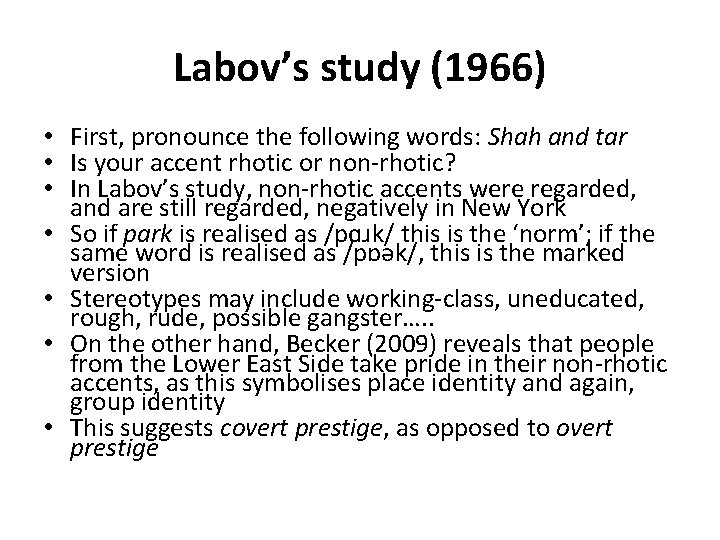
Labov’s study (1966) • First, pronounce the following words: Shah and tar • Is your accent rhotic or non-rhotic? • In Labov’s study, non-rhotic accents were regarded, and are still regarded, negatively in New York • So if park is realised as /pɑɹk/ this is the ‘norm’; if the same word is realised as /pɒək/, this is the marked version • Stereotypes may include working-class, uneducated, rough, rude, possible gangster…. . • On the other hand, Becker (2009) reveals that people from the Lower East Side take pride in their non-rhotic accents, as this symbolises place identity and again, group identity • This suggests covert prestige, as opposed to overt prestige
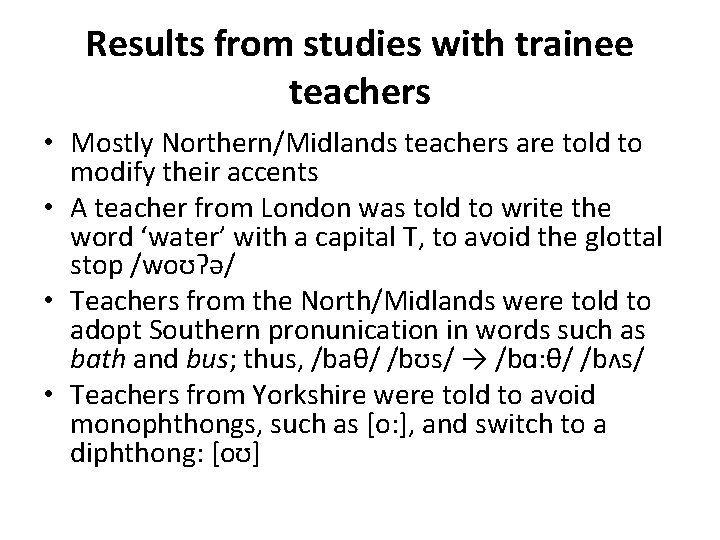
Results from studies with trainee teachers • Mostly Northern/Midlands teachers are told to modify their accents • A teacher from London was told to write the word ‘water’ with a capital T, to avoid the glottal stop /woʊʔə/ • Teachers from the North/Midlands were told to adopt Southern pronunication in words such as bath and bus; thus, /baθ/ /bʊs/ → /bɑ: θ/ /bʌs/ • Teachers from Yorkshire were told to avoid monophthongs, such as [o: ], and switch to a diphthong: [oʊ]
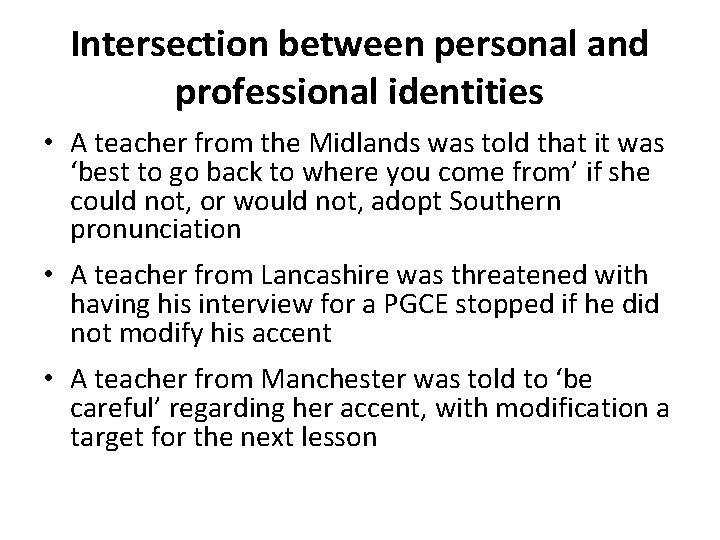
Intersection between personal and professional identities • A teacher from the Midlands was told that it was ‘best to go back to where you come from’ if she could not, or would not, adopt Southern pronunciation • A teacher from Lancashire was threatened with having his interview for a PGCE stopped if he did not modify his accent • A teacher from Manchester was told to ‘be careful’ regarding her accent, with modification a target for the next lesson
Standard accents • First, avoidance of reductions (based on the work of Ramsaran (2015)), and so a need to avoid glottal stops, for example – Likewise, a need to avoid elision, so that pure vowels become diphthongs [o: ] [e: ] → [oʊ] [eɪ] • Second, avoidance of phonological giveaways; phonemes in specific contexts which identify the (stigmatised) accent immediately – Consider nurse as /nɜ: s/ versus /nɛ: s/ – Consider back as /bak/ versus /bax/
Standard accents • Consider the word Saturday realised with three varieties of the Mancunian accent: • Posh: /satədeɪ/ • General: /satəde/ /satədɪ/ • Broad: /saədɪ/ /saʔdɪ/ • We need to also consider, however, that for many Northern Englishes, reductions are common, such as lambs ont road and I’m off t’shops
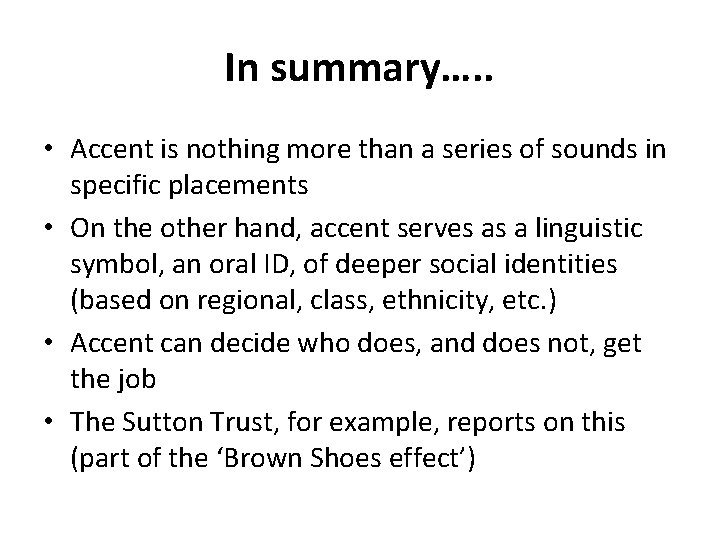
In summary…. . • Accent is nothing more than a series of sounds in specific placements • On the other hand, accent serves as a linguistic symbol, an oral ID, of deeper social identities (based on regional, class, ethnicity, etc. ) • Accent can decide who does, and does not, get the job • The Sutton Trust, for example, reports on this (part of the ‘Brown Shoes effect’)
Thank you!