
How does a computer represent data Electronic signals

- Slides: 7
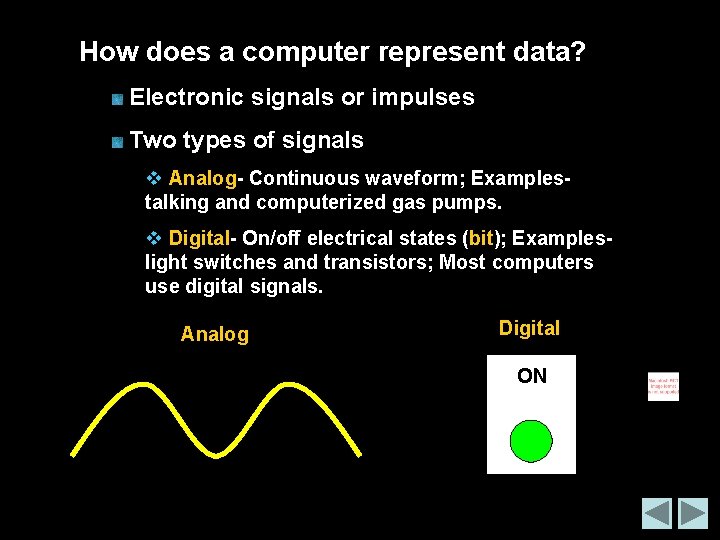
How does a computer represent data? Electronic signals or impulses Two types of signals v Analog- Continuous waveform; Examplestalking and computerized gas pumps. v Digital- On/off electrical states (bit); Exampleslight switches and transistors; Most computers use digital signals. Analog Digital ON OFF
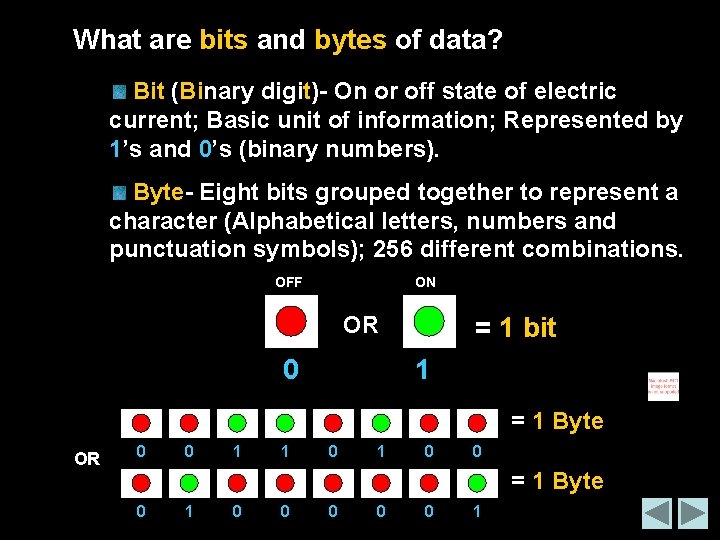
What are bits and bytes of data? Bit (Binary digit)- On or off state of electric current; Basic unit of information; Represented by 1’s and 0’s (binary numbers). Byte- Eight bits grouped together to represent a character (Alphabetical letters, numbers and punctuation symbols); 256 different combinations. OFF ON OR 0 = 1 bit 1 = 1 Byte OR 0 0 1 1 0 0 = 1 Byte 0 1 0 0 0 1
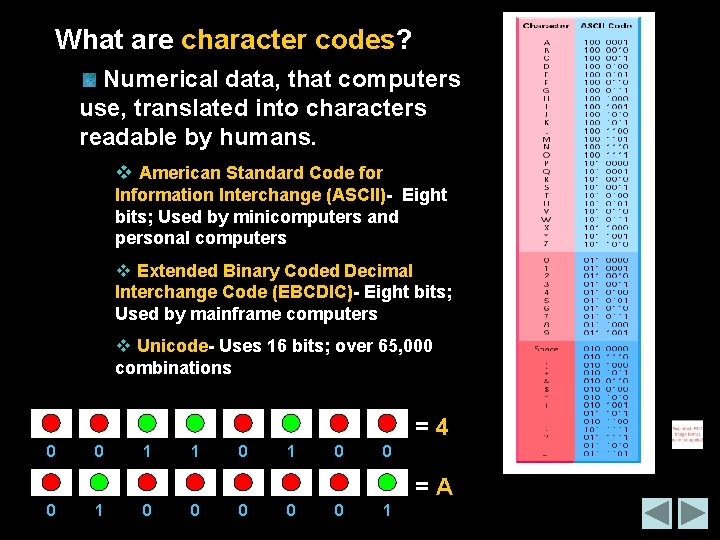
What are character codes? Numerical data, that computers use, translated into characters readable by humans. v American Standard Code for Information Interchange (ASCII)- Eight bits; Used by minicomputers and personal computers v Extended Binary Coded Decimal Interchange Code (EBCDIC)- Eight bits; Used by mainframe computers v Unicode- Uses 16 bits; over 65, 000 combinations =4 0 0 1 1 0 0 =A 0 1 0 0 0 1
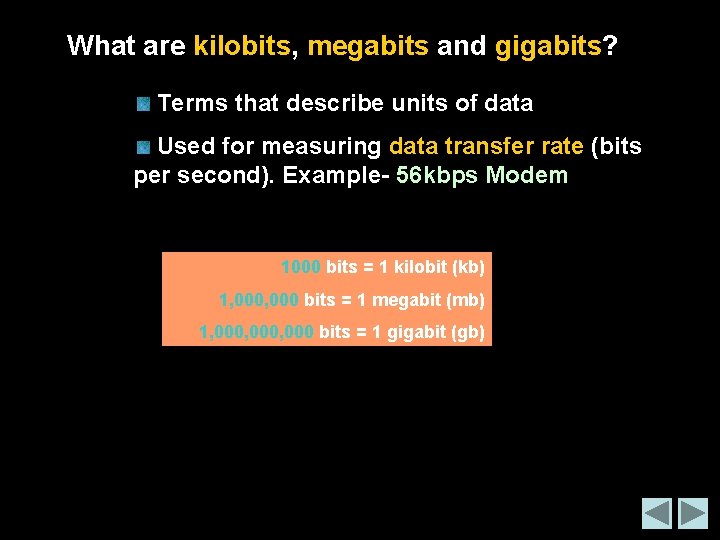
What are kilobits, megabits and gigabits? Terms that describe units of data Used for measuring data transfer rate (bits per second). Example- 56 kbps Modem 1000 bits = 1 kilobit (kb) 1, 000 bits = 1 megabit (mb) 1, 000, 000 bits = 1 gigabit (gb)
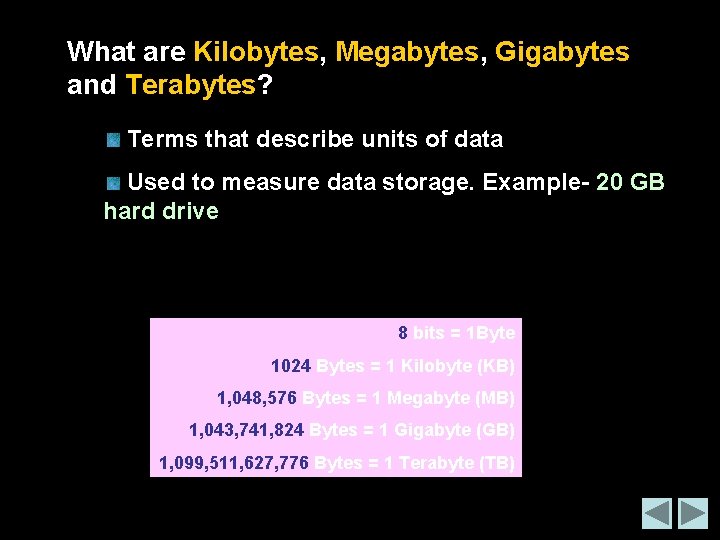
What are Kilobytes, Megabytes, Gigabytes and Terabytes? Terms that describe units of data Used to measure data storage. Example- 20 GB hard drive 8 bits = 1 Byte 1024 Bytes = 1 Kilobyte (KB) 1, 048, 576 Bytes = 1 Megabyte (MB) 1, 043, 741, 824 Bytes = 1 Gigabyte (GB) 1, 099, 511, 627, 776 Bytes = 1 Terabyte (TB)
THE END