
HOW DO YOU SAY ING OBJECTIVE SWBAT FORM
HOW DO YOU SAY ‘ING? ’
OBJECTIVE SWBAT FORM THE PRESENT PARTICIPLE AND CONTRAST IT WITH THE USE OF INFINITIVES AND THE SUBJUNCTIVE
TEXT THE PRESENT PARTICIPLE ▸ You learned yesterday that a gerund phrase, or present participle, translates as the -ing form of the verb. ▸ finir - finissant ▸ aimer - aimant
TEXT BUT THERE ARE OTHER WAYS OF SAYING 'ING!' ▸ Using the subjunctive/ past subjunctive ▸ Present tense ▸ Infinitives ▸ Imperfect tense
TEXT PRESENT PARTICIPLES ▸ Most of the time, present participles do not follow prepositions. ▸ They are either alone ( passant par la rue) ▸ Or follow the preposition 'en' ▸ (En passant)
TEXT AN ING FOLLOWING A PREPOSITION ▸ Most prepositions are followed by the infinitive ▸ Sans parler - without speaking ▸ Avant de parler - before speaking ▸ Apres de parler - after speaking ▸ continuer à parler - to continue speaking
TEXT YOU KNOW THE ‘ING’ IS AN INFINITIVE WHEN: ▸ It follows a preposition (à, pour, par, avec, sans, avant de, après de) ▸ It is NOT followed by a subject ▸ Apres de parler - After speaking
TEXT SUBJUNCTIVE ▸ If your preposition is followed by a subject, it is subjunctive. ▸ Apres que je parle - after speaking ▸ Sans que je sache - without me knowing ▸ Avant qu’il arrive - before he is arriving
TEXT SUBJUNCTIVE REVIEW ▸ The subjunctive is the tense that follows que and expressions of: ▸ Doubt ▸ volition (je veux que) ▸ uncertainty ▸ impersonal expressions (Il faut que) ▸ emotion (j’aime que)
TEXT THE EASIEST WAY TO SAY ‘ING’ ▸ Everyone asks - ‘how do I say I am skiing? ’ ▸ skier- to ski ▸ Je skie - I ski, I am skiing, I do ski ▸ So, when you conjugate a verb, any verb in the present, it means that you do the action, you are doing the action, and you do perform the action.
TEXT THE ‘ING’ THAT EVERYONE FORGETS ▸ Lastly, everyone forgets how to state what you were doing. ▸ I was skiing ▸ If you were doing the action, the expression is simply just in the imperfect. ▸ Je skiais
TEXT WHY IS THERE NO ETRE? ▸ Etre is specifically used for descriptions ▸ If you are tall, are comes from ere ▸ If you are eating, eating doesn’t describe you. Use manger.
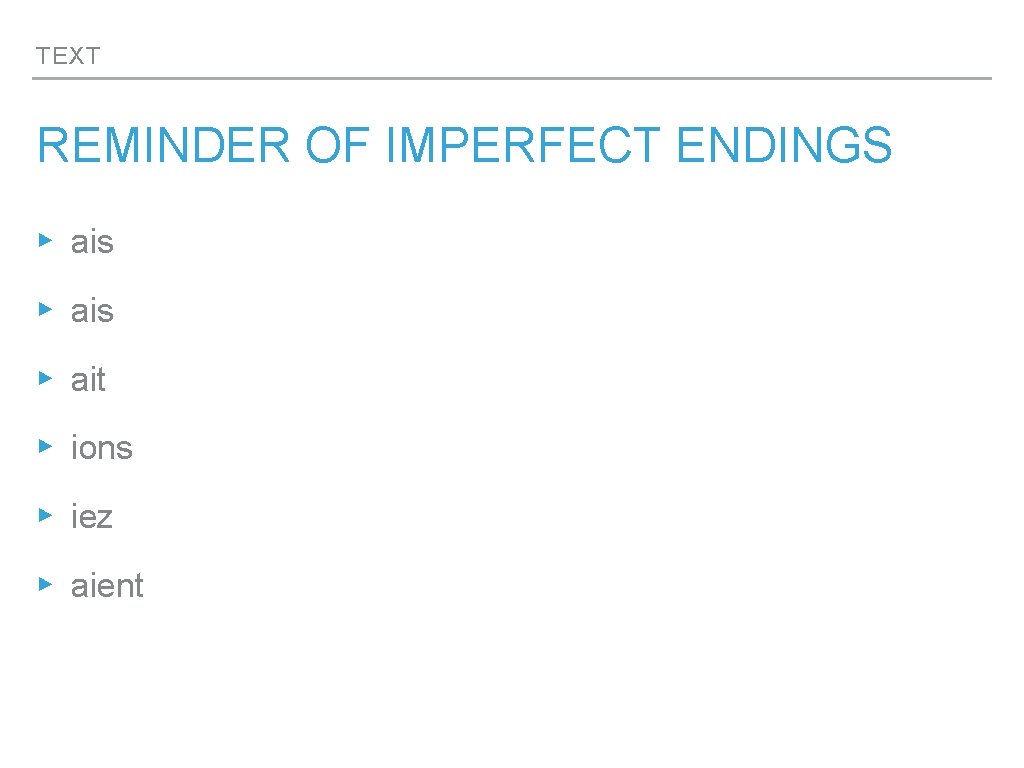
TEXT REMINDER OF IMPERFECT ENDINGS ▸ ais ▸ ait ▸ ions ▸ iez ▸ aient
- Slides: 13