
How do YOU learn Unveiling YOUR learning style
- Slides: 10
How do YOU learn? Unveiling YOUR learning style
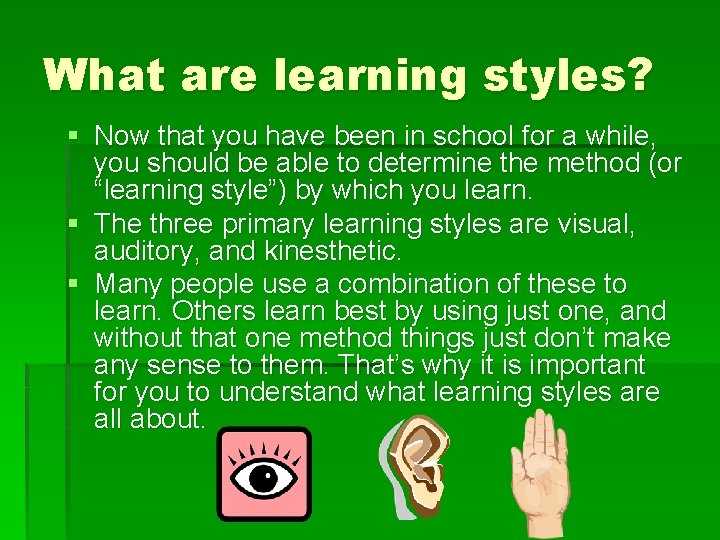
What are learning styles? § Now that you have been in school for a while, you should be able to determine the method (or “learning style”) by which you learn. § The three primary learning styles are visual, auditory, and kinesthetic. § Many people use a combination of these to learn. Others learn best by using just one, and without that one method things just don’t make any sense to them. That’s why it is important for you to understand what learning styles are all about.
What’s your learning style? § All done? Now, go back over your answers and count the number of A’s, B’s, and C’s. § If you have mostly A’s, you are probably a VISUAL learner. This means you learn best by seeing. § If you have mostly B’s, you are probably an AUDITORY learner. This means you learn best by hearing. § If you have mostly C’s, you are probably a KINESTHETIC learner. This means you learn best by doing. § If you have a tie between two learning styles, this means you learn in several ways. § Keep YOUR learning style in mind as you do homework, study for tests, and learn new material. Make sure your teachers and parents know about your learning style so they can help you learn.
Visual Learner Profile § If you are a visual learner, you learn by reading or seeing pictures. § You understand remember things by sight. § You can picture what you are learning in your head, and you learn best by using methods that are primarily visual. § You like to SEE what you are learning. § As a visual learner, you are usually neat and clean, you often close your eyes to visualize or remember something, and you will find something to watch if you become bored. § You may have difficulty with spoken directions, and may be easily distracted by sounds. § You are attracted to color, and to spoken language (like stories) that is rich in imagery.
Tips for Visual Learners Here are some things that visual learners like you can do to learn better: § Sit near the front of the classroom. § Have your eyesight checked on a regular basis. § Use flashcards to learn new words. § Try to visualize things that you hear or things that are read to you. § Write down key words, ideas, or instructions. § Draw pictures to help explain new concepts, and then explain the pictures. § Color code things. § Avoid distractions during study times. § Remember that you need to see things, not just hear things, to learn well.
Auditory Learner Profile § If you are an auditory learner, you learn by hearing and listening. § You understand remember things you have heard. You store information by the way it SOUNDS, and you prefer listening over reading and writing. § You often learn by reading out loud because you have to hear it or speak it in order to know it. § As an auditory learner, you probably hum or talk to themselves or others if you become bored. § Sometimes people think you are not paying attention, even though you may be hearing and understanding everything being said. § You have an easier time understanding spoken directions or instructions than ones that are written down.
Tips for Auditory Learners Here are some things that auditory learners like you can do to learn better: § Be sure you sit where you can hear. § Have your hearing checked on a regular basis. § Use flashcards to learn new words, but read them out loud. § Read stories, assignments, or directions out loud. § Tape yourself practicing spelling words and then listen to the tape. § Have test questions read to you out loud. § Study new material by reading it out loud. § Remember that you need to hear things, not just see things, in order to learn well.
Kinesthetic Learner Profile § If you are a kinesthetic learner, you learn by touching and doing. § You understand remember things through physical movement. § You are a “hands-on” learner who prefers to touch, move, build, or draw what you learn, and you tend to learn better when some type of physical activity is involved. § You need to be active and take frequent breaks during study sessions. § You often speak with your hands and with gestures, and you may have difficulty sitting still. § As a tactile learner, you like to take things apart and put things together, and you tend to find reasons to tinker or move around when you become bored. § You may be very well coordinated and have good athletic ability. § You can easily remember things that were done, but might have difficulty remembering what you saw or heard in the process.
Tips for Kinesthetic Learners Here are some things that kinesthetic learners like you can do to learn better: § Participate in activities that involve touching, building, moving, or drawing. § Use lots of hands-on activities like art projects, taking walks, or acting out stories. § It’s OK to chew gum, walk around, or rock in a chair while reading or studying. § Use flashcards and arrange them in groups to show relationships between ideas. § Trace words with your finger to learn spelling (finger spelling). § Take frequent breaks during reading or studying periods (frequent, but not long). § It’s OK to tap a pencil, shake your foot, or hold on to something while learning. § Use a computer to reinforce learning through the sense of touch. § Remember that you learn best by doing, not just by reading, seeing, or hearing.
What now? § As you can see, people learn in different ways, and there are many different things you can do to help yourself along the way. § Now it’s up to you to play it smart and use these tips in class and when you’re studying at home. § You should also make sure that your parents know about your learning style, so tell them about this exercise you did today. § Remember, knowing HOW you learn will make it easier for you to learn and remember new information for the rest of your life.