
How do you engage different patient types Unchanged



- Slides: 5
How do you engage different patient types?
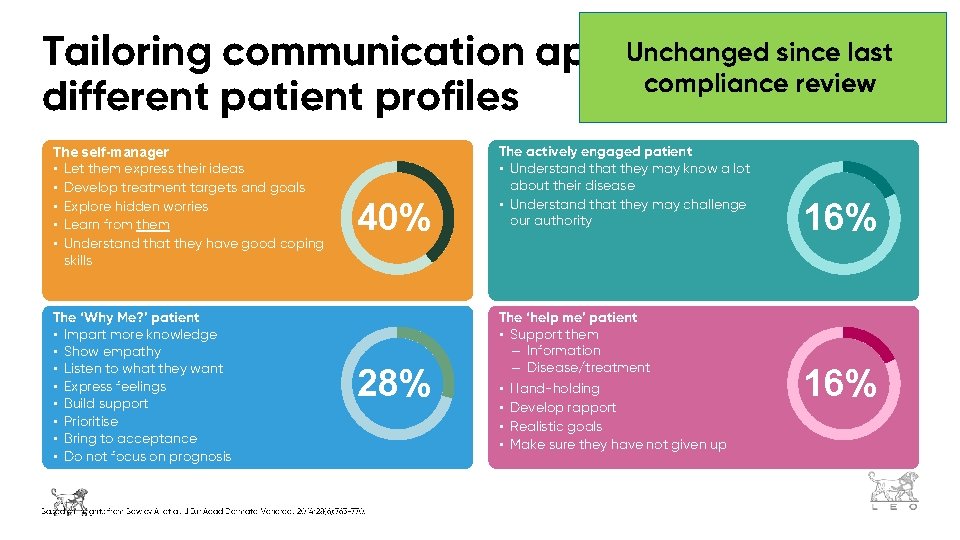
Unchanged since Tailoring communication approaches for last compliance review different patient profiles The self-manager • Let them express their ideas • Develop treatment targets and goals • Explore hidden worries • Learn from them • Understand that they have good coping skills The ‘Why Me? ’ patient • Impart more knowledge • Show empathy • Listen to what they want • Express feelings • Build support • Prioritise • Bring to acceptance • Do not focus on prognosis 40% 28% Based on insights from Bewley A, et al. J Eur Acad Dermatol Venereol. 2014; 28(6): 763 -770. The actively engaged patient • Understand that they may know a lot about their disease • Understand that they may challenge our authority The ‘help me’ patient • Support them ‒ Information ‒ Disease/treatment • Hand-holding • Develop rapport • Realistic goals • Make sure they have not given up 16%
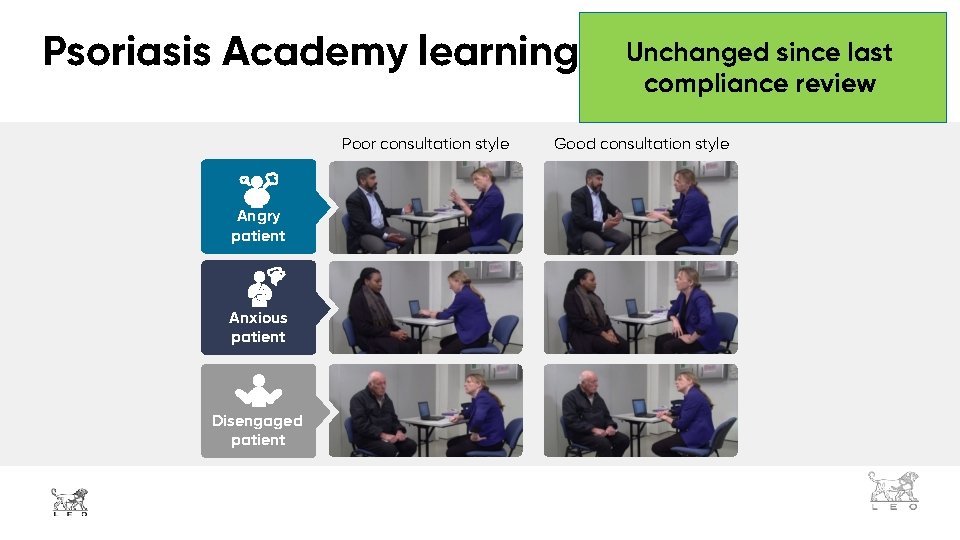
Unchanged since last Psoriasis Academy learning tools compliance review Poor consultation style Angry patient Anxious patient Disengaged patient Good consultation style
Summary Unchanged since last compliance review Research has identified four key patient profiles: Self-manager Actively engaged Why me? Help me! • Different patient profiles have different medical and treatment needs • Understanding these needs may help to improve treatment adherence 1 (e. g. through targeting of treatments, psychological assessments, educational programmes) • A person-centred approach can greatly improve patient understanding, the sharing of information and healthcare outcomes • Consider the various stages of the consultation and the communication skills required at each stage • Adapt your consultation style to meet the needs of different individuals • Individuals have different preferences for involvement in healthcare decisions 1. Bewley A, et al. J Eur Acad Dermatol Venereol. 2014; 28(6): 763 -770. 2. Cowdell F, et al. Arch Dermatol. 2012; 148(11): 1251 -1255. Multiple tools are available to dermatologists to explore patient well-being, e. g. the Person-Centred Dermatology Self-Care Index (Pe. De. Si)2 Reme mber – the first 2 minutes of a consultation are key
Are there any questions?