
How do we make decisions about uncertain events
How do we make decisions about uncertain events? • Psychophysics • Absolute and Difference Thresholds • Weber’s Law and Fechner’s Law – The concept of the jnd (just-noticeable difference) • Signal detection and Decision Theory • Response bias: payoffs and expectations • Liberal vs. conservative strategies
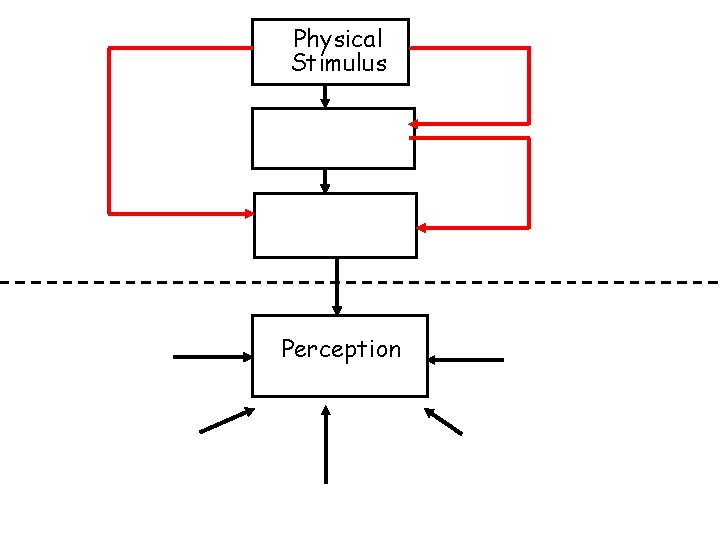
Physical Stimulus Perception
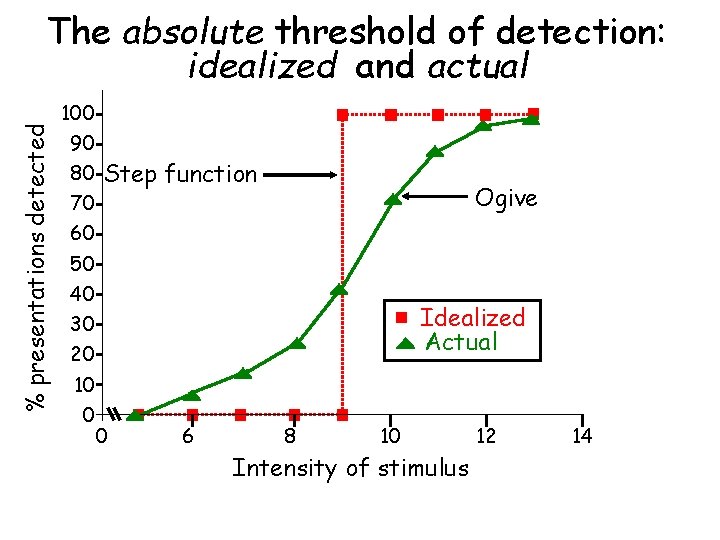
% presentations detected The absolute threshold of detection: idealized and actual 100 90 80 70 Step function Ogive 60 50 40 Idealized Actual 30 20 10 0 0 6 8 10 Intensity of stimulus 12 14
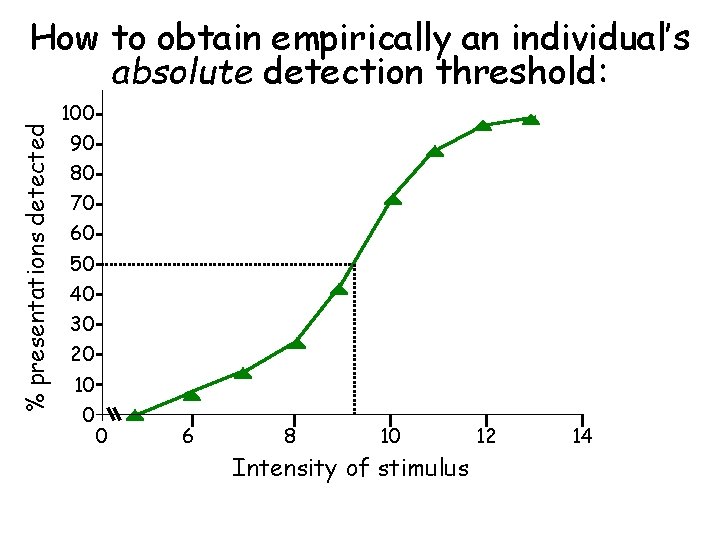
% presentations detected How to obtain empirically an individual’s absolute detection threshold: 100 90 80 70 60 50 40 30 20 10 0 0 6 8 10 Intensity of stimulus 12 14
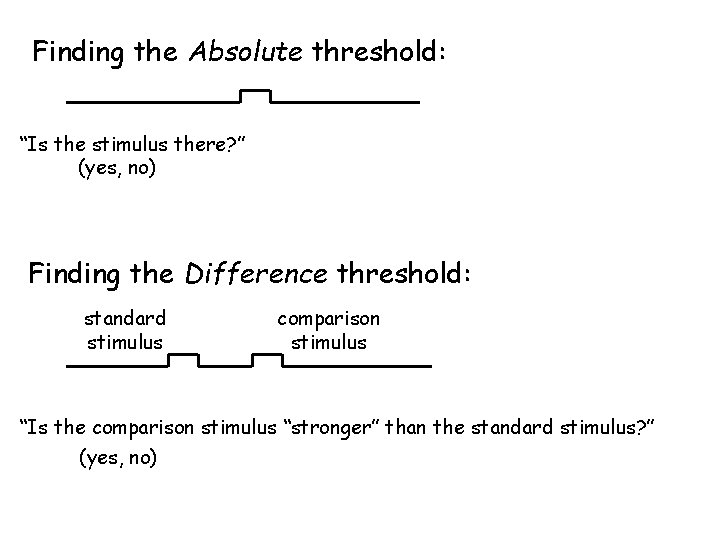
Finding the Absolute threshold: “Is the stimulus there? ” (yes, no) Finding the Difference threshold: standard stimulus comparison stimulus “Is the comparison stimulus “stronger” than the standard stimulus? ” (yes, no)
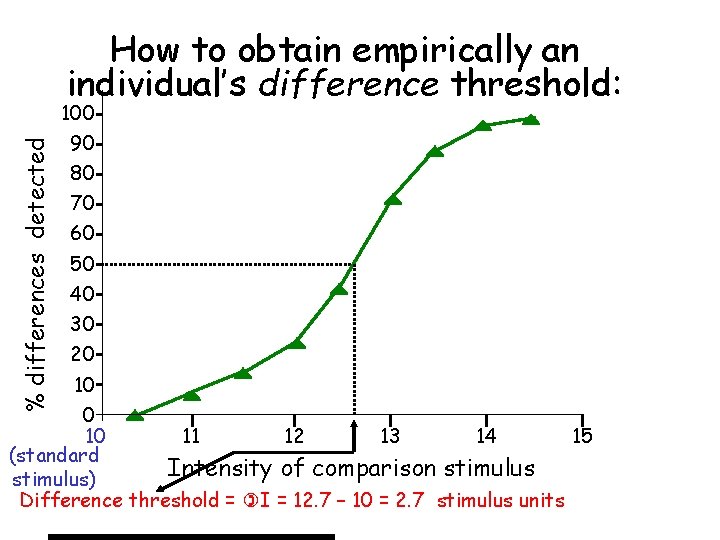
How to obtain empirically an individual’s difference threshold: % differences detected 100 90 80 70 60 50 40 30 20 10 11 12 13 14 15 (standard Intensity of comparison stimulus) Difference threshold = I = 12. 7 – 10 = 2. 7 stimulus units
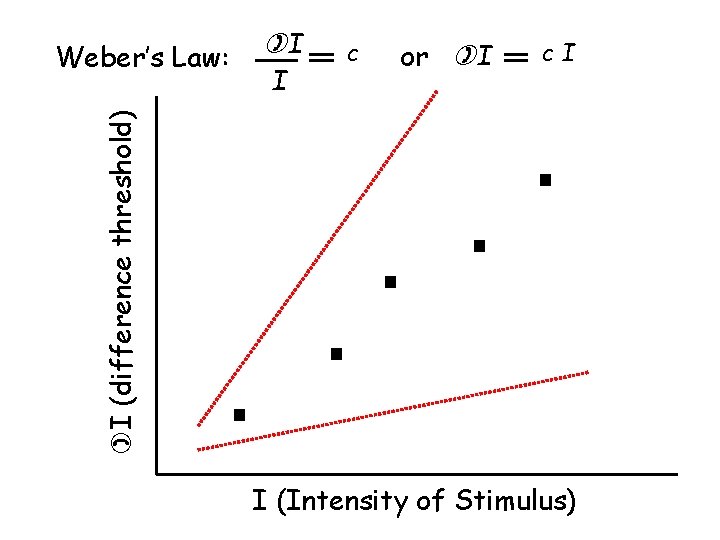
I I c or I c. I I (difference threshold) Weber’s Law: I (Intensity of Stimulus)
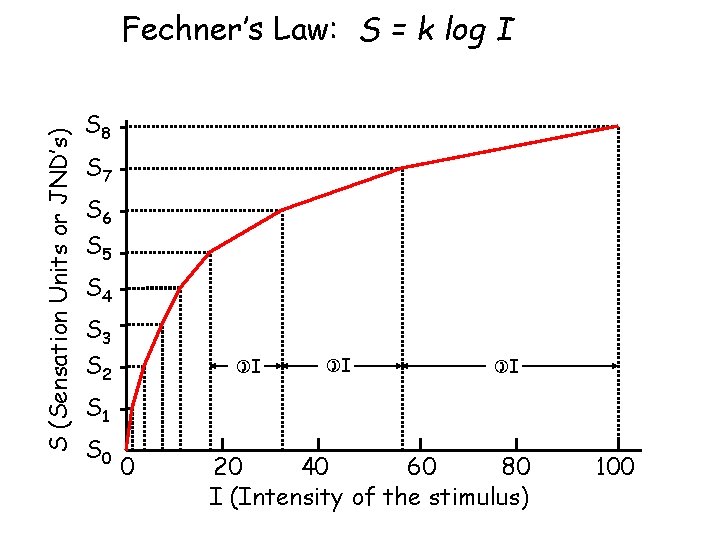
S (Sensation Units or JND’s) Fechner’s Law: S = k log I S 8 S 7 S 6 S 5 S 4 S 3 S 2 I I I S 1 S 0 0 20 40 60 80 I (Intensity of the stimulus) 100
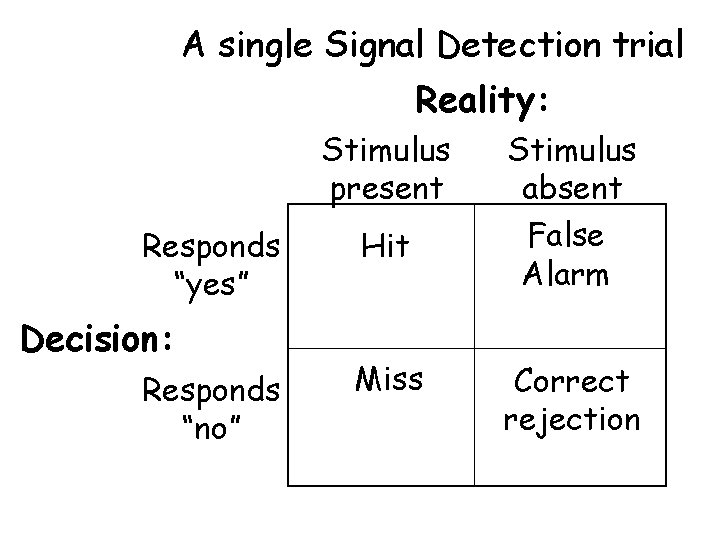
A single Signal Detection trial Reality: Stimulus present Responds “yes” Decision: Responds “no” Hit Miss Stimulus absent False Alarm Correct rejection
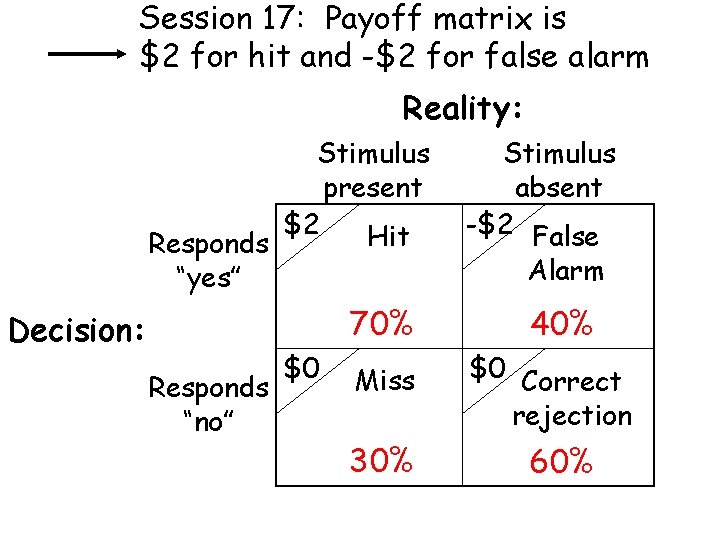
Session 17: Payoff matrix is $2 for hit and -$2 for false alarm Reality: Responds “yes” Stimulus present $2 Hit 70% Decision: Responds “no” $0 Miss 30% Stimulus absent -$2 False Alarm 40% $0 Correct rejection 60%
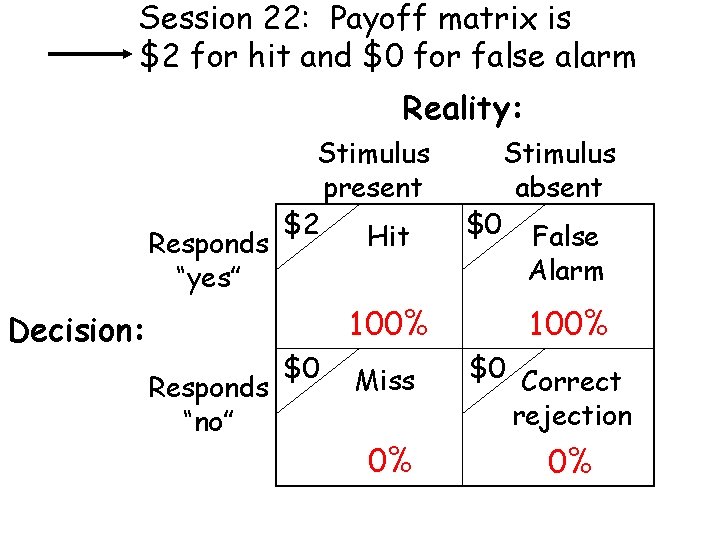
Session 22: Payoff matrix is $2 for hit and $0 for false alarm Reality: Responds “yes” Stimulus present $2 Hit 100% Decision: Responds “no” $0 Miss 0% $0 Stimulus absent False Alarm 100% $0 Correct rejection 0%
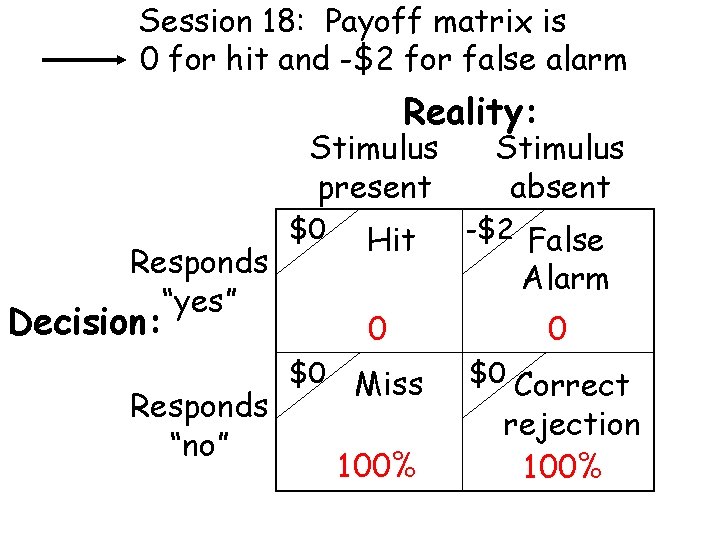
Session 18: Payoff matrix is 0 for hit and -$2 for false alarm Reality: Stimulus present Responds “yes” $0 Decision: Responds “no” Hit 0 $0 Miss 100% Stimulus absent -$2 False Alarm 0 $0 Correct rejection 100%
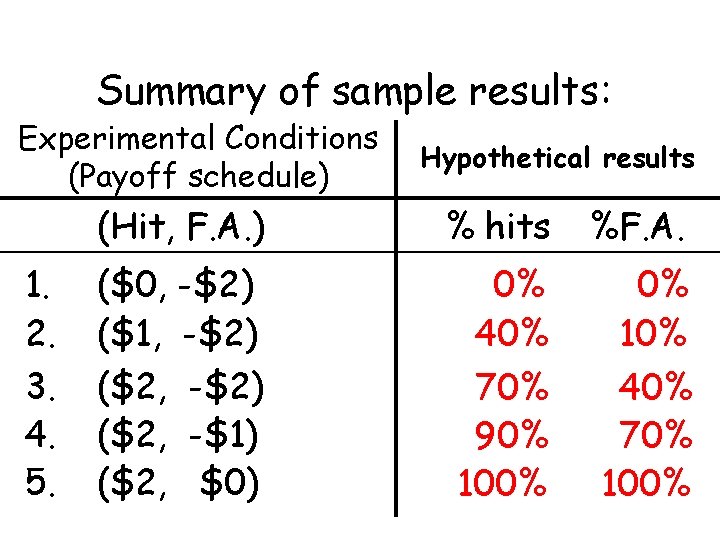
Summary of sample results: Experimental Conditions (Payoff schedule) 1. 2. 3. 4. 5. Hypothetical results (Hit, F. A. ) % hits %F. A. ($0, -$2) ($1, -$2) ($2, -$1) ($2, $0) 0% 40% 0% 10% 70% 90% 100% 40% 70% 100%
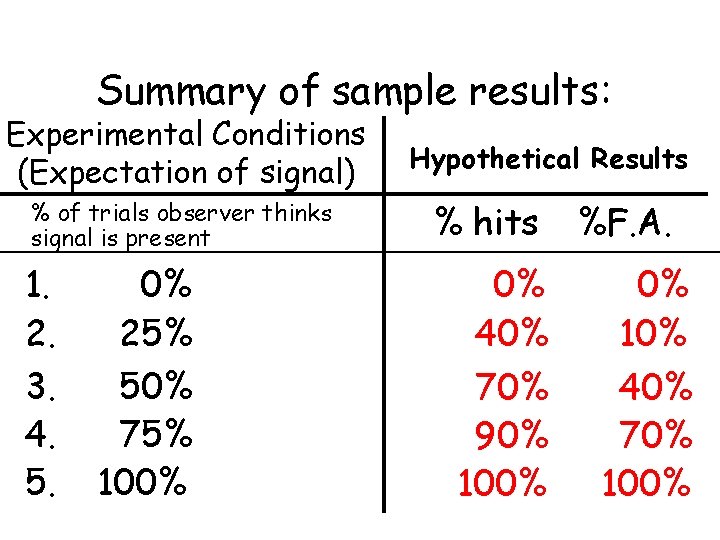
Summary of sample results: Experimental Conditions (Expectation of signal) % of trials observer thinks signal is present 1. 2. 3. 4. 5. 0% 25% 50% 75% 100% Hypothetical Results % hits %F. A. 0% 40% 0% 10% 70% 90% 100% 40% 70% 100%
- Slides: 14