
How do we get paid for that A
- Slides: 35
How do we get paid for that? A Look at Value-Based Methodologies Shaping Up in Michigan Primary Care Association 2015 Annual Conference www. mpca. net
Our Time Today �Environmental Scan �How Health Centers are Paid Today �What’s Changing �Prominent Payment Reform Models and What they Mean for Health Centers �Preparing for Payment Reform
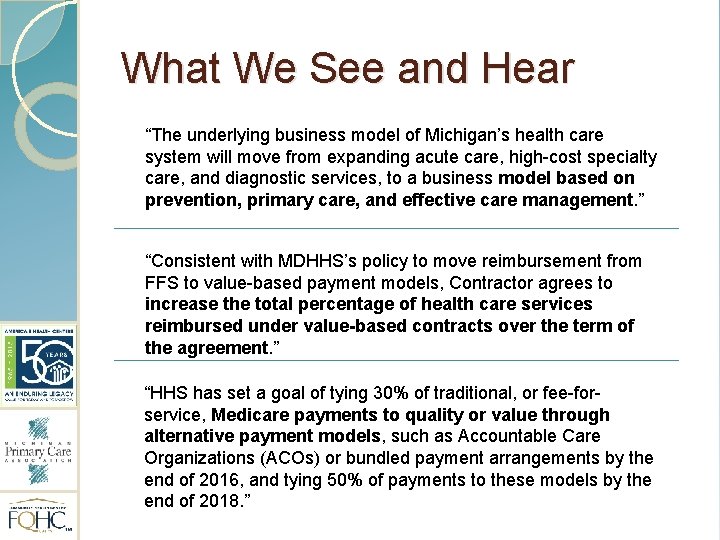
What We See and Hear “The underlying business model of Michigan’s health care system will move from expanding acute care, high-cost specialty care, and diagnostic services, to a business model based on prevention, primary care, and effective care management. ” “Consistent with MDHHS’s policy to move reimbursement from FFS to value-based payment models, Contractor agrees to increase the total percentage of health care services reimbursed under value-based contracts over the term of the agreement. ” “HHS has set a goal of tying 30% of traditional, or fee-forservice, Medicare payments to quality or value through alternative payment models, such as Accountable Care Organizations (ACOs) or bundled payment arrangements by the end of 2016, and tying 50% of payments to these models by the end of 2018. ”
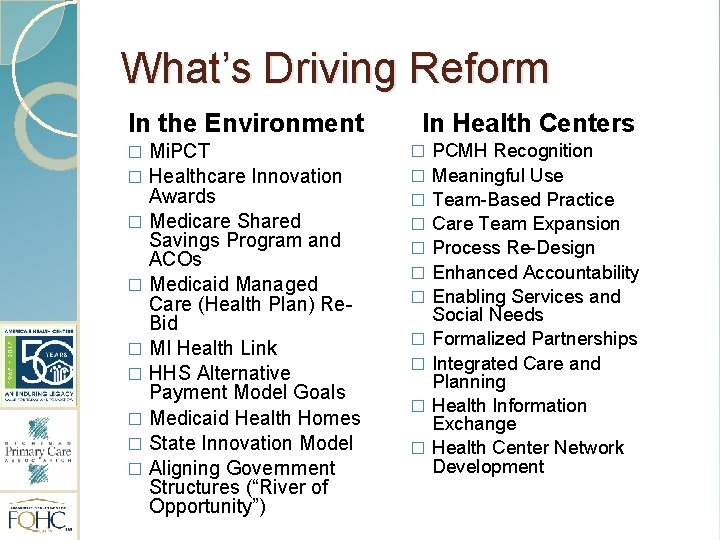
What’s Driving Reform In the Environment Mi. PCT � Healthcare Innovation Awards � Medicare Shared Savings Program and ACOs � Medicaid Managed Care (Health Plan) Re. Bid � MI Health Link � HHS Alternative Payment Model Goals � Medicaid Health Homes � State Innovation Model � Aligning Government Structures (“River of Opportunity”) � In Health Centers � � � PCMH Recognition Meaningful Use Team-Based Practice Care Team Expansion Process Re-Design Enhanced Accountability Enabling Services and Social Needs Formalized Partnerships Integrated Care and Planning Health Information Exchange Health Center Network Development
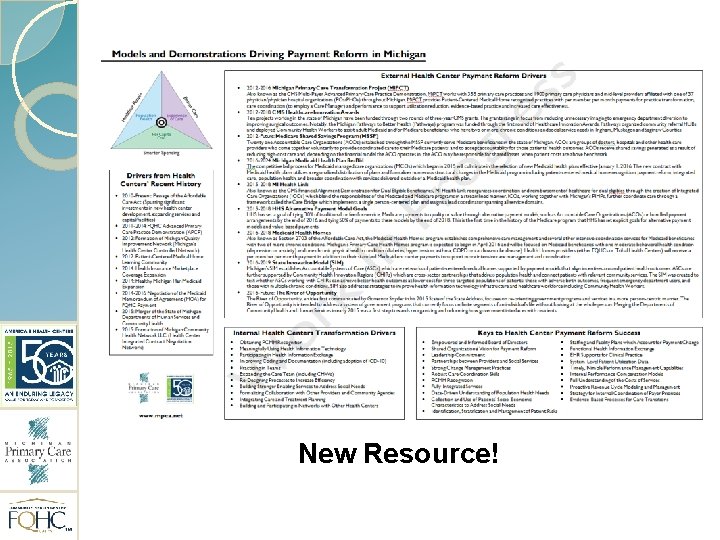
New Resource!
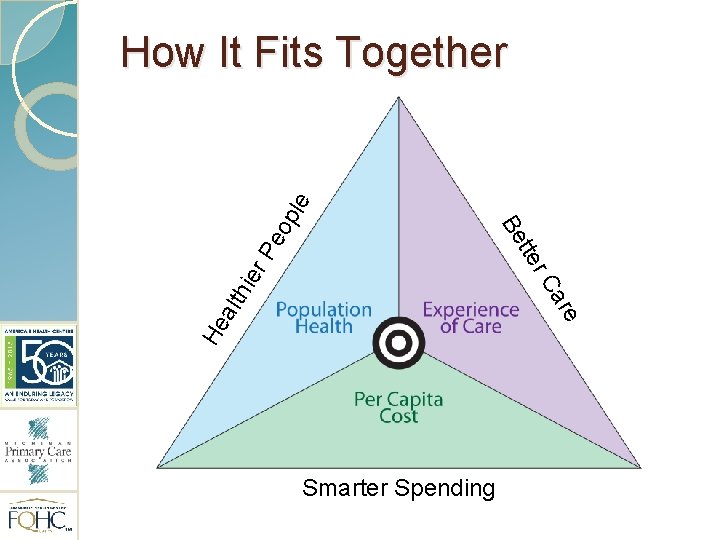
eo re Ca He alt hie r. P r tte Be ple How It Fits Together Smarter Spending
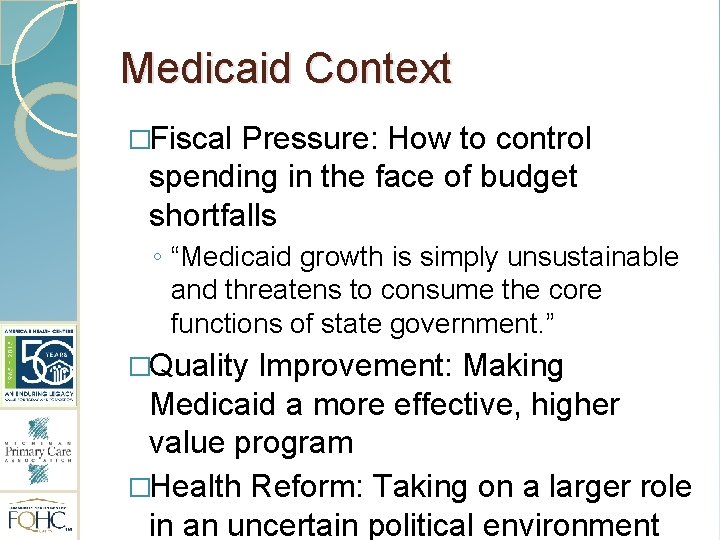
Medicaid Context �Fiscal Pressure: How to control spending in the face of budget shortfalls ◦ “Medicaid growth is simply unsustainable and threatens to consume the core functions of state government. ” �Quality Improvement: Making Medicaid a more effective, higher value program �Health Reform: Taking on a larger role in an uncertain political environment
An Outside View �“In retrospect, PPS provided perverse incentives: the higher the per-unit cost of providing care and the more face-to -face patient encounters, the higher the total revenue” �“The disparity of reimbursement between FQHCs and other private PCPs caring for the Medicaid population will leave FQHCs noncompetitive if these structural supports are eliminated in the future”
HOW HEALTH CENTERS ARE PAID TODAY
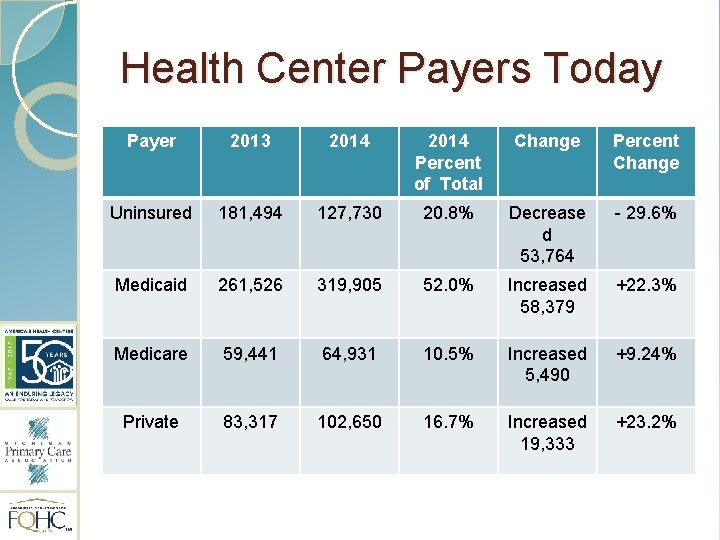
Health Center Payers Today Payer 2013 2014 Percent of Total Change Percent Change Uninsured 181, 494 127, 730 20. 8% Decrease d 53, 764 - 29. 6% Medicaid 261, 526 319, 905 52. 0% Increased 58, 379 +22. 3% Medicare 59, 441 64, 931 10. 5% Increased 5, 490 +9. 24% Private 83, 317 102, 650 16. 7% Increased 19, 333 +23. 2%
Medicaid Payment to FQHCs Today � The Medicaid program reimburses FQHCs through multiple mechanisms that, when combined, equal an established payment rate per patient visit (called an encounter) ◦ About $162 per encounter in 2015 for urban Centers and $145 for rural Centers � The core payment mechanisms include: ◦ Fee screen payments for services (i. e. do this and Medicaid will pay you this much) ◦ Quarterly interim wraparound payments (based on an anticipated number of encounters) ◦ Reconciliation settlements (following a reconciliation report and process often called a wraparound payment) � Many Medicaid health plans provide other revenue to Health Centers outside the established payment rate through incentives and
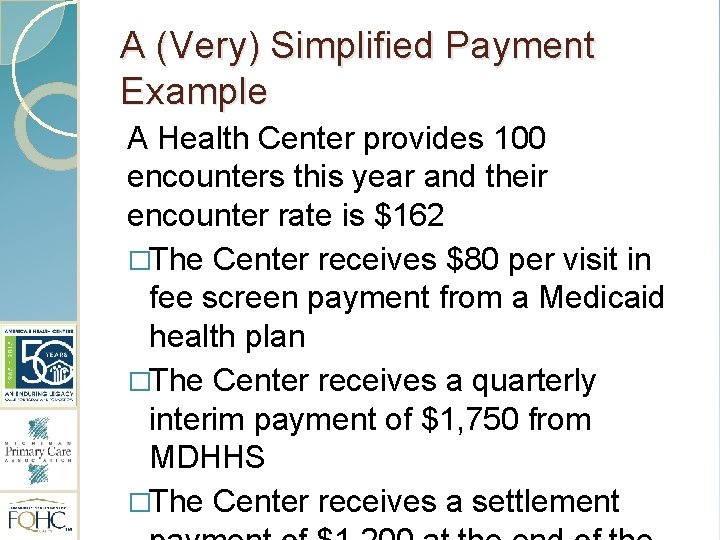
A (Very) Simplified Payment Example A Health Center provides 100 encounters this year and their encounter rate is $162 �The Center receives $80 per visit in fee screen payment from a Medicaid health plan �The Center receives a quarterly interim payment of $1, 750 from MDHHS �The Center receives a settlement
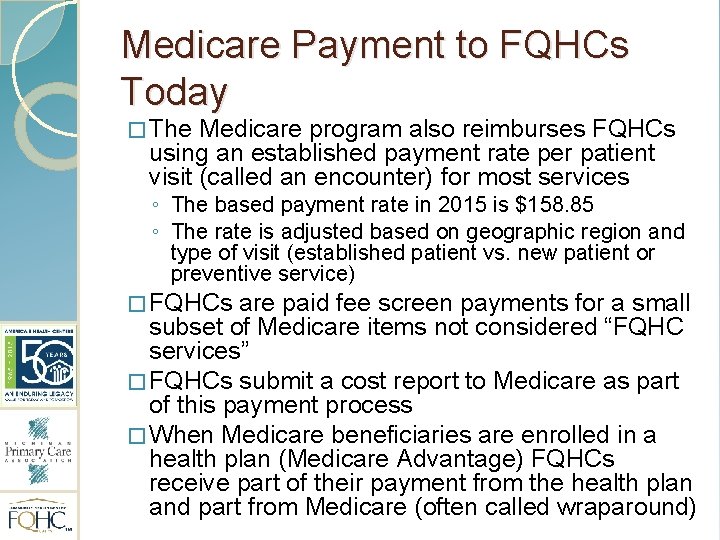
Medicare Payment to FQHCs Today � The Medicare program also reimburses FQHCs using an established payment rate per patient visit (called an encounter) for most services ◦ The based payment rate in 2015 is $158. 85 ◦ The rate is adjusted based on geographic region and type of visit (established patient vs. new patient or preventive service) � FQHCs are paid fee screen payments for a small subset of Medicare items not considered “FQHC services” � FQHCs submit a cost report to Medicare as part of this payment process � When Medicare beneficiaries are enrolled in a health plan (Medicare Advantage) FQHCs receive part of their payment from the health plan and part from Medicare (often called wraparound)
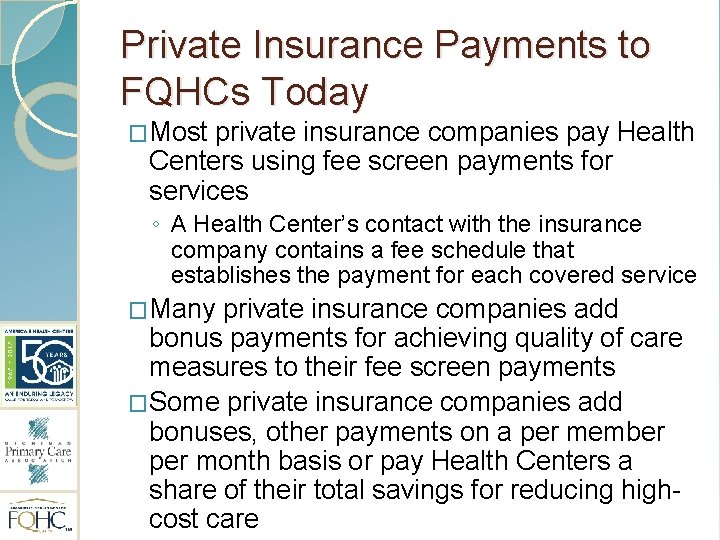
Private Insurance Payments to FQHCs Today �Most private insurance companies pay Health Centers using fee screen payments for services ◦ A Health Center’s contact with the insurance company contains a fee schedule that establishes the payment for each covered service �Many private insurance companies add bonus payments for achieving quality of care measures to their fee screen payments �Some private insurance companies add bonuses, other payments on a per member per month basis or pay Health Centers a share of their total savings for reducing highcost care
WHAT’S CHANGING
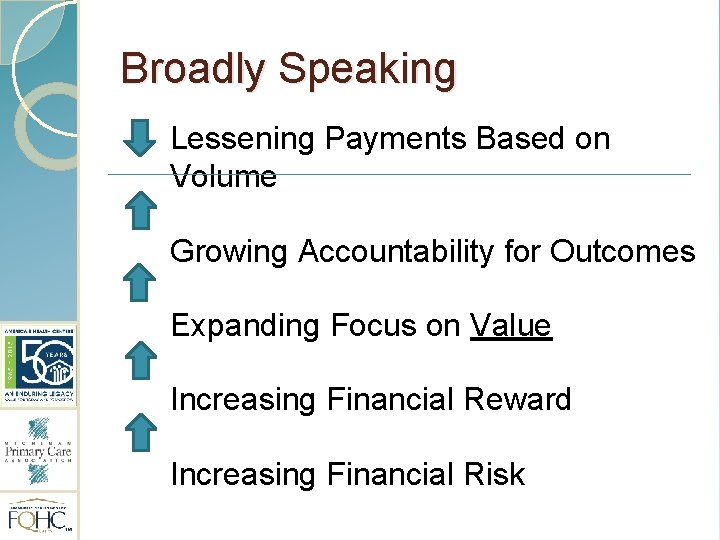
Broadly Speaking Lessening Payments Based on Volume Growing Accountability for Outcomes Expanding Focus on Value Increasing Financial Reward Increasing Financial Risk
What’s a value-based payment? �The term “value” is widely used to describe the combined assessment of both the quality and cost of a healthcare service �Conceptually, a “high-value” service is one that has high quality and low cost �Value-based payment is used to describe a payment model where the amount of payment for a service depends in some way on the quality or cost of the service that is delivered
What’s the Timeline? �Payers are approaching Health Centers and provider networks right now ◦ There’s a reason you see so many payers at this year’s conference! �Many environmental factors are pushing payers toward payment reform in a more tangible manner that we have seen before �Anticipate substantive change in the next two years (i. e. before the end of 2018) and for payment to continue to evolve over the course of the next eight years ◦ It won’t happen all at once, this is an iterative process
PROMINENT PAYMENT REFORM MODELS (AND WHAT THEY MEAN FOR HEALTH CENTERS)
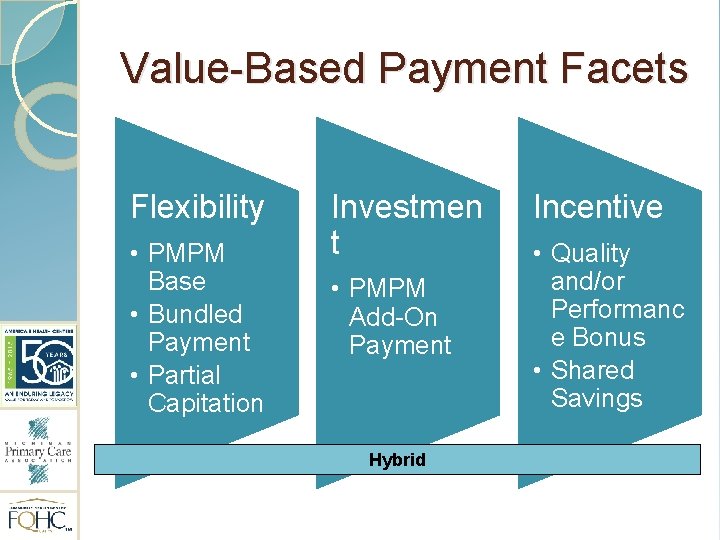
Value-Based Payment Facets Flexibility • PMPM Base • Bundled Payment • Partial Capitation Investmen t • PMPM Add-On Payment Hybrid Incentive • Quality and/or Performanc e Bonus • Shared Savings
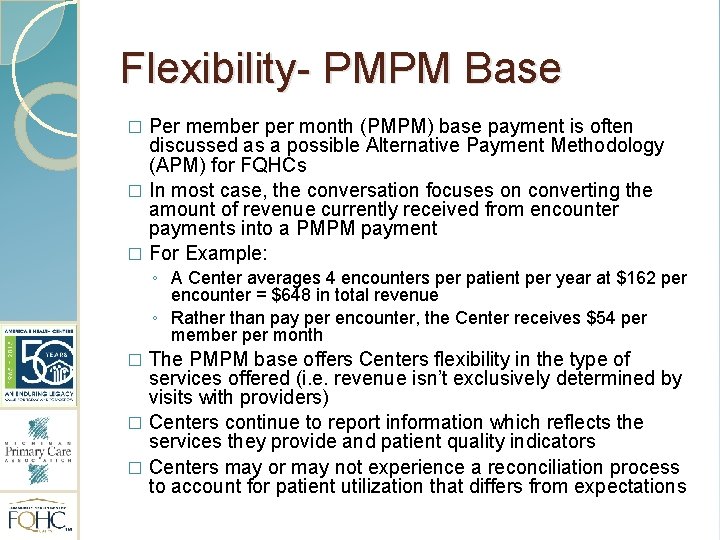
Flexibility- PMPM Base Per member per month (PMPM) base payment is often discussed as a possible Alternative Payment Methodology (APM) for FQHCs � In most case, the conversation focuses on converting the amount of revenue currently received from encounter payments into a PMPM payment � For Example: � ◦ A Center averages 4 encounters per patient per year at $162 per encounter = $648 in total revenue ◦ Rather than pay per encounter, the Center receives $54 per member per month The PMPM base offers Centers flexibility in the type of services offered (i. e. revenue isn’t exclusively determined by visits with providers) � Centers continue to report information which reflects the services they provide and patient quality indicators � Centers may or may not experience a reconciliation process to account for patient utilization that differs from expectations �
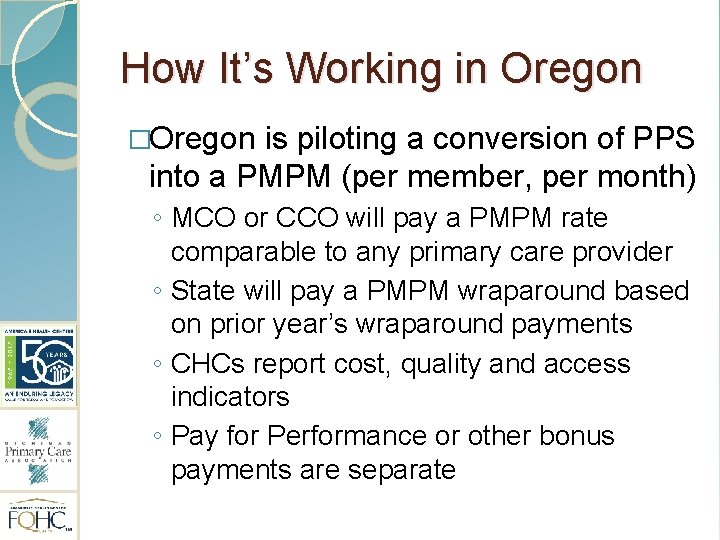
How It’s Working in Oregon �Oregon is piloting a conversion of PPS into a PMPM (per member, per month) ◦ MCO or CCO will pay a PMPM rate comparable to any primary care provider ◦ State will pay a PMPM wraparound based on prior year’s wraparound payments ◦ CHCs report cost, quality and access indicators ◦ Pay for Performance or other bonus payments are separate
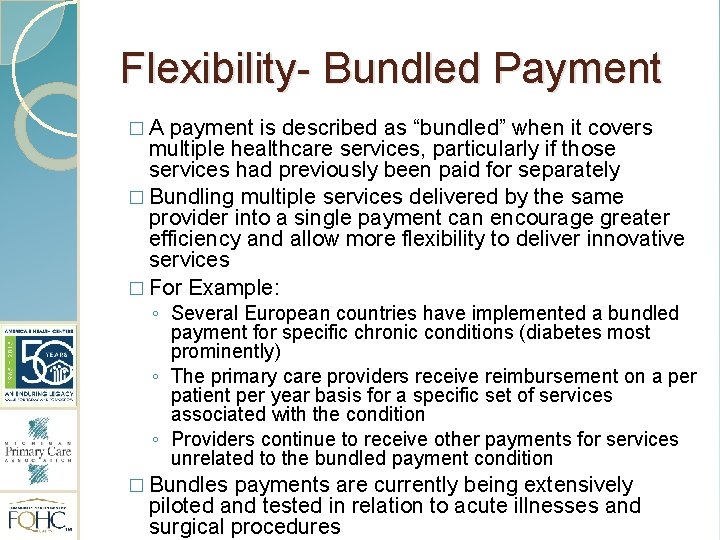
Flexibility- Bundled Payment �A payment is described as “bundled” when it covers multiple healthcare services, particularly if those services had previously been paid for separately � Bundling multiple services delivered by the same provider into a single payment can encourage greater efficiency and allow more flexibility to deliver innovative services � For Example: ◦ Several European countries have implemented a bundled payment for specific chronic conditions (diabetes most prominently) ◦ The primary care providers receive reimbursement on a per patient per year basis for a specific set of services associated with the condition ◦ Providers continue to receive other payments for services unrelated to the bundled payment condition � Bundles payments are currently being extensively piloted and tested in relation to acute illnesses and surgical procedures
Flexibility- Partial Capitation �Capitation is a payment model in which a healthcare provider is paid based on the number of individuals cared for, rather than on the number of services provided ◦ Capitation can be global (i. e. all services), but for FQHCs partial capitation (i. e. a specific subset of services) is a more likely prospect �Partial capitation is most often paid as a fixed amount per patient, so Centers are more at risk for unanticipated
Investment- PMPM Add-On �Several payers are now offering smaller PMPM add-on payments to provide revenue support for valuable provider infrastructure like PCMH recognition �These add-on payments are generally a low dollar amount per member per month (e. g. $2. 50) but they can add up to a significant revenue source ◦ A Health Center with 2, 000 members could earn $60, 000 per year at $2. 50 PMPM
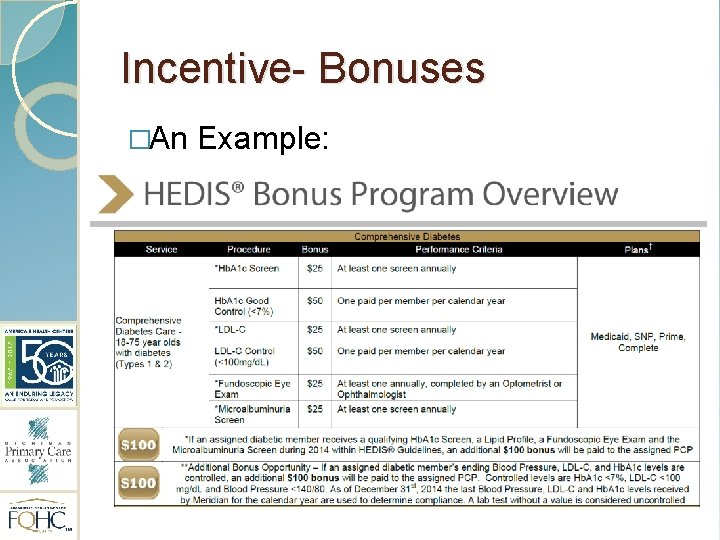
Incentive- Bonuses �Bonuses (also called incentives) are usually fixed amounts of money which provider receive for meeting specific goals �Most commonly, providers get paid bonuses for meeting and reporting quality and/or access standards ◦ The Healthcare Effectiveness Data and Information Set (HEDIS) is the most common group of standards used by payers
Incentive- Bonuses �An Example:
Incentive- Shared Savings � Shared savings is a payment arrangement between a payer and a provider in which a portion of the payment to a provider is related to how much the payer is spending on those services compared to a benchmark � Generally, shared savings stem from primary care, care coordination and care transitions work that reduces or prevents high cost emergency department and inpatient utilization � Shared savings are usually paid as a percentage, for example: ◦ The benchmark cost of a beneficiary’s services is $1, 500 ◦ The actual cost of a beneficiary's services this year was $1, 200 ◦ The provider gets paid $60 (20%) of the total savings and the payer keeps $240 � Sometimes the percentage of shared savings a provider receives is related to the provider’s quality/performance (i. e. better performance on quality measures equals a higher amount of shared savings)
PREPARING FOR PAYMENT REFORM
Transformation is Underway Already � What ◦ ◦ ◦ is your Health Center working on? Obtaining PCMH Recognition Meaningfully Using Health Information Technology Participating in Health Information Exchange Improving Coding and Documentation (including ICD 10) Practicing in Teams Expanding the Care Team (including CHWs) Re-Designing Processes to Increase Efficiency Building Stronger Enabling Services to Address Social Needs Formalizing Collaboration with Other Providers and Community Agencies Integrating Care and Treatment Planning Building and Participating in Networks with Other Health Centers
Preparing for Payment Reform � Empowered and Informed Board of Directors � Shared Organizational Vision for Payment Reform � Leadership Commitment � Partnerships between Providers and Social Services � Strong Change Management Practices � Robust Care Coordination Skills � PCMH Recognition � Fully-Integrated Services � Data-Driven Understanding of Population Health Needs � Collection and Use of Patients’ Socio-Economic Characteristics to Address Social Needs � Identification, Stratification and Management of
Preparing for Payment Reform � Staffing and Facility Plans which Account for Payment Change � Functional Health Information Exchange � EHR Supports for Clinical Practice � System-Level Patient Utilization Data � Timely, Nimble Performance Management Capabilities � Internal Performance Compensation Models � Full Understanding of the Costs of Services � Proactive Revenue Cycle Modeling and Management � Strategy for Internal Coordination of Payer Priorities � Evidence-Based Processes for Care Transitions
Coming Soon: Readiness Assessment �MPCA will be partnering with NACHC and JSI to lead Michigan Health Centers in a comprehensiveness assessment process �The results will not only inform your internal planning and work, but be used on a statewide basis to tailor supports �We’ll need your help for the assessment process to be meaningful!
Questions? Comments? �Payment Reform Glossary: ◦ www. paymentreformglossary. org �Payment Reform Primer: ◦ http: //bit. ly/1 VLOCVe �Readiness Assessment (Preview): ◦ http: //bit. ly/1 Kv. IWvl