
How do scientists record accurate measurements An Introduction
- Slides: 11
How do scientists record accurate measurements? An Introduction to Measurement Wednesday September 5, 2018 http: //www. bing. com/videos/search? q=To+The+Window+To+The+Wall+ Song&view=detail&mid=4135 A 56623 B 573168 B 09&first=0&adlt=strict 29 sec
Today’s Goals o Using your measurement instruments correctly o Converting between Celsius and Kelvin temperature o Using scientific notation
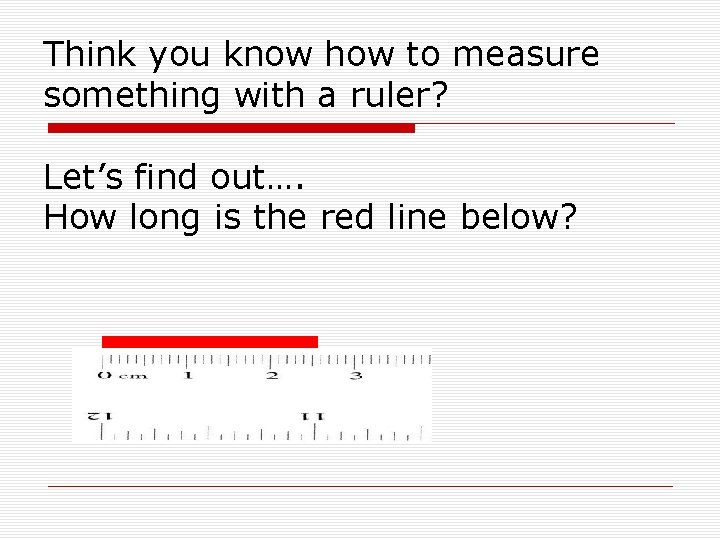
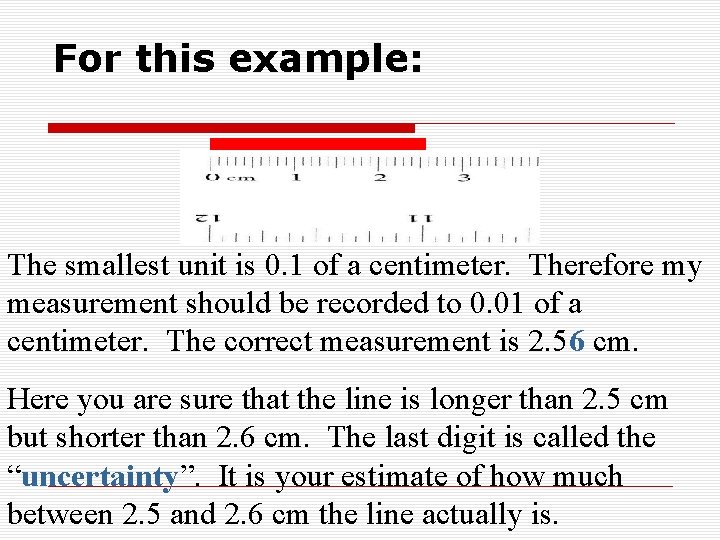
Think you know how to measure something with a ruler? Let’s find out…. How long is the red line below?
Taking a correct measurement o Determine the smallest marked unit on your instrument. o Record the measurement to one decimal place past the smallest marked unit o Don’t forget to add the units!!!
For this example: The smallest unit is 0. 1 of a centimeter. Therefore my measurement should be recorded to 0. 01 of a centimeter. The correct measurement is 2. 56 cm. Here you are sure that the line is longer than 2. 5 cm but shorter than 2. 6 cm. The last digit is called the “uncertainty”. It is your estimate of how much between 2. 5 and 2. 6 cm the line actually is.
Instruments you should be able to read: o o o Ruler Graduated cylinder Thermometer Triple beam balance Electronic balance
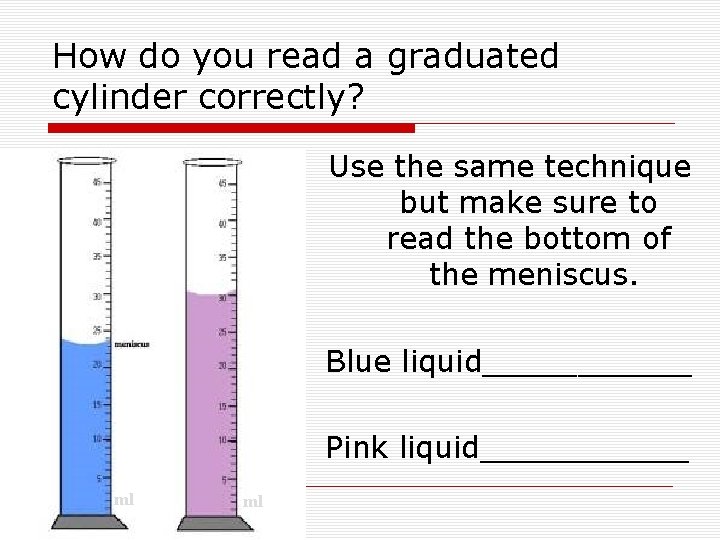
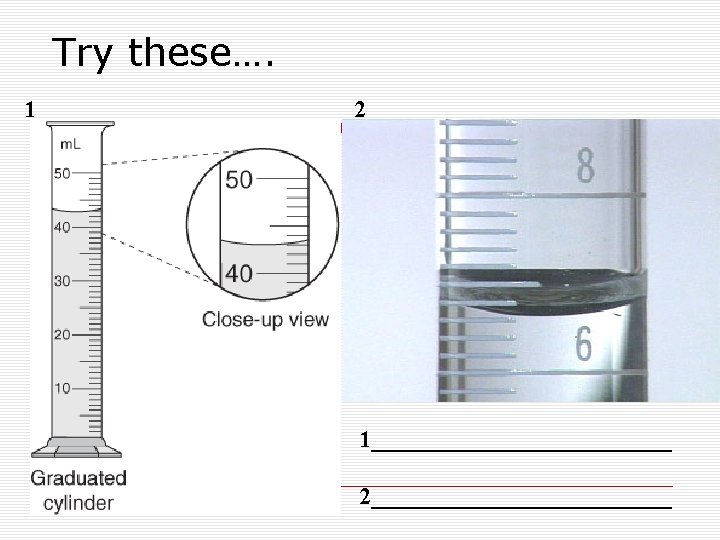
How do you read a graduated cylinder correctly? Use the same technique but make sure to read the bottom of the meniscus. Blue liquid______ Pink liquid______ ml ml
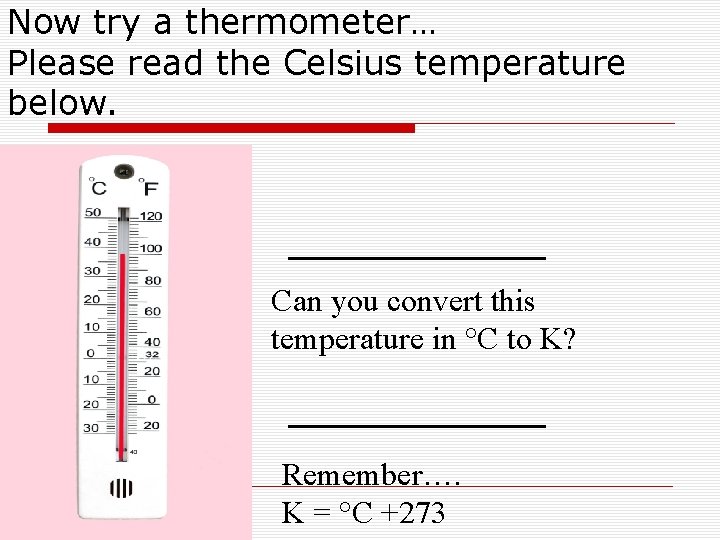
Now try a thermometer… Please read the Celsius temperature below. Can you convert this temperature in °C to K? Remember…. K = °C +273
Scientific Notation o Used to show very large or very small numbers o Looks like this n A x 10 b n where A must be greater than or equal to 1 and less than 10 and b can be any whole number + or - o If is the exponent is +, then the number greater than 1. the exponent is –, then the number less than 1.
Try these… o Change to scientific notation n 9100 n 0. 000258 o Change to standard notation n 1. 75 x 103 n 6. 25 x 10 -2