
How do Psychologists gather their data They use



- Slides: 35
How do Psychologists gather their data? They use something called… Research methods
AIM • They will always have an aim, in other words one sentence that clearly highlights what the researcher is intending to investigate. • The aim typically involves the word “investigate” or “investigation”. For example: Milgram investigated how far people would go in obeying an instruction to harm another person.
Watch • 5 Psychology Experiments you couldn’t do today, up to 3. 14. • Discuss • What was the aim of the “Little Albert” experiment?
• In rows discuss the key term “Aim” • Try to come up with some “Aims” it would be fun to meet through completing experiments at SDCC. E. g. To investigate whether missing lunch meant MUR parked more students during session 5 and 6.
Task • Define the key term “Aim” • Furnish your definition with examples from your discussion. • EXT: Look at the example you have chosen to illustrate above. Could this experiment be carried out in real life? Why/why not?
A hypothesis 1) A hypothesis is a testable statement which makes it very clear what the researcher is investigating. . E. G. Missing lunch will mean that MUR will park more students during sessions 5 and 6 than he does during those sessions without missing lunch. 2) A Null hypothesis does not predict a difference. ‘There will be no difference between…. . . E. G. Missing lunch will not effect the number of students MUR will park during sessions 5 and 6
Watch • 5 Psychology Experiments you couldn’t do today, 3. 14 up to 4. 52 • Discuss • What was the hypothesis used in the experiment known as “The Monster Study”?
Task • Define the key terms Hypothesis and Null Hypothesis • Look back at the aims you chose to write down. • Choose one, write a hypothesis and a null hypothesis based on the aim you have chosen. • EXT: What does it mean if something is “variable”? Write up your answer.
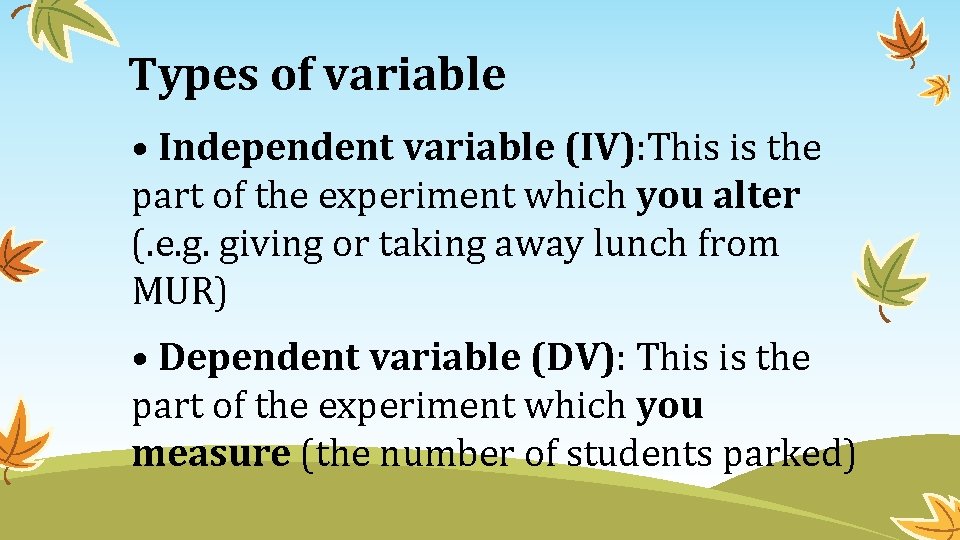
Types of variable • Independent variable (IV): This is the part of the experiment which you alter (. e. g. giving or taking away lunch from MUR) • Dependent variable (DV): This is the part of the experiment which you measure (the number of students parked)
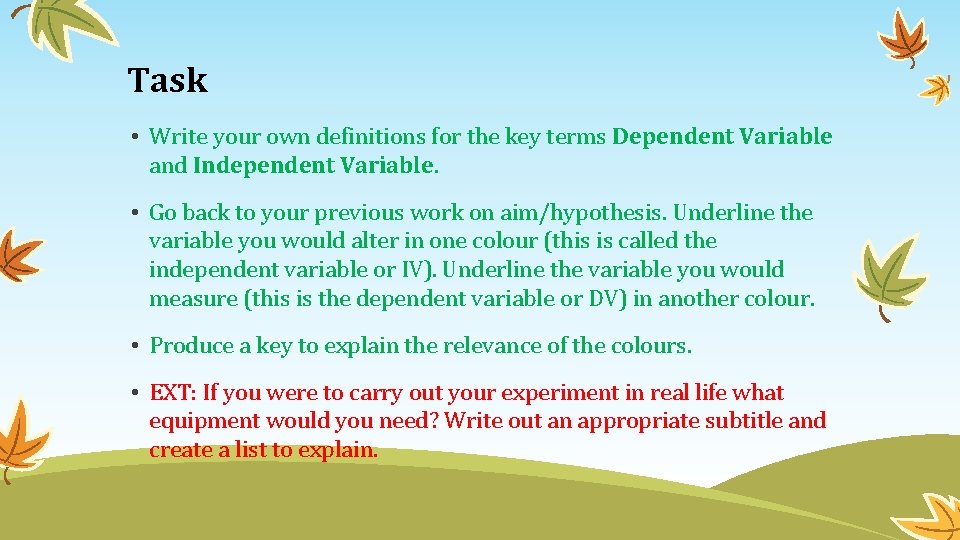
Task • Write your own definitions for the key terms Dependent Variable and Independent Variable. • Go back to your previous work on aim/hypothesis. Underline the variable you would alter in one colour (this is called the independent variable or IV). Underline the variable you would measure (this is the dependent variable or DV) in another colour. • Produce a key to explain the relevance of the colours. • EXT: If you were to carry out your experiment in real life what equipment would you need? Write out an appropriate subtitle and create a list to explain.
Complete your table sheet • Travel around the room to find descriptions, advantages and disadvantages. • Complete your table sheet with best guesses
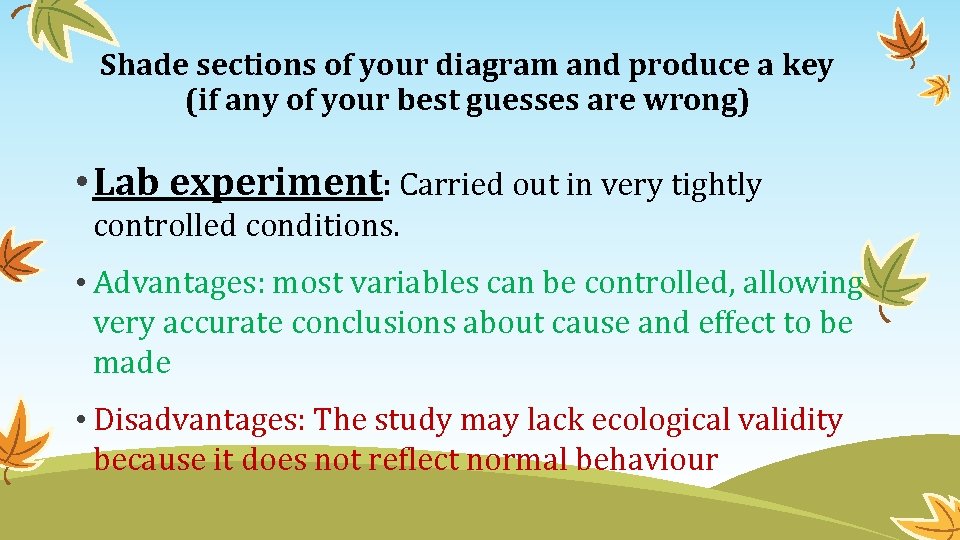
Shade sections of your diagram and produce a key (if any of your best guesses are wrong) • Lab experiment: Carried out in very tightly controlled conditions. • Advantages: most variables can be controlled, allowing very accurate conclusions about cause and effect to be made • Disadvantages: The study may lack ecological validity because it does not reflect normal behaviour
• Field experiment: Experiments carried out in everyday situations but still with the control of the IV • Advantages: Behaviour in the field is more natural than in a lab so has greater ecological validity • Disadvantages: it is not possible to have control over all variables in the field (i. e. weather)
• Natural experiment: studies a natural situation that cannot be manipulated – the IV occurs naturally (i. e. gender) • Advantages: very high ecological validity because it looks at completely natural behaviour • Disadvantages: Cannot draw conclusions about cause and effect because there are too many uncontrolled variables.
Watch • The bystander effect • Discuss what kind of experiment is this?
There are 3 types of experimental design: • For each, complete an A 4 summary page/poster. You MUST illustrate and include the advantages and disadvantages. DO NOT USE THE BACK OF THE PAGES!!!
Types of experimental design • Repeated measures: When participants take part in all conditions of the experiment. This means that each condition of the experiment includes the same group of participants. • Advantages: All participants do each activity so you don’t have a clever group for example. • Disadvantages: Participants might guess the aim of the study because they do all tasks, they can get bored or better because they have practiced the tasks (because they have repeated them) • EXT: Design an experiment which could be carried out using “repeated measures”
• Matched pairs: When participants are matched with another group (for IQ or age or gender etc. ) and complete only one condition of the experiment. • Advantage: Participants are matched on key variables so you don’t end up with a clever group for example • Disadvantage: Matching takes a long time and is difficult • EXT: Design an experiment which could be carried out using “matched pairs”
• Independent groups: Participants only complete one condition of the experiment • Advantage: There are no order effects and participants are unlikely to guess the aim of the study • Disadvantage: Participants in each group may be very different in terms of ability • EXT: Design an experiment which could be carried out using “independent groups”
Standardised Procedures • If Mr Wickenden decided to “standardise” haircuts for all students what would this mean? • Discuss
Best Guess • What might “Standardisation” mean in an experiment? What would you want to make standard/the same? • Write up your best guess under the subtitle “Standardised procedures” • Feedback and discuss. • Add to/amend your answer as appropriate. • EXT: Consider our MUR experiment. What would need to be standardised?
Extraneous Variables • Variables (other than the IV) which might effect the DV if they are not controlled. • If MUR has no lunch on a Monday and parks 17 students, then has lunch on a Wednesday and parks no students, we might think we have a definite conclusion to our experiment. • However, things are not so simple. What if MUR had 12 hours sleep on Sunday night and stayed up all night, excitedly reading French textbooks on Tuesday night? How would this impact on our experiment?
Watch • Extraneous Variables - youtube
• Under the subtitle “Extraneous Variables” write a definition. • Ext: List as many extraneous variables which may impact upon our MUR results.
Task • Look back at the experiment you started to plan last lesson. (If you were absent use the experiment planned by the person next to you). • In your row, discuss the potential extraneous variables you could come up against whilst conducting your experiment.
Write a letter to Mr. Wickenden • It needs to explain your experiment. • You need to tell him your aim and hypothesis. • You need to explain to him what the independent and dependent variables are. • You also must warn him about extraneous variables you have thought of. • Finally, you need to tell him how you would plan to “standardise procedures” if you were given permission to carry out this experiment.
• Dear Mr Wickenden • I am planning to carry out a Psychological experiment and wanted to explain the process to you in order that you may give me your thoughts on the procedure. • Through my experiment I am aiming to……. • My hypothesis is……………. . . • The independent variable is …………. I plan to control this by……………The dependent variable is……………………. . • The extraneous variables I have thought of are…………………. . • Obviously I would like to “standardise procedures” if I was given permission to carry out this experiment. I would do this by……………….
Task • Cut up and sort your card sheet. • Discuss ordering • Glue down to produce a summary. Use the subtitle “Instructions to Participants” • EXT: Write a set of instructions for MUR
Watch • Ghostbusters opening scene – youtube • What is Dr Venkman exhibiting? Discuss
Bias • It is important to make sure the experiment is as fair and unbiased as possible. This can be done in different ways depending on the design of the experiment. • Independent Groups/Matched Pairs • The decision as to which participant goes in to which condition of a study (in independent groups) or which people form which pair (in matched pairs) needs to be random in order to be totally unbiased. • This randomness is achieved through the use of a system called “random allocation”. Participants will be given a number and then numbers will be put in a bag and pulled out randomly to make the decisions.
• Repeated Measures • All participants have to take part in both conditions. Counter balancing is used to ensure fairness. • Half the participants complete condition 1 then condition 2 and vice versa for the other half of participants. This ensures that the groups are treated the same.
Find your summary posters on repeated measures etc. • Add the correct information (re. allocation of participants to conditions) to the back of the correct summary pages. • Essentially you are explaining how each experiment could be made as fair/unbiased as possible. • EXT: Add the correct info to your experiment (if appropriate)
Watch • Research Methods: The Experiment - Hypotheses, Variables and Design youtube
• Use A 3 card to produce (and then play!) games designed to help you remember the key terms/themes covered in this unit so far. • Hypothesis • Variables • Bias • Experiment design