
How do people know that this cartoon is
- Slides: 23
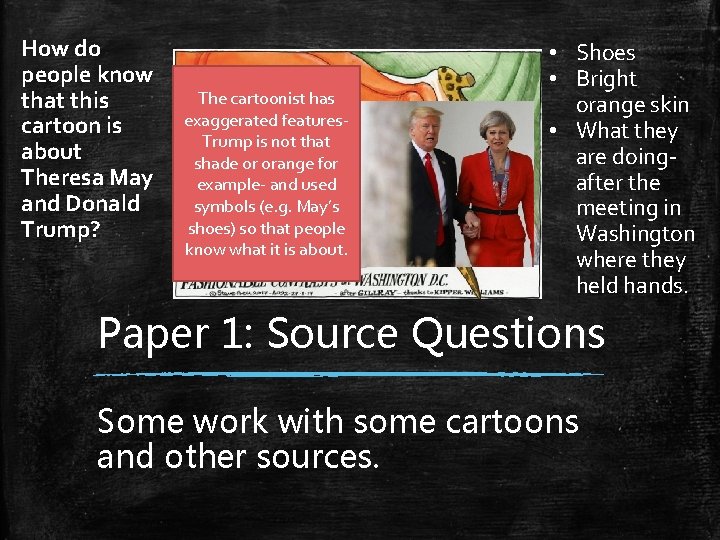
How do people know that this cartoon is about Theresa May and Donald Trump? The cartoonist has exaggerated features. Trump is not that shade or orange for example- and used symbols (e. g. May’s shoes) so that people know what it is about. • Shoes • Bright orange skin • What they are doingafter the meeting in Washington where they held hands. Paper 1: Source Questions Some work with some cartoons and other sources.
Learning Objectives ▪To be more confident working with cartoons/ sources on paper 1
Success Criteria ▪Recall contextual knowledge ▪Apply to sources ▪Practise source skills ▪Assess sample answers.
Tips for using cartoons 1. There are certain common symbols that cartoonists use to make a point. Look out for them. 2. Cartoonists exaggerate features also to make a point. 3. Everything in a cartoon is deliberate- try to work out why the cartoonist has put it there. 4. If you are unsure of what the cartoonist is getting at, try describing what you can see. 5. If you don’t recognise an event mentioned or a word, but you know something that happened around the same date then try to link it to that event. 6. Read the information you are given about the source- the exam board want you to read it and are often pointing you towards
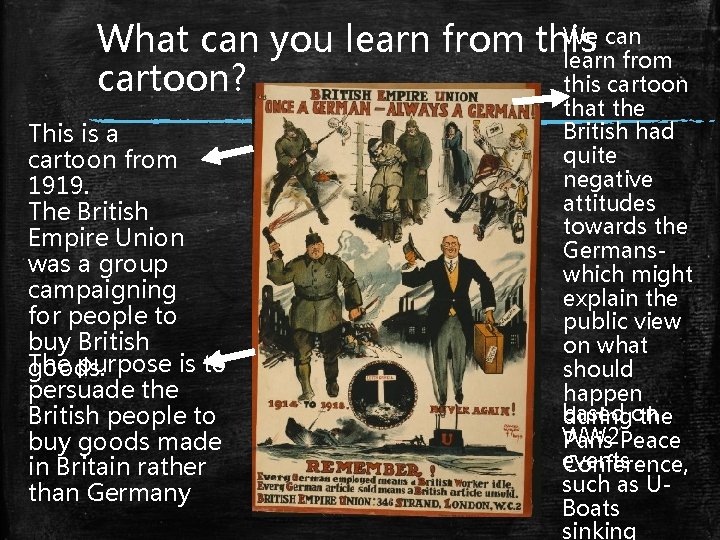
We can What can you learn from this learn from cartoon? this cartoon This is a cartoon from 1919. The British Empire Union was a group campaigning for people to buy British The purpose is to goods. persuade the British people to buy goods made in Britain rather than Germany that the British had quite negative attitudes towards the Germanswhich might explain the public view on what should happen based duringon the WW 2 Paris Peace events Conference, such as UBoats sinking
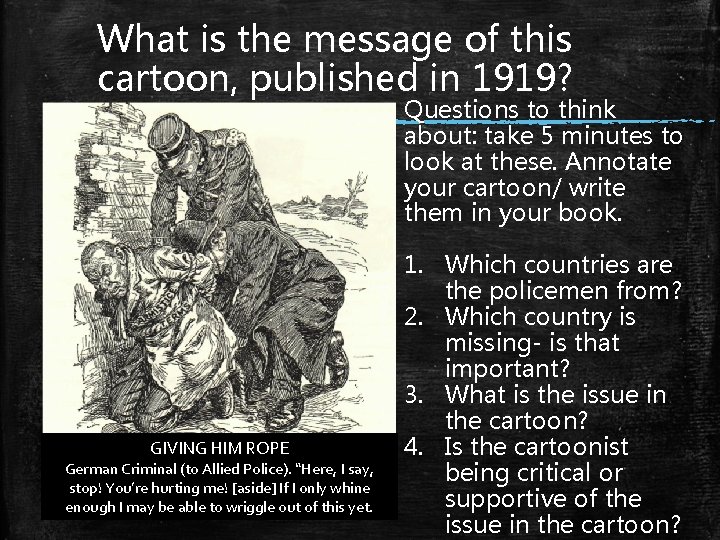
What is the message of this cartoon, published in 1919? Questions to think about: take 5 minutes to look at these. Annotate your cartoon/ write them in your book. GIVING HIM ROPE German Criminal (to Allied Police). “Here, I say, stop! You’re hurting me! [aside] If I only whine enough I may be able to wriggle out of this yet. 1. Which countries are the policemen from? 2. Which country is missing- is that important? 3. What is the issue in the cartoon? 4. Is the cartoonist being critical or supportive of the issue in the cartoon?
Answers- mark your own ▪ The cartoon is about the Paris Peace Conference and the harsh treatment of Germany- which clearly the cartoonist supports. ▪ The cartoonist is being critical of the Germans for “whining about their punishment”, believing that they deserve the treatment they were getting for Versailles. You could also claim that it is supporting the Allies and suggesting that they are doing the right thing and not to weaken or let up on Germany. ▪ That is why it is significant that the policemen are British and French rather than American, as the US under Woodrow Wilson were trying to get a better deal for Germany during the Paris Peace Talks. The cartoonist may be referring to that by having left them out- so it needs to be Britain and France that stay tough.
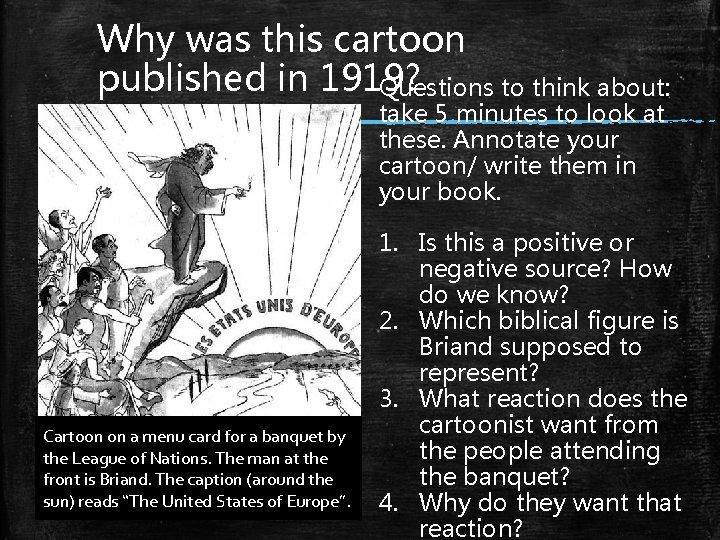
Why was this cartoon published in 1919? Questions to think about: take 5 minutes to look at these. Annotate your cartoon/ write them in your book. Cartoon on a menu card for a banquet by the League of Nations. The man at the front is Briand. The caption (around the sun) reads “The United States of Europe”. 1. Is this a positive or negative source? How do we know? 2. Which biblical figure is Briand supposed to represent? 3. What reaction does the cartoonist want from the people attending the banquet? 4. Why do they want that reaction?
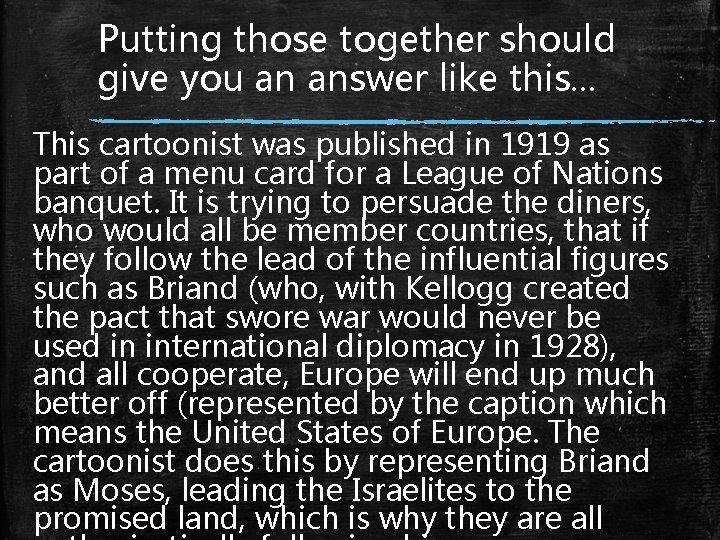
Putting those together should give you an answer like this. . . This cartoonist was published in 1919 as part of a menu card for a League of Nations banquet. It is trying to persuade the diners, who would all be member countries, that if they follow the lead of the influential figures such as Briand (who, with Kellogg created the pact that swore war would never be used in international diplomacy in 1928), and all cooperate, Europe will end up much better off (represented by the caption which means the United States of Europe. The cartoonist does this by representing Briand as Moses, leading the Israelites to the promised land, which is why they are all
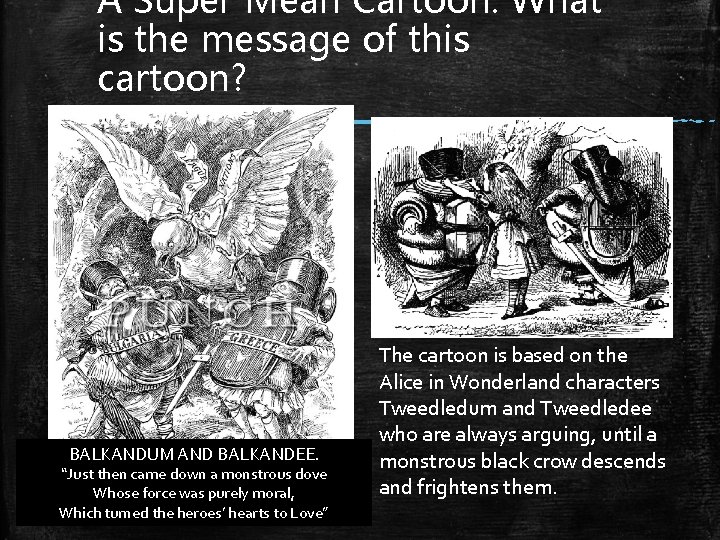
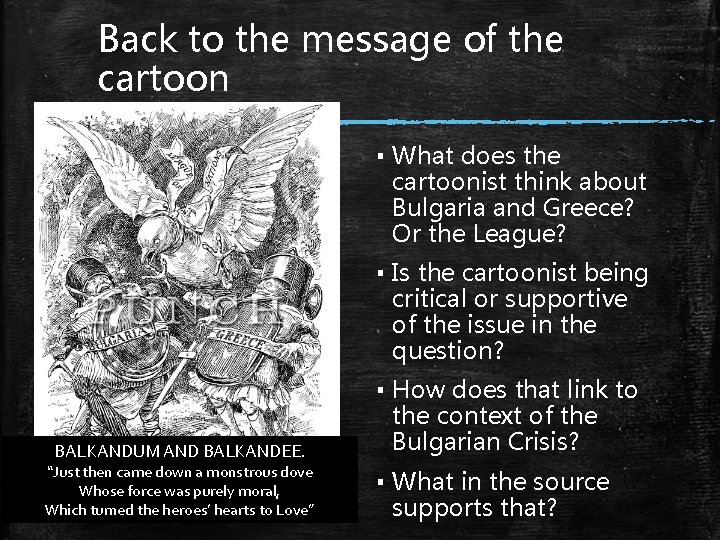
A Super Mean Cartoon. What is the message of this cartoon? BALKANDUM AND BALKANDEE. “Just then came down a monstrous dove Whose force was purely moral, Which turned the heroes’ hearts to Love” The cartoon is based on the Alice in Wonderland characters Tweedledum and Tweedledee who are always arguing, until a monstrous black crow descends and frightens them.
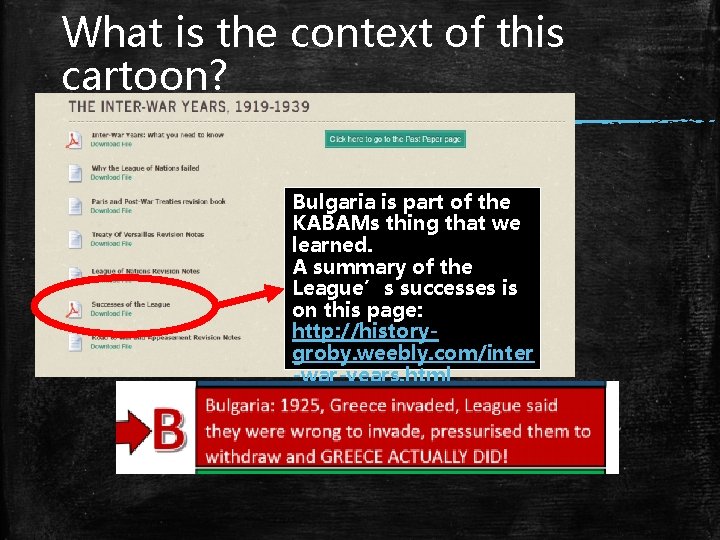
What is the context of this cartoon? Bulgaria is part of the KABAMs thing that we learned. A summary of the League’s successes is on this page: http: //historygroby. weebly. com/inter -war-years. html
Back to the message of the cartoon ▪ What does the cartoonist think about Bulgaria and Greece? Or the League? ▪ Is the cartoonist being critical or supportive of the issue in the question? BALKANDUM AND BALKANDEE. “Just then came down a monstrous dove Whose force was purely moral, Which turned the heroes’ hearts to Love” ▪ How does that link to the context of the Bulgarian Crisis? ▪ What in the source supports that?
Answers 1. The cartoonist is critical of Bulgaria and Greece“childish” squabbling. Supportive of the League. 2. Therefore, the cartoonist is being supportive of the League’s actions. 3. The League had put pressure on the Greeks to withdraw the troops that it had used to invade Bulgaria. They had only used their powers of persuasion. Greece agreed to Represented as children’s story characters League shown as dove- bird of peace
Is this a good response to the question ‘what is the cartoonist’s message? ▪ The cartoonist is celebrating the League’s actions by referring to the League’s moral force “turning the heroes’ hearts to love”. This means the cartoonist is supporting the League’s actions and thinks they were the right thing to do- that’s why he represented the League as the Your answer should be no. It is missin dove of peace. context.
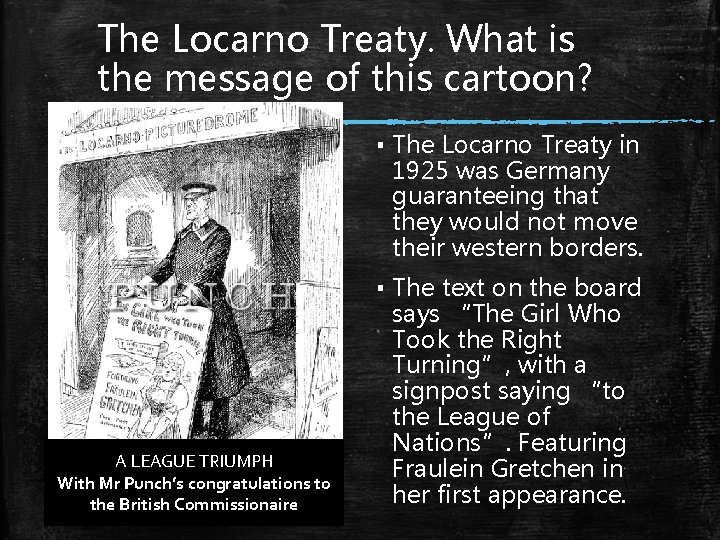
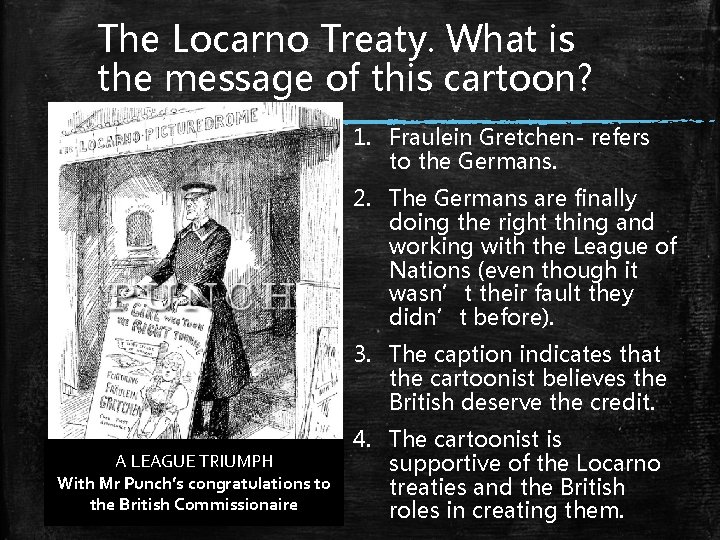
The Locarno Treaty. What is the message of this cartoon? ▪ The Locarno Treaty in 1925 was Germany guaranteeing that they would not move their western borders. A LEAGUE TRIUMPH With Mr Punch’s congratulations to the British Commissionaire ▪ The text on the board says “The Girl Who Took the Right Turning”, with a signpost saying “to the League of Nations”. Featuring Fraulein Gretchen in her first appearance.
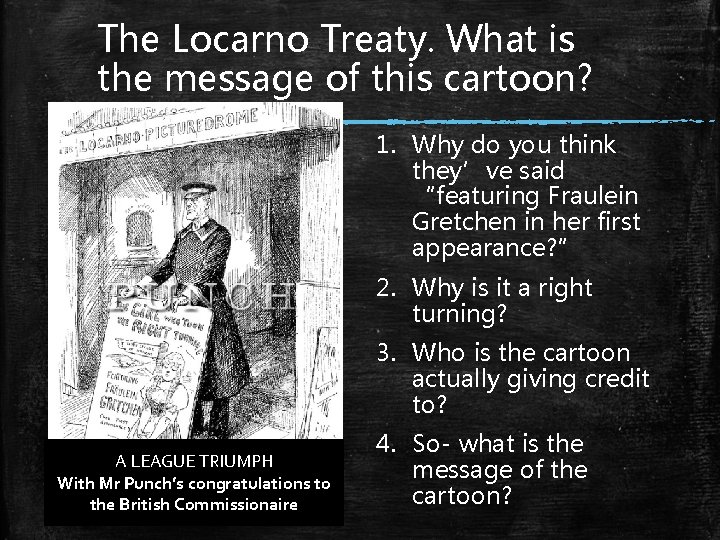
The Locarno Treaty. What is the message of this cartoon? 1. Why do you think they’ve said “featuring Fraulein Gretchen in her first appearance? ” 2. Why is it a right turning? 3. Who is the cartoon actually giving credit to? A LEAGUE TRIUMPH With Mr Punch’s congratulations to the British Commissionaire 4. So- what is the message of the cartoon?
The Locarno Treaty. What is the message of this cartoon? 1. Fraulein Gretchen- refers to the Germans. 2. The Germans are finally doing the right thing and working with the League of Nations (even though it wasn’t their fault they didn’t before). 3. The caption indicates that the cartoonist believes the British deserve the credit. A LEAGUE TRIUMPH With Mr Punch’s congratulations to the British Commissionaire 4. The cartoonist is supportive of the Locarno treaties and the British roles in creating them.
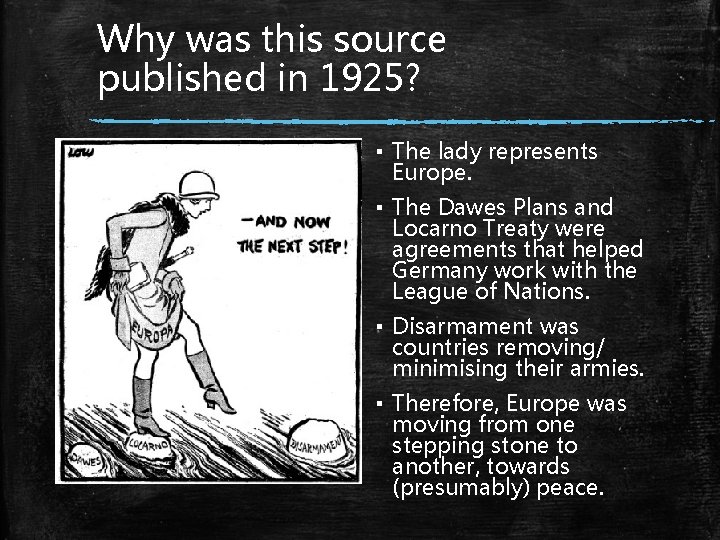
Why was this source published in 1925? ▪ The lady represents Europe. ▪ The Dawes Plans and Locarno Treaty were agreements that helped Germany work with the League of Nations. ▪ Disarmament was countries removing/ minimising their armies. ▪ Therefore, Europe was moving from one stepping stone to another, towards (presumably) peace.
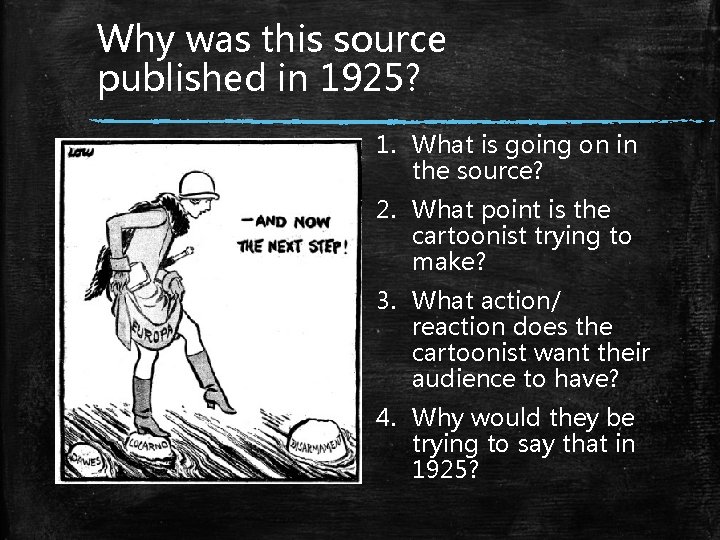
Why was this source published in 1925? 1. What is going on in the source? 2. What point is the cartoonist trying to make? 3. What action/ reaction does the cartoonist want their audience to have? 4. Why would they be trying to say that in 1925?
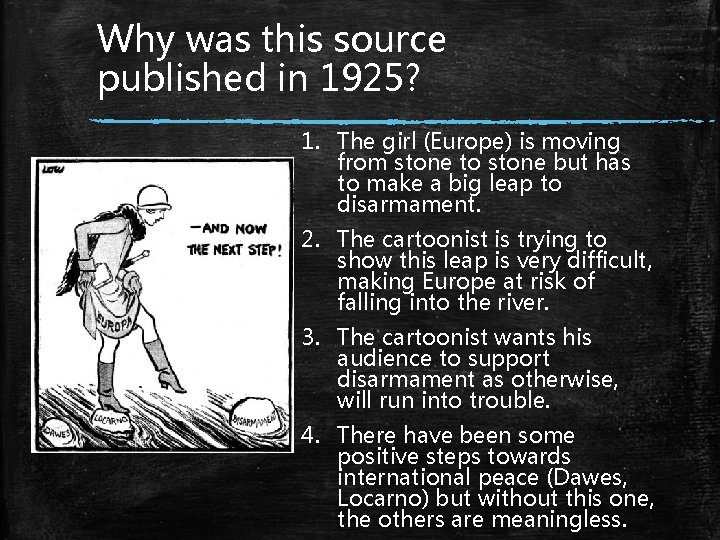
Why was this source published in 1925? 1. The girl (Europe) is moving from stone to stone but has to make a big leap to disarmament. 2. The cartoonist is trying to show this leap is very difficult, making Europe at risk of falling into the river. 3. The cartoonist wants his audience to support disarmament as otherwise, will run into trouble. 4. There have been some positive steps towards international peace (Dawes, Locarno) but without this one, the others are meaningless.
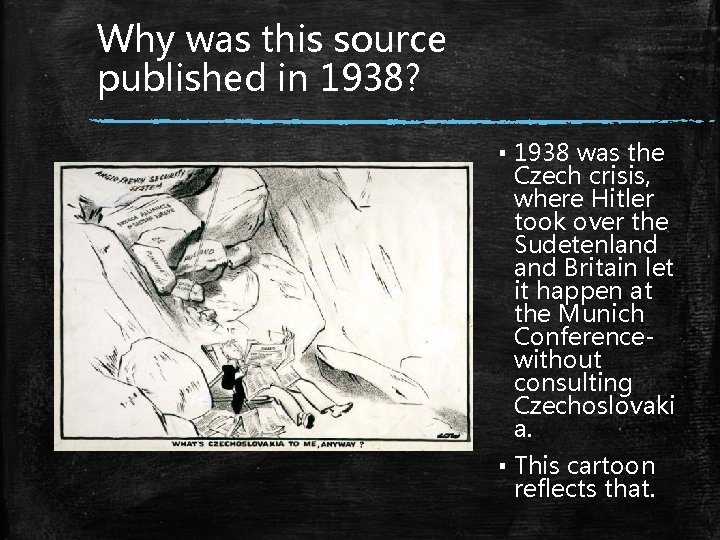
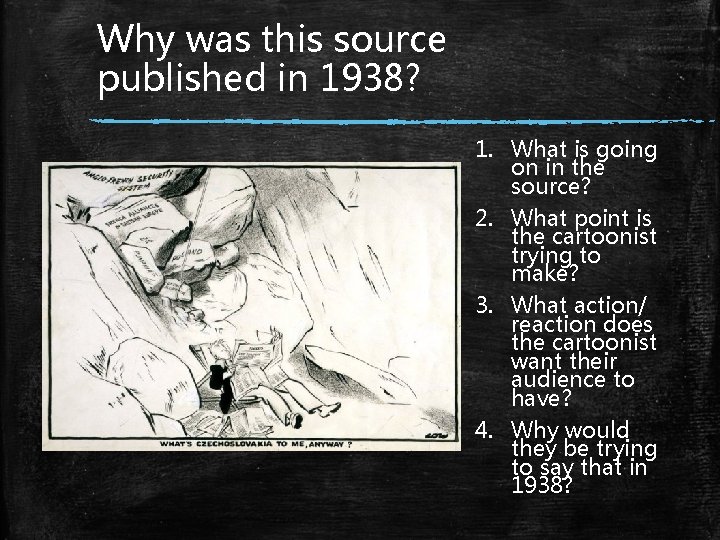
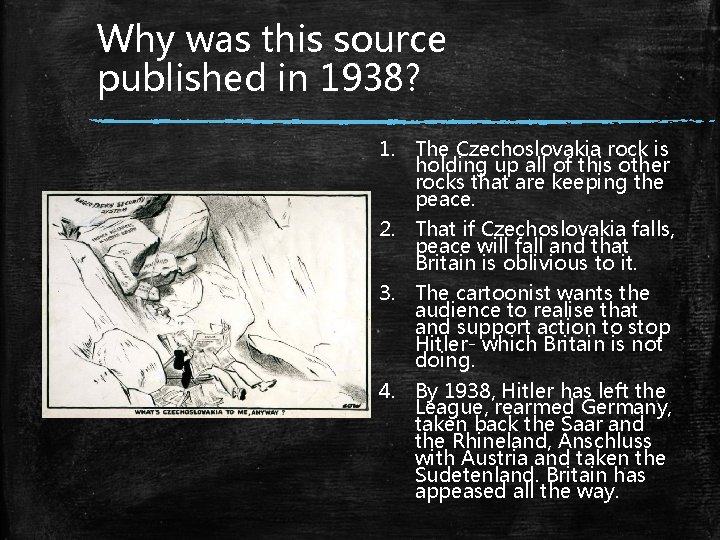
Why was this source published in 1938? ▪ 1938 was the Czech crisis, where Hitler took over the Sudetenland Britain let it happen at the Munich Conferencewithout consulting Czechoslovaki a. ▪ This cartoon reflects that.
Why was this source published in 1938? 1. What is going on in the source? 2. What point is the cartoonist trying to make? 3. What action/ reaction does the cartoonist want their audience to have? 4. Why would they be trying to say that in 1938?
Why was this source published in 1938? 1. The Czechoslovakia rock is holding up all of this other rocks that are keeping the peace. 2. That if Czechoslovakia falls, peace will fall and that Britain is oblivious to it. 3. The cartoonist wants the audience to realise that and support action to stop Hitler- which Britain is not doing. 4. By 1938, Hitler has left the League, rearmed Germany, taken back the Saar and the Rhineland, Anschluss with Austria and taken the Sudetenland. Britain has appeased all the way.