
How do microscopes work What EXACTLY is inside


- Slides: 24
� How do microscopes work? � What EXACTLY is inside a cell? � How do substances move in/ out of cells? � How do cells divide? � What’s the difference between tissues and organs? � How do plants move water around if they don’t have blood? � Why does exercise make us breathe faster? � What does a heart look like inside? � What are we made up of? � Why does water flow? � Why is DNA called the ‘Double Helix’? � What exactly IS a ‘balanced diet’? � How do our bodies defend against infection? � Is there any real proof that smoking causes cancer? � Who was Darwin and why was he important? � What do Botanical Gardens do?
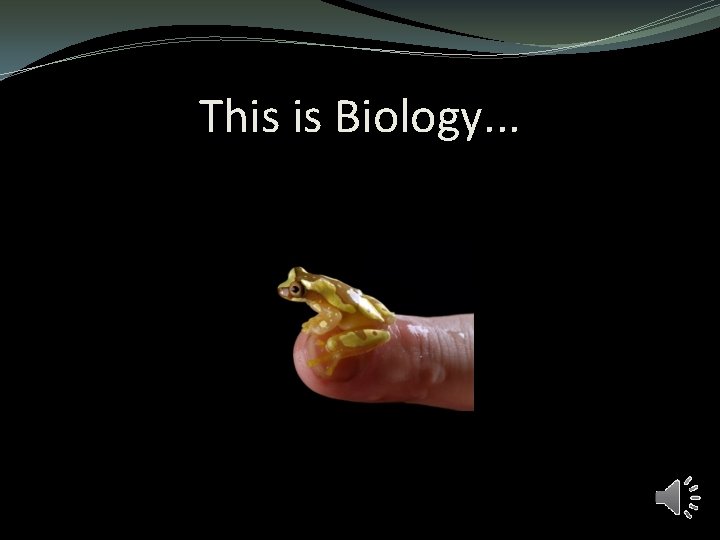
This is Biology. . .
� How do cells communicate with each other? � Why do lizards sunbathe to stay alive? � How exactly does a nerve signal travel? � What causes diabetes and how might we treat it in the future? � How can a urine sample tell us if someone has kidney disease. . or is pregnant? � Exactly what does go on in photosynthesis? � Why is cyanide so toxic? � What does the genetic code actually say? � Why can’t two non tonguerollers produce a roller? � How do populations evolve? � How can we use genetics to improve crops and farm animals? � Why you might be cloning yourself in the future � How mould saved millions � How a genetic fingerprint is taken � What is gene therapy? � Why conservation is so important
WELCOME TO THE BIOLOGY DEPARTMENT
Large numbers of our students going on to study “Biology-related” courses at University (usually over 50% of A level students): Medicine, dentistry, midwifery, sports science, biochemistry, biomedical science, biological science, zoology, neuroscience…
Minimum entry requirement �Grade 6 or above in Biology, or a grade 6 or above in Trilogy (Combined) Science �Grade 4 in GCSE English Language �Grade 5 in GCSE Maths
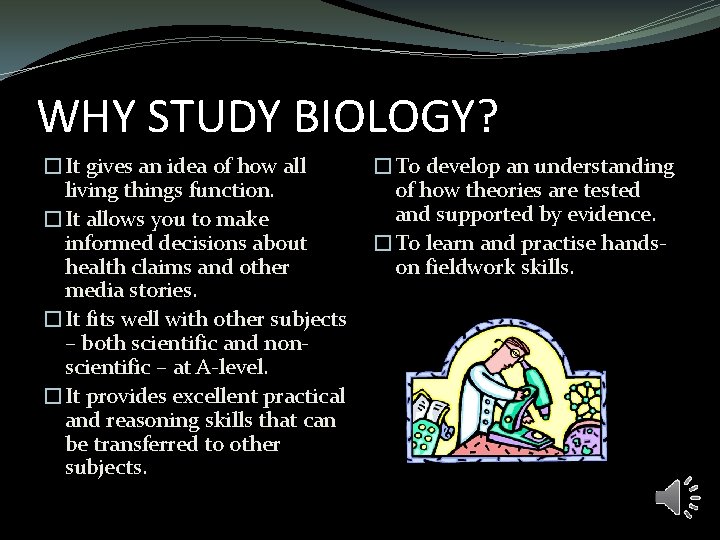
WHY STUDY BIOLOGY? �It gives an idea of how all living things function. �It allows you to make informed decisions about health claims and other media stories. �It fits well with other subjects – both scientific and nonscientific – at A-level. �It provides excellent practical and reasoning skills that can be transferred to other subjects. �To develop an understanding of how theories are tested and supported by evidence. �To learn and practise handson fieldwork skills.
AQA �A levels are fully linear. . . �. . . assessment of the whole course takes place at the end of two years of study
Assessment pattern �For A level Biology: � 3 papers sat at the end of the course (June 2022) �Paper 1: 2 hrs- 35% of total marks �Paper 2: 2 hrs- 35% �Paper 3: 2 hrs- 30% �Exams will involve a mixture of multiple choice/structured questions/extended response questions covering theory and practical skills / a 25 mark essay question! �Practical endorsement: recorded as a Pass/Fail grade on the exam certificate
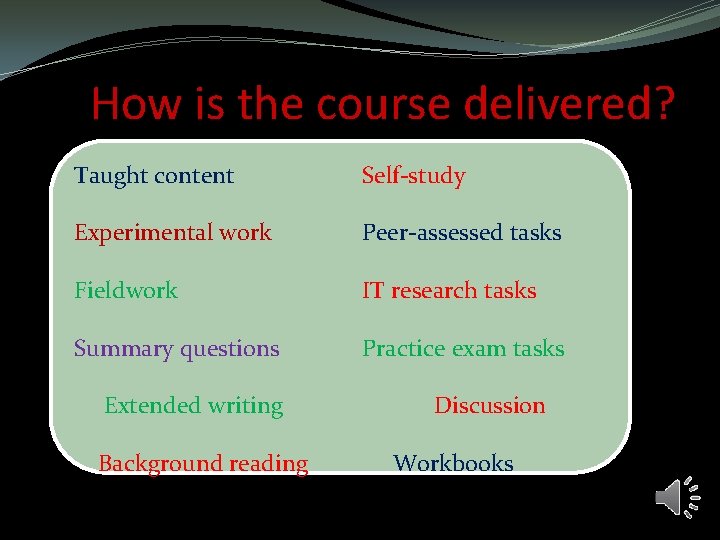
How is the course delivered? Taught content Self-study Experimental work Peer-assessed tasks Fieldwork IT research tasks Summary questions Practice exam tasks Extended writing Background reading Discussion Workbooks
STRUCTURE OF THE COURSE 4 topics in y 12 �Biological molecules �Cells �Exchange �Genetics
A level Biology Units �Energy transfers in and between organisms �Response to changes in internal and external environments �Genetics, populations, evolution and ecosystems �Control of gene expression 4 topics in y 13
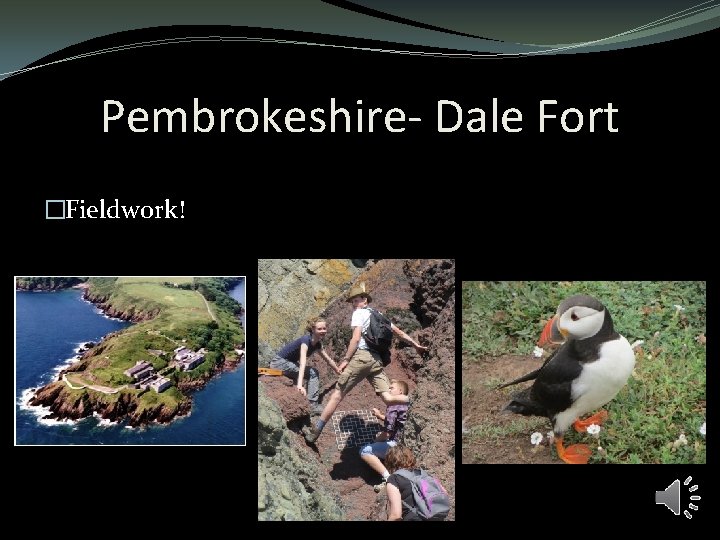
Pembrokeshire- Dale Fort �Fieldwork!
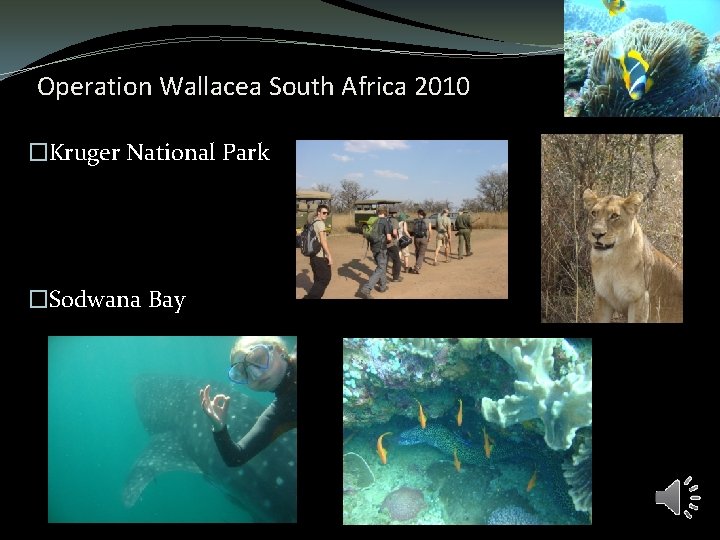
Operation Wallacea South Africa 2010 �Kruger National Park �Sodwana Bay
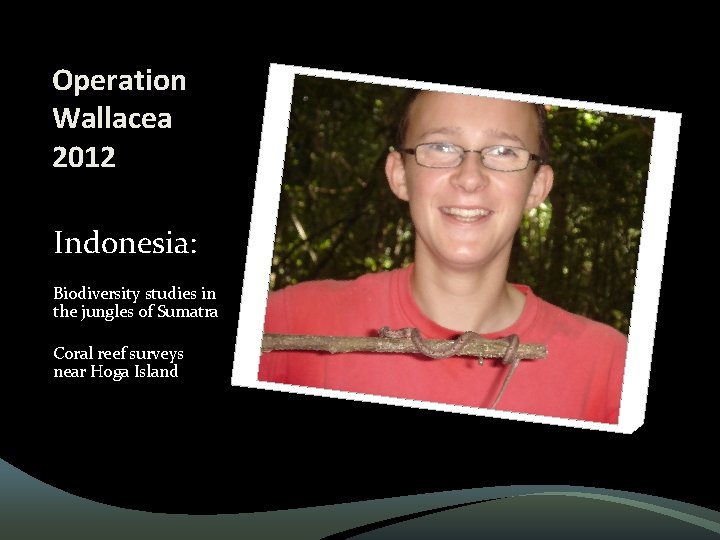
Operation Wallacea 2012 Indonesia: Biodiversity studies in the jungles of Sumatra Coral reef surveys near Hoga Island
Honduras 2014 Cusuco National Park and Utila island:
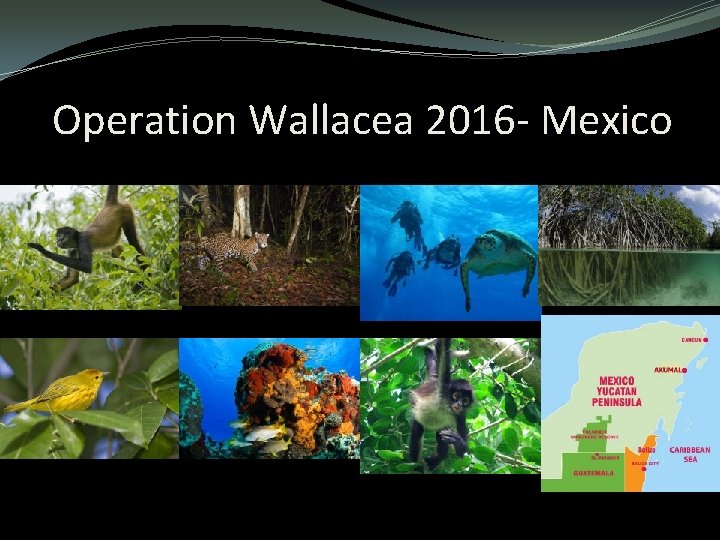
Operation Wallacea 2016 - Mexico
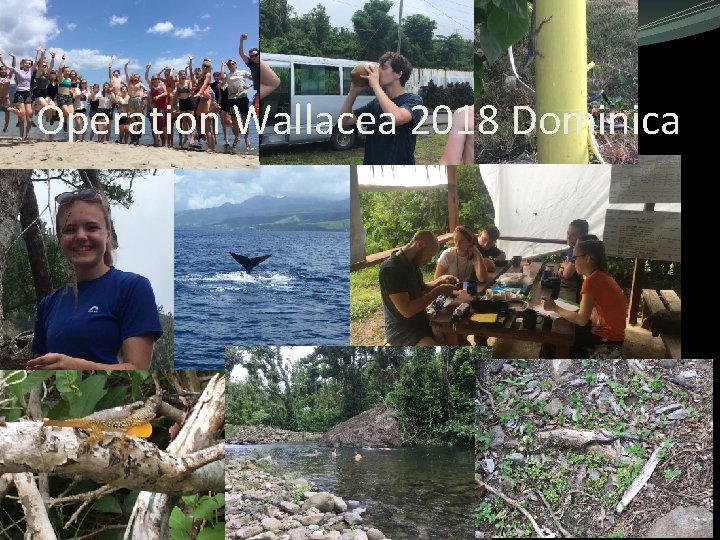
Operation Wallacea 2018 Dominica
CAREERS AND BIOLOGY �Biotechnology: Biologists apply scientific principles to develop and enhance products, tools, and technological advances in fields such as agriculture, food science, and medicine.
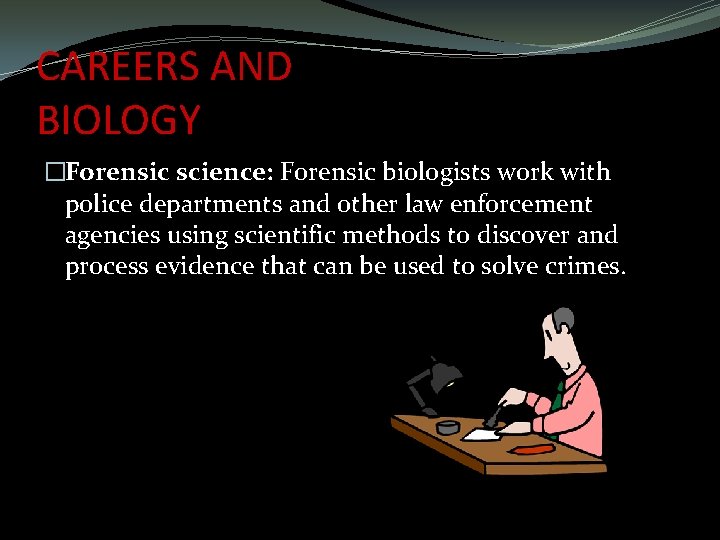
CAREERS AND BIOLOGY �Forensic science: Forensic biologists work with police departments and other law enforcement agencies using scientific methods to discover and process evidence that can be used to solve crimes.
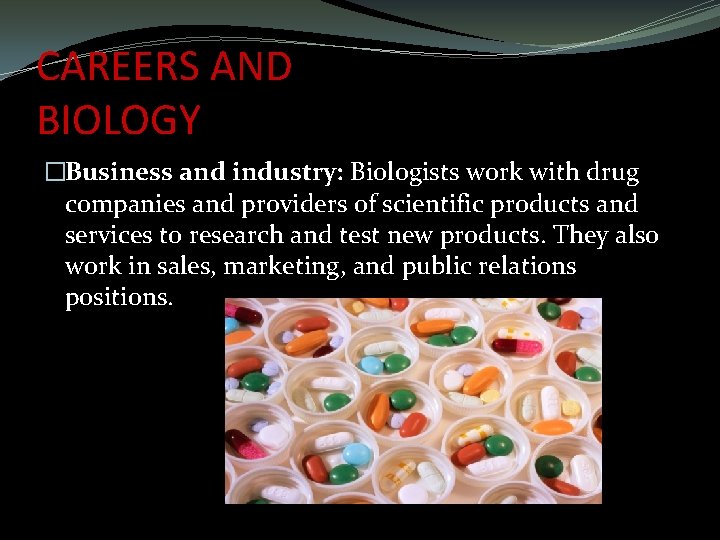
CAREERS AND BIOLOGY �Business and industry: Biologists work with drug companies and providers of scientific products and services to research and test new products. They also work in sales, marketing, and public relations positions.
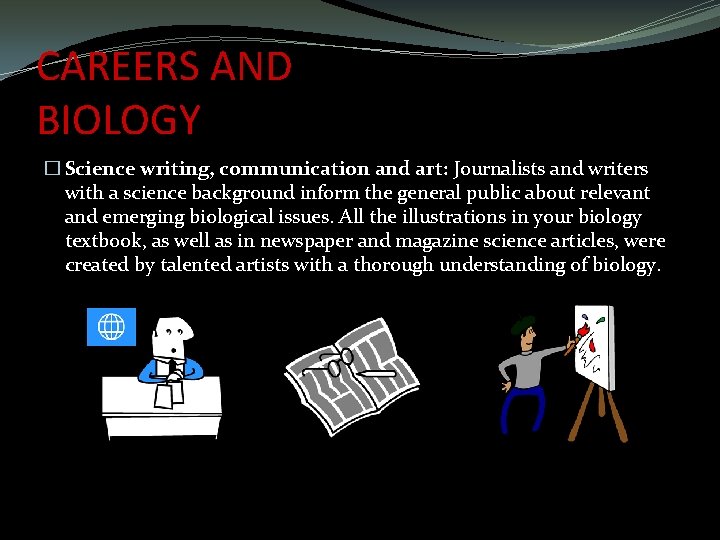
CAREERS AND BIOLOGY � Science writing, communication and art: Journalists and writers with a science background inform the general public about relevant and emerging biological issues. All the illustrations in your biology textbook, as well as in newspaper and magazine science articles, were created by talented artists with a thorough understanding of biology.
So come on in and give it a whirl!