
How do Humans Impact Aquatic Systems Introduction Definition
- Slides: 48
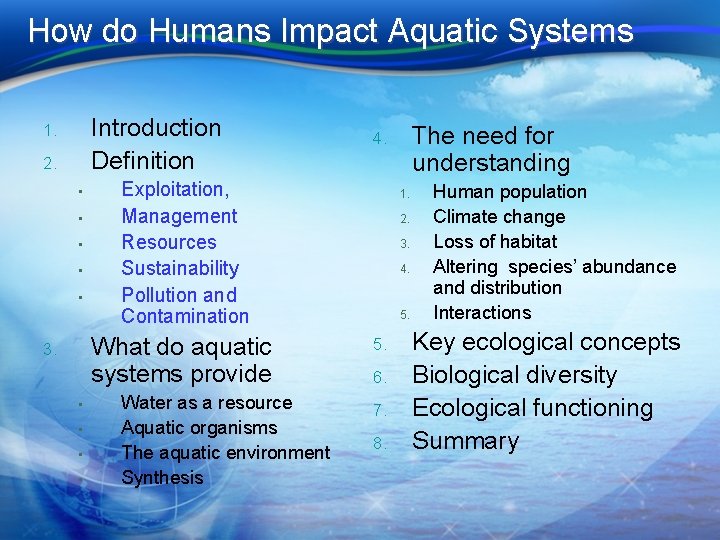
How do Humans Impact Aquatic Systems Introduction Definition 1. 2. • • • Exploitation, Management Resources Sustainability Pollution and Contamination What do aquatic systems provide 3. • • Water as a resource Aquatic organisms The aquatic environment Synthesis The need for understanding 4. 1. 2. 3. 4. 5. 6. 7. 8. Human population Climate change Loss of habitat Altering species’ abundance and distribution Interactions Key ecological concepts Biological diversity Ecological functioning Summary
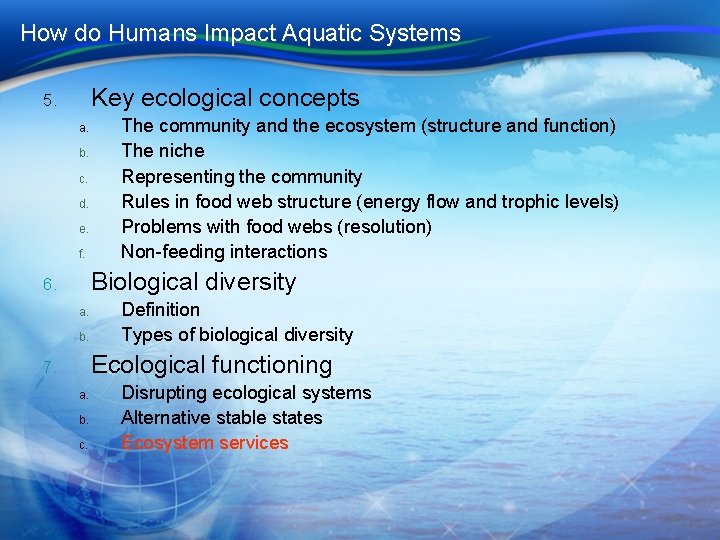
How do Humans Impact Aquatic Systems Key ecological concepts 5. a. b. c. d. e. f. The community and the ecosystem (structure and function) The niche Representing the community Rules in food web structure (energy flow and trophic levels) Problems with food webs (resolution) Non-feeding interactions Biological diversity 6. a. b. Definition Types of biological diversity Ecological functioning 7. a. b. c. Disrupting ecological systems Alternative stable states Ecosystem services
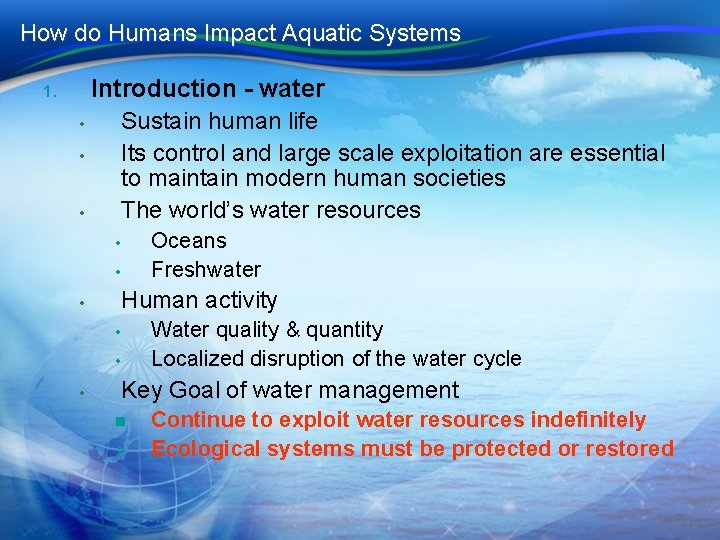
How do Humans Impact Aquatic Systems 1. Introduction - water • Sustain human life • Its control and large scale exploitation are essential to maintain modern human societies • The world’s water resources Oceans Freshwater • • Human activity • Water quality & quantity Localized disruption of the water cycle • • • Key Goal of water management n Ø Continue to exploit water resources indefinitely Ecological systems must be protected or restored
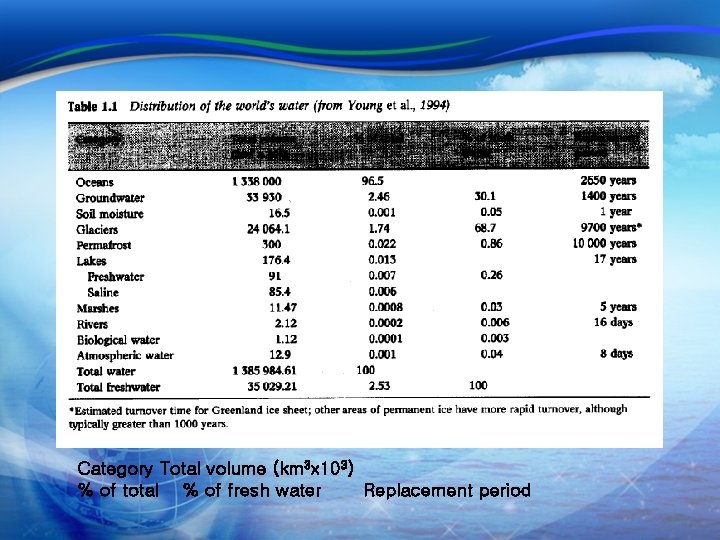
Category Total volume (km 3 x 10³) % of total % of fresh water Replacement period
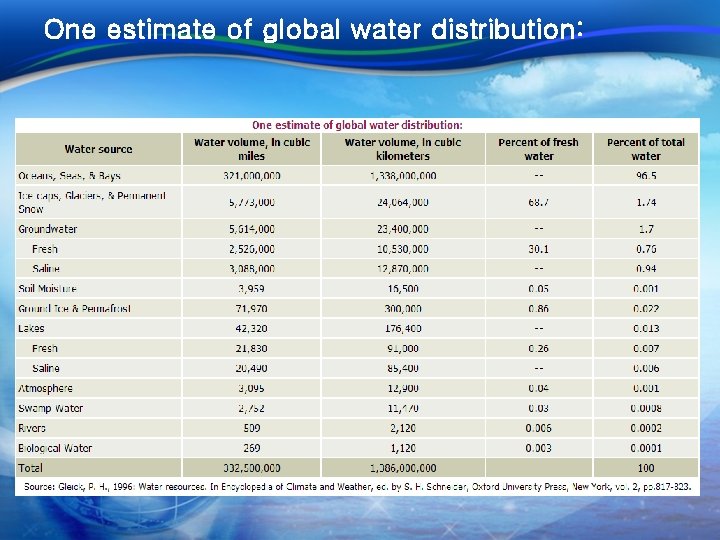
One estimate of global water distribution:
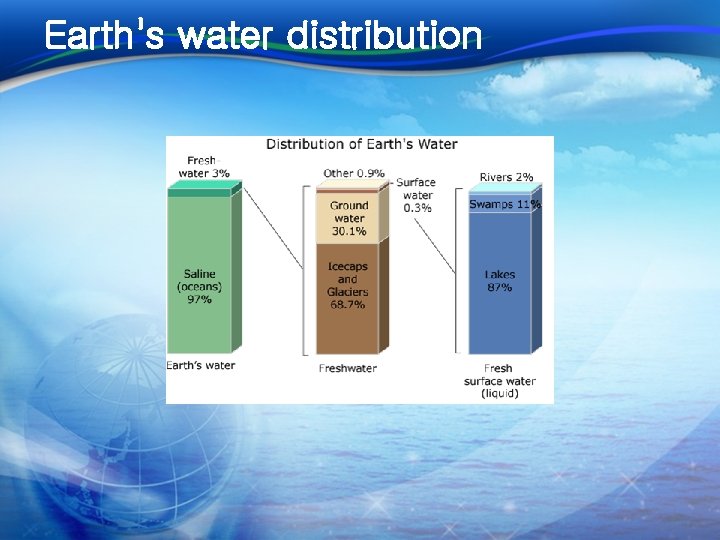
Earth's water distribution
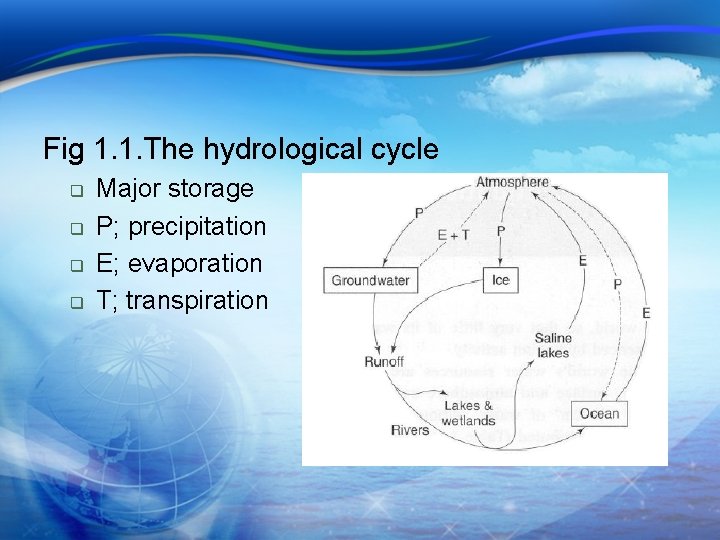
Fig 1. 1. The hydrological cycle q q Major storage P; precipitation E; evaporation T; transpiration
How do Humans Impact Aquatic Systems 2. Definition 1. Exploitation: The use by humans of water or its products for their own benefit sediment; living organisms; water itself; Process 2. Management: Mechanisms whereby their exploitation is controlled or regulated n n 3. To reduce or reverse detrimental effects on the supply or quality of the resource being exploited To reduce the negative effects of exploitation on ecological systems within the exploited water Resources: the components of water body that are exploited n n n Diminish through over-use (fish) Availability or quality Renewable vs. Non-renewable q n Finite and not replaceable vs. reproduction Rate of exploitation: Rates of human extraction relative to the rate of creation
How do Humans Impact Aquatic Systems 2. Definition 4. Sustainability: the management of resources in a way that does not deplete them and therefore ensures their continuation. n n 5. Convention on Biological Diversity Level of exploitation that does not exceed the capacity for self-renewal. Pollution and contamination n n Pollution: the introduction of substances or energy into the environment resulting in deleterious effects to humans, human activities or other living components of the environment: human activity; bad Contamination: the introduction, directly or indirectly, of substances or energy into the environment such that levels are altered for those that would have existed without human activity.
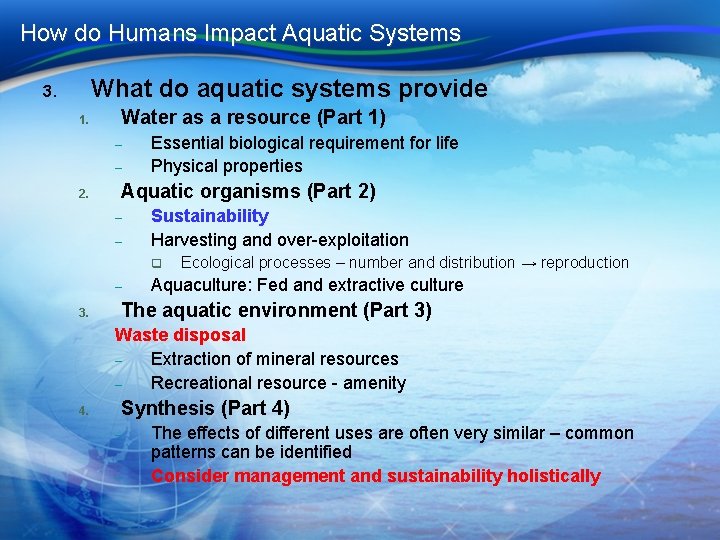
How do Humans Impact Aquatic Systems What do aquatic systems provide 3. 1. Water as a resource (Part 1) – – 2. Essential biological requirement for life Physical properties Aquatic organisms (Part 2) – – Sustainability Harvesting and over-exploitation q – 3. Ecological processes – number and distribution → reproduction Aquaculture: Fed and extractive culture The aquatic environment (Part 3) Waste disposal – Extraction of mineral resources – Recreational resource - amenity 4. Synthesis (Part 4) – – The effects of different uses are often very similar – common patterns can be identified Consider management and sustainability holistically
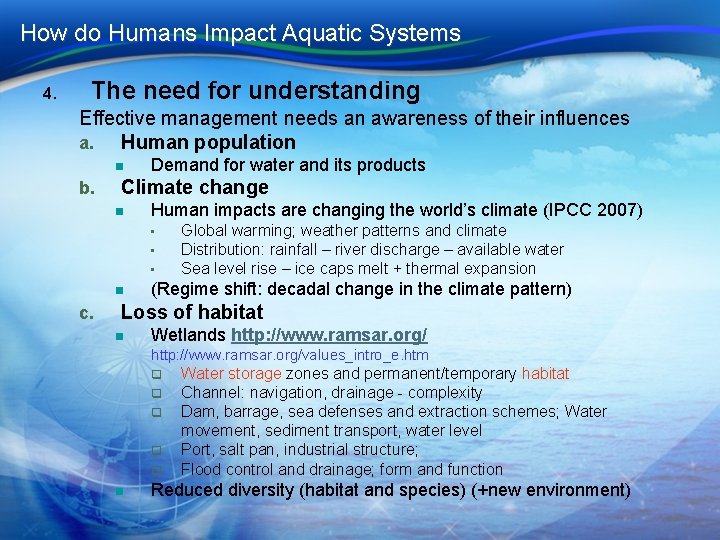
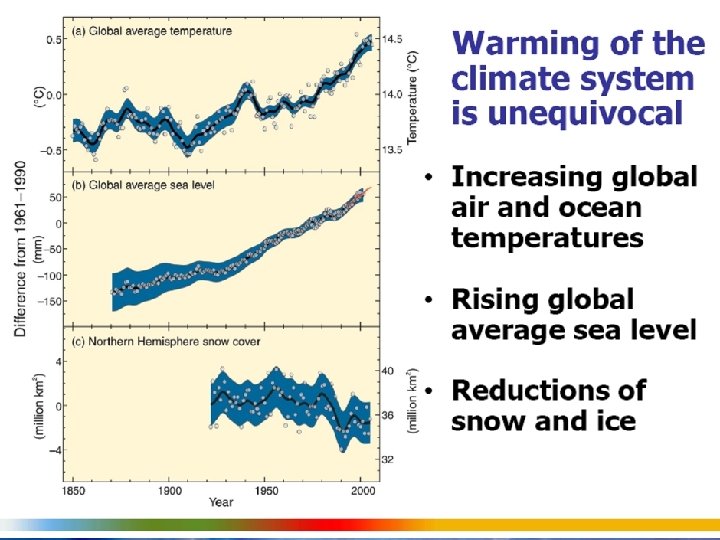
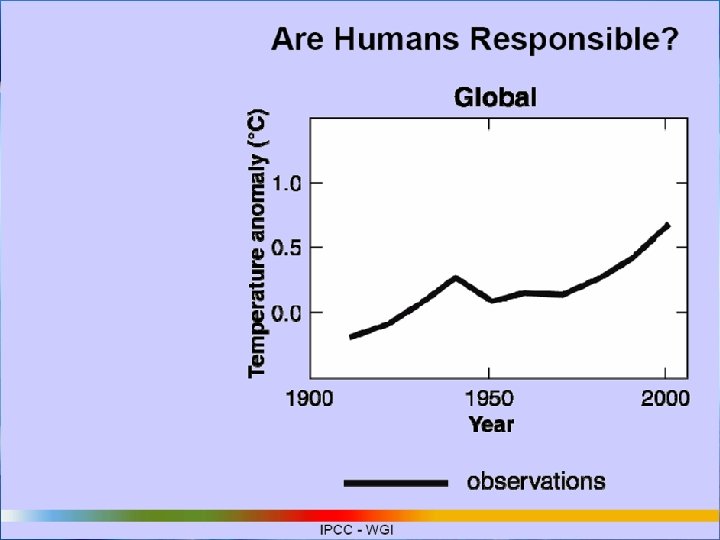
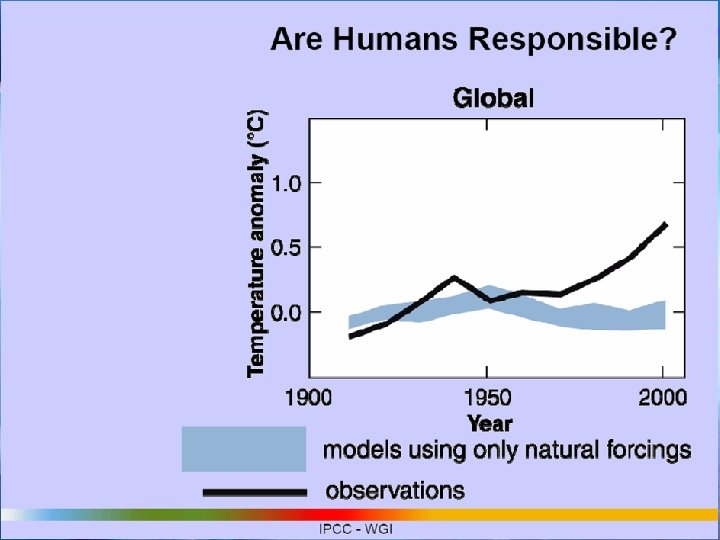
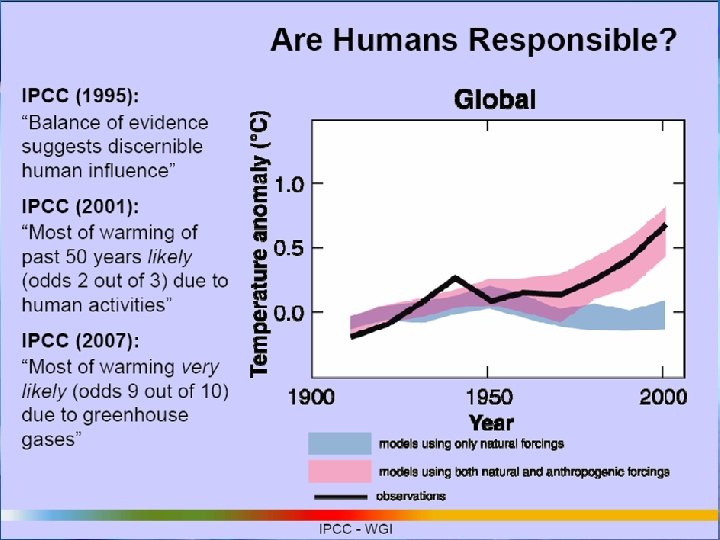
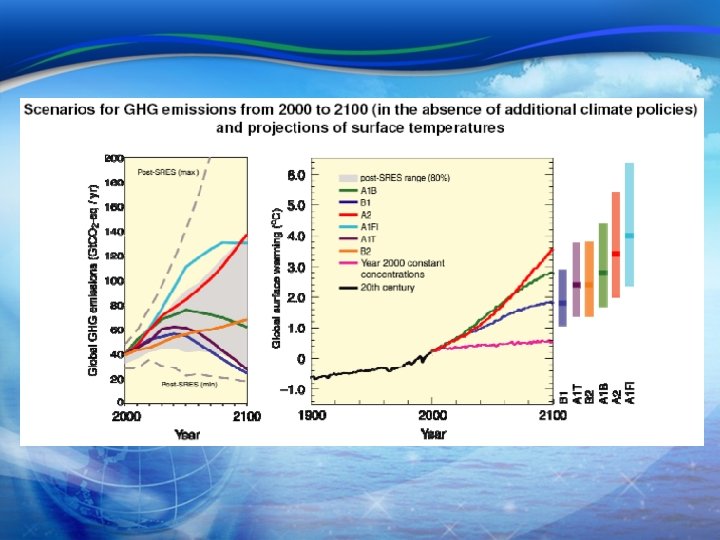
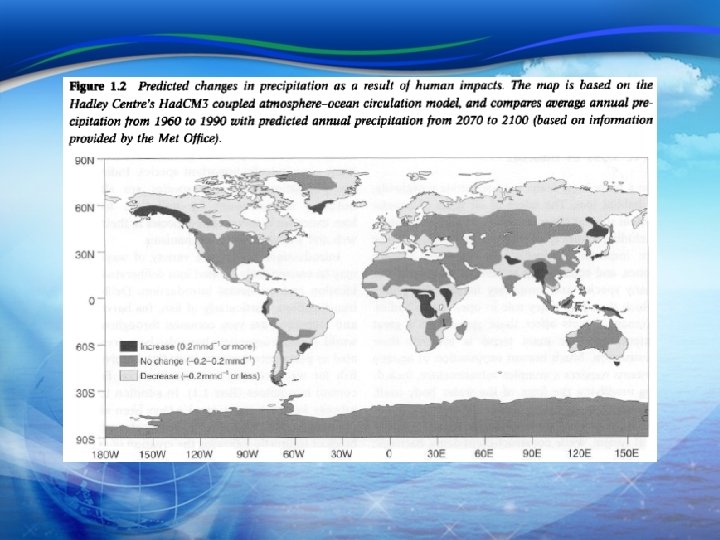
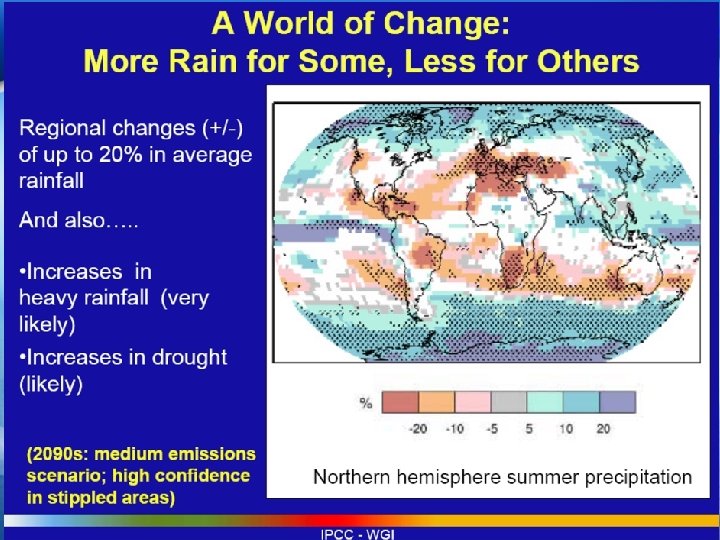
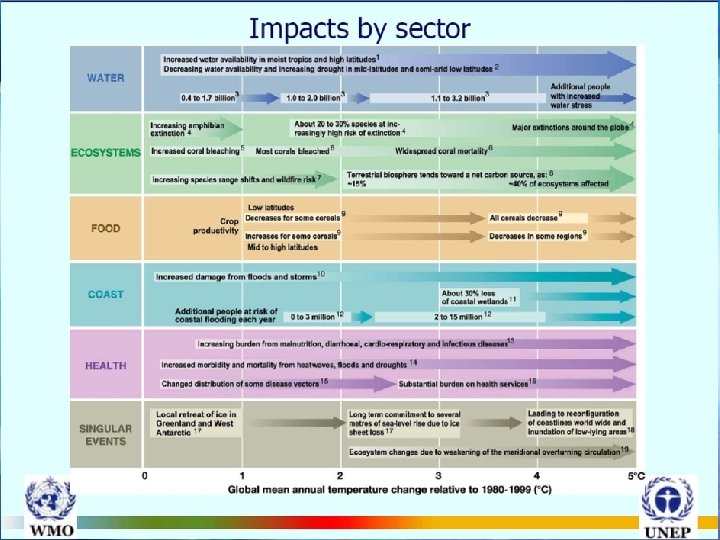
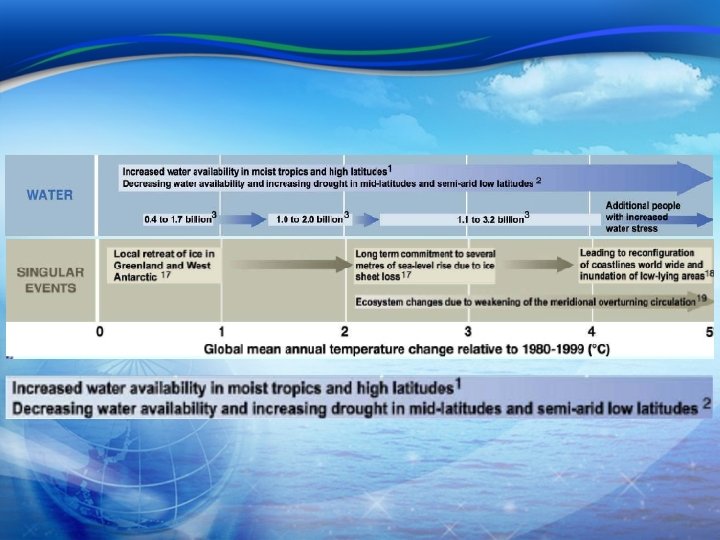
How do Humans Impact Aquatic Systems 4. The need for understanding Effective management needs an awareness of their influences a. Human population n b. Demand for water and its products Climate change n Human impacts are changing the world’s climate (IPCC 2007) • • • n c. Global warming; weather patterns and climate Distribution: rainfall – river discharge – available water Sea level rise – ice caps melt + thermal expansion (Regime shift: decadal change in the climate pattern) Loss of habitat n Wetlands http: //www. ramsar. org/values_intro_e. htm q q q n Water storage zones and permanent/temporary habitat Channel: navigation, drainage - complexity Dam, barrage, sea defenses and extraction schemes; Water movement, sediment transport, water level Port, salt pan, industrial structure; Flood control and drainage; form and function Reduced diversity (habitat and species) (+new environment)
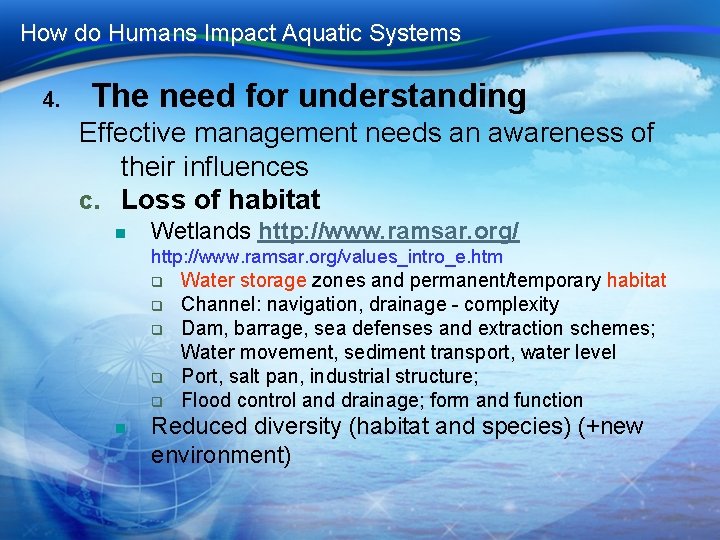
How do Humans Impact Aquatic Systems 4. The need for understanding Effective management needs an awareness of their influences c. Loss of habitat n Wetlands http: //www. ramsar. org/values_intro_e. htm q q q n Water storage zones and permanent/temporary habitat Channel: navigation, drainage - complexity Dam, barrage, sea defenses and extraction schemes; Water movement, sediment transport, water level Port, salt pan, industrial structure; Flood control and drainage; form and function Reduced diversity (habitat and species) (+new environment)
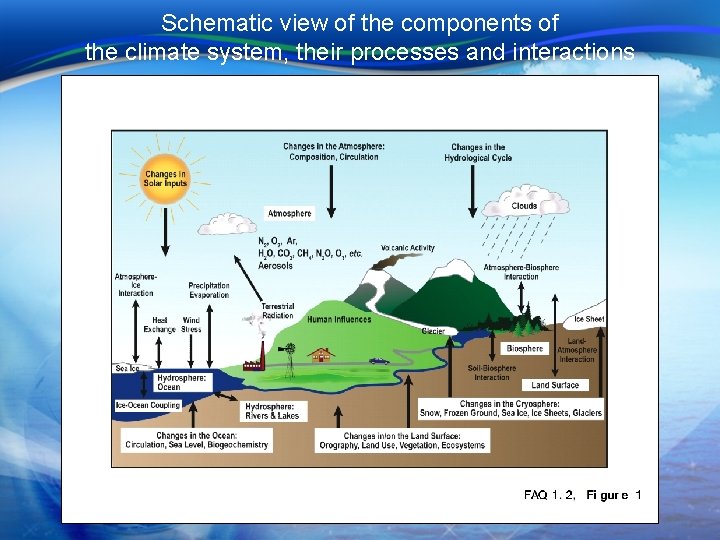
Schematic view of the components of the climate system, their processes and interactions
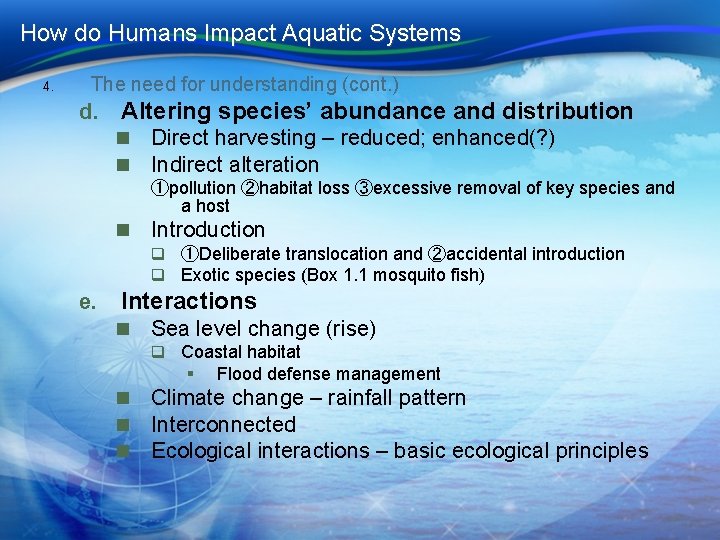
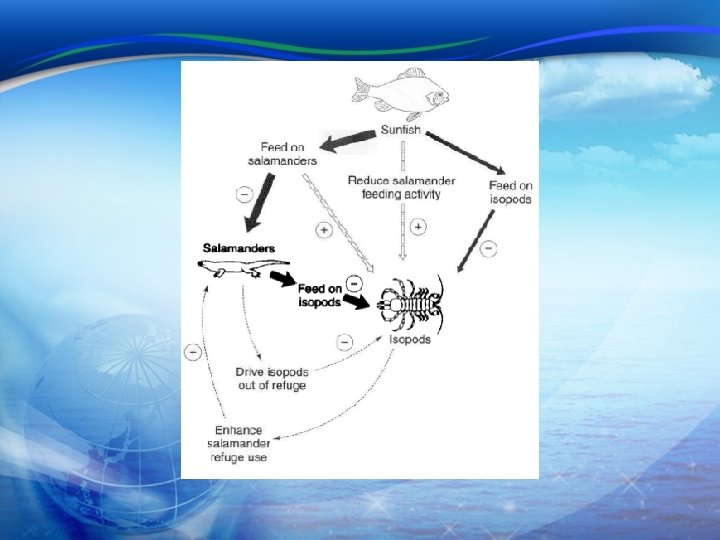
How do Humans Impact Aquatic Systems 4. The need for understanding (cont. ) d. Altering species’ abundance and distribution n n Direct harvesting – reduced; enhanced(? ) Indirect alteration ①pollution ②habitat loss ③excessive removal of key species and a host n Introduction q ①Deliberate translocation and ②accidental introduction q Exotic species (Box 1. 1 mosquito fish) e. Interactions n Sea level change (rise) q Coastal habitat § Flood defense management n n n Climate change – rainfall pattern Interconnected Ecological interactions – basic ecological principles
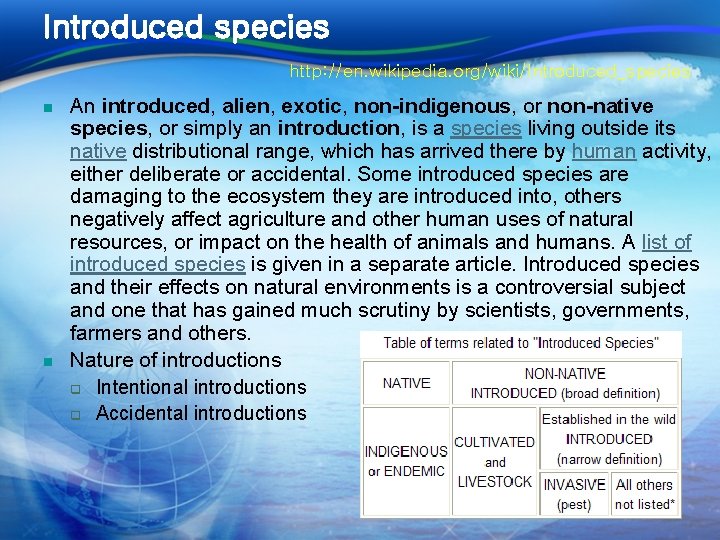
Introduced species http: //en. wikipedia. org/wiki/Introduced_species n n An introduced, alien, exotic, non-indigenous, or non-native species, or simply an introduction, is a species living outside its native distributional range, which has arrived there by human activity, either deliberate or accidental. Some introduced species are damaging to the ecosystem they are introduced into, others negatively affect agriculture and other human uses of natural resources, or impact on the health of animals and humans. A list of introduced species is given in a separate article. Introduced species and their effects on natural environments is a controversial subject and one that has gained much scrutiny by scientists, governments, farmers and others. Nature of introductions q Intentional introductions q Accidental introductions
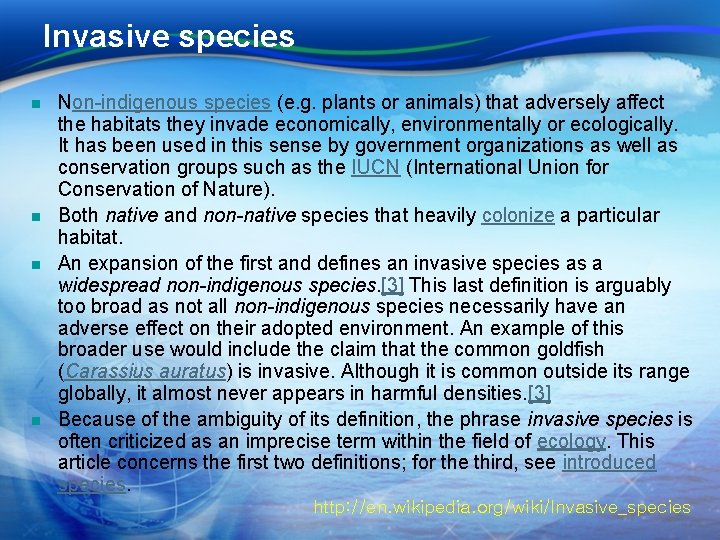
Invasive species n n Non-indigenous species (e. g. plants or animals) that adversely affect the habitats they invade economically, environmentally or ecologically. It has been used in this sense by government organizations as well as conservation groups such as the IUCN (International Union for Conservation of Nature). Both native and non-native species that heavily colonize a particular habitat. An expansion of the first and defines an invasive species as a widespread non-indigenous species. [3] This last definition is arguably too broad as not all non-indigenous species necessarily have an adverse effect on their adopted environment. An example of this broader use would include the claim that the common goldfish (Carassius auratus) is invasive. Although it is common outside its range globally, it almost never appears in harmful densities. [3] Because of the ambiguity of its definition, the phrase invasive species is often criticized as an imprecise term within the field of ecology. This article concerns the first two definitions; for the third, see introduced species. http: //en. wikipedia. org/wiki/Invasive_species
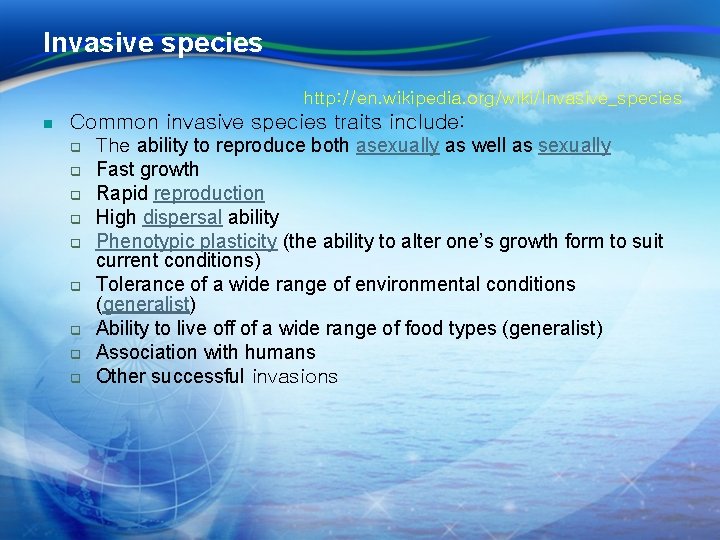
Invasive species http: //en. wikipedia. org/wiki/Invasive_species n Common invasive species traits include: q The ability to reproduce both asexually as well as sexually q Fast growth q Rapid reproduction q High dispersal ability q Phenotypic plasticity (the ability to alter one’s growth form to suit current conditions) q Tolerance of a wide range of environmental conditions (generalist) q Ability to live off of a wide range of food types (generalist) q Association with humans q Other successful invasions
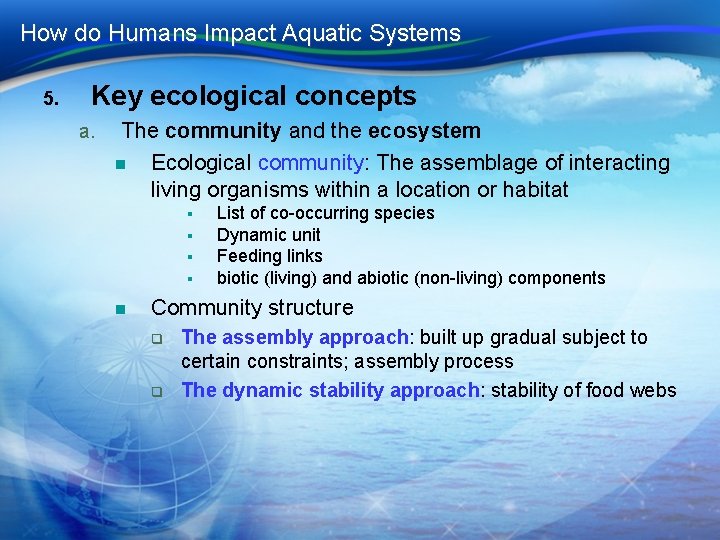
How do Humans Impact Aquatic Systems 5. Key ecological concepts a. The community and the ecosystem n Ecological community: The assemblage of interacting living organisms within a location or habitat § § n List of co-occurring species Dynamic unit Feeding links biotic (living) and abiotic (non-living) components Community structure q q The assembly approach: built up gradual subject to certain constraints; assembly process The dynamic stability approach: stability of food webs
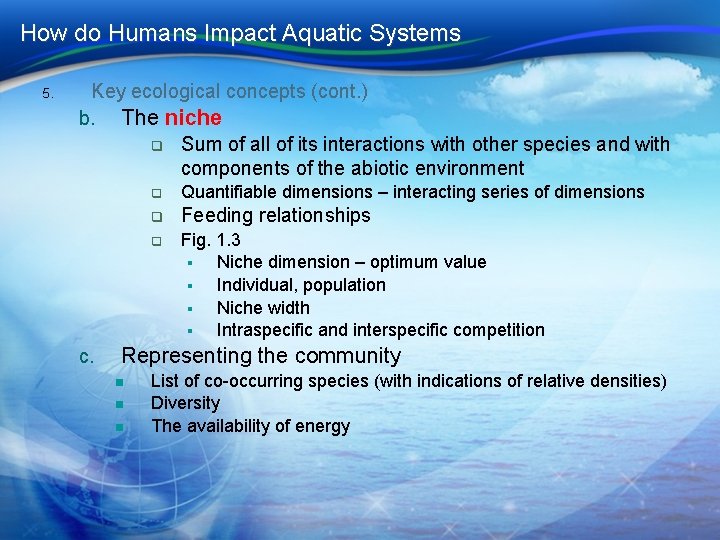
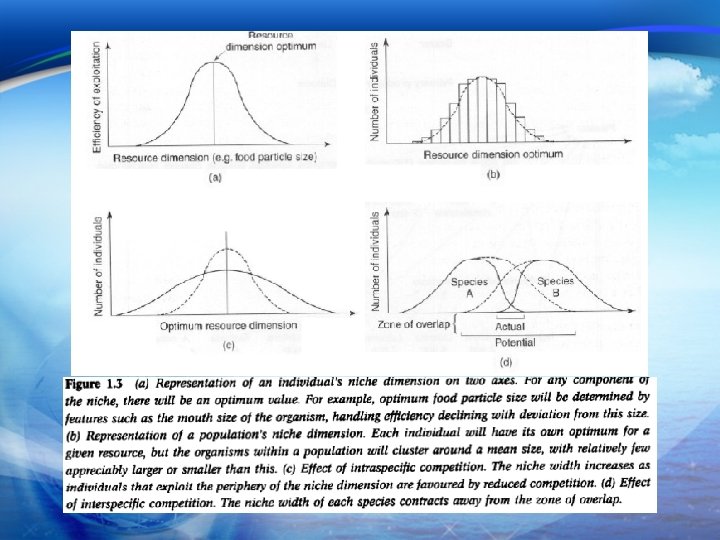
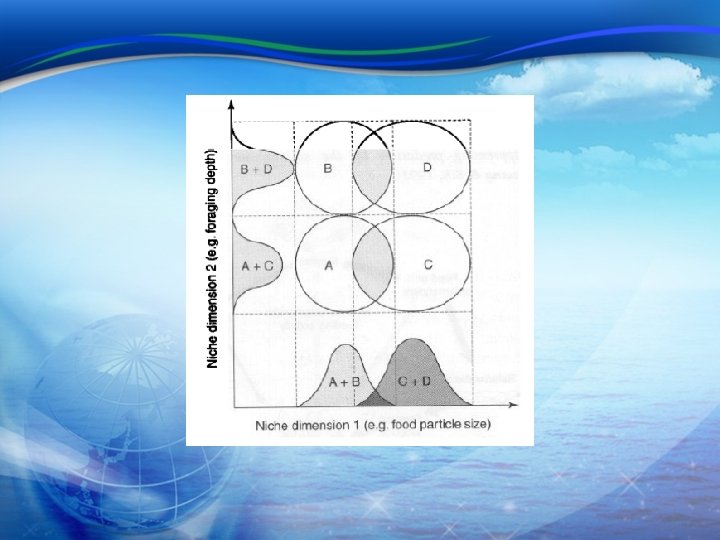
How do Humans Impact Aquatic Systems 5. Key ecological concepts (cont. ) b. The niche q Sum of all of its interactions with other species and with components of the abiotic environment c. q Quantifiable dimensions – interacting series of dimensions q Feeding relationships q Fig. 1. 3 § Niche dimension – optimum value § Individual, population § Niche width § Intraspecific and interspecific competition Representing the community n n n List of co-occurring species (with indications of relative densities) Diversity The availability of energy
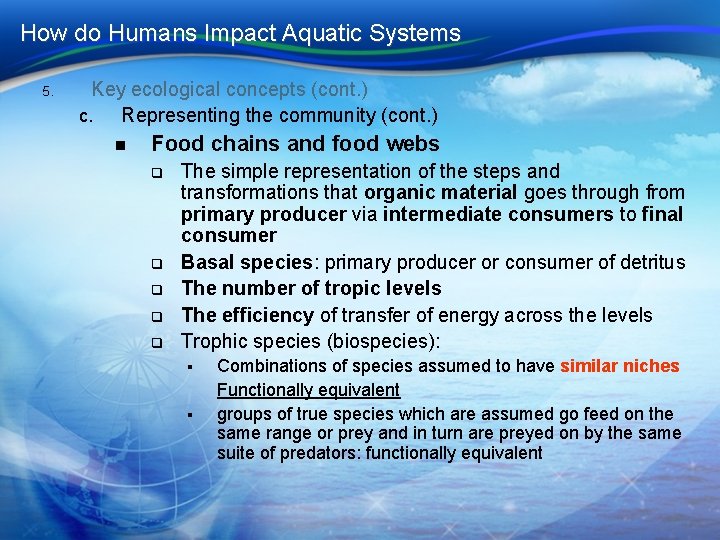
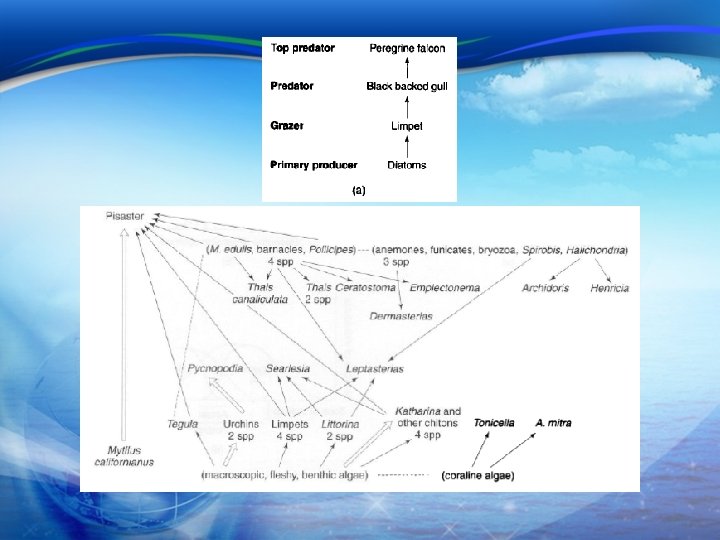
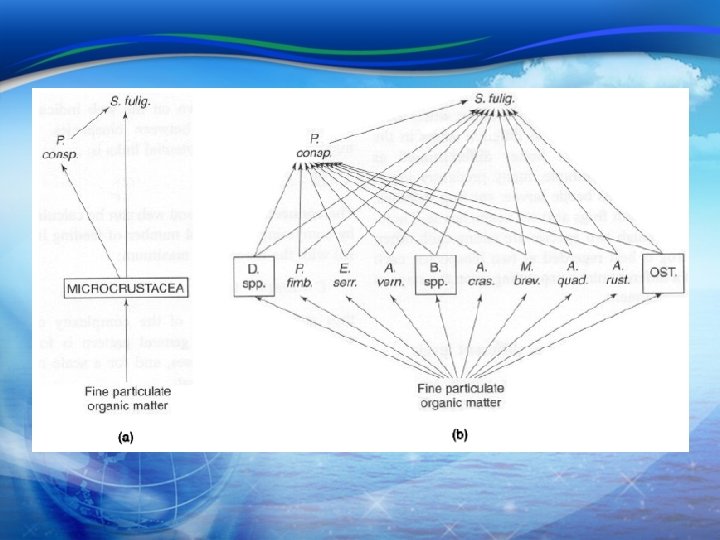
How do Humans Impact Aquatic Systems 5. Key ecological concepts (cont. ) c. Representing the community (cont. ) n Food chains and food webs q q q The simple representation of the steps and transformations that organic material goes through from primary producer via intermediate consumers to final consumer Basal species: primary producer or consumer of detritus The number of tropic levels The efficiency of transfer of energy across the levels Trophic species (biospecies): § § Combinations of species assumed to have similar niches Functionally equivalent groups of true species which are assumed go feed on the same range or prey and in turn are preyed on by the same suite of predators: functionally equivalent
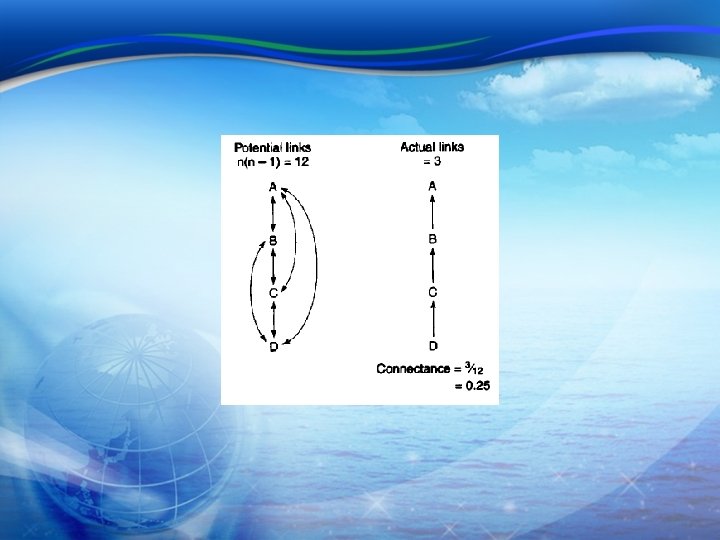
How do Humans Impact Aquatic Systems 5. Key ecological concepts (cont. ) d. Rules in food web structure • Energy flow • • • Proportions of species at different levels: constant • • • Basal species to species richness: B/S = 0. 19 Intermediate species to S: I/S = 0. 53 Top predators to S: T/S = 0. 29 The ratio of prey to predators (B + I)/(I + T) = 0. 89 Omnivory • • One way Two species eat each other (life stages) Two of more trophic levels Links in the food web • • • Max. number of potential links : S 2 - S = S(S-1) Connectance (C); actual number of feeding links (L) C = L / S(S-1): complexity of a web
How do Humans Impact Aquatic Systems 5. Key ecological concepts (cont. ) d. Rules in food web structure • Compartrmentalization • • Keystone species • • • Decreasing connection with increasing complexity Linkage density (mean number of links per species) Guild (groups of species can be identified which are exploiting a similar food resource, often with a degree of overlap) A single species whose role is critical to the maintenance of the community, and whose removal will cause a major change in community structure By examining the effects of their removal Food chain length
How do Humans Impact Aquatic Systems 5. Key ecological concepts (cont. ) d. Rules in food web structure • Food chain length • • • Energetic hypothesis: The length of food chains is limited by inefficiency of energy transfer along the chain. Dynamic stability hypothesis: Population fluctuations at a low level are transferred and magnified up the chain, making the upper levels unstable if their food supply fluctuates below the amount required to sustain viable populations. Dimensionability: 2 -D, 3 -D
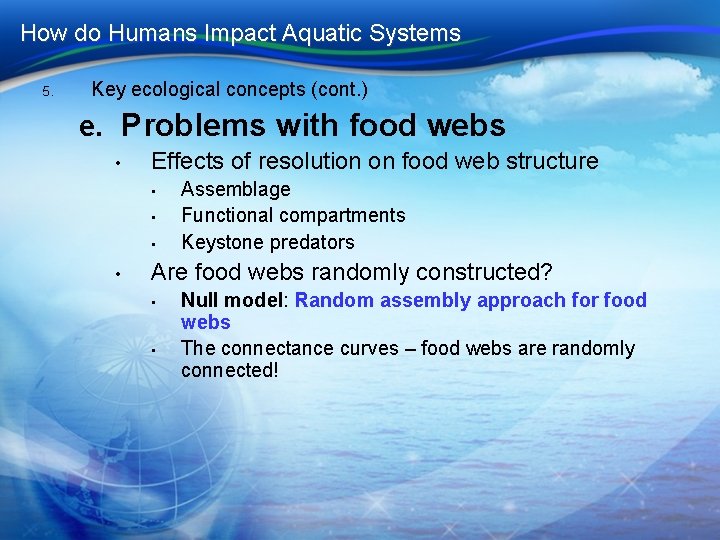
How do Humans Impact Aquatic Systems 5. Key ecological concepts (cont. ) e. Problems with food webs • Effects of resolution on food web structure • • Assemblage Functional compartments Keystone predators Are food webs randomly constructed? • • Null model: Random assembly approach for food webs The connectance curves – food webs are randomly connected!
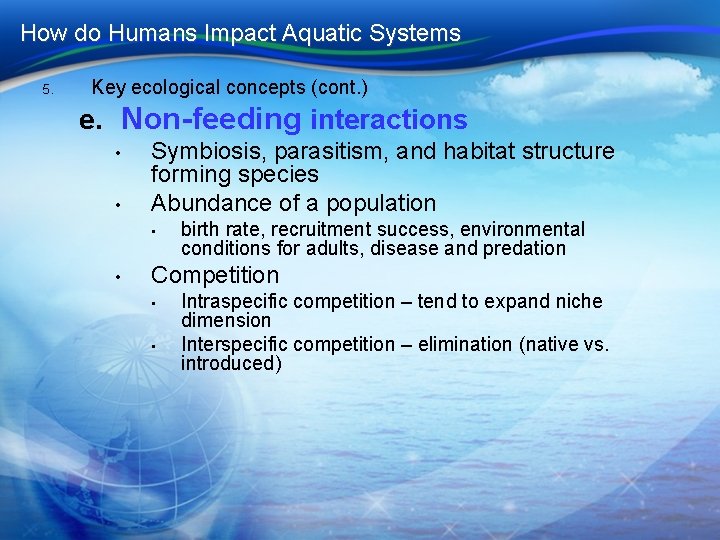
How do Humans Impact Aquatic Systems 5. Key ecological concepts (cont. ) e. Non-feeding interactions • • Symbiosis, parasitism, and habitat structure forming species Abundance of a population • • birth rate, recruitment success, environmental conditions for adults, disease and predation Competition • • Intraspecific competition – tend to expand niche dimension Interspecific competition – elimination (native vs. introduced)
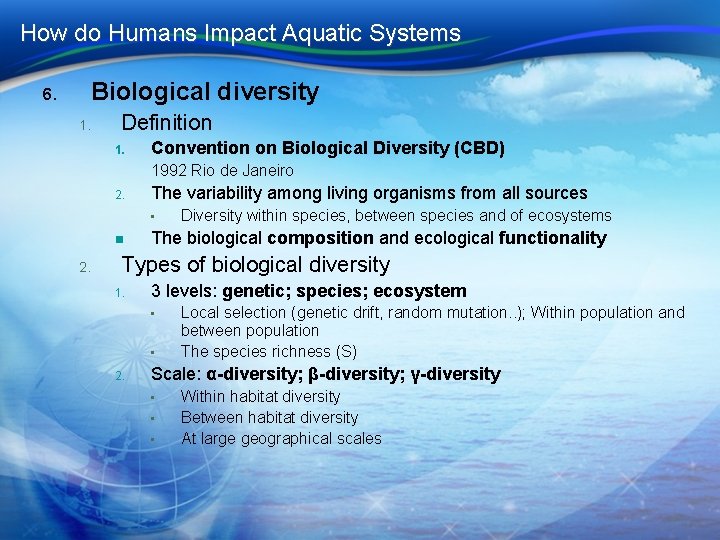
How do Humans Impact Aquatic Systems Biological diversity 6. 1. Definition 1. Convention on Biological Diversity (CBD) 1992 Rio de Janeiro 2. The variability among living organisms from all sources • n 2. Diversity within species, between species and of ecosystems The biological composition and ecological functionality Types of biological diversity 1. 3 levels: genetic; species; ecosystem • • 2. Local selection (genetic drift, random mutation. . ); Within population and between population The species richness (S) Scale: α-diversity; β-diversity; γ-diversity • • • Within habitat diversity Between habitat diversity At large geographical scales
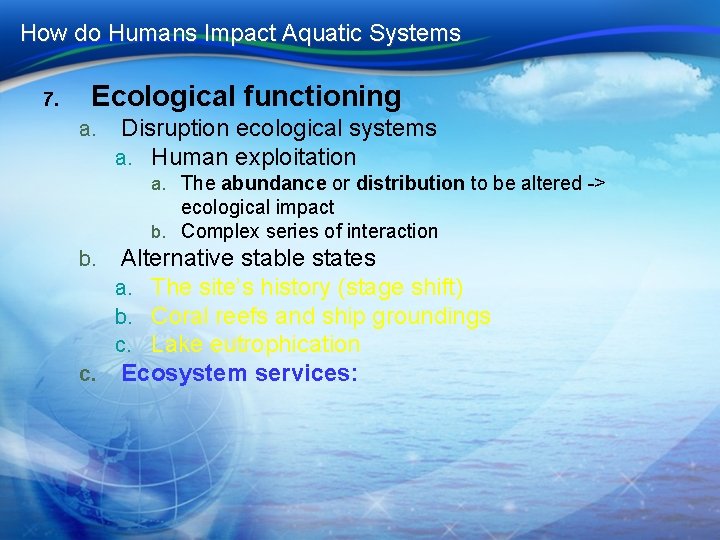
How do Humans Impact Aquatic Systems 7. Ecological functioning a. Disruption ecological systems a. Human exploitation a. The abundance or distribution to be altered -> ecological impact b. Complex series of interaction Alternative stable states a. The site’s history (stage shift) b. Coral reefs and ship groundings c. Lake eutrophication c. Ecosystem services: b.
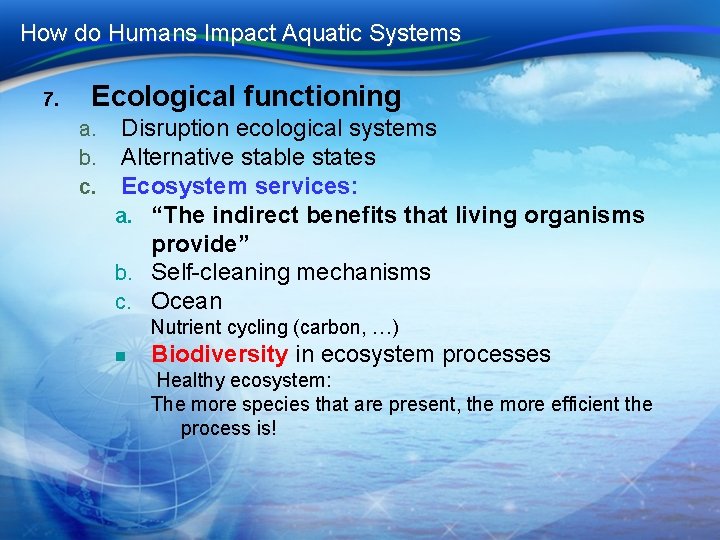
How do Humans Impact Aquatic Systems 7. Ecological functioning a. b. c. Disruption ecological systems Alternative stable states Ecosystem services: a. “The indirect benefits that living organisms provide” b. Self-cleaning mechanisms c. Ocean Nutrient cycling (carbon, …) n Biodiversity in ecosystem processes Healthy ecosystem: The more species that are present, the more efficient the process is!
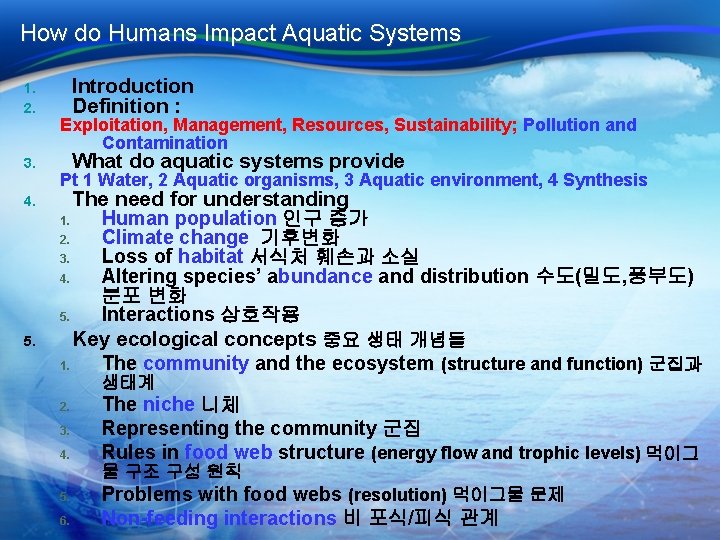
How do Humans Impact Aquatic Systems 1. 2. 3. 4. 5. Introduction Definition : Exploitation, Management, Resources, Sustainability; Pollution and Contamination What do aquatic systems provide Pt 1 Water, 2 Aquatic organisms, 3 Aquatic environment, 4 Synthesis The need for understanding 1. Human population 인구 증가 2. Climate change 기후변화 3. Loss of habitat 서식처 훼손과 소실 4. Altering species’ abundance and distribution 수도(밀도, 풍부도) 분포 변화 5. Interactions 상호작용 Key ecological concepts 중요 생태 개념들 1. The community and the ecosystem (structure and function) 군집과 생태계 2. 3. 4. The niche 니체 Representing the community 군집 Rules in food web structure (energy flow and trophic levels) 먹이그 물 구조 구성 원칙 5. 6. Problems with food webs (resolution) 먹이그물 문제 Non-feeding interactions 비 포식/피식 관계
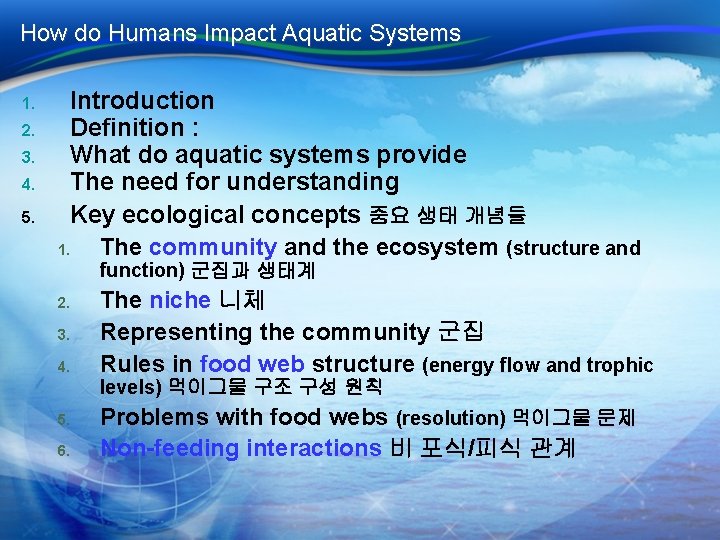
How do Humans Impact Aquatic Systems 1. 2. 3. 4. 5. Introduction Definition : What do aquatic systems provide The need for understanding Key ecological concepts 중요 생태 개념들 1. The community and the ecosystem (structure and function) 군집과 생태계 2. 3. 4. The niche 니체 Representing the community 군집 Rules in food web structure (energy flow and trophic levels) 먹이그물 구조 구성 원칙 5. 6. Problems with food webs (resolution) 먹이그물 문제 Non-feeding interactions 비 포식/피식 관계
How do Humans Impact Aquatic Systems Biological diversity 생물종 다양성 6. 1. 2. Definition Types of biological diversity Ecological functioning 생태기능 7. 1. 2. 3. Disrupting ecological systems Alternative stable states Ecosystem services 생태계 지원 기능
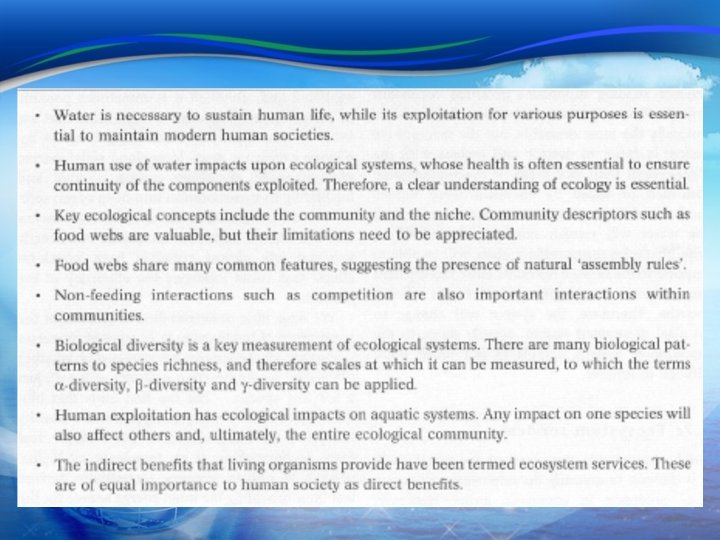
8. • • Summary Sustain human life, essential to maintain modern human societies Impacts on ecological systems → understanding of ecology Community and niche; food web Food web – ‘natural assembly rules’ Non-feeding interactions; competition Biological diversity Any impact → affect others → entire ecological community Ecosystem services