
How Do Cells Divide How Prokaryotes Reproduce Prokaryotes
- Slides: 10
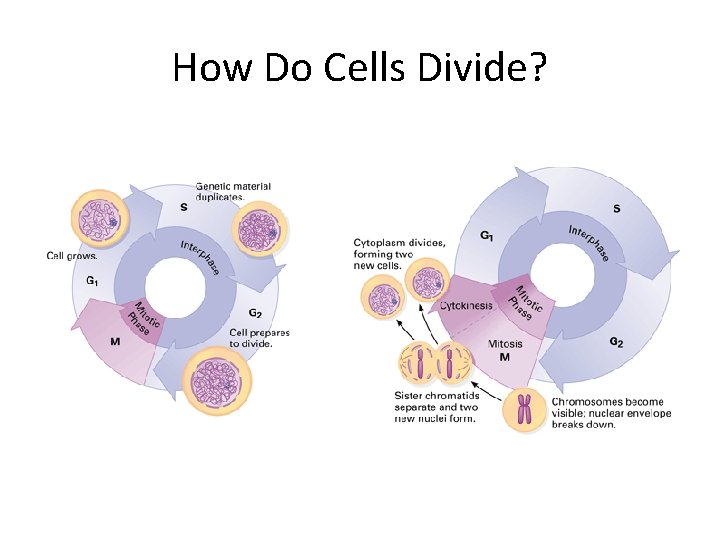
How Do Cells Divide?
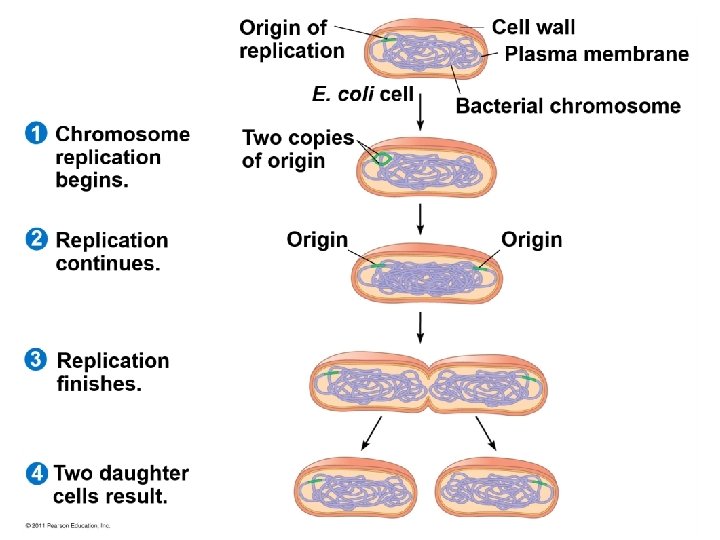
How Prokaryotes Reproduce • Prokaryotes (bacteria and archaea) reproduce by a type of cell division called binary fission • In binary fission, the chromosome replicates (beginning at the origin of replication), and the two daughter chromosomes actively move apart • The plasma membrane pinches inward, dividing the cell into two
Evolution of Mitosis • Since prokaryotes evolved before eukaryotes, mitosis probably evolved from binary fission • Certain protists exhibit types of cell division that seem intermediate between binary fission and mitosis
Regulation of Cell Division • The frequency of cell division varies with the type of cell • These differences result from regulation at the molecular level • Cancer cells manage to escape the usual controls on the cell cycle
Cell Cycle Control System • The events of the cell cycle are directed by a distinct cell cycle control system, which is similar to a clock • The cell cycle control system is regulated by both internal and external controls • The clock has specific checkpoints where the cell cycle stops until a go-ahead signal is received
Cell Cycle Control System • For many cells, the G 1 checkpoint seems to be the most important • If a cell receives a go-ahead signal at the G 1 checkpoint, it will usually complete the cycle. • If the cell does not receive the go-ahead signal, it will exit the cycle, switching into a nondividing state called the G 0 phase
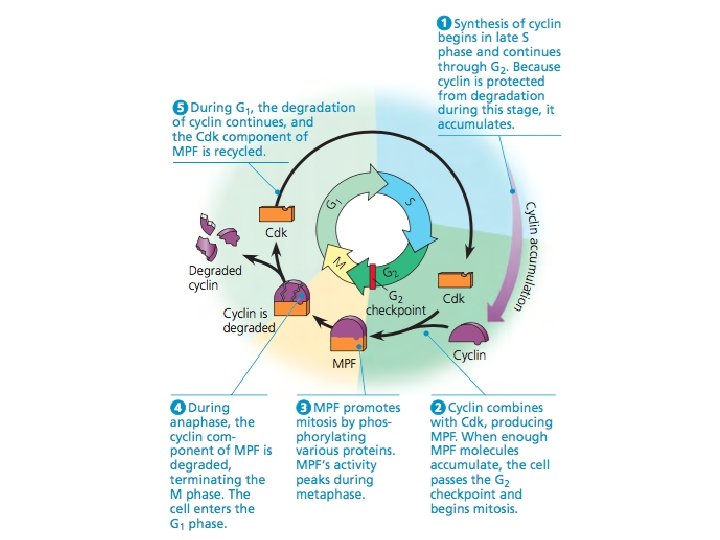
Cyclins and CDKs • Two types of regulatory proteins are involved in cell cycle control: cyclins and cyclin-dependent kinases (Cdks) • Cdks activity fluctuates during the cell cycle because it is controled by cyclins, so named because their concentrations vary with the cell cycle • MPF (maturation-promoting factor) is a cyclin. Cdk complex that triggers a cell’s passage past the G 2 checkpoint into the M phase
External Signals • An example of external signals is densitydependent inhibition, in which crowded cells stop dividing • Most animal cells also exhibit anchorage dependence, in which they must be attached to a substratum in order to divide • Cancer cells exhibit neither density-dependent inhibition nor anchorage dependence