
How Did the Japanese Economy React to the


- Slides: 47
How Did the Japanese Economy React to the World Financial Crisis? -Changes in Reallocation, Japanese exporting firm heterogeneity, and International Competitiveness. Presented at the 3 rd Asia KLEMS Conference at Taipei on August 13, 2015 Ivan Deseatnicov (Hitotsubashi University and JSPS) Kyoji Fukao (Hitotsubashi University and RIETI) Tomohiko Inui (Gakushuin University and RIETI) Koji Ito (Kyoto University and RIETI) Young. Gak Kim (Senshu University) Motohiro Kumagai (Hitotsubashi University) Tsutomu Miyagawa (Gakushuin University and RIETI) Miho Takizawa (Toyo University) Hongyong Zhang (RIETI) 1
Introduction • Examining the structural change in the Japanese economy at the aggregate, establishment and firm levels • Aggregate level: Following Goodridge, Haskel, and Wallis (2015), we decompose the decline TFP growth rate after the World Financial Crisis into structural and cyclical factors. • Structural factors consist of reallocation effect of production factors and industries. • Cyclical factor is represented by the change in utilization rate. • Establishment Level:Examine Japanese Exporting Establishment Characteristics • Firm level: Using financial statements in East Asian countries, we examine the change in international competitiveness in Japanese firms. 2
Content Introduction 1. How Did the Japanese Economy React to the World Financial Crisis? -1. 1. Aggregate Reallocation Effects in Japan -1. 2. Productivity puzzle in Japan? -1. 3. Cyclical variation in factor utilization -1. 4. Structural weakness 2. Global Value Chain Measurement -2. 1. Global Value Chain Measurement -2. 2. A sketch of the level of detail to consider -2. 3. Accounting for firm heterogeneity -2. 4. This Study -2. 5. Data -2. 6. Facts -2. 7. Extended input-output tables for the whole manufacturing sector, 2011 -2. 8. An example of input-output tables for two industries, 2011 -2. 9. Main Findings 3. An international comparison of the TFP levels of Japanese, Korean and Chinese listed firms -3. 1. Main Findings -3. 2. Methodology for International Comparison of Firms’ TFP Level -3. 3. Relative output, capital and intermediate input prices (2000, Japan=1), Industry 1 -16 -3. 4. Relative output, capital and intermediate input prices (2000, Japan=1), Industry 17 -33 -3. 5. TFP Growth Rate (percent per annum) -3. 6. TFP in Japan, Korea and China: Chemical industry -3. 7. TFP in Japan, Korea and China: Primary metal industry -3. 8. TFP in Japan, Korea and China: Non-electrical machinery industry -3. 9. TFP in Japan, Korea and China: Electrical machinery industry -3. 10. TFP in Japan, Korea and China: Motor vehicle industry Conclusion References 3
1. How Did the Japanese Economy React to the World Financial Crisis? 4
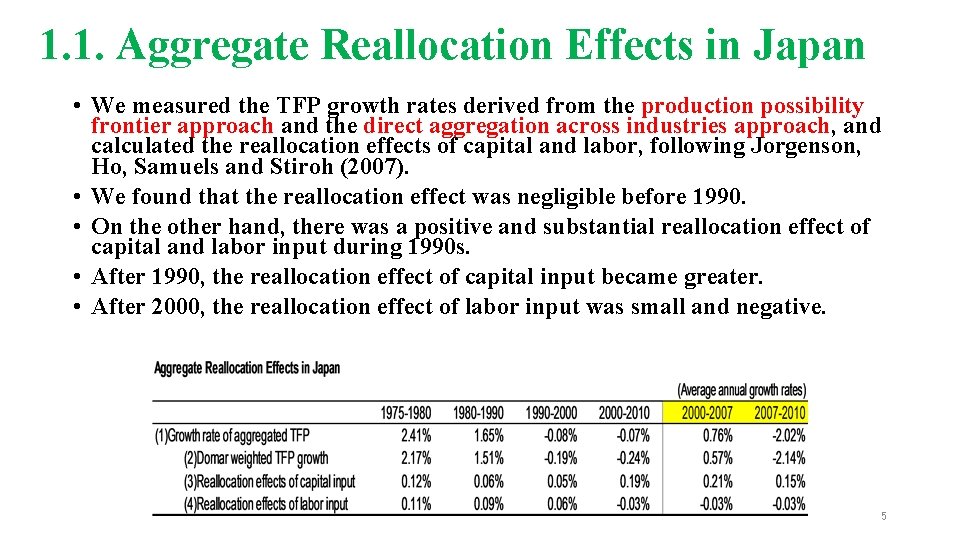
1. 1. Aggregate Reallocation Effects in Japan • We measured the TFP growth rates derived from the production possibility frontier approach and the direct aggregation across industries approach, and calculated the reallocation effects of capital and labor, following Jorgenson, Ho, Samuels and Stiroh (2007). • We found that the reallocation effect was negligible before 1990. • On the other hand, there was a positive and substantial reallocation effect of capital and labor input during 1990 s. • After 1990, the reallocation effect of capital input became greater. • After 2000, the reallocation effect of labor input was small and negative. 5
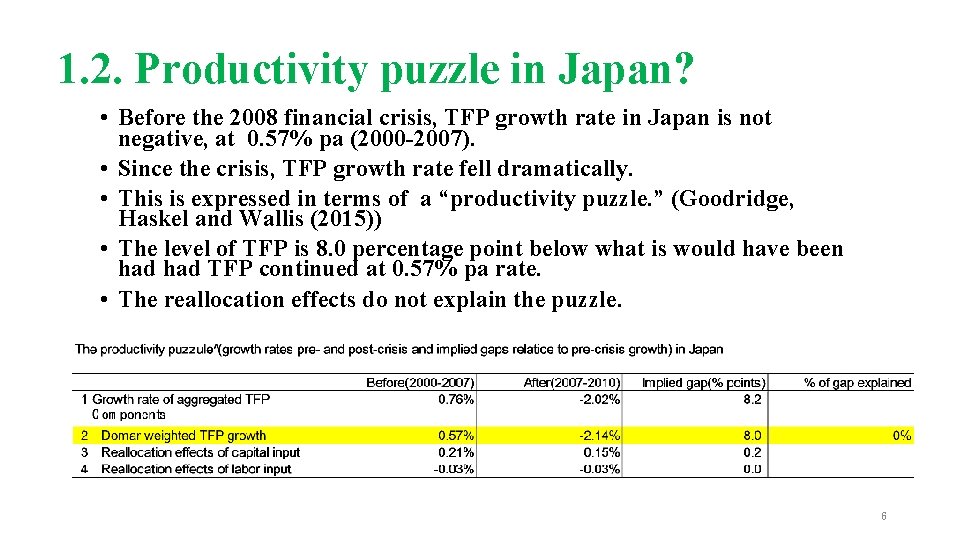
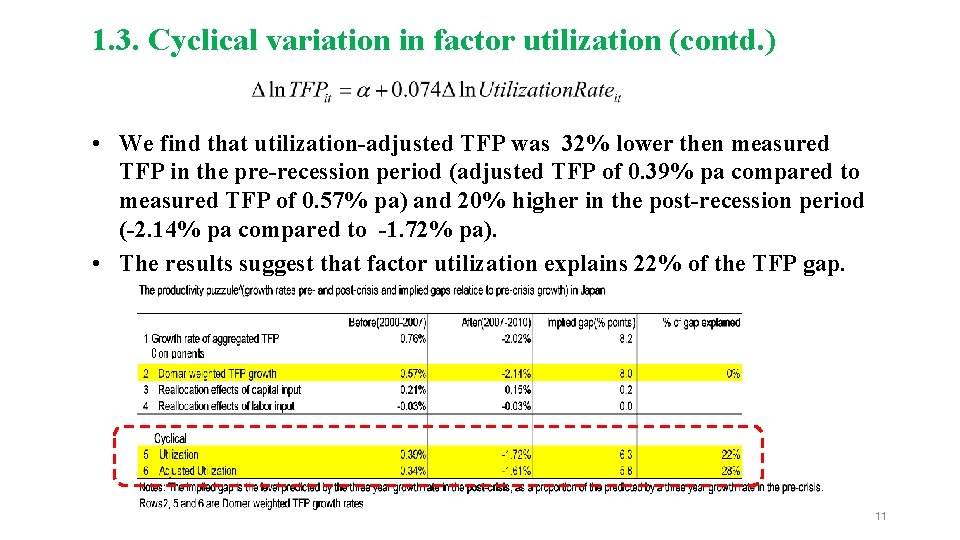
1. 2. Productivity puzzle in Japan? • Before the 2008 financial crisis, TFP growth rate in Japan is not negative, at 0. 57% pa (2000 -2007). • Since the crisis, TFP growth rate fell dramatically. • This is expressed in terms of a “productivity puzzle. ” (Goodridge, Haskel and Wallis (2015)) • The level of TFP is 8. 0 percentage point below what is would have been had TFP continued at 0. 57% pa rate. • The reallocation effects do not explain the puzzle. 6
1. 3. Cyclical variation in factor utilization • We also test whethere is mismeasurement of inputs due to changes in factor utilization. • Goodridge et al. (2015) measured factor utilization rate based on Basu et, al (2006) which depends on fluctuations in labor hours. • In Japan, we have data on capital utilization rate in the manufacturing sector published by METI. • Then, we measure utilization rates by industry from Financial Statements Statistics of Corporations by Ministry of Finance. 7
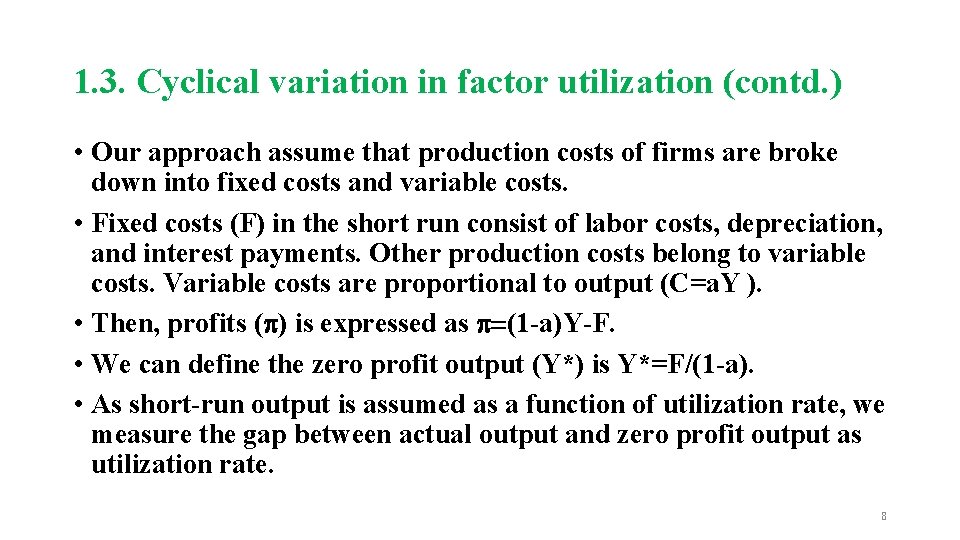
1. 3. Cyclical variation in factor utilization (contd. ) • Our approach assume that production costs of firms are broke down into fixed costs and variable costs. • Fixed costs (F) in the short run consist of labor costs, depreciation, and interest payments. Other production costs belong to variable costs. Variable costs are proportional to output (C=a. Y ). • Then, profits (p) is expressed as p=(1 -a)Y-F. • We can define the zero profit output (Y*) is Y*=F/(1 -a). • As short-run output is assumed as a function of utilization rate, we measure the gap between actual output and zero profit output as utilization rate. 8
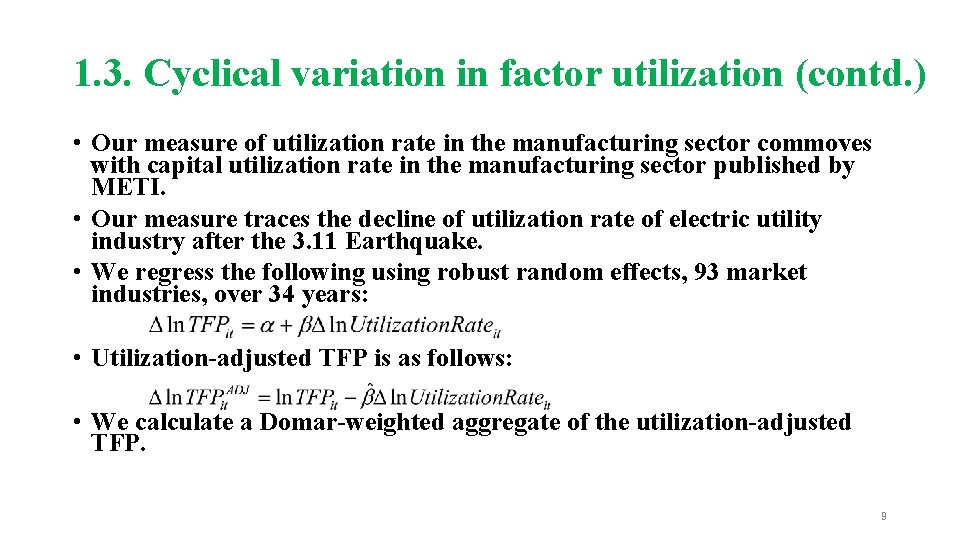
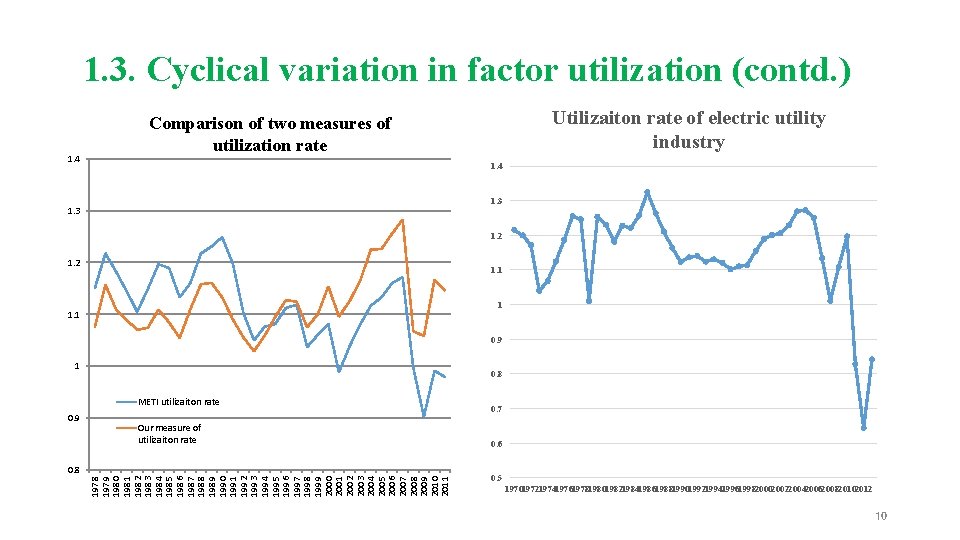
1. 3. Cyclical variation in factor utilization (contd. ) • Our measure of utilization rate in the manufacturing sector commoves with capital utilization rate in the manufacturing sector published by METI. • Our measure traces the decline of utilization rate of electric utility industry after the 3. 11 Earthquake. • We regress the following using robust random effects, 93 market industries, over 34 years: • Utilization-adjusted TFP is as follows: • We calculate a Domar-weighted aggregate of the utilization-adjusted TFP. 9
1. 3. Cyclical variation in factor utilization (contd. ) 1. 4 Utilizaiton rate of electric utility industry Comparison of two measures of utilization rate 1. 4 1. 3 1. 2 1. 1 1 1. 1 0. 9 1 0. 8 METI utilizaiton rate 0. 9 Our measure of utilizaiton rate 1978 1979 1980 1981 1982 1983 1984 1985 1986 1987 1988 1989 1990 1991 1992 1993 1994 1995 1996 1997 1998 1999 2000 2001 2002 2003 2004 2005 2006 2007 2008 2009 2010 2011 0. 8 0. 7 0. 6 0. 5 1970197219741976197819801982198419861988199019921994199619982000200220042006200820102012 10
1. 3. Cyclical variation in factor utilization (contd. ) • We find that utilization-adjusted TFP was 32% lower then measured TFP in the pre-recession period (adjusted TFP of 0. 39% pa compared to measured TFP of 0. 57% pa) and 20% higher in the post-recession period (-2. 14% pa compared to -1. 72% pa). • The results suggest that factor utilization explains 22% of the TFP gap. 11
1. 4. Structural weakness • We try to understand which sectors account for the weakness of TFP growth during the crisis. • Is it due to the slowdown in particular industries such as non-manufacturing sectors? • To examine this, we calculate TFP growth rate without non-manufacturing sectors before and after the crisis. 12
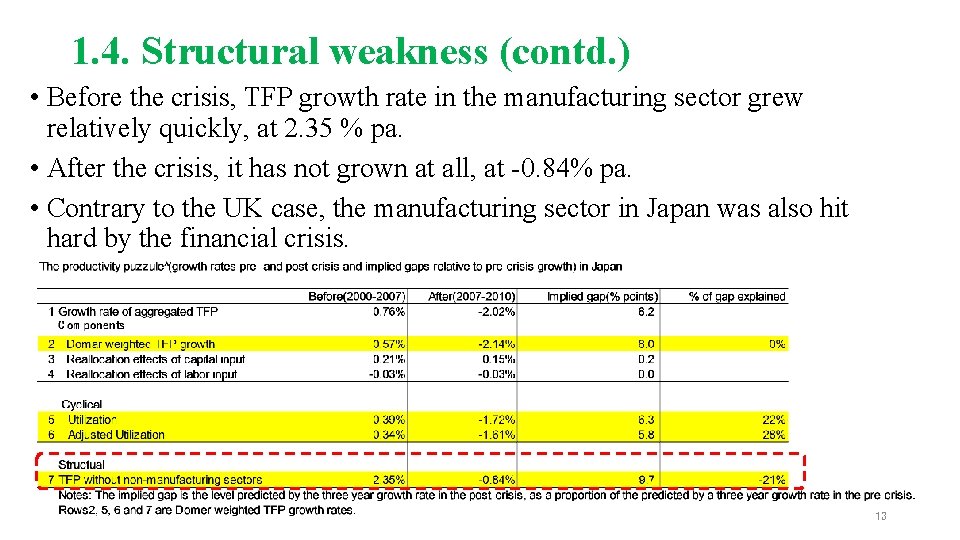
1. 4. Structural weakness (contd. ) • Before the crisis, TFP growth rate in the manufacturing sector grew relatively quickly, at 2. 35 % pa. • After the crisis, it has not grown at all, at -0. 84% pa. • Contrary to the UK case, the manufacturing sector in Japan was also hit hard by the financial crisis. 13
2. Firm Heterogeneity in Input-Output Analyses 14
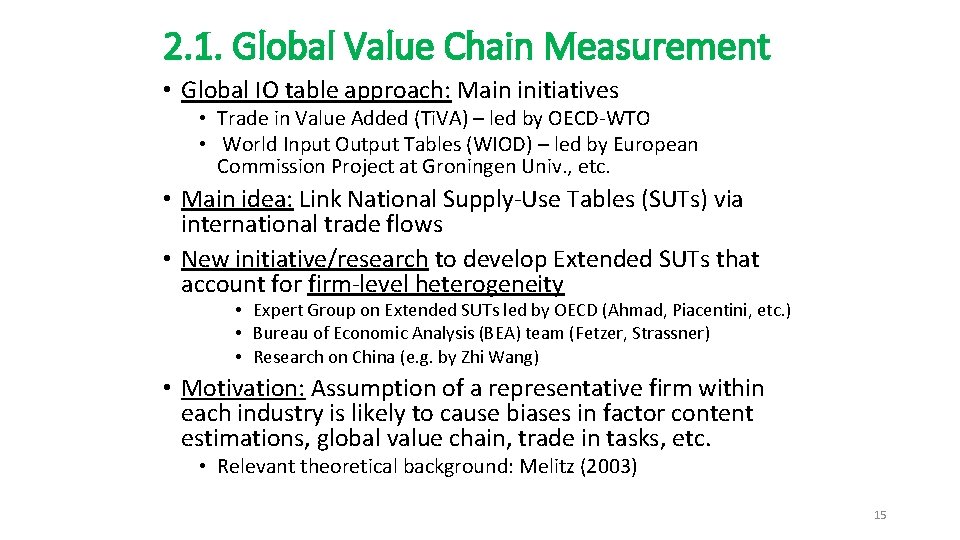
2. 1. Global Value Chain Measurement • Global IO table approach: Main initiatives • Trade in Value Added (Ti. VA) – led by OECD‐WTO • World Input Output Tables (WIOD) – led by European Commission Project at Groningen Univ. , etc. • Main idea: Link National Supply‐Use Tables (SUTs) via international trade flows • New initiative/research to develop Extended SUTs that account for firm‐level heterogeneity • Expert Group on Extended SUTs led by OECD (Ahmad, Piacentini, etc. ) • Bureau of Economic Analysis (BEA) team (Fetzer, Strassner) • Research on China (e. g. by Zhi Wang) • Motivation: Assumption of a representative firm within each industry is likely to cause biases in factor content estimations, global value chain, trade in tasks, etc. • Relevant theoretical background: Melitz (2003) 15
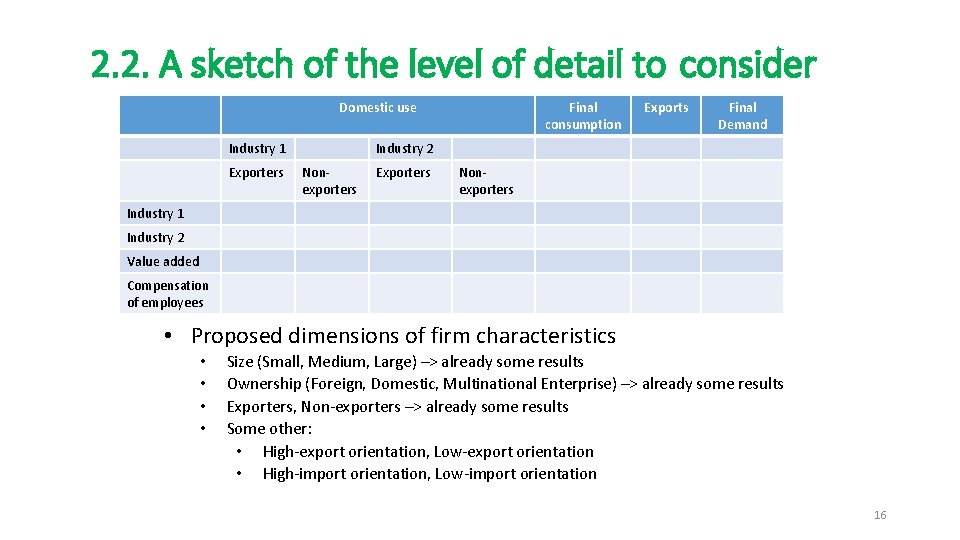
2. 2. A sketch of the level of detail to consider Domestic use Industry 1 Exporters Final consumption Exports Final Demand Industry 2 Non‐ exporters Exporters Non‐ exporters Industry 1 Industry 2 Value added Compensation of employees • Proposed dimensions of firm characteristics • • Size (Small, Medium, Large) –> already some results Ownership (Foreign, Domestic, Multinational Enterprise) –> already some results Exporters, Non‐exporters –> already some results Some other: • High‐export orientation, Low‐export orientation • High‐import orientation, Low‐import orientation 16
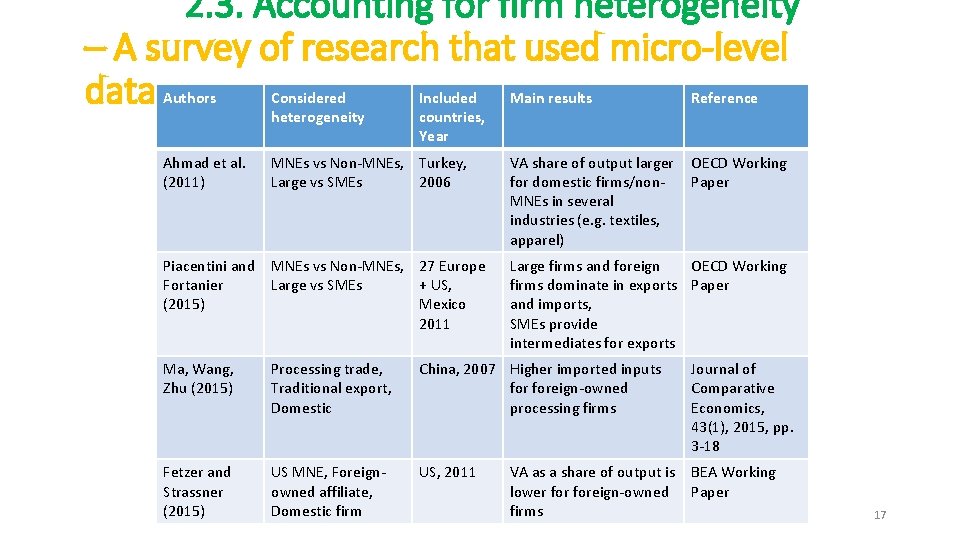
2. 3. Accounting for firm heterogeneity – A survey of research that used micro-level data Authors Considered heterogeneity Included countries, Year Ahmad et al. (2011) MNEs vs Non‐MNEs, Turkey, Large vs SMEs 2006 Piacentini and MNEs vs Non‐MNEs, 27 Europe Fortanier Large vs SMEs + US, (2015) Mexico 2011 Main results Reference VA share of output larger OECD Working for domestic firms/non‐ Paper MNEs in several industries (e. g. textiles, apparel) Large firms and foreign OECD Working firms dominate in exports Paper and imports, SMEs provide intermediates for exports Ma, Wang, Zhu (2015) Processing trade, Traditional export, Domestic China, 2007 Higher imported inputs foreign‐owned processing firms Fetzer and Strassner (2015) US MNE, Foreign‐ owned affiliate, Domestic firm US, 2011 Journal of Comparative Economics, 43(1), 2015, pp. 3‐ 18 VA as a share of output is BEA Working lower foreign‐owned Paper firms 17
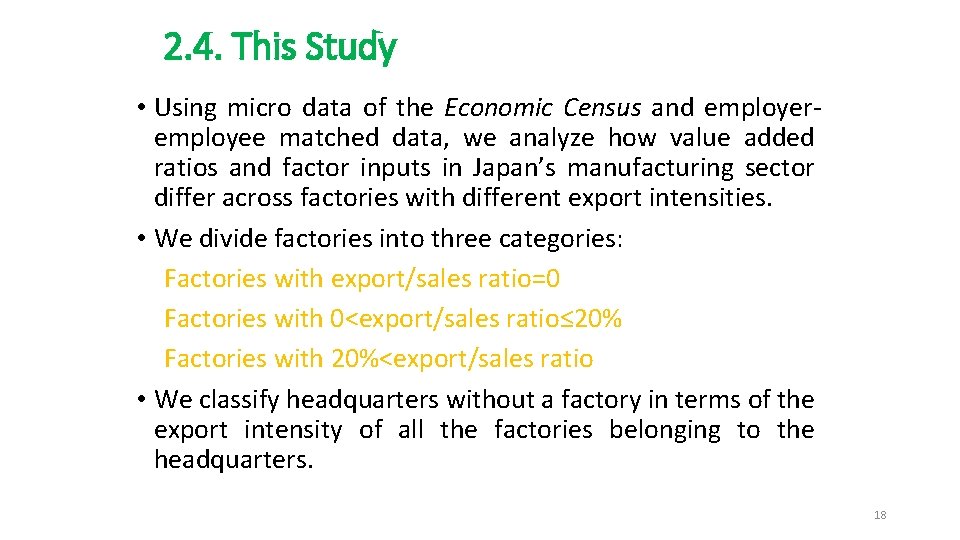
2. 4. This Study • Using micro data of the Economic Census and employer‐ employee matched data, we analyze how value added ratios and factor inputs in Japan’s manufacturing sector differ across factories with different export intensities. • We divide factories into three categories: Factories with export/sales ratio=0 Factories with 0<export/sales ratio≤ 20% Factories with 20%<export/sales ratio • We classify headquarters without a factory in terms of the export intensity of all the factories belonging to the headquarters. 18
2. 5. Data • Economic Census for Business Activity (2011) • 332, 360 establishments • Basic Survey on Wage Structure (2011) • 273, 377 employees • Matching • 256, 301 employees (93. 8% of Basic Survey on Wage Structure) • 8, 887 establishments (2. 7% of Economic Census for Business Activity ) 19
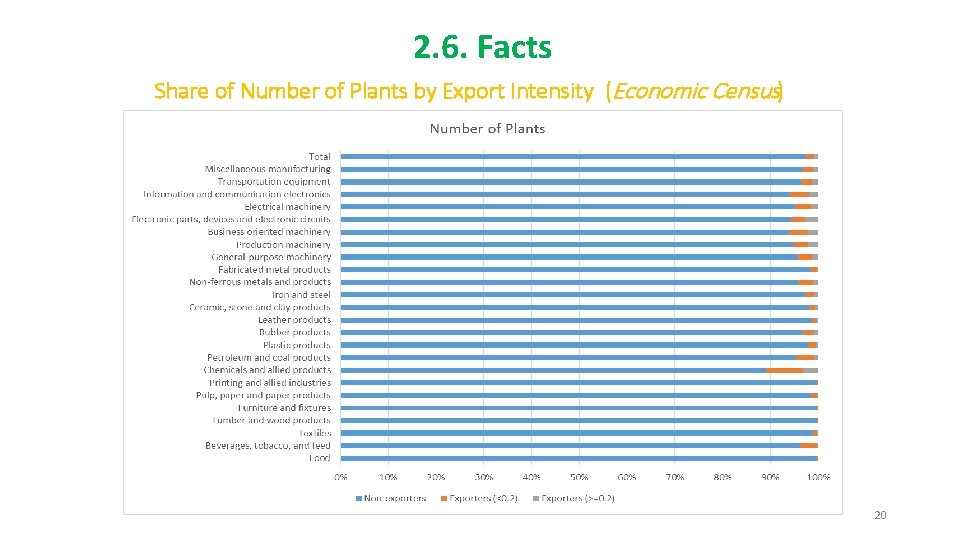
2. 6. Facts Share of Number of Plants by Export Intensity (Economic Census) 20
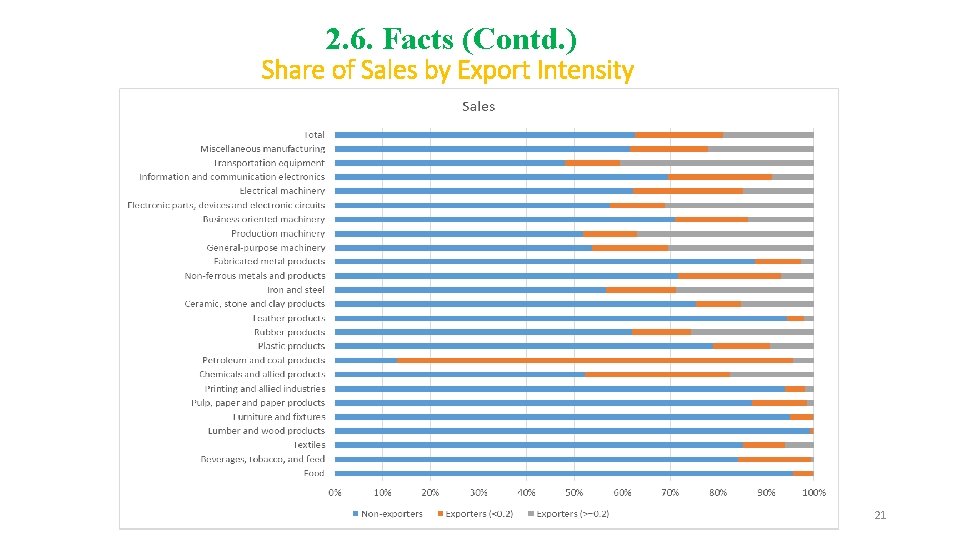
2. 6. Facts (Contd. ) Share of Sales by Export Intensity 21
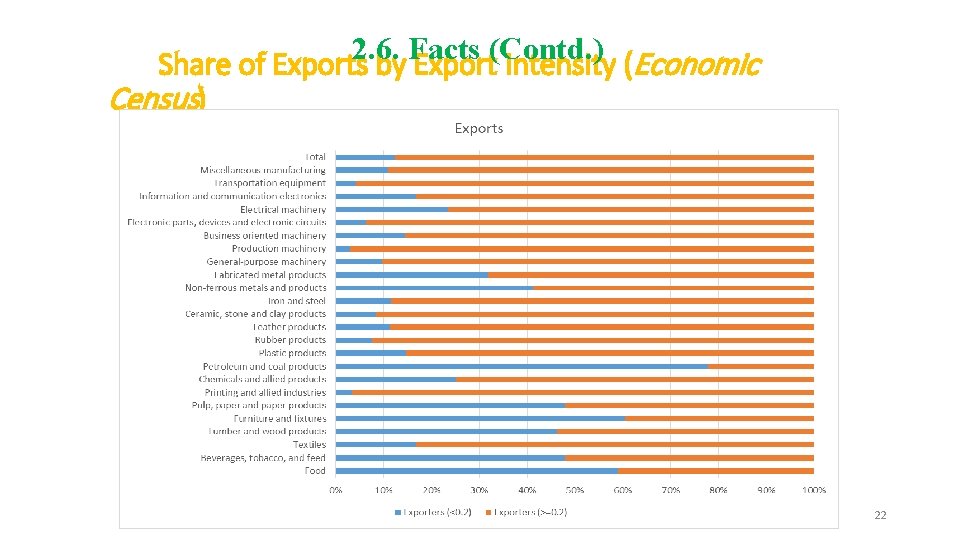
2. 6. Facts (Contd. ) Share of Exports by Export Intensity (Economic Census) 22
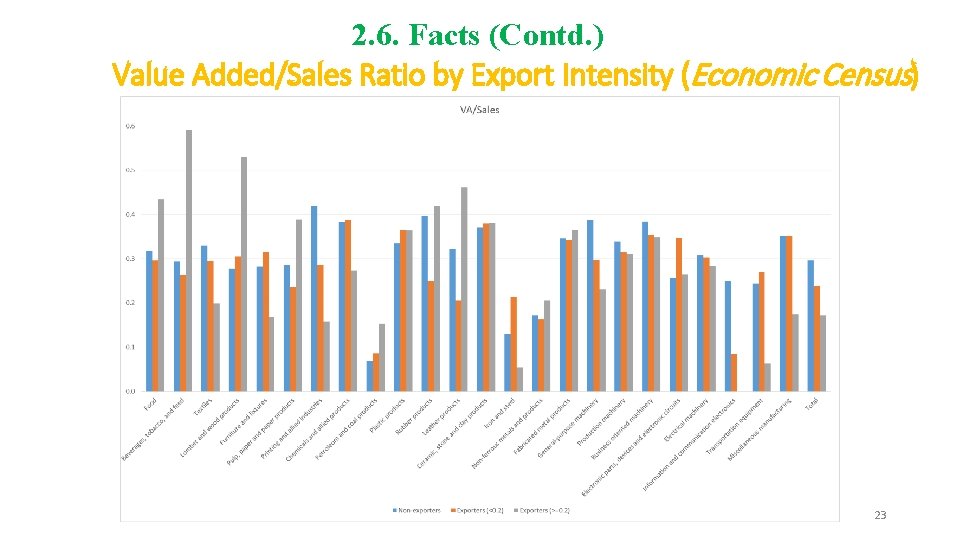
2. 6. Facts (Contd. ) Value Added/Sales Ratio by Export Intensity (Economic Census) 23
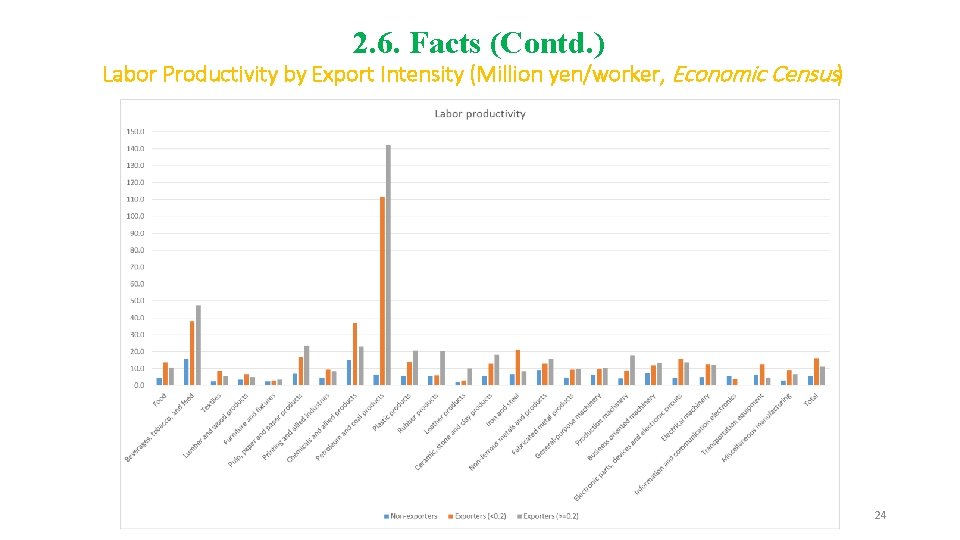
2. 6. Facts (Contd. ) Labor Productivity by Export Intensity (Million yen/worker, Economic Census) 24
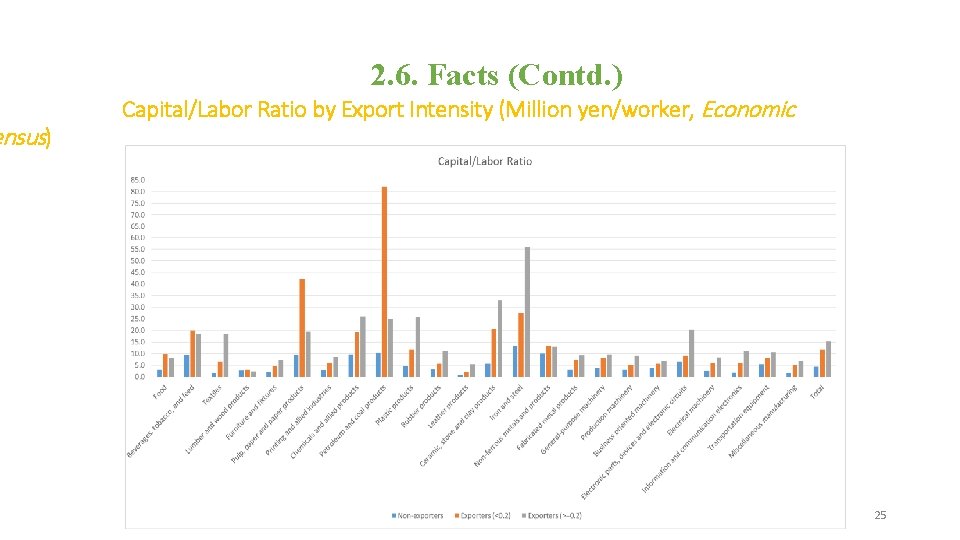
ensus) 2. 6. Facts (Contd. ) Capital/Labor Ratio by Export Intensity (Million yen/worker, Economic 25
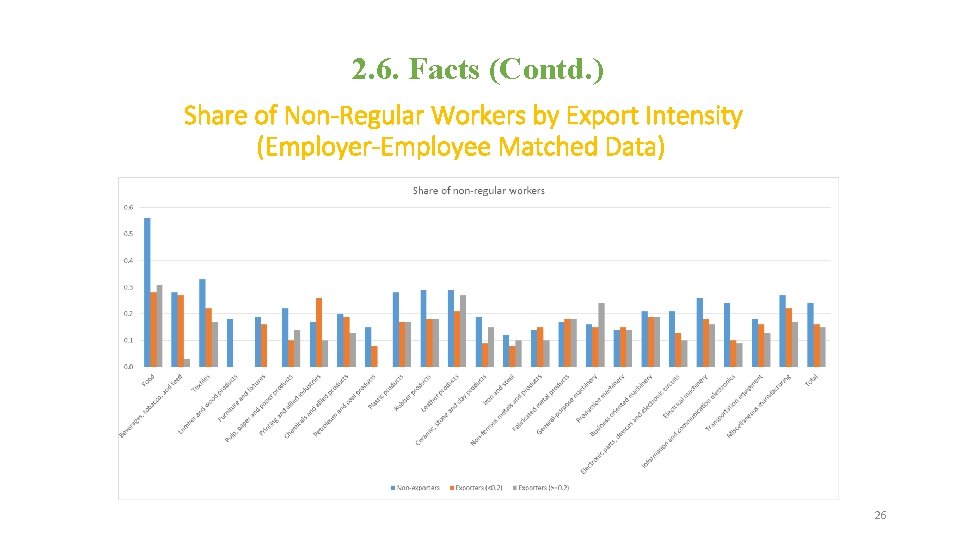
2. 6. Facts (Contd. ) Share of Non-Regular Workers by Export Intensity (Employer-Employee Matched Data) 26
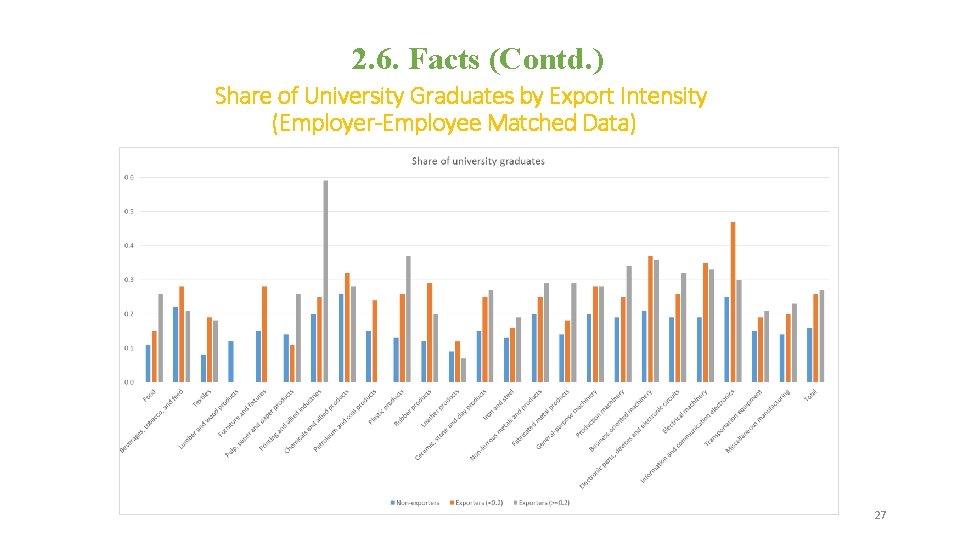
2. 6. Facts (Contd. ) Share of University Graduates by Export Intensity (Employer-Employee Matched Data) 27
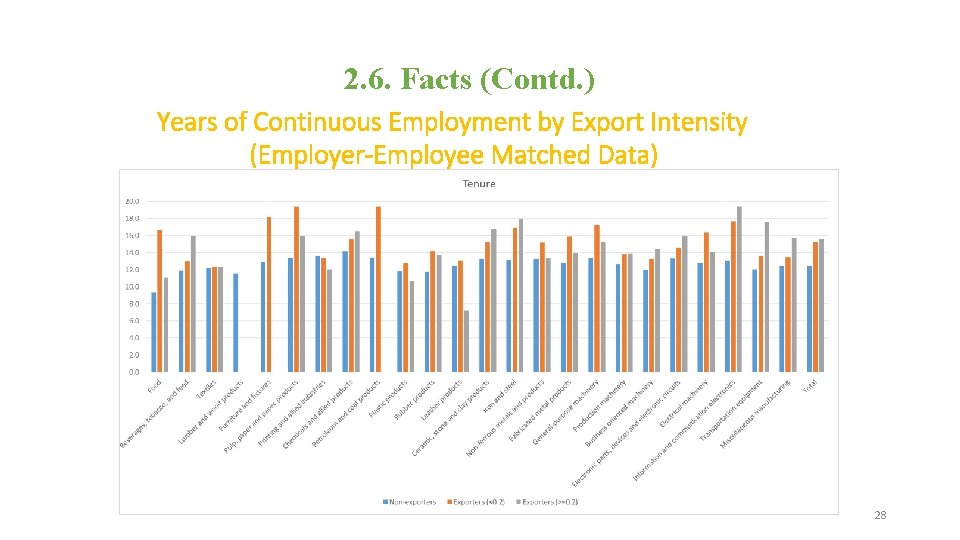
2. 6. Facts (Contd. ) Years of Continuous Employment by Export Intensity (Employer-Employee Matched Data) 28
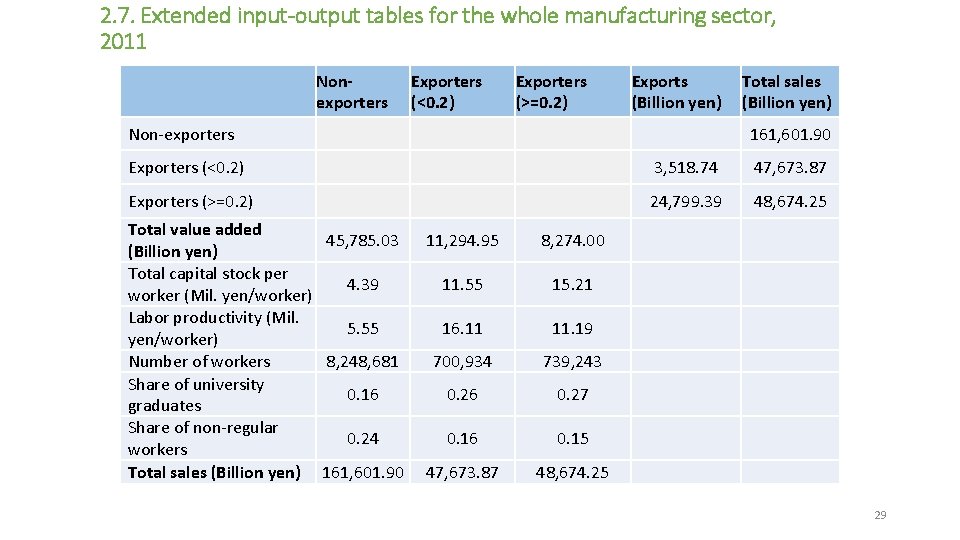
2. 7. Extended input-output tables for the whole manufacturing sector, 2011 Nonexporters Exporters (<0. 2) Exporters (>=0. 2) Exports (Billion yen) Total sales (Billion yen) Non‐exporters 161, 601. 90 Exporters (<0. 2) 3, 518. 74 47, 673. 87 Exporters (>=0. 2) 24, 799. 39 48, 674. 25 Total value added 45, 785. 03 (Billion yen) Total capital stock per 4. 39 worker (Mil. yen/worker) Labor productivity (Mil. 5. 55 yen/worker) Number of workers 8, 248, 681 Share of university 0. 16 graduates Share of non‐regular 0. 24 workers Total sales (Billion yen) 161, 601. 90 11, 294. 95 8, 274. 00 11. 55 15. 21 16. 11 11. 19 700, 934 739, 243 0. 26 0. 27 0. 16 0. 15 47, 673. 87 48, 674. 25 29
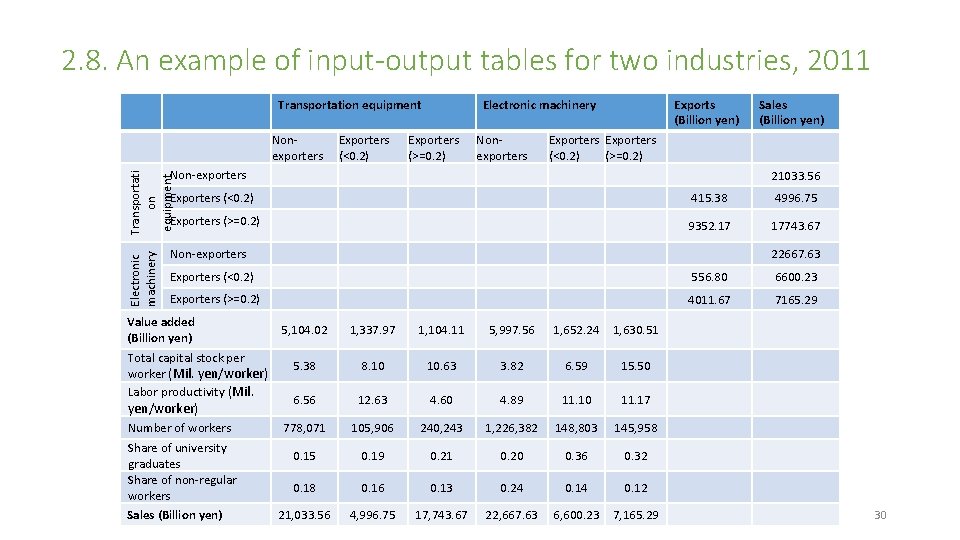
2. 8. An example of input-output tables for two industries, 2011 Transportation equipment Non‐ exporters Exporters (<0. 2) Electronic machinery Exporters (>=0. 2) Non‐ exporters Exports (Billion yen) Exporters (<0. 2) (>=0. 2) Non‐exporters 21033. 56 Exporters (<0. 2) 415. 38 4996. 75 Exporters (>=0. 2) 9352. 17 17743. 67 Non‐exporters 22667. 63 Exporters (<0. 2) 556. 80 6600. 23 Exporters (>=0. 2) 4011. 67 7165. 29 Transportati on equipment Electronic machinery Sales (Billion yen) Value added (Billion yen) Total capital stock per worker (Mil. yen/worker) Labor productivity (Mil. yen/worker) Number of workers Share of university graduates Share of non‐regular workers Sales (Billion yen) 5, 104. 02 1, 337. 97 1, 104. 11 5, 997. 56 1, 652. 24 1, 630. 51 5. 38 8. 10 10. 63 3. 82 6. 59 15. 50 6. 56 12. 63 4. 60 4. 89 11. 10 11. 17 778, 071 105, 906 240, 243 1, 226, 382 148, 803 145, 958 0. 15 0. 19 0. 21 0. 20 0. 36 0. 32 0. 18 0. 16 0. 13 0. 24 0. 12 21, 033. 56 4, 996. 75 17, 743. 67 22, 667. 63 6, 600. 23 7, 165. 29 30
2. 9. Main Findings • Most of Japan’s manufacturing exports are conducted by a relatively small number of large establishments, which employ only about 15% of workers in the manufacturing sector. • More than 80% of Japan’s manufacturing exports are conducted by export‐oriented establishments, whose export/sales ratio is above 20%. Caveat: The data on factories’ export in the Economic Census cover only 40% of Japan’s total exports. • Exporting establishments tend to be larger and more physical and human capital intensive than non‐exporting establishments. • The labor productivity of exporting establishments tends to be much higher than of non‐exporting establishments. 31
3. An international comparison of the TFP levels of Japanese, Korean and Chinese listed firms 32
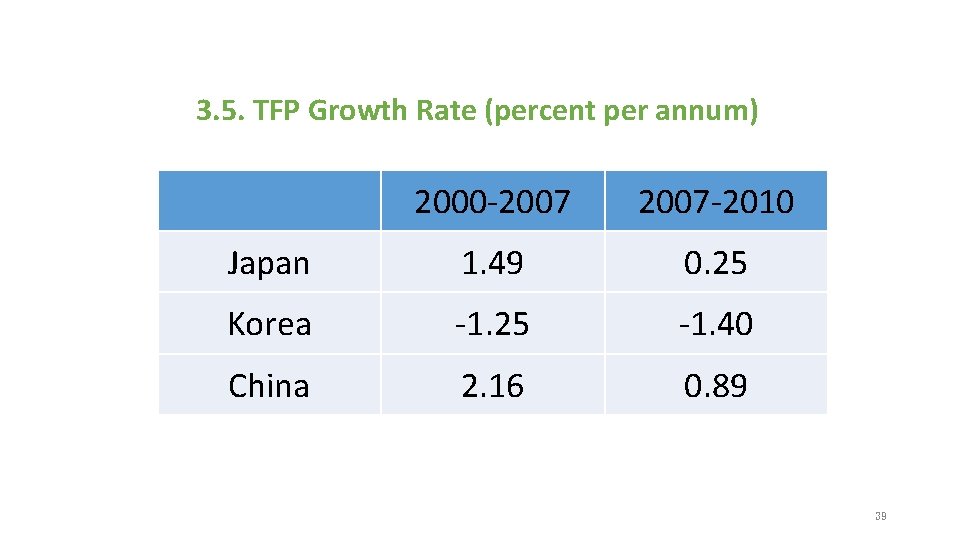
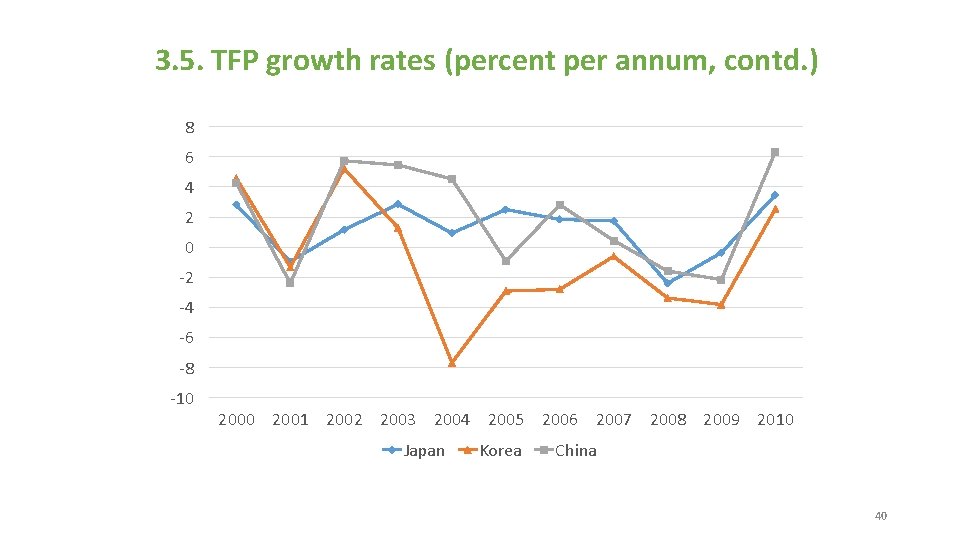
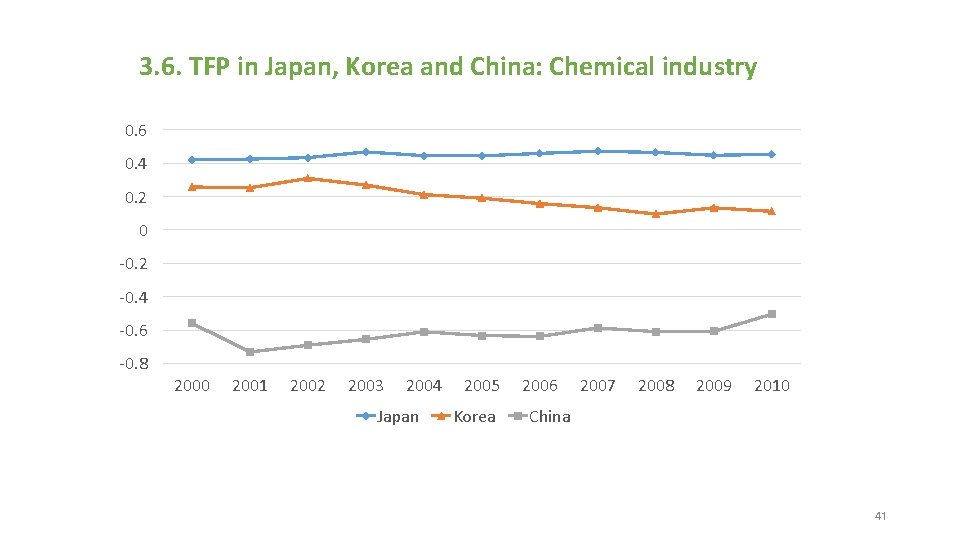
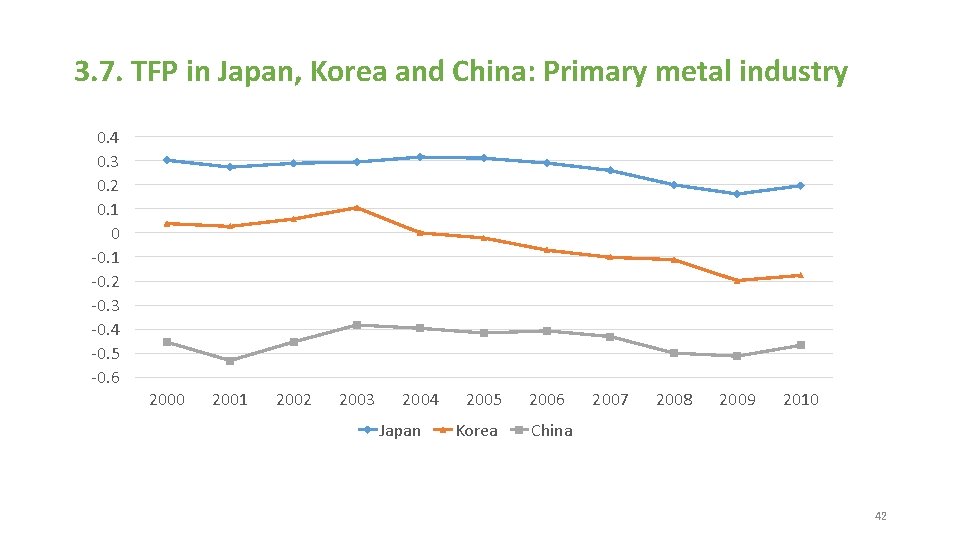
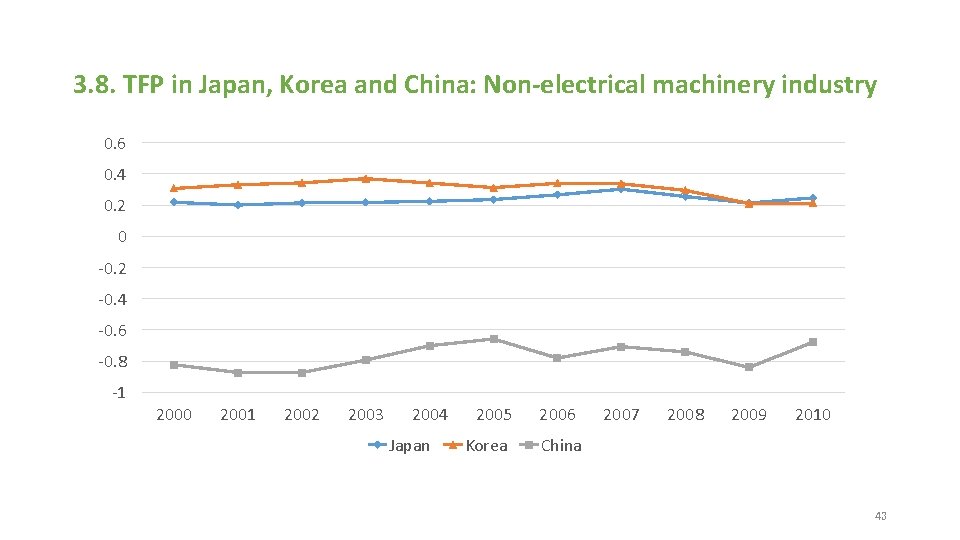
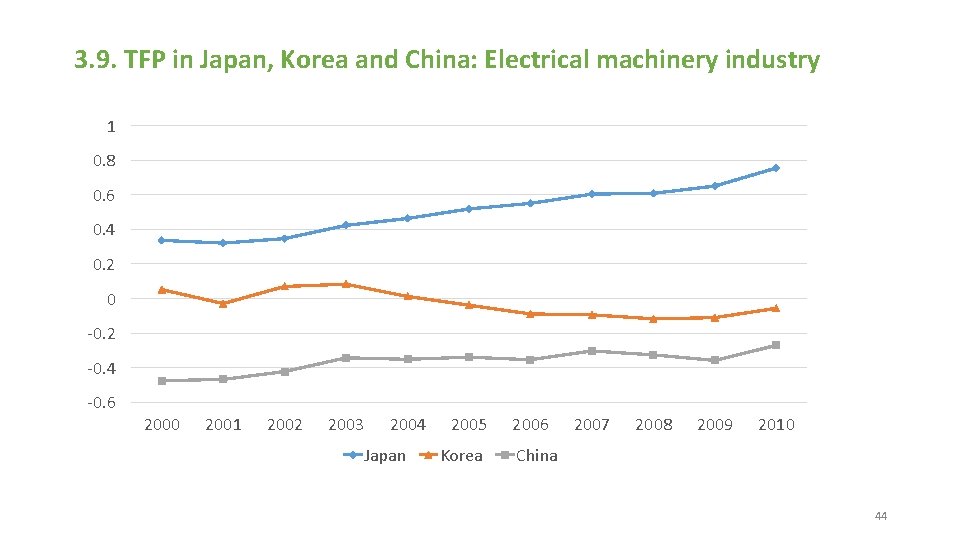
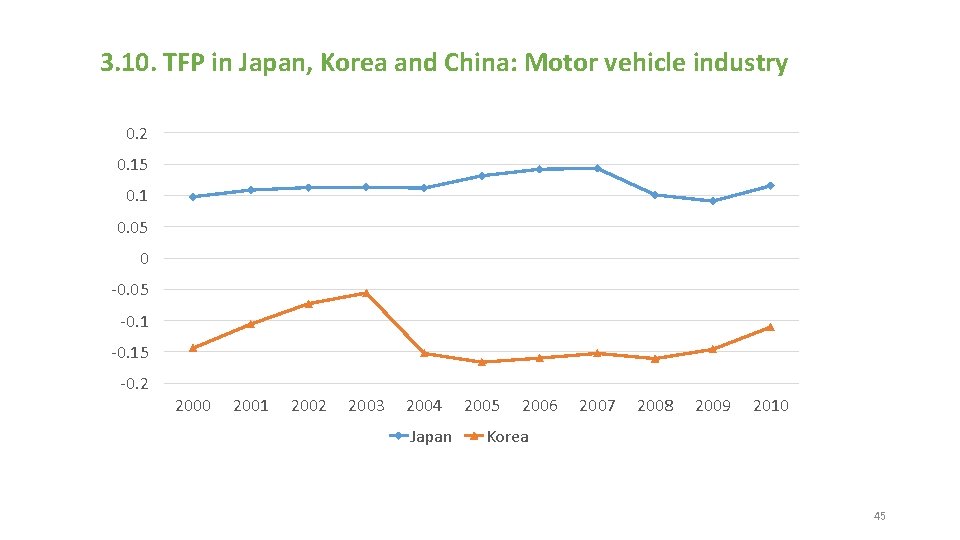
3. 1. Main Findings ・We extended our previous estimation results on international comparisons of TFP levels of Japanese, Korean and Chinese firms in Fukao et al. (2011). ・In many sectors, Japan’s TFP levels are the highest, and Korea follows. China’s TFP levels are the lowest. ・After the financial crisis, all the three countries' TFP growth rates and levels dropped substantially. 33
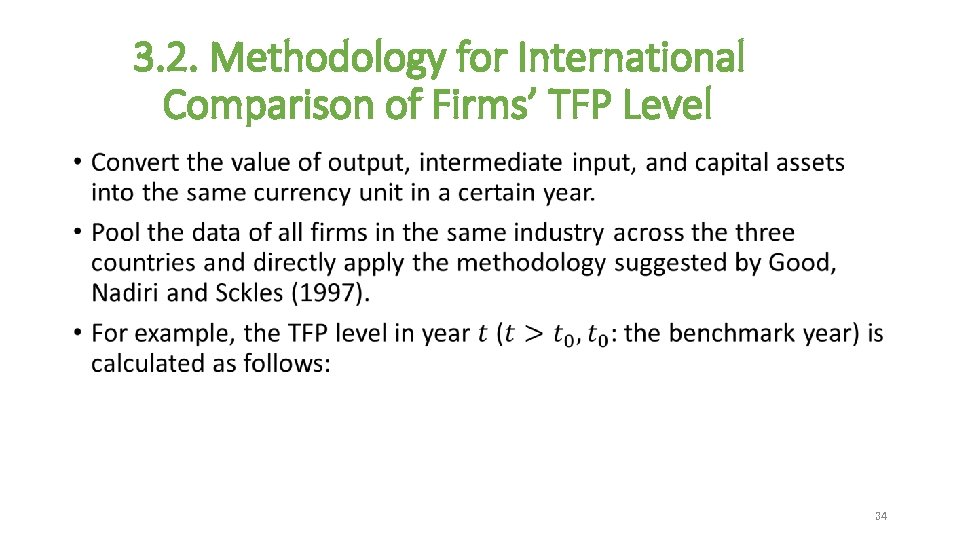
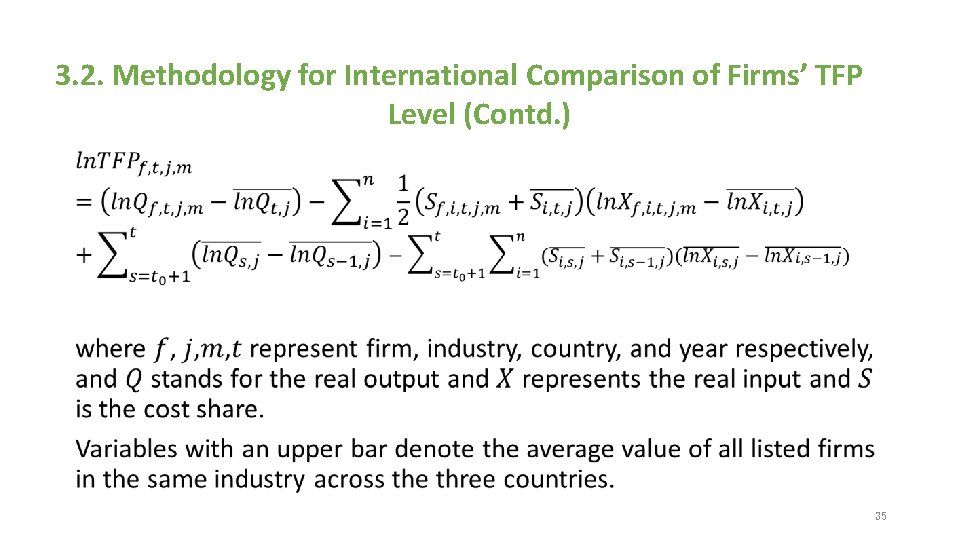
3. 2. Methodology for International Comparison of Firms’ TFP Level • 34
3. 2. Methodology for International Comparison of Firms’ TFP Level (Contd. ) • 35
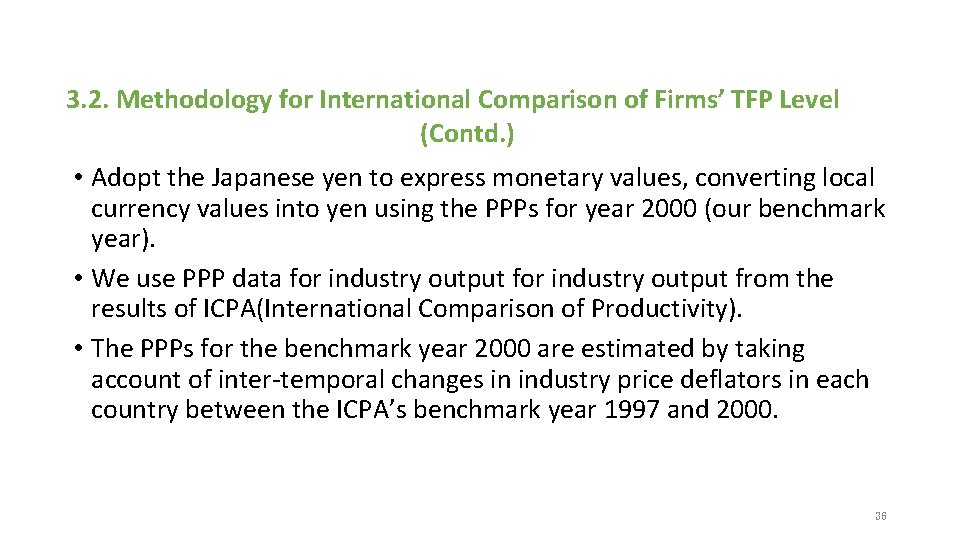
3. 2. Methodology for International Comparison of Firms’ TFP Level (Contd. ) • Adopt the Japanese yen to express monetary values, converting local currency values into yen using the PPPs for year 2000 (our benchmark year). • We use PPP data for industry output from the results of ICPA(International Comparison of Productivity). • The PPPs for the benchmark year 2000 are estimated by taking account of inter‐temporal changes in industry price deflators in each country between the ICPA’s benchmark year 1997 and 2000. 36
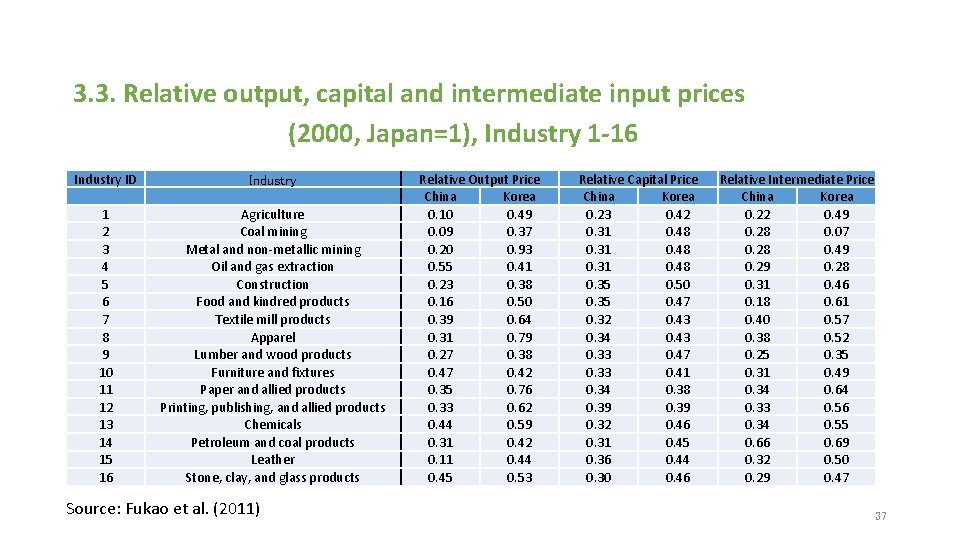
3. 3. Relative output, capital and intermediate input prices (2000, Japan=1), Industry 1 -16 Industry ID Industry 1 2 3 4 5 6 7 8 9 10 11 12 13 14 15 16 Agriculture Coal mining Metal and non‐metallic mining Oil and gas extraction Construction Food and kindred products Textile mill products Apparel Lumber and wood products Furniture and fixtures Paper and allied products Printing, publishing, and allied products Chemicals Petroleum and coal products Leather Stone, clay, and glass products Source: Fukao et al. (2011) Relative Output Price China Korea 0. 10 0. 49 0. 09 0. 37 0. 20 0. 93 0. 55 0. 41 0. 23 0. 38 0. 16 0. 50 0. 39 0. 64 0. 31 0. 79 0. 27 0. 38 0. 47 0. 42 0. 35 0. 76 0. 33 0. 62 0. 44 0. 59 0. 31 0. 42 0. 11 0. 44 0. 45 0. 53 Relative Capital Price China Korea 0. 23 0. 42 0. 31 0. 48 0. 35 0. 50 0. 35 0. 47 0. 32 0. 43 0. 34 0. 43 0. 33 0. 47 0. 33 0. 41 0. 34 0. 38 0. 39 0. 32 0. 46 0. 31 0. 45 0. 36 0. 44 0. 30 0. 46 Relative Intermediate Price China Korea 0. 22 0. 49 0. 28 0. 07 0. 28 0. 49 0. 28 0. 31 0. 46 0. 18 0. 61 0. 40 0. 57 0. 38 0. 52 0. 25 0. 31 0. 49 0. 34 0. 64 0. 33 0. 56 0. 34 0. 55 0. 66 0. 69 0. 32 0. 50 0. 29 0. 47 37
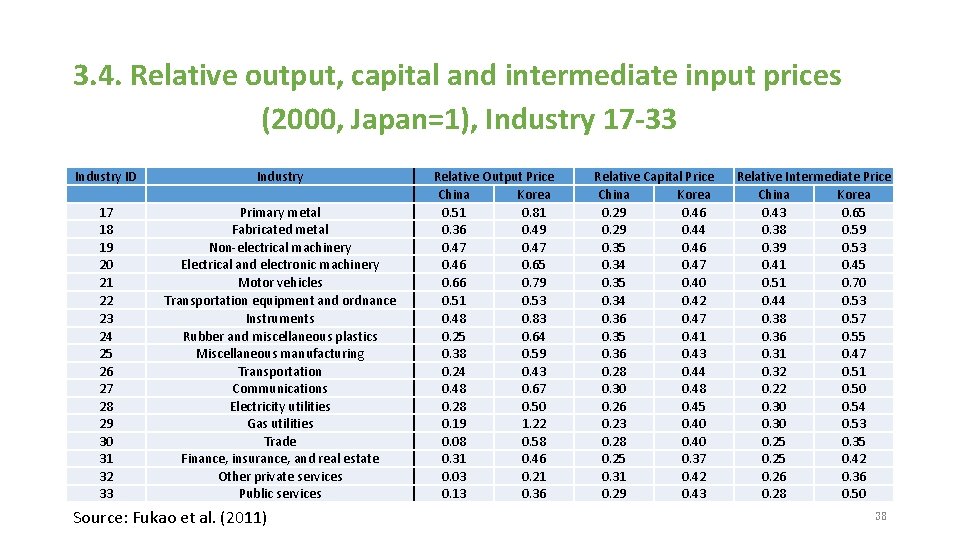
3. 4. Relative output, capital and intermediate input prices (2000, Japan=1), Industry 17 -33 Industry ID Industry 17 18 19 20 21 22 23 24 25 26 27 28 29 30 31 32 33 Primary metal Fabricated metal Non‐electrical machinery Electrical and electronic machinery Motor vehicles Transportation equipment and ordnance Instruments Rubber and miscellaneous plastics Miscellaneous manufacturing Transportation Communications Electricity utilities Gas utilities Trade Finance, insurance, and real estate Other private services Public services Source: Fukao et al. (2011) Relative Output Price China Korea 0. 51 0. 81 0. 36 0. 49 0. 47 0. 46 0. 65 0. 66 0. 79 0. 51 0. 53 0. 48 0. 83 0. 25 0. 64 0. 38 0. 59 0. 24 0. 43 0. 48 0. 67 0. 28 0. 50 0. 19 1. 22 0. 08 0. 58 0. 31 0. 46 0. 03 0. 21 0. 13 0. 36 Relative Capital Price China Korea 0. 29 0. 46 0. 29 0. 44 0. 35 0. 46 0. 34 0. 47 0. 35 0. 40 0. 34 0. 42 0. 36 0. 47 0. 35 0. 41 0. 36 0. 43 0. 28 0. 44 0. 30 0. 48 0. 26 0. 45 0. 23 0. 40 0. 28 0. 40 0. 25 0. 37 0. 31 0. 42 0. 29 0. 43 Relative Intermediate Price China Korea 0. 43 0. 65 0. 38 0. 59 0. 39 0. 53 0. 41 0. 45 0. 51 0. 70 0. 44 0. 53 0. 38 0. 57 0. 36 0. 55 0. 31 0. 47 0. 32 0. 51 0. 22 0. 50 0. 30 0. 54 0. 30 0. 53 0. 25 0. 35 0. 25 0. 42 0. 26 0. 36 0. 28 0. 50 38
3. 5. TFP Growth Rate (percent per annum) 2000‐ 2007‐ 2010 Japan 1. 49 0. 25 Korea ‐ 1. 25 ‐ 1. 40 China 2. 16 0. 89 39
3. 5. TFP growth rates (percent per annum, contd. ) 8 6 4 2 0 ‐ 2 ‐ 4 ‐ 6 ‐ 8 ‐ 10 2001 2002 2003 2004 2005 2006 2007 2008 2009 2010 Japan Korea China 40
3. 6. TFP in Japan, Korea and China: Chemical industry 0. 6 0. 4 0. 2 0 ‐ 0. 2 ‐ 0. 4 ‐ 0. 6 ‐ 0. 8 2000 2001 2002 2003 2004 Japan 2005 Korea 2006 2007 2008 2009 2010 China 41
3. 7. TFP in Japan, Korea and China: Primary metal industry 0. 4 0. 3 0. 2 0. 1 0 ‐ 0. 1 ‐ 0. 2 ‐ 0. 3 ‐ 0. 4 ‐ 0. 5 ‐ 0. 6 2000 2001 2002 2003 2004 Japan 2005 Korea 2006 2007 2008 2009 2010 China 42
3. 8. TFP in Japan, Korea and China: Non-electrical machinery industry 0. 6 0. 4 0. 2 0 ‐ 0. 2 ‐ 0. 4 ‐ 0. 6 ‐ 0. 8 ‐ 1 2000 2001 2002 2003 2004 Japan 2005 Korea 2006 2007 2008 2009 2010 China 43
3. 9. TFP in Japan, Korea and China: Electrical machinery industry 1 0. 8 0. 6 0. 4 0. 2 0 ‐ 0. 2 ‐ 0. 4 ‐ 0. 6 2000 2001 2002 2003 2004 Japan 2005 Korea 2006 2007 2008 2009 2010 China 44
3. 10. TFP in Japan, Korea and China: Motor vehicle industry 0. 2 0. 15 0. 1 0. 05 0 ‐ 0. 05 ‐ 0. 15 ‐ 0. 2 2000 2001 2002 2003 2004 Japan 2005 2006 2007 2008 2009 2010 Korea 45
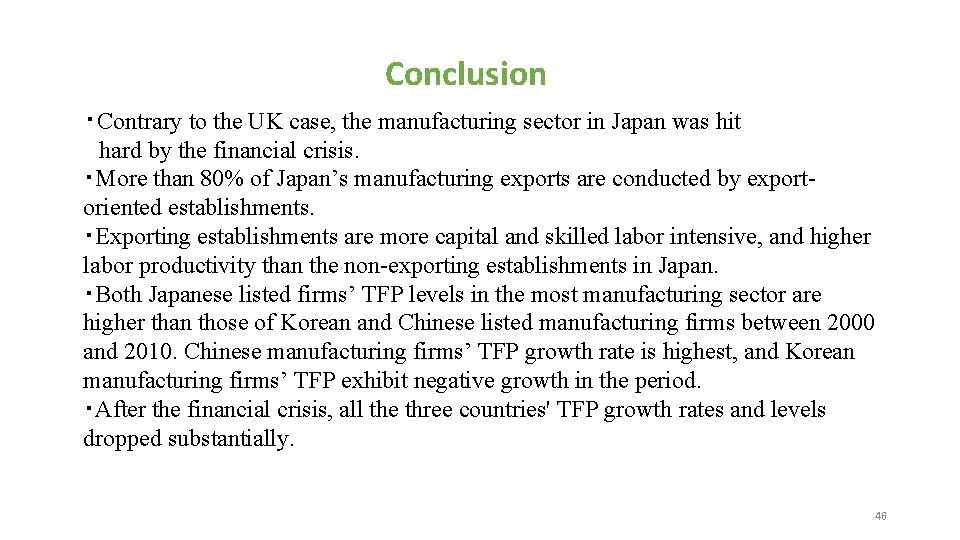
Conclusion ・Contrary to the UK case, the manufacturing sector in Japan was hit hard by the financial crisis. ・More than 80% of Japan’s manufacturing exports are conducted by exportoriented establishments. ・Exporting establishments are more capital and skilled labor intensive, and higher labor productivity than the non-exporting establishments in Japan. ・Both Japanese listed firms’ TFP levels in the most manufacturing sector are higher than those of Korean and Chinese listed manufacturing firms between 2000 and 2010. Chinese manufacturing firms’ TFP growth rate is highest, and Korean manufacturing firms’ TFP exhibit negative growth in the period. ・After the financial crisis, all the three countries' TFP growth rates and levels dropped substantially. 46
References Ahmad, Nadim and Araujo, Sonia, “Using Trade Microdata to Improve Trade in Value Added Measures: Proof of Concept Using Turkish Data. ” OECD Working Paper, 2011. Basu, S. , J. Fernald, and M. Kimball (2006) “Are Technology Improvements Contractionary? ” The American Economic Review 96(5), pp. 1418‐ 48. Fetzer, James and Strassner, Erich H. , “Identifying Heterogeneity in the Production Components of Globally Engaged Business Enterprises in the United States, ” working paper, 2015 Fukao Kyoji, Inui Tomohiko, Ito Keiko, Kim Young. Gak, and Yuan Tangjun, “An International Comparison of the TFP Levels and the Productivity Convergence of Japanese, Korean, Taiwan, and Chinese Listed Firms, ” Journal of Chinese Economic and Business Studies, 9(2), 2011, pp. 127‐ 150. Good, D. H. , M. I. Nadiri, and R. C. Sickles (1997) “Index Number and Factor Demand Approaches to the Estimation of Productivity, ” in: M. Hashem Pesaran and Peter Schmidt (eds. ), Handbook of Applied Econometrics: Microeconomics, vol. II, pp. 14‐ 80, Blackwell, Oxford Goodridge, P. , J. Haskel, and G. Wallis (2015) “Accounting the UK Productivity Puzzle: A Decomposition and Predictions” Imperial Colledge London Business School. Jorgenson, D. W. , M. S. Ho, and K. J. Stiroh (2007), “Industry Origins of the American Productivity Resurgence”, Economic Systems Research 19(3), oo. 229‐ 52. Melitz, Marc J. , “The Impact of Trade on Intra‐Industry Reallocations and Aggregate Industry Productivity, ” Econometrica, 71(6), 2003, pp. 1695‐ 1725. Ma, Hong, Wang, Zhi, and Zhu, Kunfu, “Domestic Content in China’s Exports and its Distribution by Firm Ownership, ” Journal of Comparative Economics, 43(1), 2015, pp. 3‐ 18. Piacentini, Mario and Fortanier, Fabienne, “Firm Heterogeneity and Trade in Value Added, ” OECD Working Paper, 2015. 47