
How did the Industrial Revolution change transport in
- Slides: 1
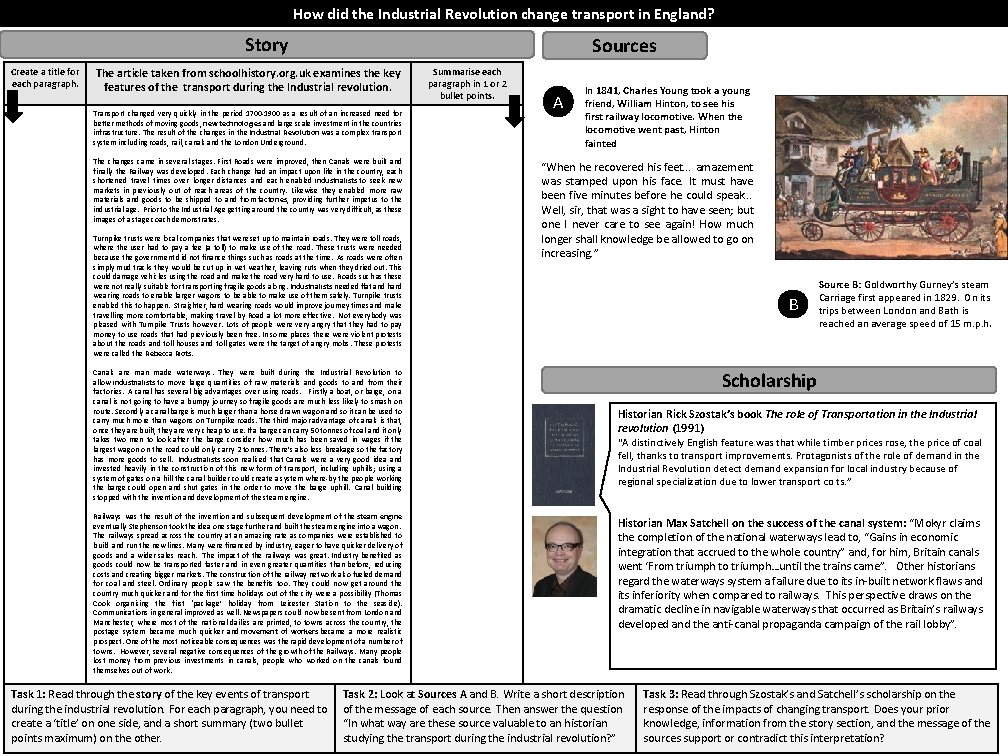
How did the Industrial Revolution change transport in England? Story Create a title for each paragraph. Sources The article taken from schoolhistory. org. uk examines the key features of the transport during the Industrial revolution. Transport changed very quickly in the period 1700 -1900 as a result of an increased need for better methods of moving goods, new technologies and large scale investment in the countries infrastructure. The result of the changes in the Industrial Revolution was a complex transport system including roads, rail, canals and the London Underground. The changes came in several stages. First Roads were improved, then Canals were built and finally the Railway was developed. Each change had an impact upon life in the country, each shortened travel times over longer distances and each enabled industrialists to seek new markets in previously out of reach areas of the country. Likewise they enabled more raw materials and goods to be shipped to and from factories, providing further impetus to the industrial age. Prior to the Industrial Age getting around the country was very difficult, as these images of a stage coach demonstrates. Turnpike trusts were local companies that were set up to maintain roads. They were toll roads, where the user had to pay a fee (a toll) to make use of the road. These trusts were needed because the government did not finance things such as roads at the time. As roads were often simply mud tracks they would be cut up in wet weather, leaving ruts when they dried out. This could damage vehicles using the road and make the road very hard to use. Roads such as these were not really suitable for transporting fragile goods along. Industrialists needed flat and hard wearing roads to enable larger wagons to be able to make use of them safely. Turnpike trusts enabled this to happen. Straighter, hard wearing roads would improve journey times and make travelling more comfortable, making travel by Road a lot more effective. Not everybody was pleased with Turnpike Trusts however. Lots of people were very angry that they had to pay money to use roads that had previously been free. In some places there were violent protests about the roads and toll houses and toll gates were the target of angry mobs. These protests were called the Rebecca Riots. Canals are man made waterways. They were built during the Industrial Revolution to allow industrialists to move large quantities of raw materials and goods to and from their factories. A canal has several big advantages over using roads. Firstly a boat, or barge, on a canal is not going to have a bumpy journey so fragile goods are much less likely to smash on route. Secondly a canal barge is much larger than a horse drawn wagon and so it can be used to carry much more than wagons on Turnpike roads. The third major advantage of canals is that, once they are built, they are very cheap to use. If a barge can carry 50 tonnes of coal and it only takes two men to look after the barge consider how much has been saved in wages if the largest wagon on the road could only carry 2 tonnes. There’s also less breakage so the factory has more goods to sell. Industrialists soon realised that Canals were a very good idea and invested heavily in the construction of this new form of transport, including uphills; using a system of gates on a hill the canal builder could create a system where-by the people working the barge could open and shut gates in the order to move the barge uphill. Canal building stopped with the invention and development of the steam engine. Railways was the result of the invention and subsequent development of the steam engine eventually Stephenson took the idea one stage further and built the steam engine into a wagon. The railways spread across the country at an amazing rate as companies were established to build and run the new lines. Many were financed by industry, eager to have quicker delivery of goods and a wider sales reach. The impact of the railways was great. Industry benefited as goods could now be transported faster and in even greater quantities than before, reducing costs and creating bigger markets. The construction of the railway network also fueled demand for coal and steel. Ordinary people saw the benefits too. They could now get around the country much quicker and for the first time holidays out of the city were a possibility (Thomas Cook organising the first ‘package’ holiday from Leicester Station to the seaside). Communications in general improved as well. Newspapers could now be sent from London and Manchester, where most of the national dailies are printed, to towns across the country, the postage system became much quicker and movement of workers became a more realistic prospect. One of the most noticeable consequences was the rapid development of a number of towns. However, several negative consequences of the growth of the Railways. Many people lost money from previous investments in canals, people who worked on the canals found themselves out of work. Task 1: Read through the story of the key events of transport during the industrial revolution. For each paragraph, you need to create a ‘title’ on one side, and a short summary (two bullet points maximum) on the other. Summarise each paragraph in 1 or 2 bullet points. A In 1841, Charles Young took a young friend, William Hinton, to see his first railway locomotive. When the locomotive went past, Hinton fainted “When he recovered his feet. . . amazement was stamped upon his face. It must have been five minutes before he could speak. . . Well, sir, that was a sight to have seen; but one I never care to see again! How much longer shall knowledge be allowed to go on increasing. ” B Source B: Goldworthy Gurney’s steam Carriage first appeared in 1829. On its trips between London and Bath is reached an average speed of 15 m. p. h. Scholarship Historian Rick Szostak’s book The role of Transportation in the Industrial revolution (1991) “A distinctively English feature was that while timber prices rose, the price of coal fell, thanks to transport improvements. Protagonists of the role of demand in the Industrial Revolution detect demand expansion for local industry because of regional specialization due to lower transport co ts. ” Historian Max Satchell on the success of the canal system: “Mokyr claims the completion of the national waterways lead to, “Gains in economic integration that accrued to the whole country” and, for him, Britain canals went ‘From triumph to triumph…until the trains came”. Other historians regard the waterways system a failure due to its in-built network flaws and its inferiority when compared to railways. This perspective draws on the dramatic decline in navigable waterways that occurred as Britain’s railways developed and the anti-canal propaganda campaign of the rail lobby”. Task 2: Look at Sources A and B. Write a short description of the message of each source. Then answer the question “In what way are these source valuable to an historian studying the transport during the industrial revolution? ” Task 3: Read through Szostak’s and Satchell’s scholarship on the response of the impacts of changing transport. Does your prior knowledge, information from the story section, and the message of the sources support or contradict this interpretation?