
How did civilizations first develop in Mesopotamia Focus



- Slides: 12
How did civilizations first develop in Mesopotamia? Focus Question: Was Ancient Sumer a Civilization? *
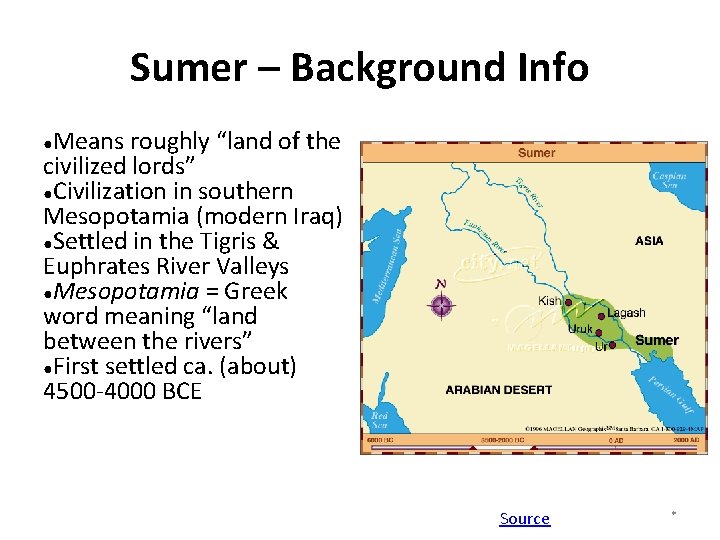
Sumer – Background Info Means roughly “land of the civilized lords” ●Civilization in southern Mesopotamia (modern Iraq) ●Settled in the Tigris & Euphrates River Valleys ●Mesopotamia = Greek word meaning “land between the rivers” ●First settled ca. (about) 4500 -4000 BCE ● Source *
Was Sumer a Civilization? Today, you will provide evidence that proves ancient Sumer was in fact a civilization. ●To do this, we will use the GRAPES tool to see how these artifacts show the different aspects of a civilization: ● Geography ●Religion ●Achievements ●Political System (government) ●Economics ●Social Structure ● *
Title your paper GRAPES OF SUMER First, label your boxes with the 6 characteristics that make up GRAPES ●Your pages should look something like this -> ● *
GEOGRAPHY ACHIEVEMENTS ECONOMICS RELIGION POLITICAL SYSTEM (GOVERNMENT) SOCIAL STRUCTURE *
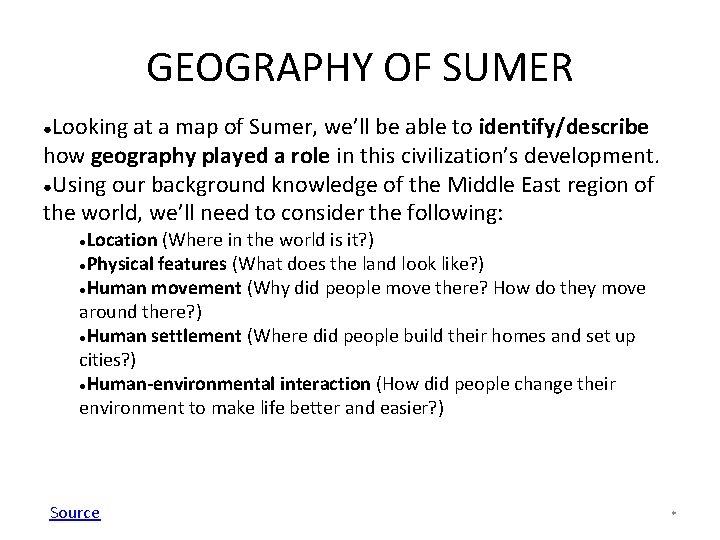
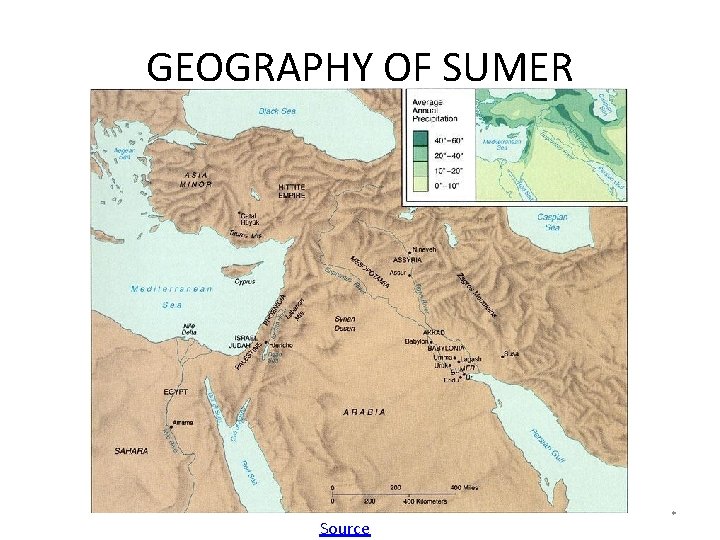
GEOGRAPHY OF SUMER Looking at a map of Sumer, we’ll be able to identify/describe how geography played a role in this civilization’s development. ●Using our background knowledge of the Middle East region of the world, we’ll need to consider the following: ● Location (Where in the world is it? ) ●Physical features (What does the land look like? ) ●Human movement (Why did people move there? How do they move around there? ) ●Human settlement (Where did people build their homes and set up cities? ) ●Human-environmental interaction (How did people change their environment to make life better and easier? ) ● Source *
GEOGRAPHY OF SUMER Source *
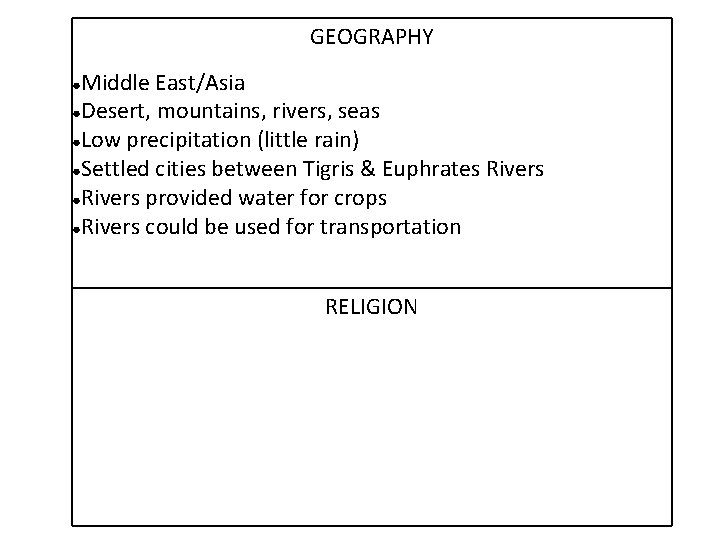
GEOGRAPHY Middle East/Asia ●Desert, mountains, rivers, seas ●Low precipitation (little rain) ●Settled cities between Tigris & Euphrates Rivers ●Rivers provided water for crops ●Rivers could be used for transportation ● RELIGION
GRAPES of Sumer Instructions: 1. You will gather information for the rest of the GRAPES boxes. You will first discuss with your elbow partner what characteristics made ancient Sumer a civilization, one component at a time. In complete, detailed sentences, describe the characteristics that make ancient Sumer a civilization on your paper. 2. For each component, you will need to also sketch a detailed illustration of any artifact, idea, example, etc. in the same box (this is what historians actually do). *
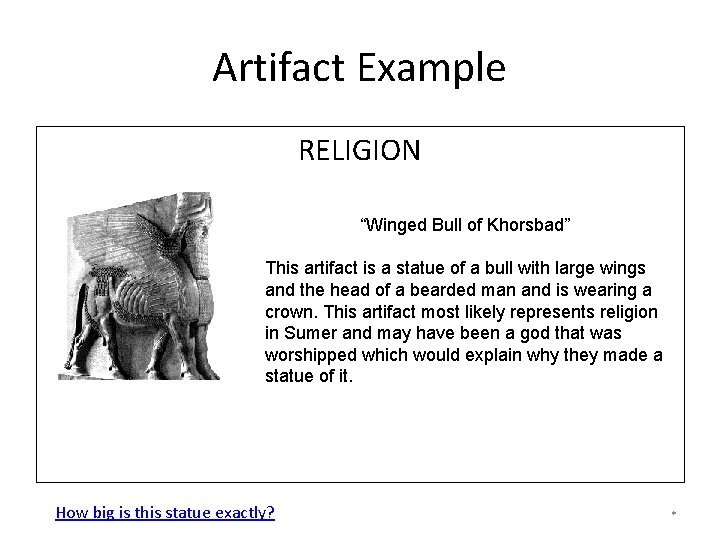
Artifact Example RELIGION “Winged Bull of Khorsbad” This artifact is a statue of a bull with large wings and the head of a bearded man and is wearing a crown. This artifact most likely represents religion in Sumer and may have been a god that was worshipped which would explain why they made a statue of it. How big is this statue exactly? *
The question you are answering is: Was ancient Sumer a civilization? *
Scoring Rubric: Your response will be scored as reaching one of the following levels: ● 4 – Student consistently excels at accurately answering the question in detail and meeting the lesson objective. ● 3 – Student has satisfactorily and accurately answered the question with detail and has met the lesson objective. ● 2 – Student is making progress toward answering the question and is making progress toward meeting the lesson objective. ● 1 – Student is targeted for growth toward answering the question and may need additional assistance in meeting the lesson objective. ● *