
HOW CULTURAL FACTORS AFFECT MEMORY ONE COGNITIVE PROCESS
- Slides: 10
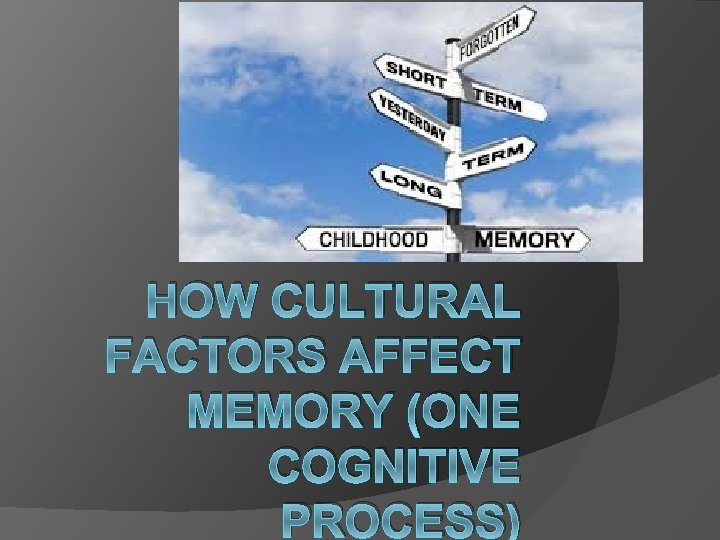
HOW CULTURAL FACTORS AFFECT MEMORY (ONE COGNITIVE PROCESS)
� If one assumes that cognitive processes (here memory), follow universal laws, then all humans, regardless of culture perform the same.
Research showing cultural factors that influence cognition (memory) Culture affects our schemas & values Culture affects why people remember, how they remember, when they remember, what they remember and whether they find it necessary to remember at all (Wang & Ross 2007) Can you apply this in your own life?
Cross-cultural research Cognitive psychology research Traditionally conducted in Western Europe (with a tradition of formal schooling) � Western researchers tested on nonwestern countries (found differences draw the wrong conclusions) � Results only valid in western countries � Must have insight into language and culture of a group �
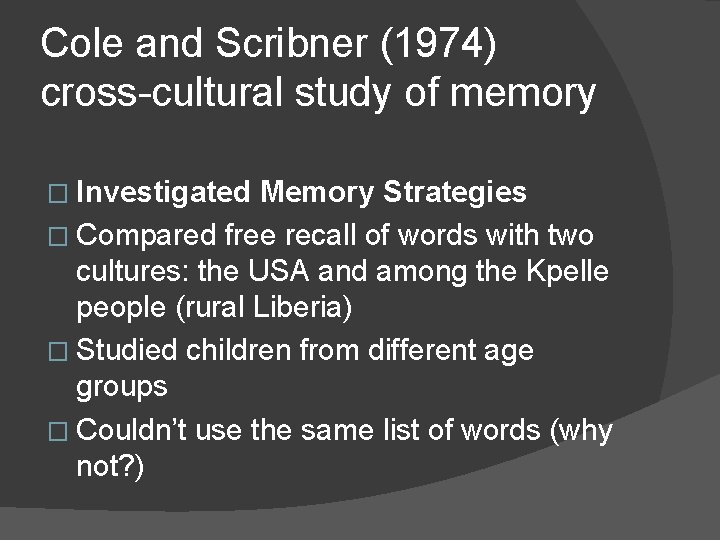
Cole and Scribner (1974) cross-cultural study of memory � Investigated Memory Strategies � Compared free recall of words with two cultures: the USA and among the Kpelle people (rural Liberia) � Studied children from different age groups � Couldn’t use the same list of words (why not? )
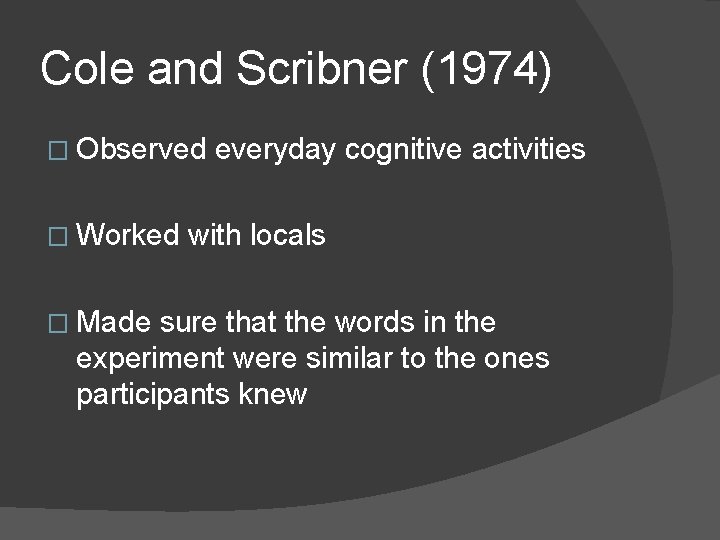
Cole and Scribner (1974) � Observed � Worked � Made everyday cognitive activities with locals sure that the words in the experiment were similar to the ones participants knew
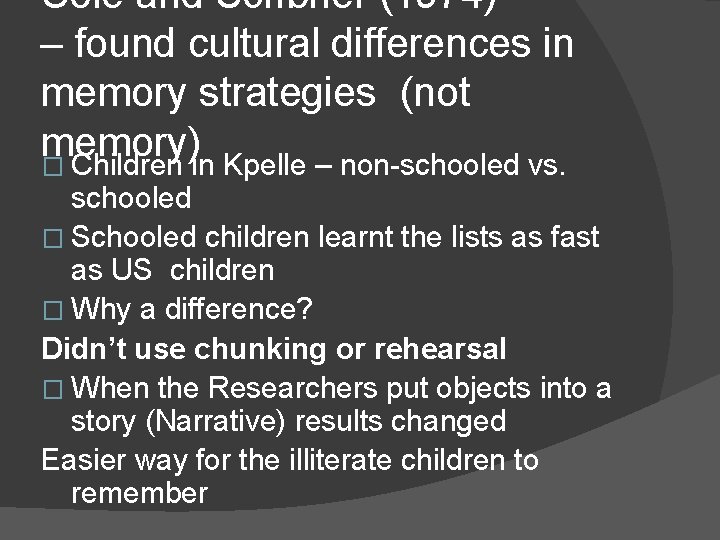
Cole and Scribner (1974) – found cultural differences in memory strategies (not memory) � Children in Kpelle – non-schooled vs. schooled � Schooled children learnt the lists as fast as US children � Why a difference? Didn’t use chunking or rehearsal � When the Researchers put objects into a story (Narrative) results changed Easier way for the illiterate children to remember
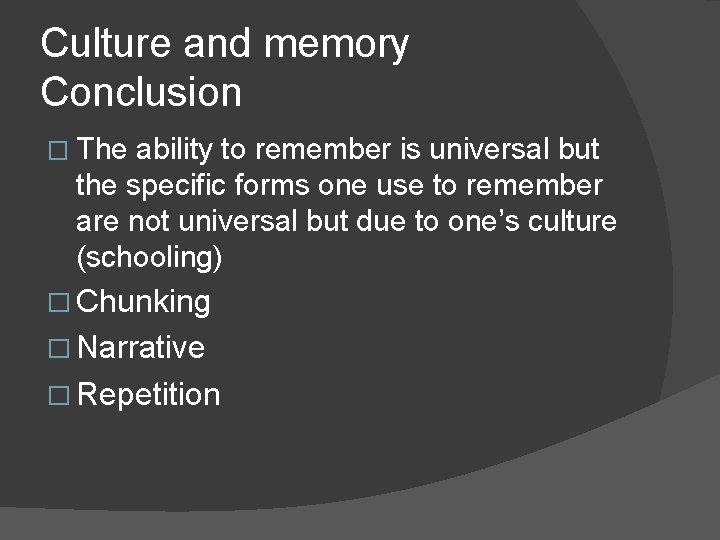
Culture and memory Conclusion � The ability to remember is universal but the specific forms one use to remember are not universal but due to one’s culture (schooling) � Chunking � Narrative � Repetition
Evaluation? � Method? � Ethics? � Culture? � Application? � Gender?
Research showing cultural factors that influence cognition (memory) � Schema theory (can be used to explain why our memory differs) � Bartlett – affect remembering (reconstructive memory) The War of the Ghost 1932 - whether people’s memory for a story is affected by previous knowledge (schemas) and the extent to which memory is reconstructive.