
How computers work What is Sequential Logic Sequential




- Slides: 23
How computers work? What is Sequential Logic? (Sequential Logic Tutor LT 2) Ravi Raizada Limrose Group, Wrexham, UK
limrose Computer can be many things to many people! Keyboards, Screens, Disk Drives, Robot, Internet?
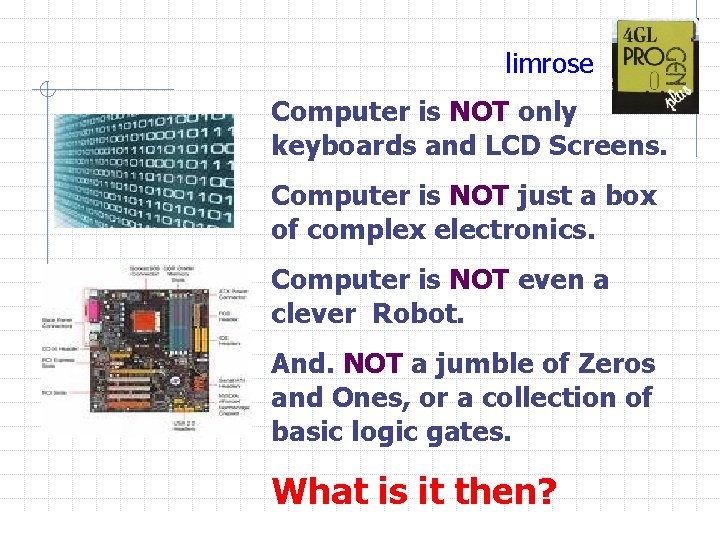
limrose Computer is NOT only keyboards and LCD Screens. Computer is NOT just a box of complex electronics. Computer is NOT even a clever Robot. And. NOT a jumble of Zeros and Ones, or a collection of basic logic gates. What is it then?
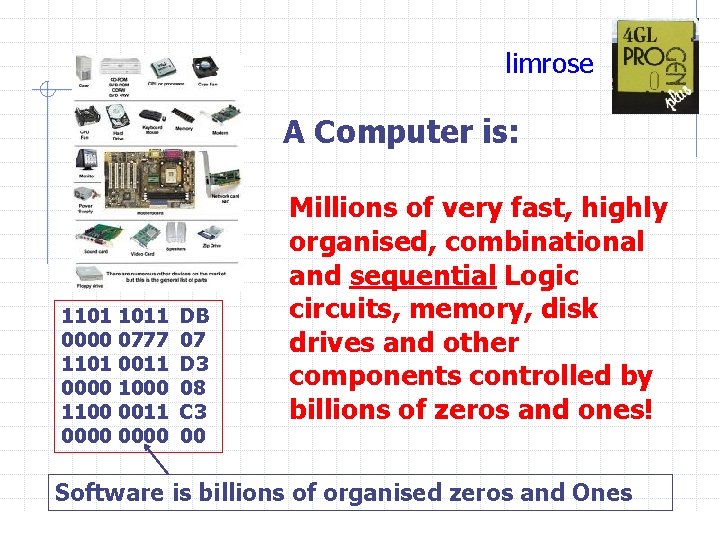
limrose A Computer is: 1101 1011 0000 0777 1101 0011 0000 1100 0011 0000 DB 07 D 3 08 C 3 00 Millions of very fast, highly organised, combinational and sequential Logic circuits, memory, disk drives and other components controlled by billions of zeros and ones! Software is billions of organised zeros and Ones
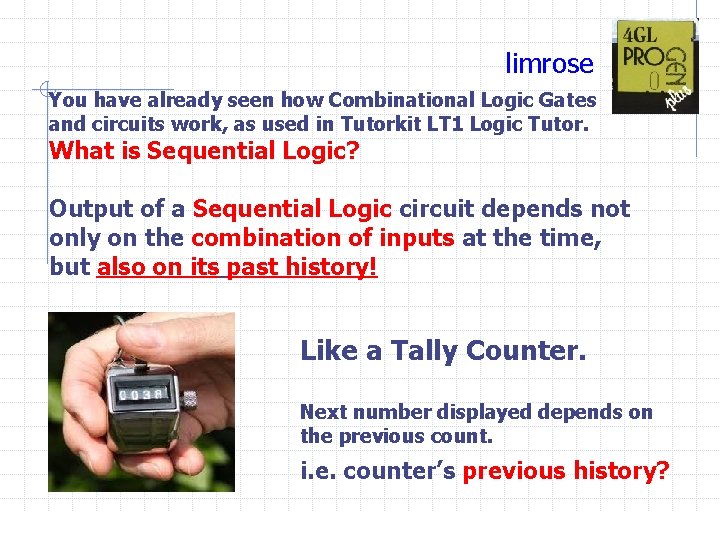
limrose You have already seen how Combinational Logic Gates and circuits work, as used in Tutorkit LT 1 Logic Tutor. What is Sequential Logic? Output of a Sequential Logic circuit depends not only on the combination of inputs at the time, but also on its past history! Like a Tally Counter. Next number displayed depends on the previous count. i. e. counter’s previous history?
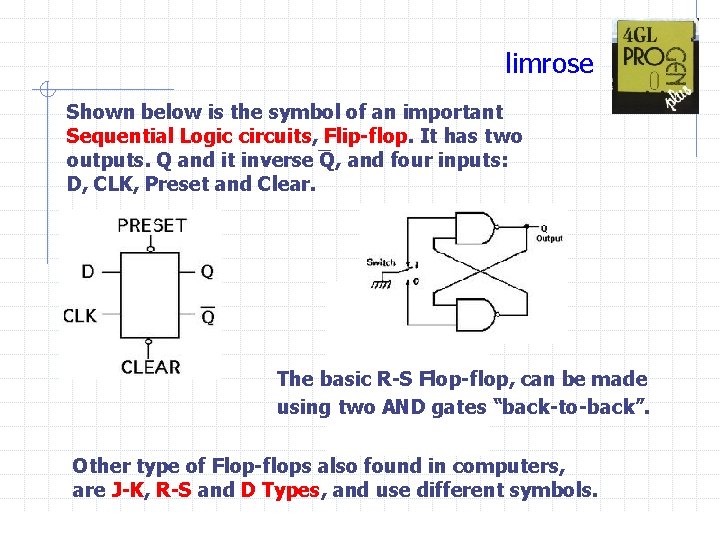
limrose Shown below is the symbol of an important Sequential Logic circuits, Flip-flop. It has two outputs. Q and it inverse Q, and four inputs: D, CLK, Preset and Clear. The basic R-S Flop-flop, can be made using two AND gates “back-to-back”. Other type of Flop-flops also found in computers, are J-K, R-S and D Types, and use different symbols.
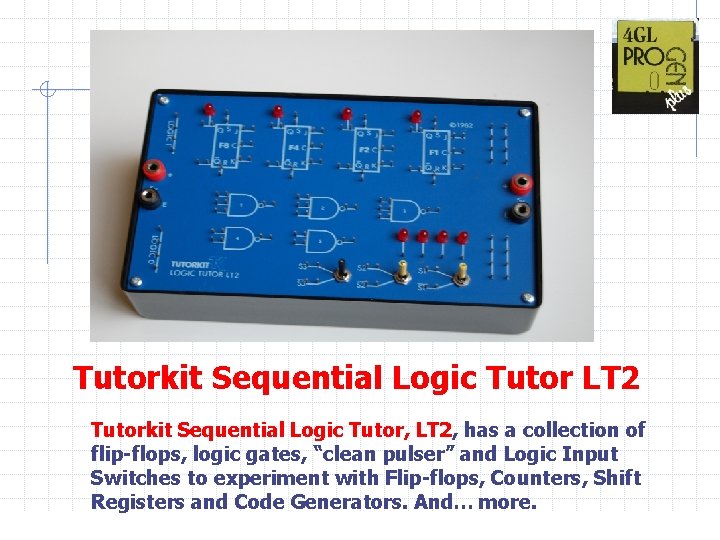
limrose Tutorkit Sequential Logic Tutor LT 2 Tutorkit Sequential Logic Tutor, LT 2, has a collection of flip-flops, logic gates, “clean pulser” and Logic Input Switches to experiment with Flip-flops, Counters, Shift Registers and Code Generators. And… more.
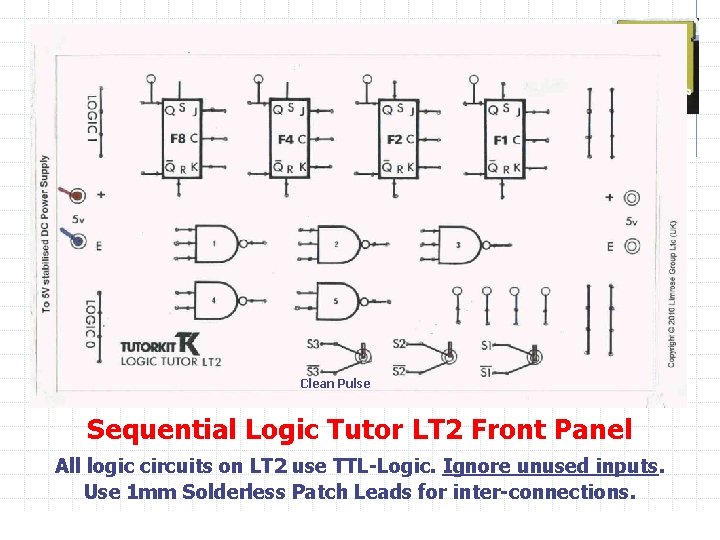
limrose Clean Pulse Sequential Logic Tutor LT 2 Front Panel All logic circuits on LT 2 use TTL-Logic. Ignore unused inputs. Use 1 mm Solderless Patch Leads for inter-connections.
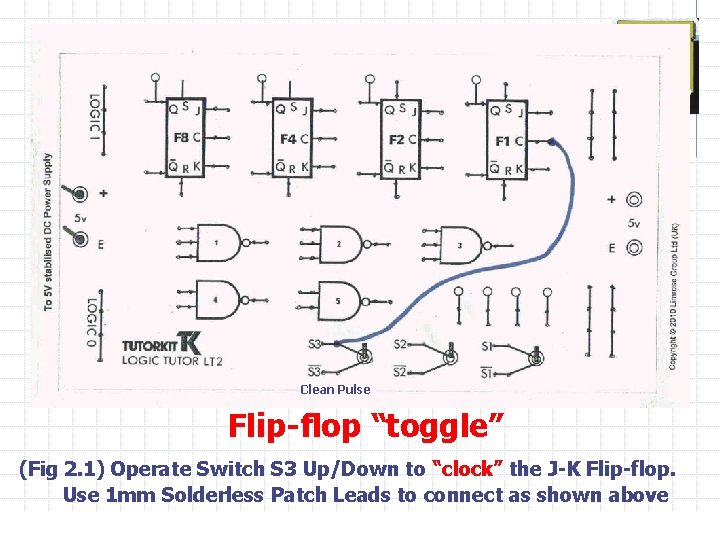
limrose Clean Pulse Flip-flop “toggle” (Fig 2. 1) Operate Switch S 3 Up/Down to “clock” the J-K Flip-flop. Use 1 mm Solderless Patch Leads to connect as shown above
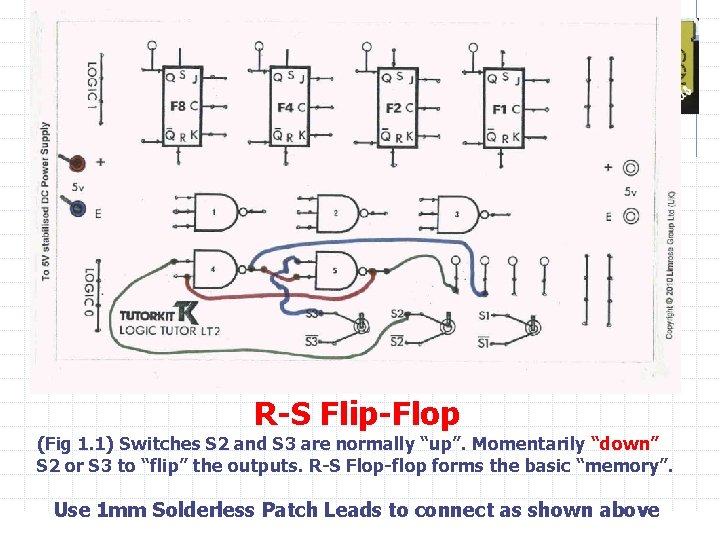
limrose R-S Flip-Flop (Fig 1. 1) Switches S 2 and S 3 are normally “up”. Momentarily “down” S 2 or S 3 to “flip” the outputs. R-S Flop-flop forms the basic “memory”. Use 1 mm Solderless Patch Leads to connect as shown above
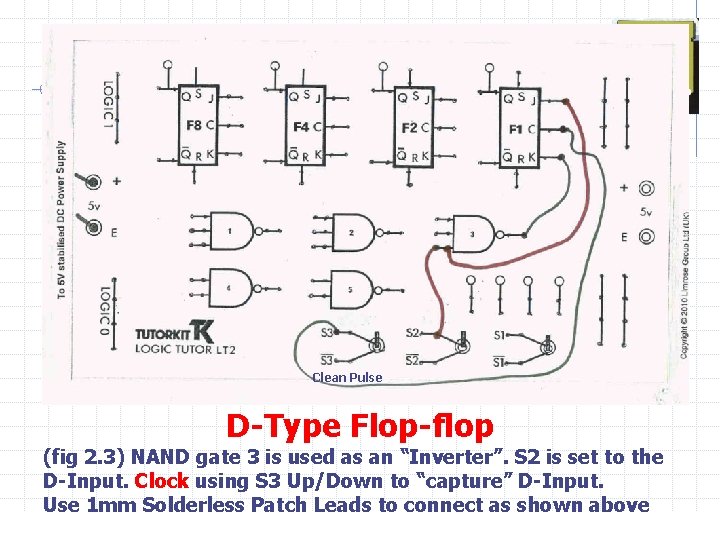
limrose Clean Pulse D-Type Flop-flop (fig 2. 3) NAND gate 3 is used as an “Inverter”. S 2 is set to the D-Input. Clock using S 3 Up/Down to “capture” D-Input. Use 1 mm Solderless Patch Leads to connect as shown above
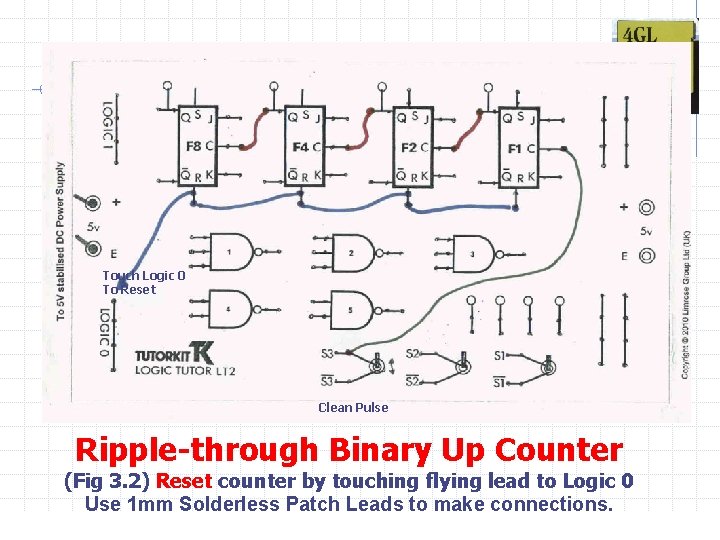
limrose Touch Logic 0 To Reset Clean Pulse Ripple-through Binary Up Counter (Fig 3. 2) Reset counter by touching flying lead to Logic 0 Use 1 mm Solderless Patch Leads to make connections.
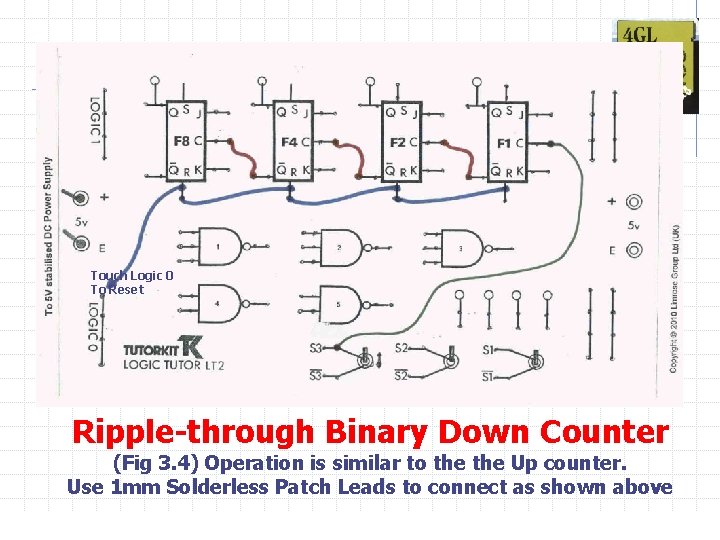
limrose Touch Logic 0 To Reset Ripple-through Binary Down Counter (Fig 3. 4) Operation is similar to the Up counter. Use 1 mm Solderless Patch Leads to connect as shown above
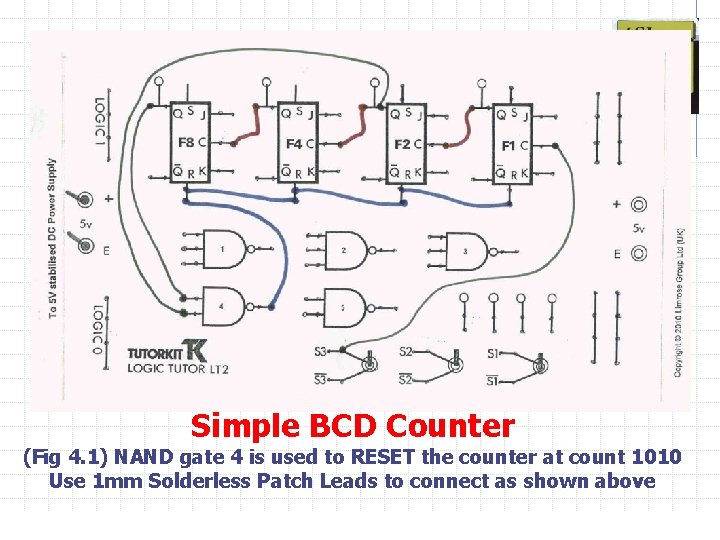
limrose Simple BCD Counter (Fig 4. 1) NAND gate 4 is used to RESET the counter at count 1010 Use 1 mm Solderless Patch Leads to connect as shown above
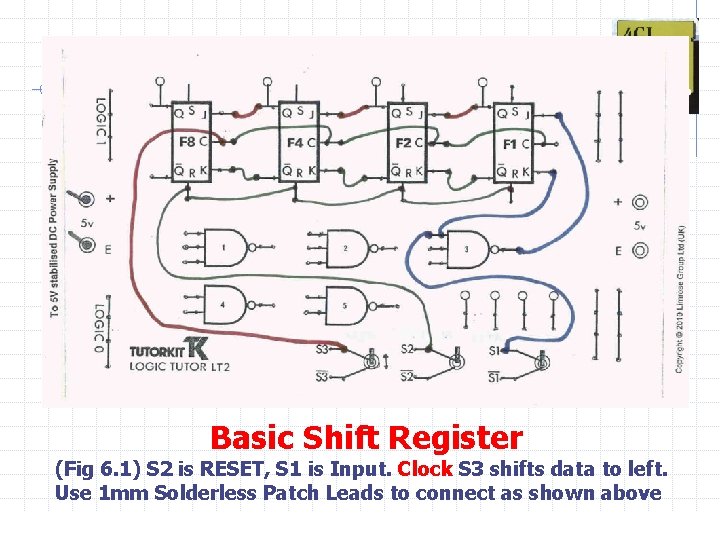
limrose Basic Shift Register (Fig 6. 1) S 2 is RESET, S 1 is Input. Clock S 3 shifts data to left. Use 1 mm Solderless Patch Leads to connect as shown above
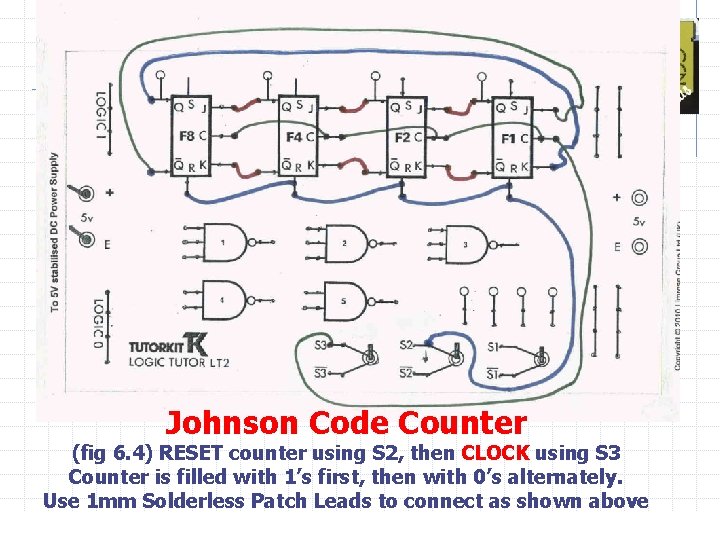
limrose Johnson Code Counter (fig 6. 4) RESET counter using S 2, then CLOCK using S 3 Counter is filled with 1’s first, then with 0’s alternately. Use 1 mm Solderless Patch Leads to connect as shown above
limrose And. More…. . Ring Counter Chain Code Generator Parallel-entry Shift Register etc. Use LT 2 in conjunction with LT 1 if more logic gates are required. Fire your imagination to create your own sequential circuits?
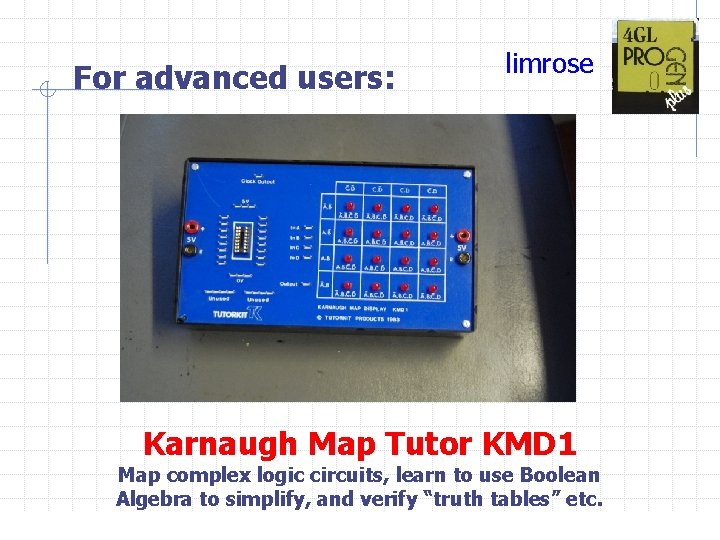
For advanced users: limrose Karnaugh Map Tutor KMD 1 Map complex logic circuits, learn to use Boolean Algebra to simplify, and verify “truth tables” etc.
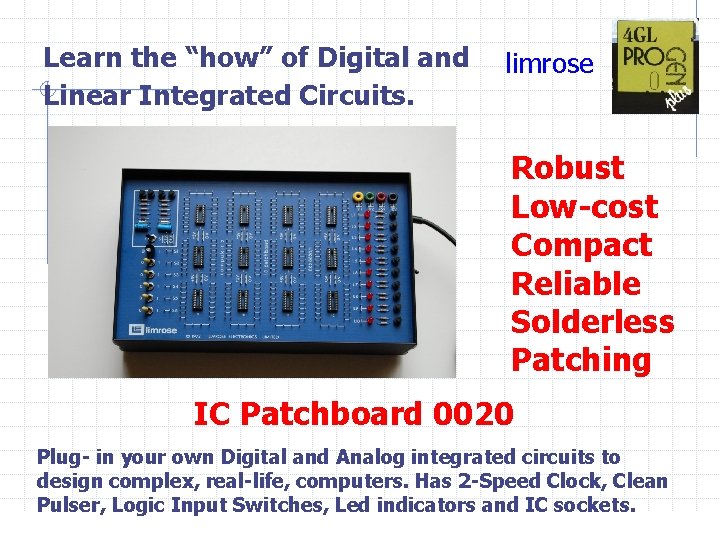
Learn the “how” of Digital and Linear Integrated Circuits. limrose Robust Low-cost Compact Reliable Solderless Patching IC Patchboard 0020 Plug- in your own Digital and Analog integrated circuits to design complex, real-life, computers. Has 2 -Speed Clock, Clean Pulser, Logic Input Switches, Led indicators and IC sockets.
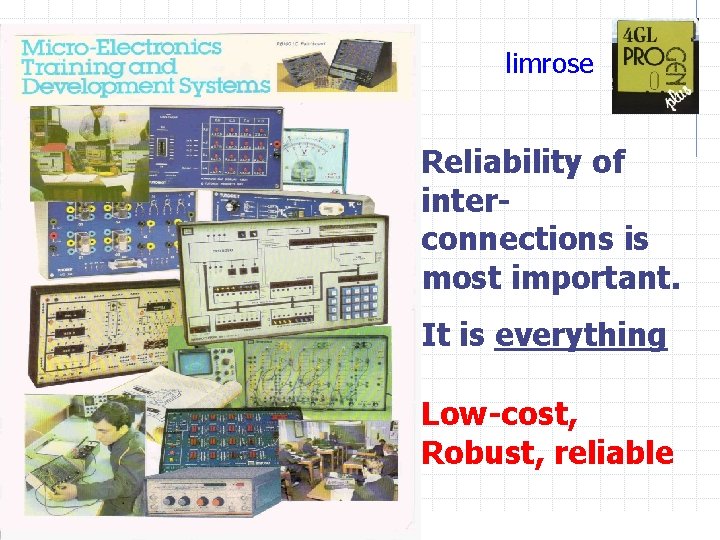
limrose Reliability of interconnections is most important. It is everything Low-cost, Robust, reliable
limrose Limrose also designed and marketed the first Microprocessor Trainer in UK. Vintage Limrose logic training systems and computers are now housed in Museum of Computing in Milton Keynes (UK), where they are also used to introduce school children to the intellectually stimulating and fascinating subject of logic.
Limrose have helped thousands of teachers and college lecturers to learn, manipulate and exploit the mystery of zeros and ones Limrose Group (UK) Limited Tel: (44) 1978 85 5555 www. limrosegroup. com Copyright 2015 limrose Group (UK)
Thank you