
How Computers Work Lecture 8 Asynchronous State Machines

- Slides: 29
How Computers Work Lecture 8 Asynchronous State Machines and Metastability How Computers Work Lecture 8 Page 1
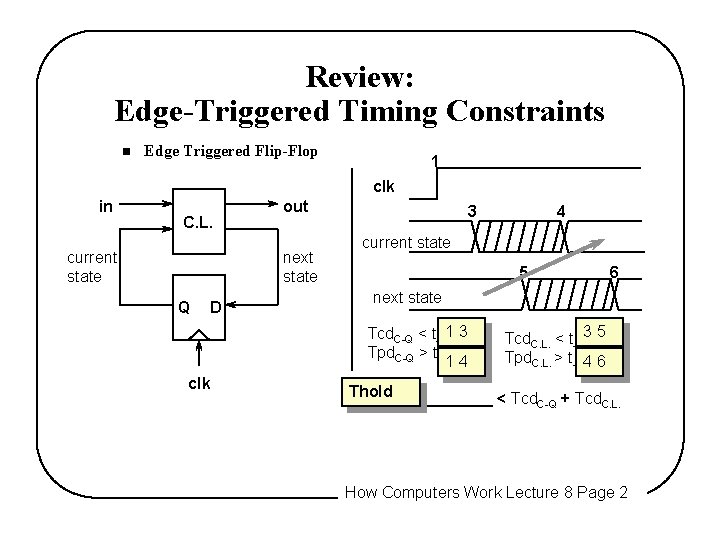
Review: Edge-Triggered Timing Constraints n Edge Triggered Flip-Flop 1 clk in C. L. current state out next state Q D 3 current state 5 6 next state 13 Tcd. C-Q < t____ Tpd. C-Q > t____ 14 clk 4 35 Tcd. C. L. < t____ Tpd. C. L. > t____ 46 Thold _________ < Tcd. C-Q + Tcd. C. L. How Computers Work Lecture 8 Page 2
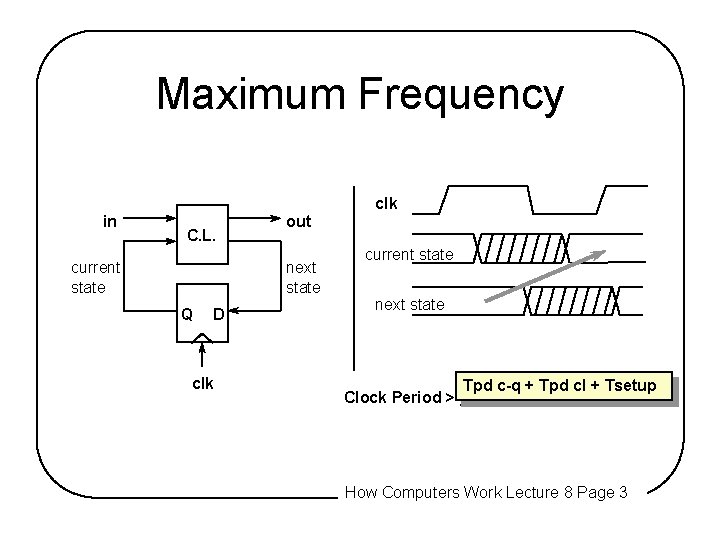
Maximum Frequency clk in C. L. current state out next state Q D clk current state next state Tpd c-q + Tpd cl + Tsetup Clock Period > ______ How Computers Work Lecture 8 Page 3
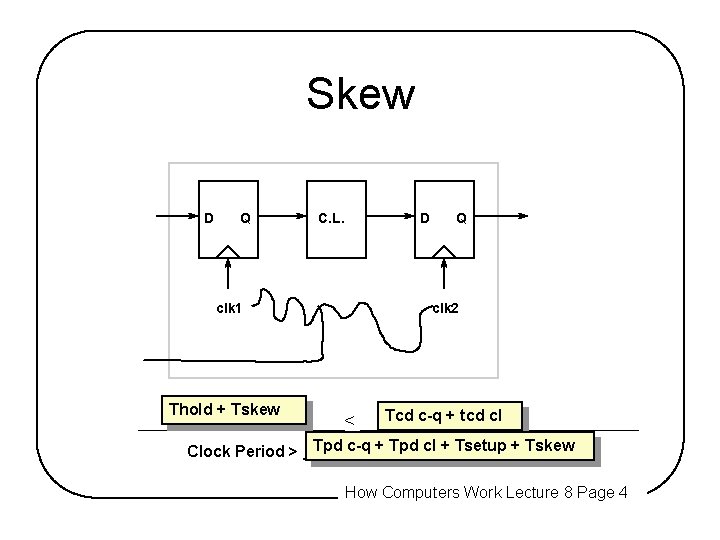
Skew D Q clk 1 C. L. D Q clk 2 Thold + Tskew Tcd c-q + tcd cl ____________< ________________ Tpd c-q + Tpd cl + Tsetup + Tskew Clock Period > ________________ How Computers Work Lecture 8 Page 4
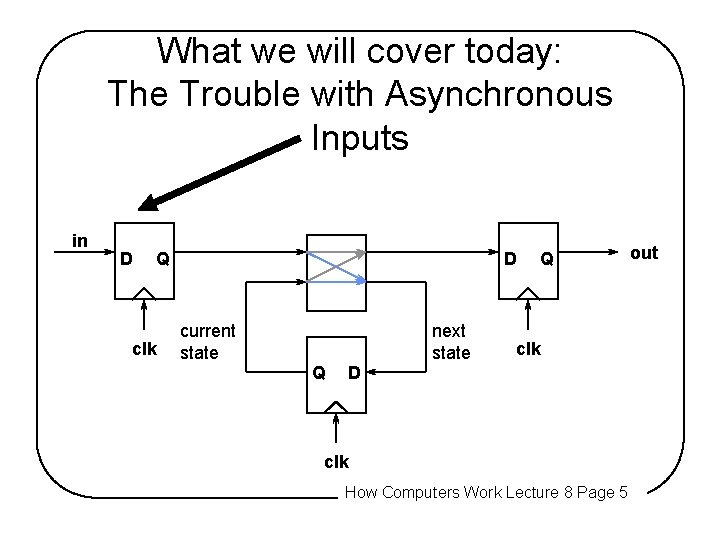
What we will cover today: The Trouble with Asynchronous Inputs in D Q clk D current state Q D next state Q clk How Computers Work Lecture 8 Page 5 out
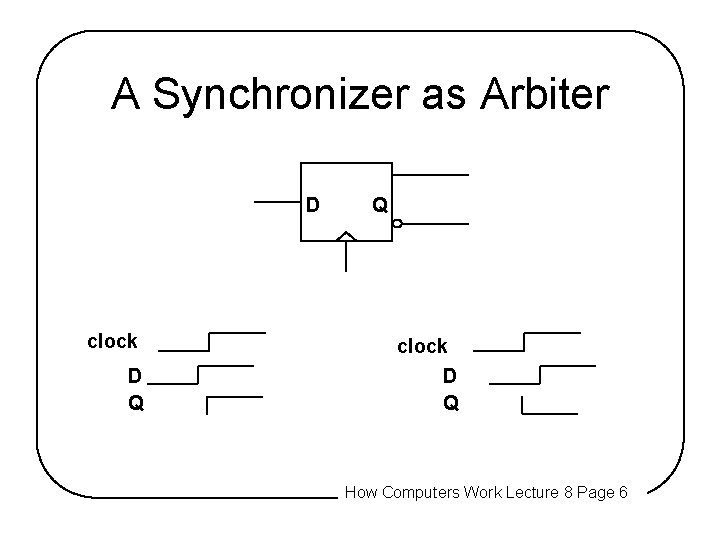
A Synchronizer as Arbiter D clock D Q Q clock D Q How Computers Work Lecture 8 Page 6
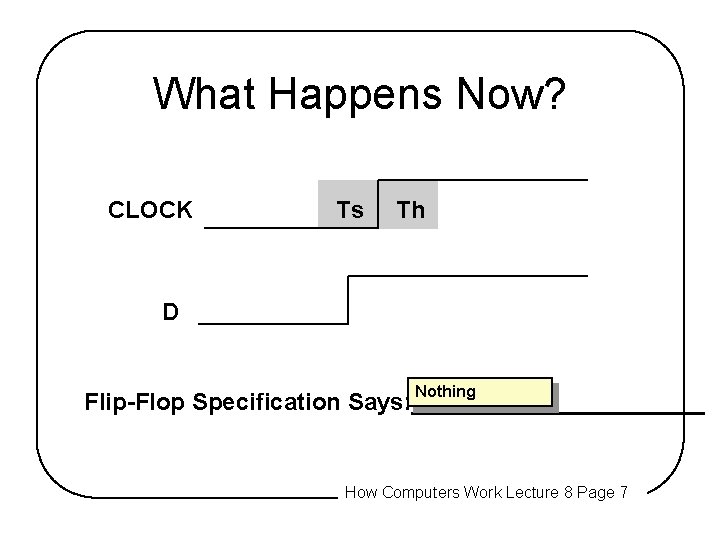
What Happens Now? CLOCK Ts Th D Nothing Flip-Flop Specification Says: ___________ How Computers Work Lecture 8 Page 7
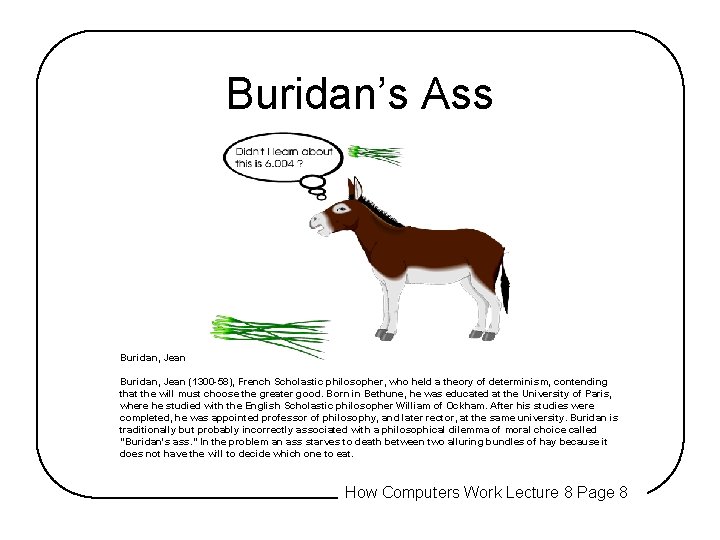
Buridan’s Ass Buridan, Jean (1300 -58), French Scholastic philosopher, who held a theory of determinism, contending that the will must choose the greater good. Born in Bethune, he was educated at the University of Paris, where he studied with the English Scholastic philosopher William of Ockham. After his studies were completed, he was appointed professor of philosophy, and later rector, at the same university. Buridan is traditionally but probably incorrectly associated with a philosophical dilemma of moral choice called "Buridan's ass. " In the problem an ass starves to death between two alluring bundles of hay because it does not have the will to decide which one to eat. How Computers Work Lecture 8 Page 8
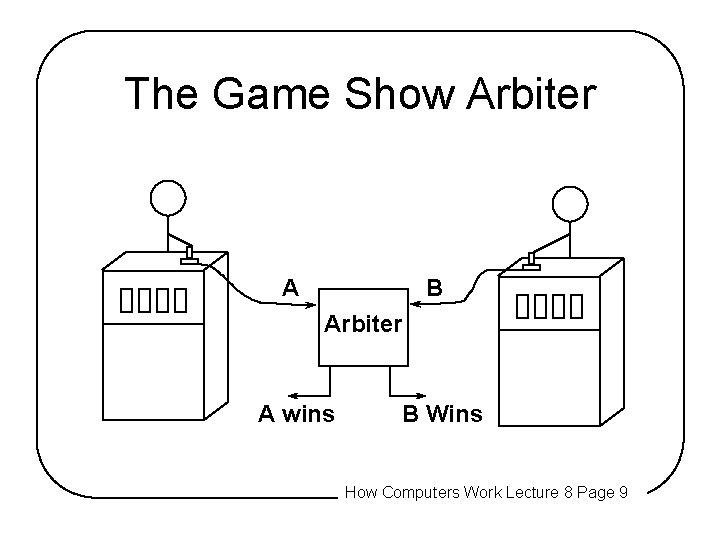
The Game Show Arbiter A B Arbiter A wins B Wins How Computers Work Lecture 8 Page 9
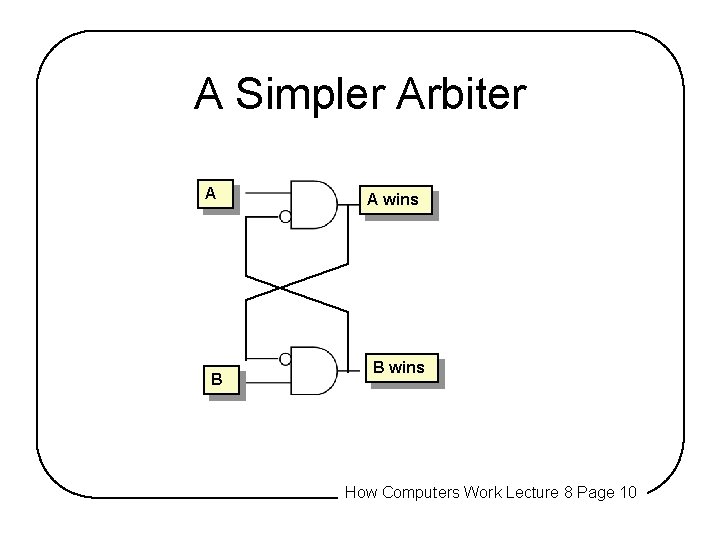
A Simpler Arbiter A B A wins B wins How Computers Work Lecture 8 Page 10
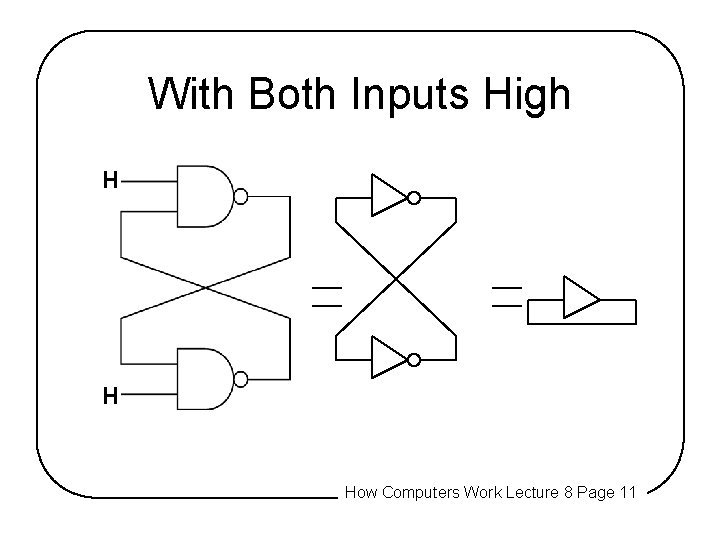
With Both Inputs High H H How Computers Work Lecture 8 Page 11
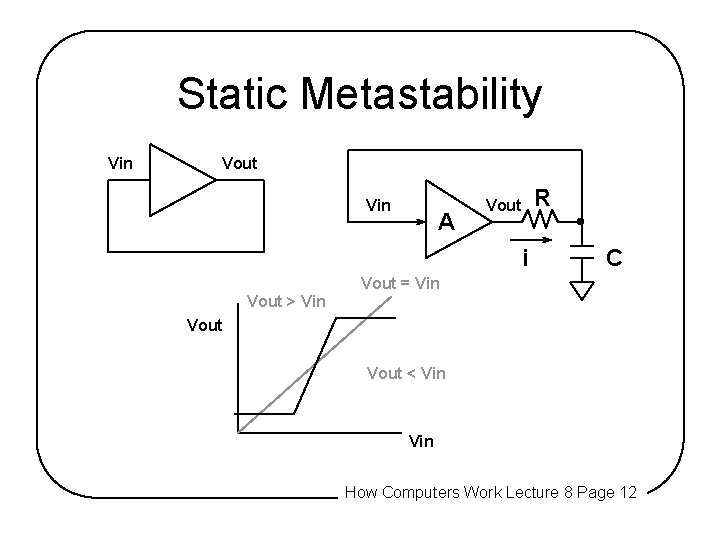
Static Metastability Vin Vout Vin A R Vout i C Vout = Vin Vout > Vin Vout < Vin How Computers Work Lecture 8 Page 12
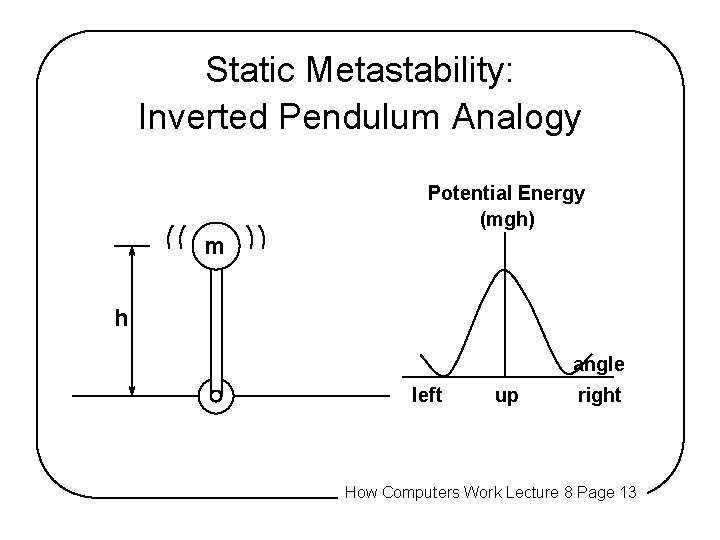
Static Metastability: Inverted Pendulum Analogy Potential Energy (mgh) m h angle left up right How Computers Work Lecture 8 Page 13
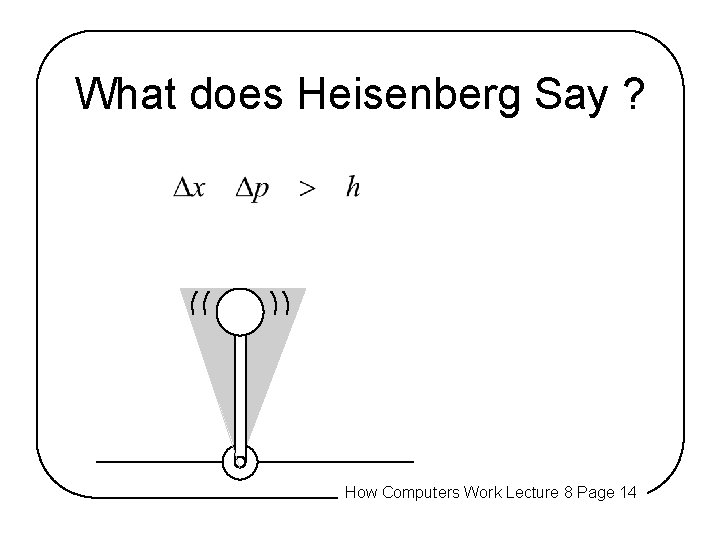
What does Heisenberg Say ? How Computers Work Lecture 8 Page 14
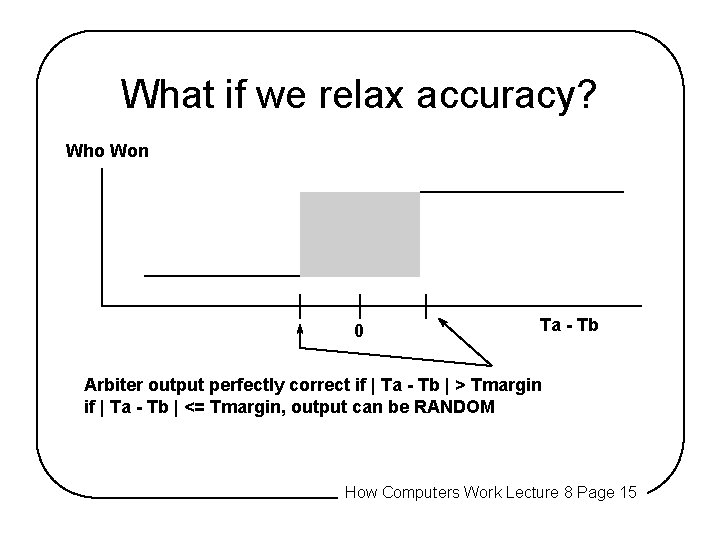
What if we relax accuracy? Who Won 0 Ta - Tb Arbiter output perfectly correct if | Ta - Tb | > Tmargin if | Ta - Tb | <= Tmargin, output can be RANDOM How Computers Work Lecture 8 Page 15
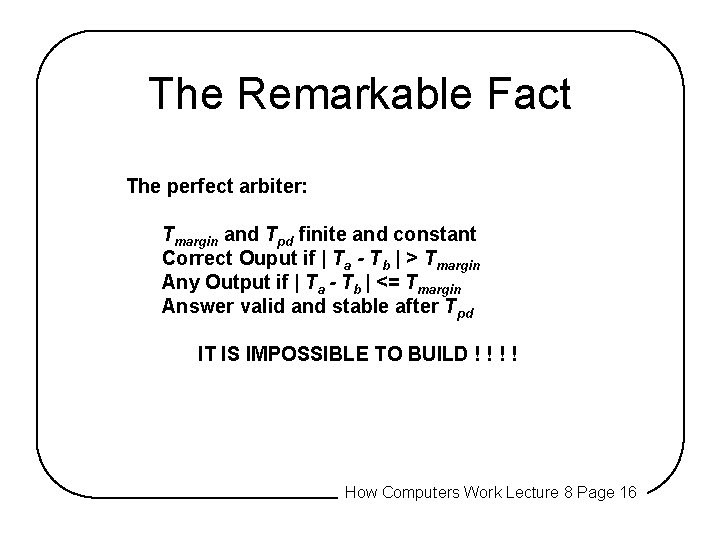
The Remarkable Fact The perfect arbiter: Tmargin and Tpd finite and constant Correct Ouput if | Ta - Tb | > Tmargin Any Output if | Ta - Tb | <= Tmargin Answer valid and stable after Tpd IT IS IMPOSSIBLE TO BUILD ! ! How Computers Work Lecture 8 Page 16
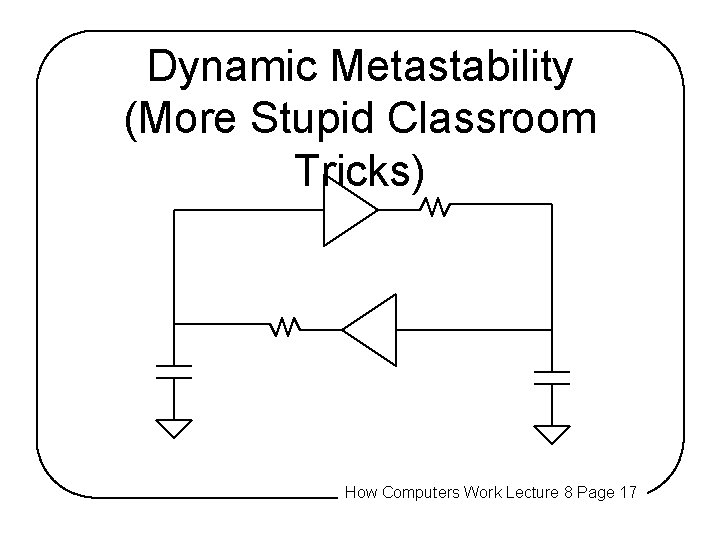
Dynamic Metastability (More Stupid Classroom Tricks) How Computers Work Lecture 8 Page 17
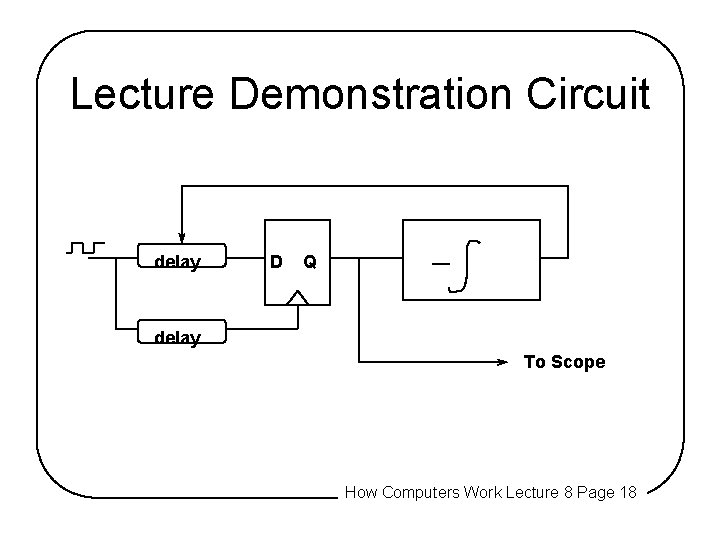
Lecture Demonstration Circuit delay D Q delay To Scope How Computers Work Lecture 8 Page 18
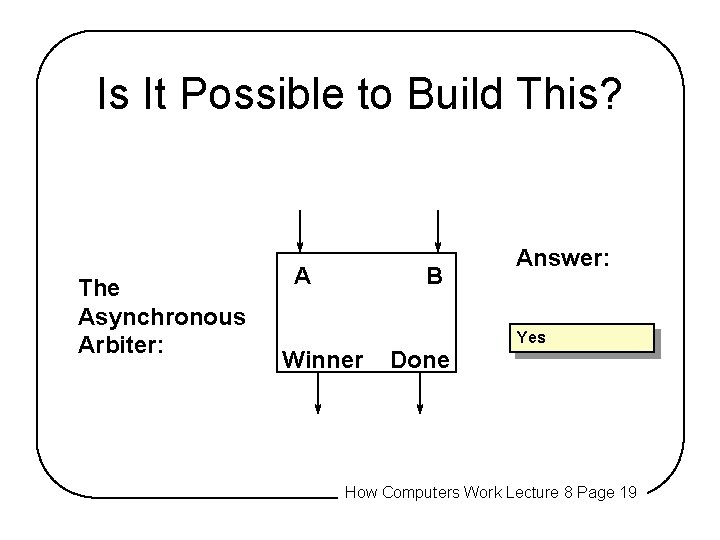
Is It Possible to Build This? The Asynchronous Arbiter: A B Winner Done Answer: Yes _____ How Computers Work Lecture 8 Page 19
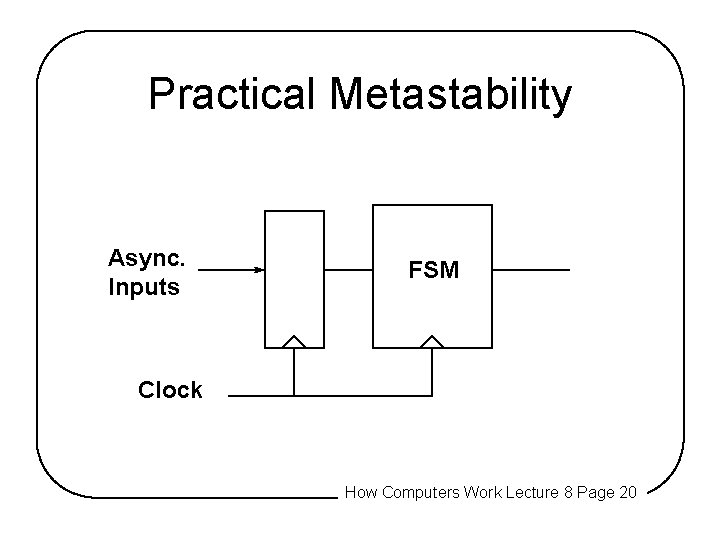
Practical Metastability Async. Inputs FSM Clock How Computers Work Lecture 8 Page 20
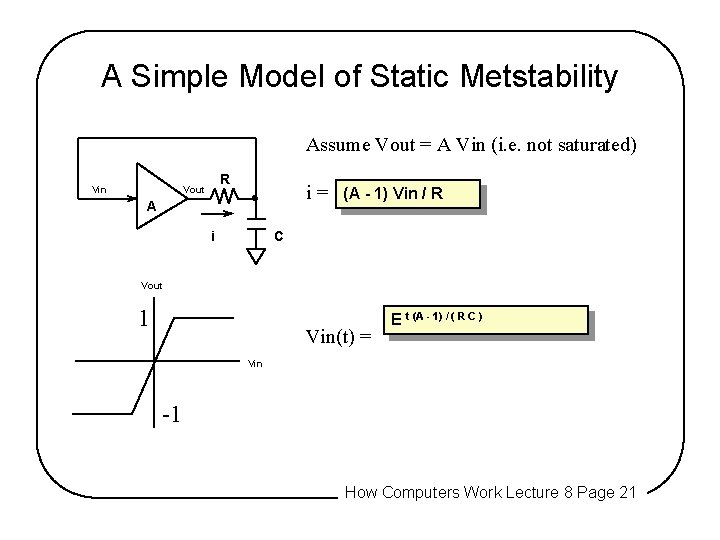
A Simple Model of Static Metstability Assume Vout = A Vin (i. e. not saturated) Vin R Vout i= A i (A - 1) Vin / R C Vout 1 Vin(t) = E t (A - 1) / ( R C ) Vin -1 How Computers Work Lecture 8 Page 21
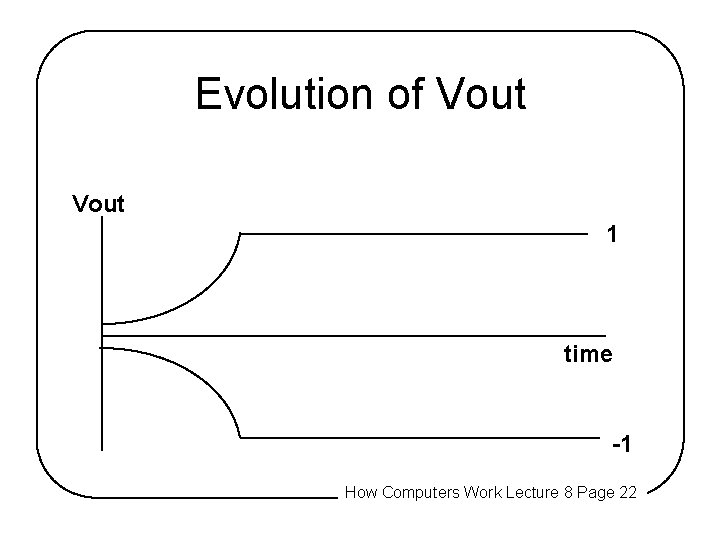
Evolution of Vout 1 time -1 How Computers Work Lecture 8 Page 22
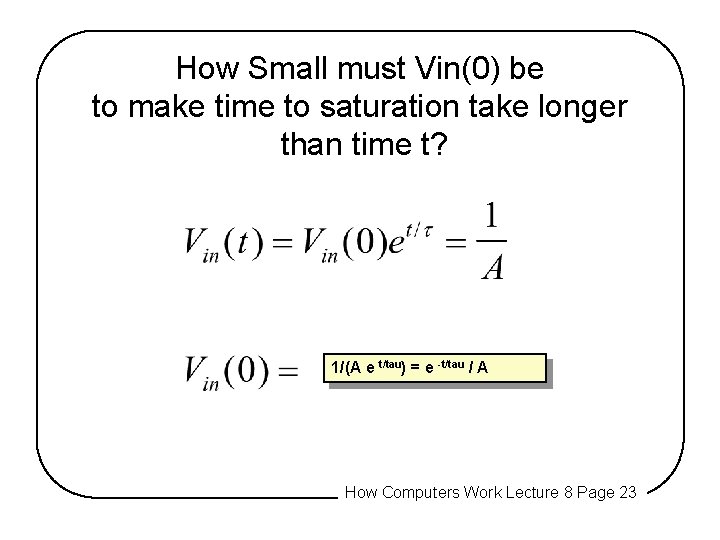
How Small must Vin(0) be to make time to saturation take longer than time t? 1/(A e t/tau) = e -t/tau / A How Computers Work Lecture 8 Page 23
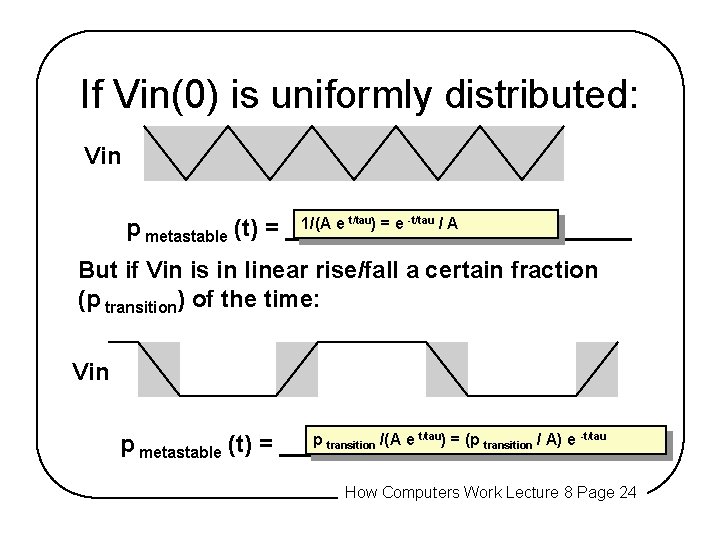
If Vin(0) is uniformly distributed: Vin 1/(A e t/tau) = e -t/tau / A p metastable (t) = _____________ But if Vin is in linear rise/fall a certain fraction (p transition) of the time: Vin p transition /(A e t/tau) = (p transition / A) e -t/tau p metastable (t) = _____________ How Computers Work Lecture 8 Page 24
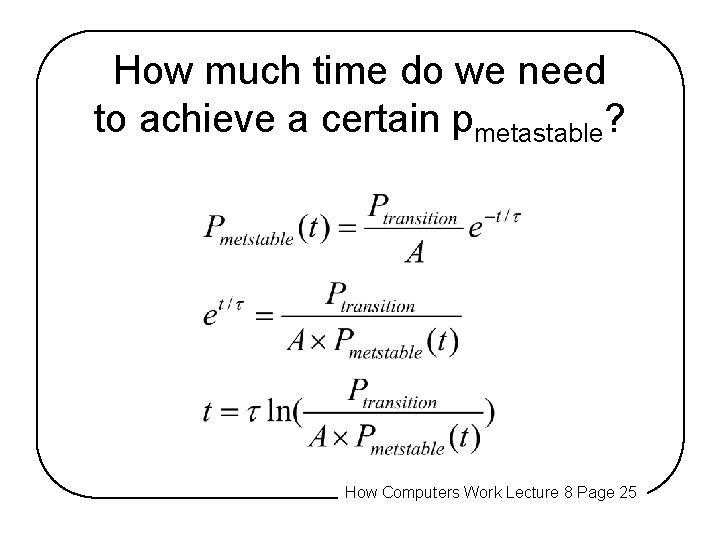
How much time do we need to achieve a certain pmetastable? How Computers Work Lecture 8 Page 25
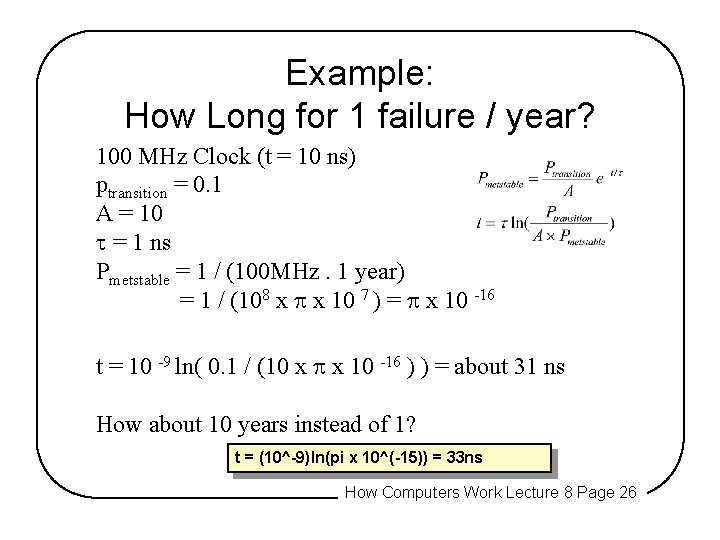
Example: How Long for 1 failure / year? 100 MHz Clock (t = 10 ns) ptransition = 0. 1 A = 10 t = 1 ns Pmetstable = 1 / (100 MHz. 1 year) = 1 / (108 x p x 10 7 ) = p x 10 -16 t = 10 -9 ln( 0. 1 / (10 x p x 10 -16 ) ) = about 31 ns How about 10 years instead of 1? t = (10^-9)ln(pi x 10^(-15)) = 33 ns How Computers Work Lecture 8 Page 26
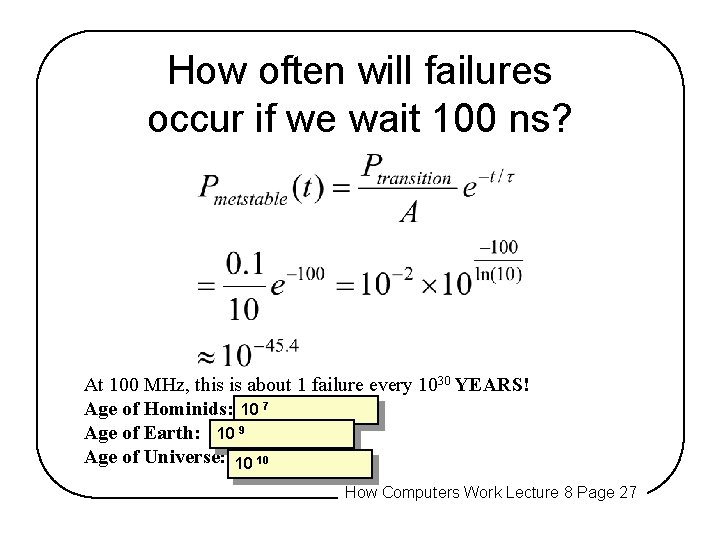
How often will failures occur if we wait 100 ns? At 100 MHz, this is about 1 failure every 1030 YEARS! Age of Hominids: 10 7 Age of Earth: 10 9 Age of Universe: 10 10 How Computers Work Lecture 8 Page 27
Is this a Good Excuse For Cruising a Light? You get 10 30 Years! How Computers Work Lecture 8 Page 28
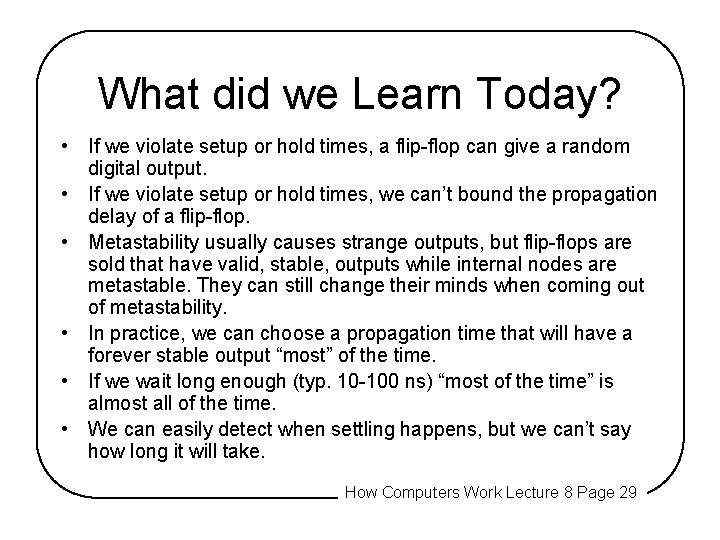
What did we Learn Today? • If we violate setup or hold times, a flip-flop can give a random digital output. • If we violate setup or hold times, we can’t bound the propagation delay of a flip-flop. • Metastability usually causes strange outputs, but flip-flops are sold that have valid, stable, outputs while internal nodes are metastable. They can still change their minds when coming out of metastability. • In practice, we can choose a propagation time that will have a forever stable output “most” of the time. • If we wait long enough (typ. 10 -100 ns) “most of the time” is almost all of the time. • We can easily detect when settling happens, but we can’t say how long it will take. How Computers Work Lecture 8 Page 29