
How Computers Work Lecture 11 Introduction to the

- Slides: 28
How Computers Work Lecture 11 Introduction to the Physics of Computation How Computers Work Lecture 11 Page 1
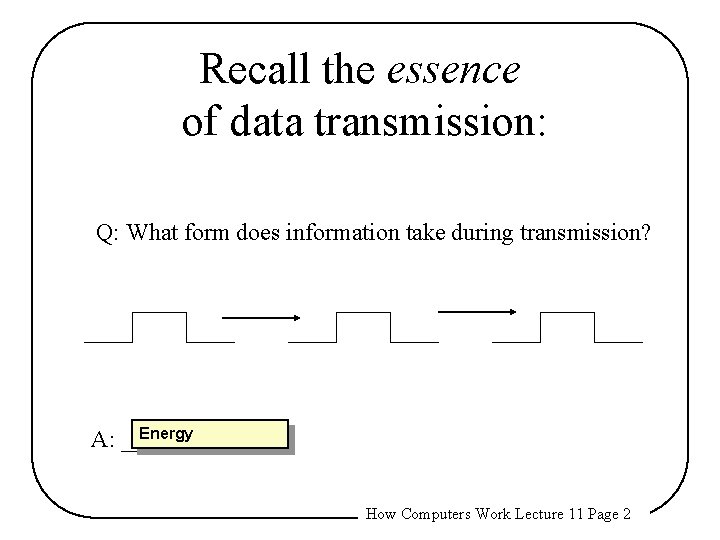
Recall the essence of data transmission: Q: What form does information take during transmission? Energy A: _______ How Computers Work Lecture 11 Page 2
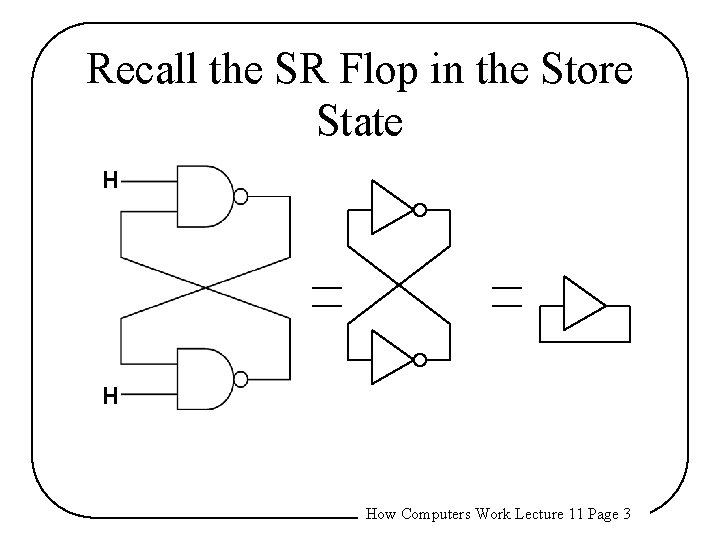
Recall the SR Flop in the Store State H H How Computers Work Lecture 11 Page 3
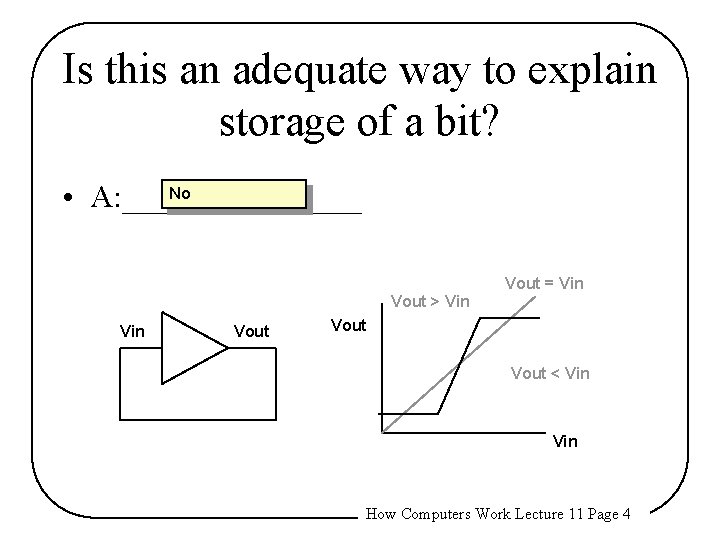
Is this an adequate way to explain storage of a bit? No • A: ________ Vout = Vin Vout > Vin Vout < Vin How Computers Work Lecture 11 Page 4
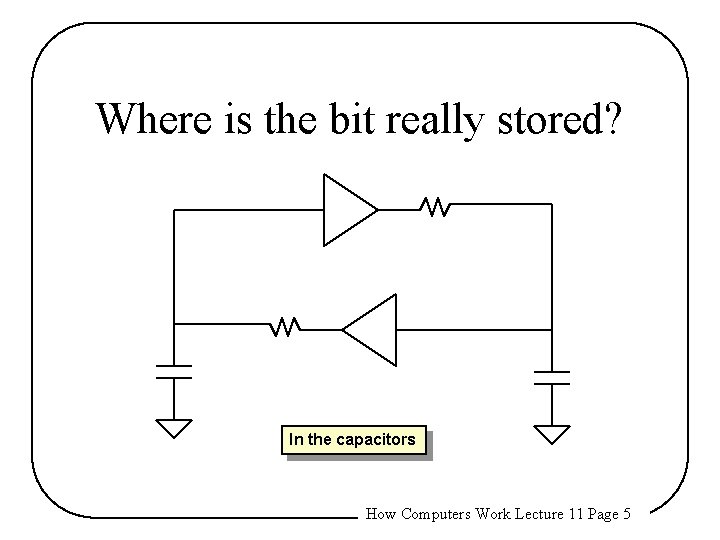
Where is the bit really stored? In the capacitors How Computers Work Lecture 11 Page 5
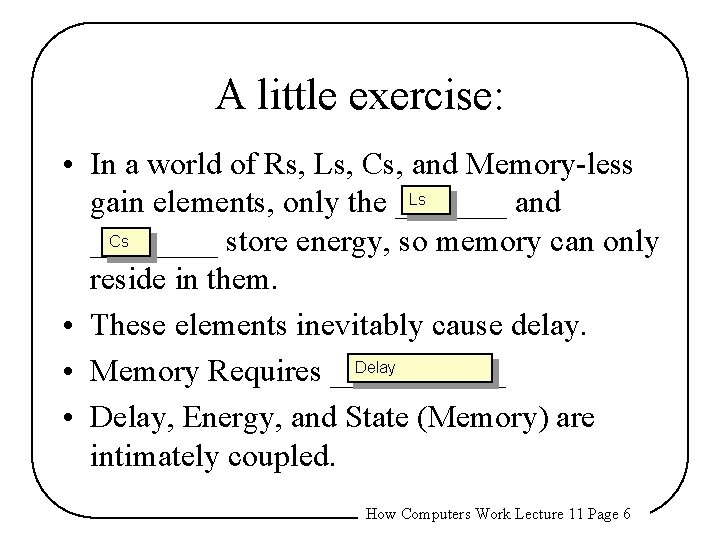
A little exercise: • In a world of Rs, Ls, Cs, and Memory-less Ls gain elements, only the _______ and Cs ____ store energy, so memory can only reside in them. • These elements inevitably cause delay. Delay • Memory Requires ______ • Delay, Energy, and State (Memory) are intimately coupled. How Computers Work Lecture 11 Page 6
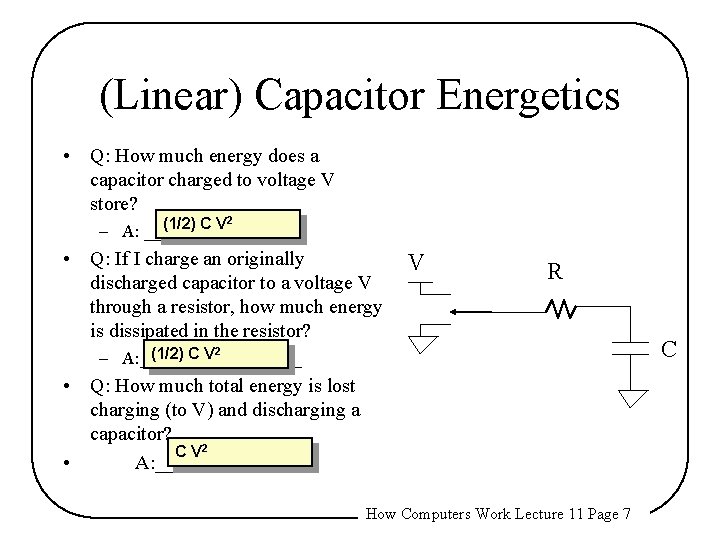
(Linear) Capacitor Energetics • Q: How much energy does a capacitor charged to voltage V store? (1/2) C V – A: _________ 2 • Q: If I charge an originally discharged capacitor to a voltage V through a resistor, how much energy is dissipated in the resistor? V R (1/2) C V 2 – A: _________ • Q: How much total energy is lost charging (to V) and discharging a capacitor? C V 2 • A: ________ How Computers Work Lecture 11 Page 7 C
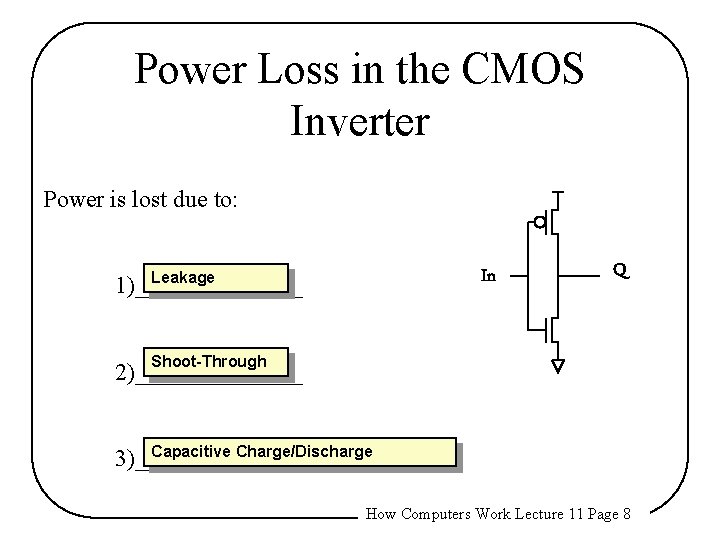
Power Loss in the CMOS Inverter Power is lost due to: In Leakage 1)_______ Q Shoot-Through 2)_______ Capacitive Charge/Discharge 3)_______ How Computers Work Lecture 11 Page 8
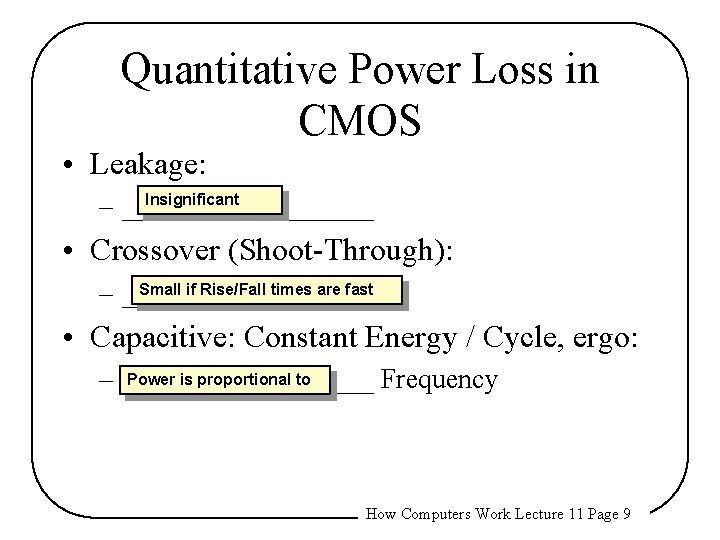
Quantitative Power Loss in CMOS • Leakage: Insignificant – _________ • Crossover (Shoot-Through): Small if Rise/Fall times are fast – _________ • Capacitive: Constant Energy / Cycle, ergo: Power is proportional to – _________ Frequency How Computers Work Lecture 11 Page 9
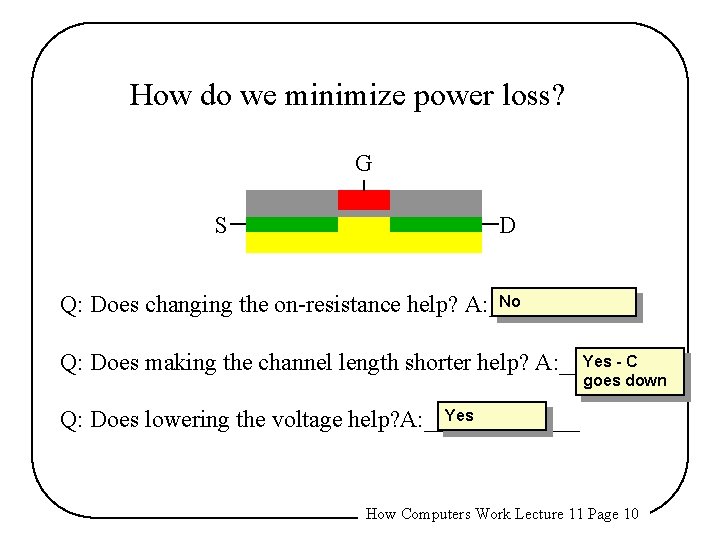
How do we minimize power loss? G S D No Q: Does changing the on-resistance help? A: ______ Yes - C Q: Does making the channel length shorter help? A: _______ goes down Yes Q: Does lowering the voltage help? A: _______ How Computers Work Lecture 11 Page 10
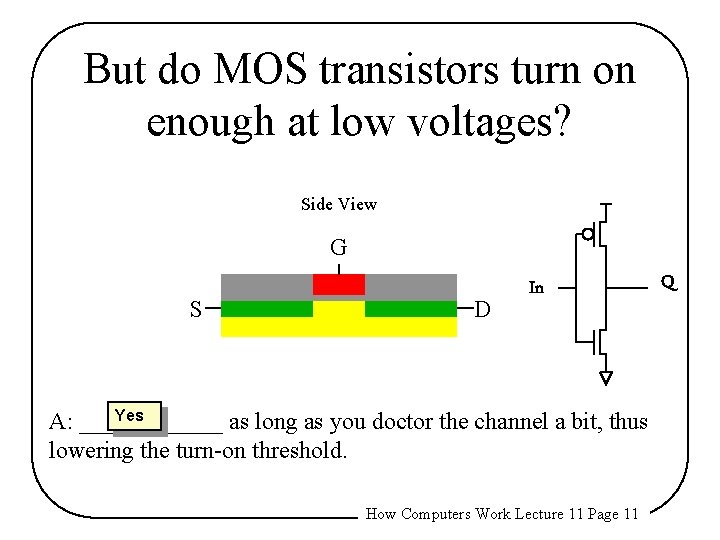
But do MOS transistors turn on enough at low voltages? Side View G S D In Yes A: ______ as long as you doctor the channel a bit, thus lowering the turn-on threshold. How Computers Work Lecture 11 Page 11 Q
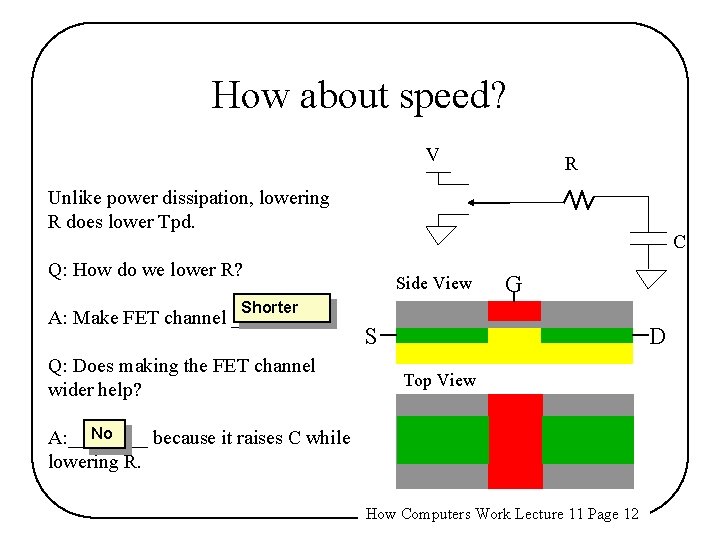
How about speed? V R Unlike power dissipation, lowering R does lower Tpd. C Q: How do we lower R? Side View G Shorter A: Make FET channel _____ Q: Does making the FET channel wider help? S D Top View No A: ____ because it raises C while lowering R. How Computers Work Lecture 11 Page 12
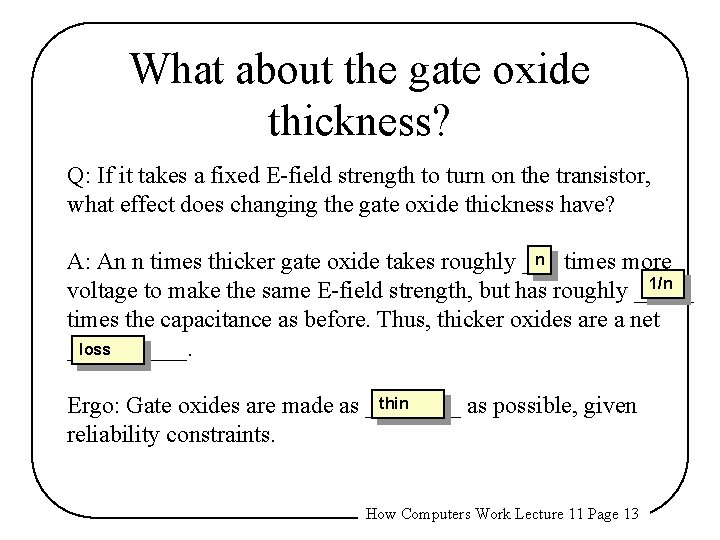
What about the gate oxide thickness? Q: If it takes a fixed E-field strength to turn on the transistor, what effect does changing the gate oxide thickness have? n times more A: An n times thicker gate oxide takes roughly ___ 1/n voltage to make the same E-field strength, but has roughly _____ times the capacitance as before. Thus, thicker oxides are a net loss _____. thin Ergo: Gate oxides are made as ____ as possible, given reliability constraints. How Computers Work Lecture 11 Page 13
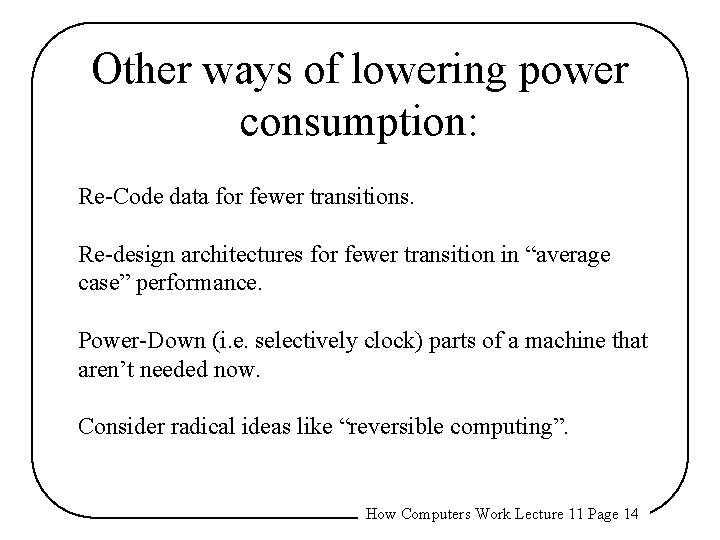
Other ways of lowering power consumption: Re-Code data for fewer transitions. Re-design architectures for fewer transition in “average case” performance. Power-Down (i. e. selectively clock) parts of a machine that aren’t needed now. Consider radical ideas like “reversible computing”. How Computers Work Lecture 11 Page 14
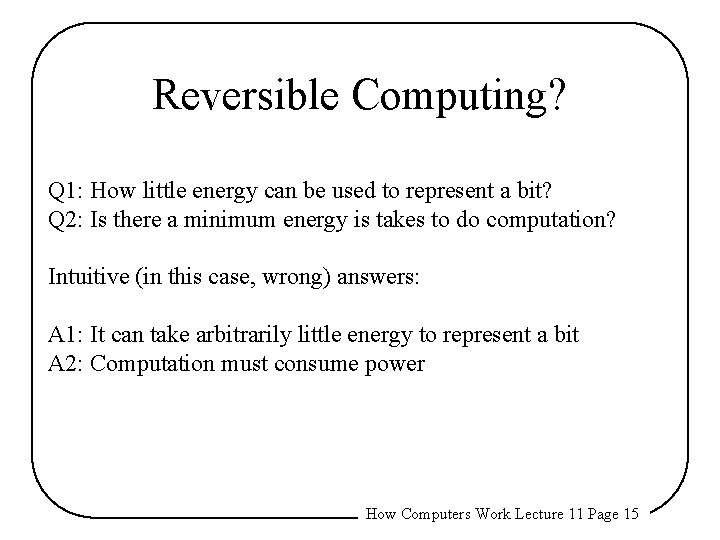
Reversible Computing? Q 1: How little energy can be used to represent a bit? Q 2: Is there a minimum energy is takes to do computation? Intuitive (in this case, wrong) answers: A 1: It can take arbitrarily little energy to represent a bit A 2: Computation must consume power How Computers Work Lecture 11 Page 15
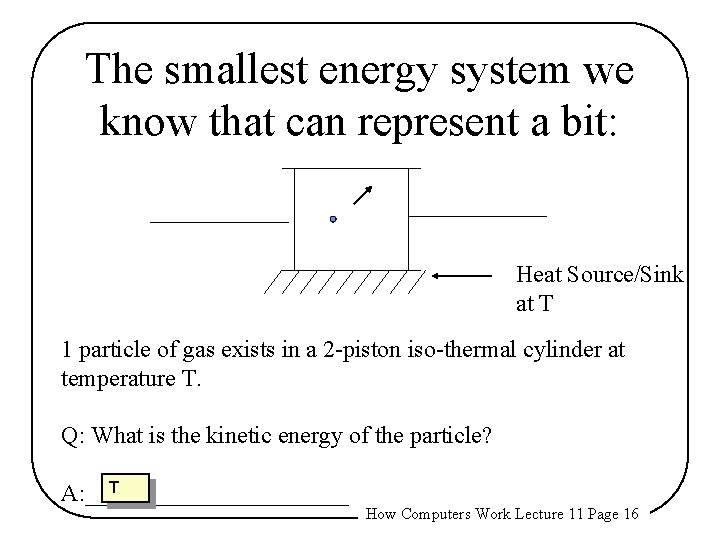
The smallest energy system we know that can represent a bit: Heat Source/Sink at T 1 particle of gas exists in a 2 -piston iso-thermal cylinder at temperature T. Q: What is the kinetic energy of the particle? T A: ___________ How Computers Work Lecture 11 Page 16
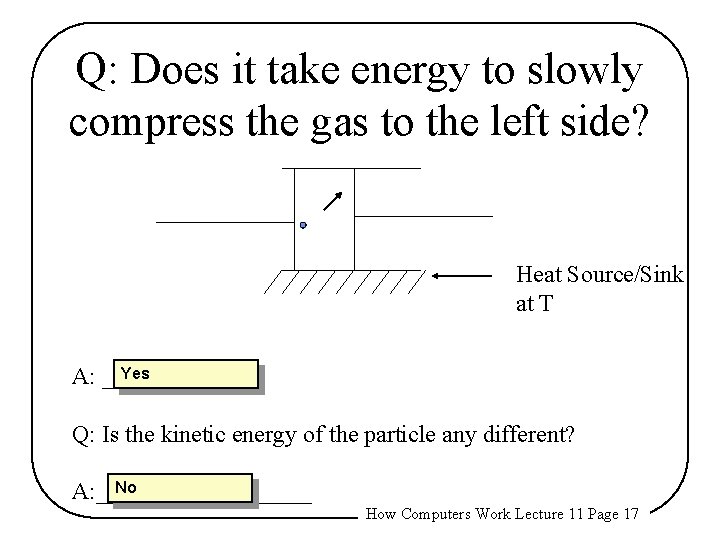
Q: Does it take energy to slowly compress the gas to the left side? Heat Source/Sink at T Yes A: ______ Q: Is the kinetic energy of the particle any different? No A: _________ How Computers Work Lecture 11 Page 17
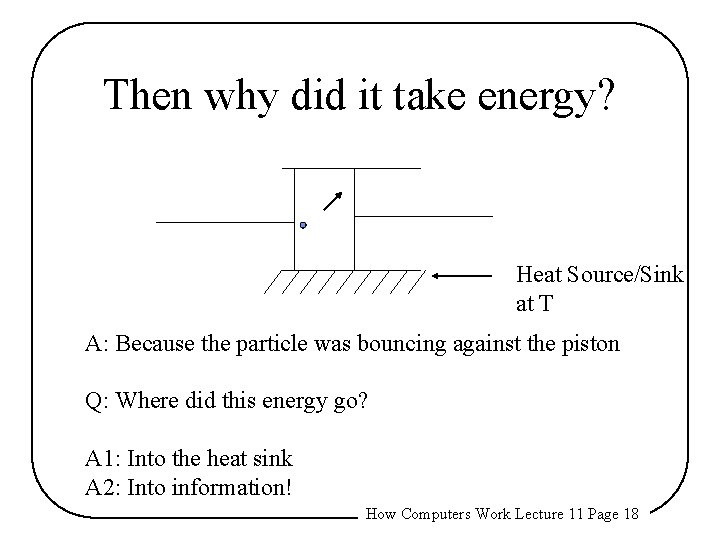
Then why did it take energy? Heat Source/Sink at T A: Because the particle was bouncing against the piston Q: Where did this energy go? A 1: Into the heat sink A 2: Into information! How Computers Work Lecture 11 Page 18
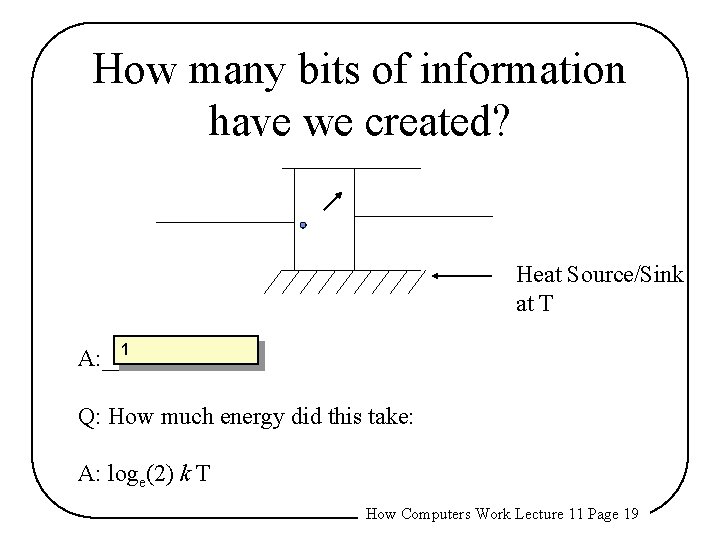
How many bits of information have we created? Heat Source/Sink at T 1 A: ______ Q: How much energy did this take: A: loge(2) k T How Computers Work Lecture 11 Page 19
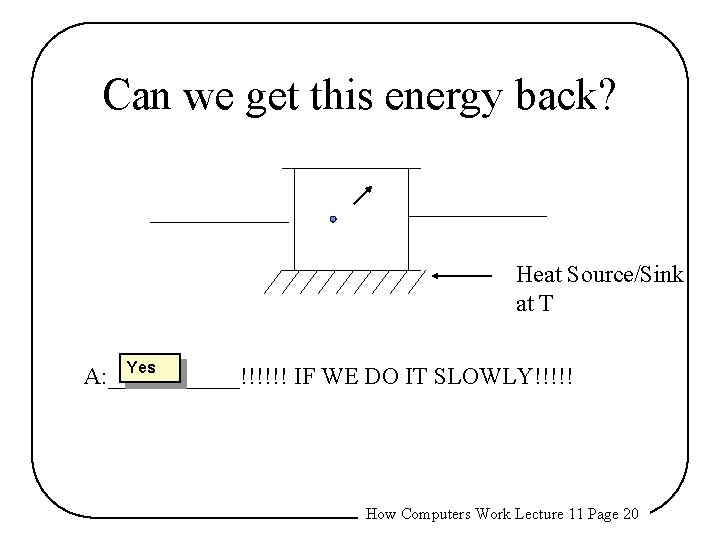
Can we get this energy back? Heat Source/Sink at T Yes A: ______!!!!!! IF WE DO IT SLOWLY!!!!! How Computers Work Lecture 11 Page 20
Summary: • Slow (i. e. reversible) thermodynamic processes can recover the energy put into creating a bit. • Fast (i. e. irreversible) processes loose part of this energy. • We can recover an arbitrarily high fraction of the energy put in by going slowly enough. • There’s nothing special about the isothermal heat sink - adiabatic (insulated) cylinders work too, it’s the speed that’s important. How Computers Work Lecture 11 Page 21
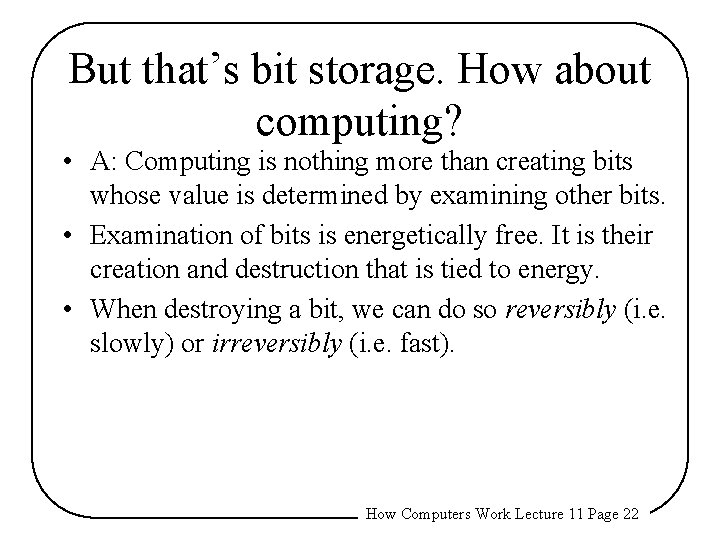
But that’s bit storage. How about computing? • A: Computing is nothing more than creating bits whose value is determined by examining other bits. • Examination of bits is energetically free. It is their creation and destruction that is tied to energy. • When destroying a bit, we can do so reversibly (i. e. slowly) or irreversibly (i. e. fast). How Computers Work Lecture 11 Page 22
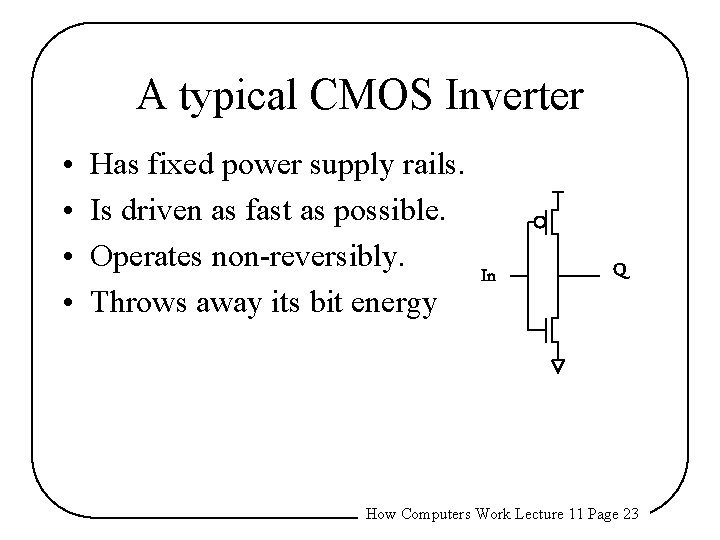
A typical CMOS Inverter • • Has fixed power supply rails. Is driven as fast as possible. Operates non-reversibly. Throws away its bit energy In Q How Computers Work Lecture 11 Page 23
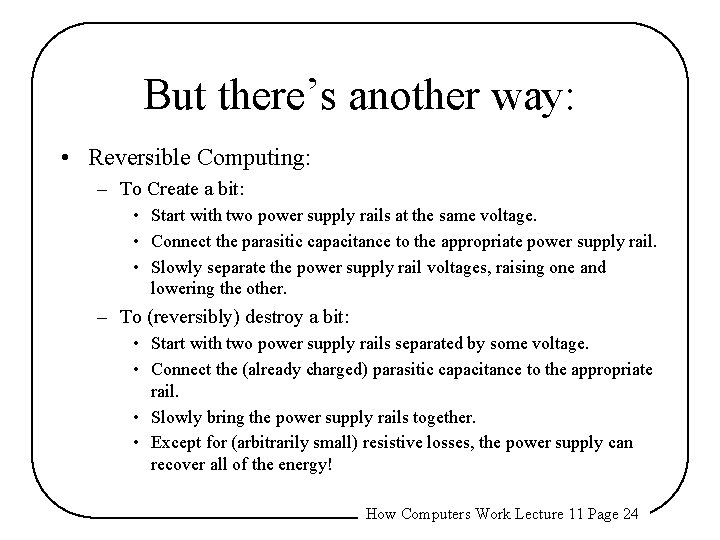
But there’s another way: • Reversible Computing: – To Create a bit: • Start with two power supply rails at the same voltage. • Connect the parasitic capacitance to the appropriate power supply rail. • Slowly separate the power supply rail voltages, raising one and lowering the other. – To (reversibly) destroy a bit: • Start with two power supply rails separated by some voltage. • Connect the (already charged) parasitic capacitance to the appropriate rail. • Slowly bring the power supply rails together. • Except for (arbitrarily small) resistive losses, the power supply can recover all of the energy! How Computers Work Lecture 11 Page 24
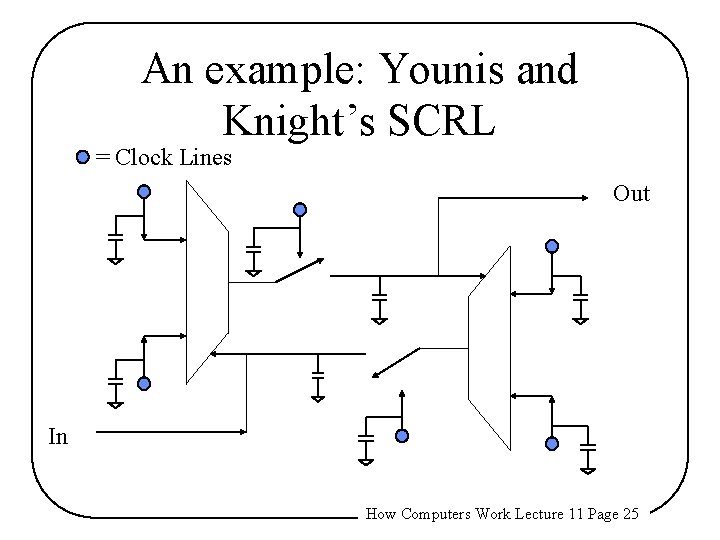
An example: Younis and Knight’s SCRL = Clock Lines Out In How Computers Work Lecture 11 Page 25
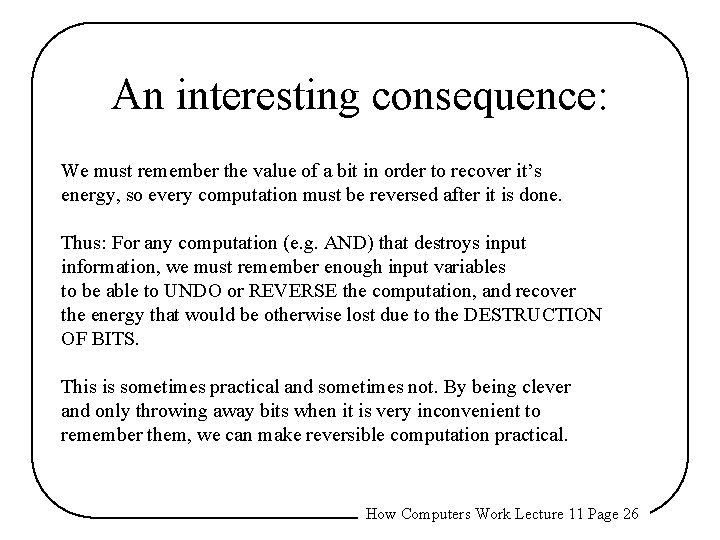
An interesting consequence: We must remember the value of a bit in order to recover it’s energy, so every computation must be reversed after it is done. Thus: For any computation (e. g. AND) that destroys input information, we must remember enough input variables to be able to UNDO or REVERSE the computation, and recover the energy that would be otherwise lost due to the DESTRUCTION OF BITS. This is sometimes practical and sometimes not. By being clever and only throwing away bits when it is very inconvenient to remember them, we can make reversible computation practical. How Computers Work Lecture 11 Page 26
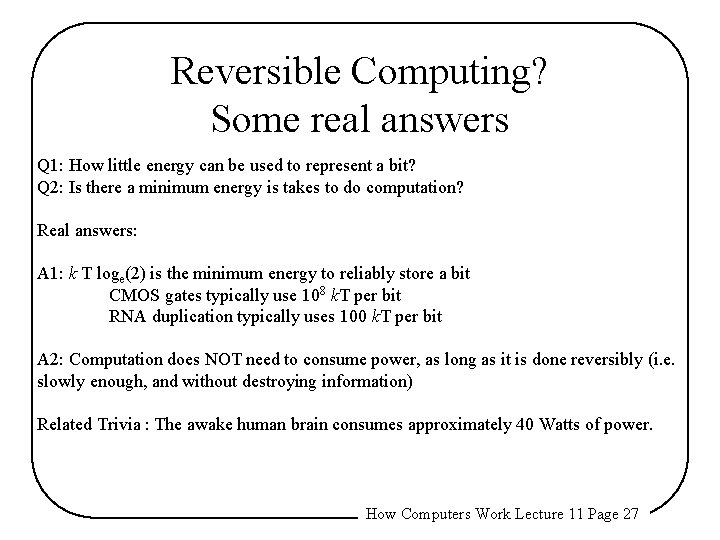
Reversible Computing? Some real answers Q 1: How little energy can be used to represent a bit? Q 2: Is there a minimum energy is takes to do computation? Real answers: A 1: k T loge(2) is the minimum energy to reliably store a bit CMOS gates typically use 108 k. T per bit RNA duplication typically uses 100 k. T per bit A 2: Computation does NOT need to consume power, as long as it is done reversibly (i. e. slowly enough, and without destroying information) Related Trivia : The awake human brain consumes approximately 40 Watts of power. How Computers Work Lecture 11 Page 27
To Learn More Read: • • Feynman Lectures on Computation http: //www. ai. mit. edu/people/tk/lowpower/crl. ps http: //www. ai. mit. edu/people/tk/lowpower/low 94. ps “Thermodynamics of Computation - A Review” Charles H. Bennett, International Journal of Theoretical Physics 21, 905(1982) How Computers Work Lecture 11 Page 28